Untitled (Skull)
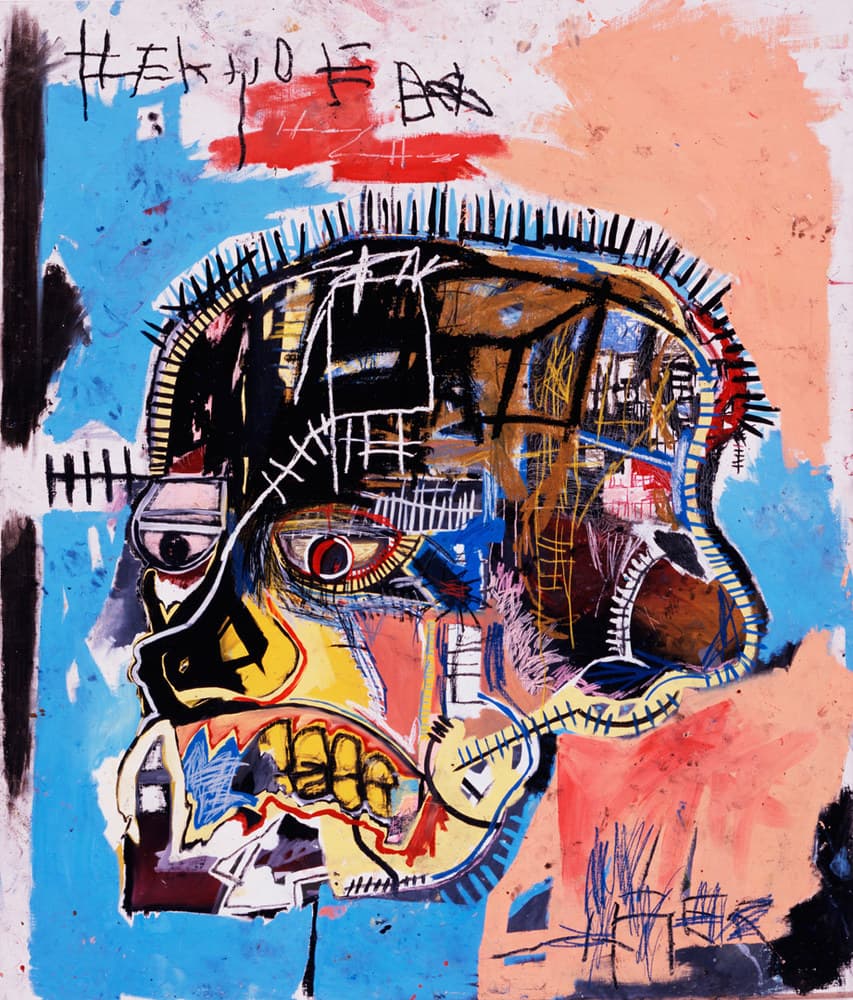
A large head fills the canvas, built as a skull and painted as a living face at the same time. One eye is dead and grey, the other is ringed in red and looks out. The Broad in Los Angeles catalogues the painting only as Untitled. The word Skull in brackets is the atlas's description of what is in the picture, added to tell it apart from a second 1981 canvas in the same collection with exactly the same title. Jean-Michel Basquiat did not title it.
- 1981
- Acrylic and oilstick on canvas
- The BroadLos Angeles, United States
About Jean-Michel Basquiat
What the painting shows
A head is set slightly left of centre against a field of sky blue on the left and salmon pink on the right. Its crown is a dome of brown, ochre, black and yellow patches crossed by drawn ladders, grids and short white rungs. A row of black spikes runs along the top of the skull like cropped hair or a row of stitches.
The two eyes do not match. The left one is a pale grey-white lozenge with a black pupil, half covered by a flat grey bar, and it registers nothing. The right one is a yellow almond with a red ring around a dark blue pupil, black lashes radiating from the lid, and a red oval drawn around the whole socket.
Below them a heavy black wedge stands in for the nose, with a yellow triangle cut into it. The mouth is a wide band of eight or nine yellow teeth outlined in black, with red and white gum lines above and below and a blue scribble pushed against its left end. A column of black letterforms runs across the top of the canvas, several crossed by horizontal bars; they do not resolve into a word.
The canvas is 205.74 by 175.9 centimetres, about 81 by 69 inches, in acrylic and oilstick.
Why the title is in brackets
The Broad catalogues the painting as Untitled, 1981. A second canvas in the same collection carries the same catalogue title and the same year, accession number F-BASQ-1P92.19, and is a different object in acrylic, oilstick, paper collage and spray paint.
Two works cannot share one address in the atlas, so a descriptor was added. The word Skull comes from the picture and from nothing else: the head is drawn with an exposed cranium, a nasal cavity and a full row of bared teeth.
The parenthetical is descriptive. Jean-Michel Basquiat did not title the painting, no institution records a title for it, and the atlas does not claim one for him.
Months, not days
The Broad's own note makes a point of the working method. Most of Jean-Michel Basquiat's pieces were finished in bursts of energy over a few days; he laboured over this one for months, which the museum says is evident in the worked surface and the imagery.
The surface bears that out. Paint is scraped back and repainted across the cranium, drawn lines run under later colour, and the blue and pink grounds are dragged over each other at the edges.
The museum reads the head as a form of self-portraiture, with the skull somewhere between life and death, the eyes listless and the face sunken. It also reads the intensity as bound up with the pressure of becoming a commercially successful artist. Both are the museum's readings rather than documented statements by the painter.
Shown at his first New York solo exhibition
The Broad records that the painting was presented at Jean-Michel Basquiat's debut solo gallery exhibition in New York City. That was the Annina Nosei Gallery in 1981, the year the critic and poet René Ricard published his essay The Radiant Child in the magazine Artforum and the market arrived.
He was twenty years old when the year began. Three years earlier he had been spraying one-line statements signed SAMO on walls in Lower Manhattan with his schoolfriend Al Diaz.
The Broad also connects the head to the modernist habit of borrowing African masks, and to the mask as a way of working on identity. The painting has no recorded Paris exhibition history. Jean-Michel Basquiat's own Paris connection is firm — he showed at the Galerie Daniel Templon in 1987 and at the Galerie Yvon Lambert in January 1988 — but it belongs to him rather than to this canvas.
Close reading
Reading the work, detail by detail
A head built as a skull and painted as a face. Start with the letters along the top edge and the row of black spikes over the cranium, then the two eyes, which do not match, and drop to the nose, the teeth and the worked brown dome on the right.
1.The letters along the top
Eight or nine letterforms are drawn in a line across the top edge, most of them crossed through with a horizontal bar in the same black. They read as capitals without resolving into a word in the museum's reproduction, and no institutional record transcribes them.
2.The spikes over the cranium
The spikes sit outside the drawn outline of the head, so they are not hair growing from it. They run the full curve of the cranium and stop where the skull turns down at each side.
3.The left eye
This eye is flat. The lid is a grey bar laid straight across it, the white is a single unmodulated shape, and the pupil is a plain black disc with no highlight. The Broad describes the eyes in the painting as listless.
4.The right eye
The second eye is built in four colours where the first uses two, and it is the only place on the head where a red line closes a shape. The lashes are drawn as separate strokes fanning outward, which makes the socket read as open.
5.The nose
The nasal cavity is painted as a solid black mass rather than drawn as an opening. The yellow triangle inside it is the only light in the shape, and the white line at its left is the skull's outer contour showing through later paint.
6.The teeth
The teeth are each drawn as a separate rectangle and filled in yellow, with the black outlines left visible over the fill. The blue scribble at the left end is oil stick worked in over dry paint, and it covers the corner of the mouth rather than continuing it.
7.The right side of the skull
This is the most reworked part of the surface. Drawn lines sit under later paint and further lines are scratched back over the top, with rungs and ladder forms repeated at three or four different scales. The Broad records that Jean-Michel Basquiat laboured over the painting for months.
8.The scrawl at the lower right
A separate passage of blue oil stick is scrawled over a drawn black grid near the bottom right corner, away from the head. It carries no legible letters, and the salmon ground shows through it everywhere.
Timeline
1978
With Al Diaz, begins spraying statements signed SAMO on walls in Lower Manhattan.
1981
Painted in acrylic and oilstick, over months rather than days, and shown at Jean-Michel Basquiat's first solo gallery exhibition in New York, at the Annina Nosei Gallery.
1982
Enters the Broad collection; The Broad gives the accession date as 9 December 1982 and the number B-BASQ-2P82.32.
1988
Jean-Michel Basquiat dies of a heroin overdose at his Great Jones Street studio in Manhattan on 12 August, aged twenty-seven.
2026
Listed by The Broad as on view in Los Angeles.
Where to see it
The Broad
Los Angeles, United States
A public viewing address has not yet been confirmed for this holding.
The Broad lists the painting as on view and gives its accession date as 9 December 1982. Museums rotate their walls, so check the record before travelling.
Frequently asked questions
What is the real title of Basquiat's skull painting at The Broad?
Untitled. The Broad catalogues it with no title at all, under accession number B-BASQ-2P82.32. The word Skull in brackets is the atlas's description of what the canvas shows, added because The Broad owns a second 1981 painting by Jean-Michel Basquiat with exactly the same catalogue title.
Where is Basquiat's Untitled (Skull) of 1981?
The Broad in Los Angeles, which lists it as on view. It is acrylic and oilstick on canvas, 205.74 by 175.9 centimetres, accession number B-BASQ-2P82.32. The Broad owns thirteen works by Jean-Michel Basquiat in total.
Is Untitled (Skull) a self-portrait?
The Broad says it may be considered a form of self-portraiture, and that many of Jean-Michel Basquiat's paintings are in some way autobiographical. He left no statement naming himself as the subject, so the reading is the museum's rather than his.
How long did Basquiat take to paint it?
Months. The Broad notes that he laboured over the painting for months while most of his pieces were completed in bursts of energy over a few days, and that the long work is visible in the reworked surface.
Why are the two eyes different?
One eye is a pale grey lozenge with a black pupil, partly covered by a flat grey bar. The other is a yellow almond with a red ring around a dark pupil and black lashes radiating from the lid. The museum describes the eyes as listless and the head as caught between life and death.
Is there a Jean-Michel Basquiat painting in Paris?
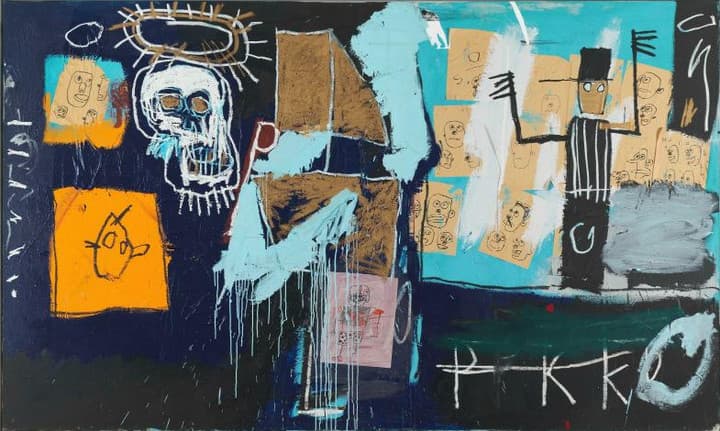
Yes, but not this one. The Centre Pompidou holds Slave Auction of 1982, given to the Musée national d'art moderne by its friends' association in 1993. The Broad's 1981 canvas has no recorded Paris exhibition history.
More by Jean-Michel Basquiat
If you like Jean-Michel Basquiat
Explore painters from the same movements and circles.
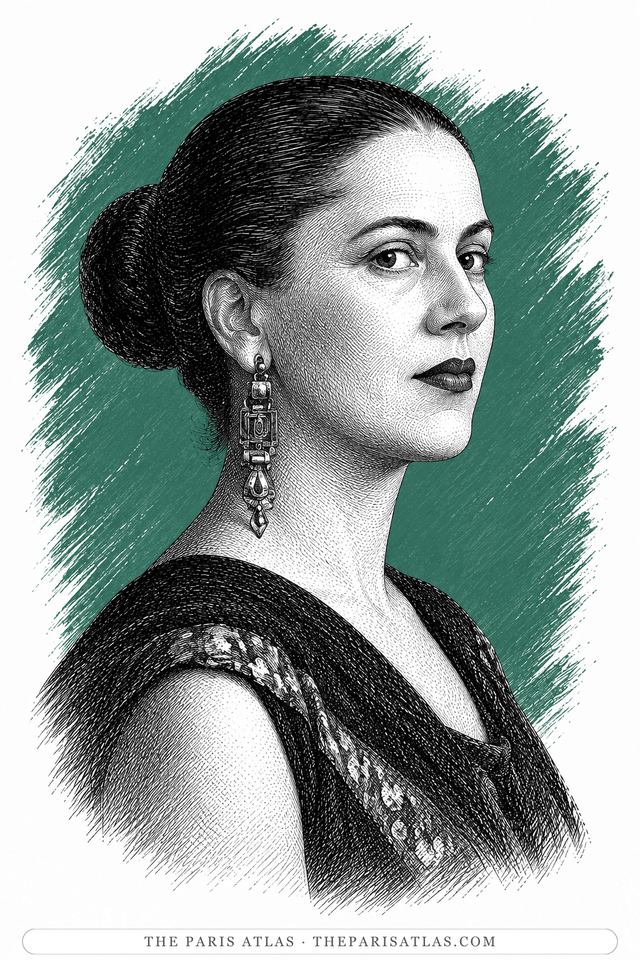
Tarsila do Amaral
Brazilian painter who spent the 1920s moving between São Paulo and Paris, studied Cubism under André Lhote, Albert Gleizes and Fernand Léger, and used what she learned to paint Brazilian towns, railways, plants and bodies. Her 1928 painting Abaporu prompted the manifesto that gave the Anthropophagic movement its name.
View artist
Arman
French-American artist, lifelong friend of Yves Klein, and a founder of New Realism.
View artist
Jean Arp
Strasbourg-born sculptor and poet — Hans in German, Jean in French, both all his life — who co-founded Dada at the Cabaret Voltaire in 1916, composed collages by dropping torn paper 'according to the laws of chance', and settled at Meudon outside Paris in a house his wife Sophie Taeuber-Arp designed.
View artist
References
The sources below include collection records, catalogues, scholarly research, and primary materials that informed this page. They document Untitled (Skull), its making, and its place in cultural history.


1Jean-Michel Basquiat, Untitled (1981) — object record, B-BASQ-2P82.32
WebsiteThe Broad, Los AngelesUsed forThe Broad's object record: the catalogue title Untitled, the medium, dimensions, accession number and date, the on-view status, the Artestar credit line, and the museum's note on the months of work and the Annina Nosei debut.
2Jean-Michel Basquiat, Untitled (1981) — object record, F-BASQ-1P92.19
WebsiteThe Broad, Los AngelesUsed forThe Broad's record for the second painting of 1981 catalogued as Untitled, accession number F-BASQ-1P92.19 — the collision that made a descriptive parenthetical necessary.
3Jean-Michel Basquiat — artist page and collection holdings
WebsiteThe Broad, Los AngelesUsed forThe Broad's artist page: the SAMO tags with Al Diaz, the 1980 Times Square Show, René Ricard's The Radiant Child, and the museum's Basquiat holdings.
4Jean-Michel Basquiat — artist page of the licensing agency named in the museums' credit lines
WebsiteArtestar, New YorkUsed forArtestar's artist page for Jean-Michel Basquiat, the licensing agent named in the credit lines of all three holding institutions.
5Jean-Michel Basquiat (6 March – 14 May 2019) — exhibition page with the artist's exhibition chronology
WebsiteThe Brant Foundation Art Study Center, New YorkUsed forThe exhibition chronology, source for the 1981 Annina Nosei solo show and for the Paris exhibitions of 1987 and 1988.
These references provide the documented foundation for this work's history and interpretation. Claim-level citations remain attached to the specific claims they support.
 Explore more resources