Hollywood Africans
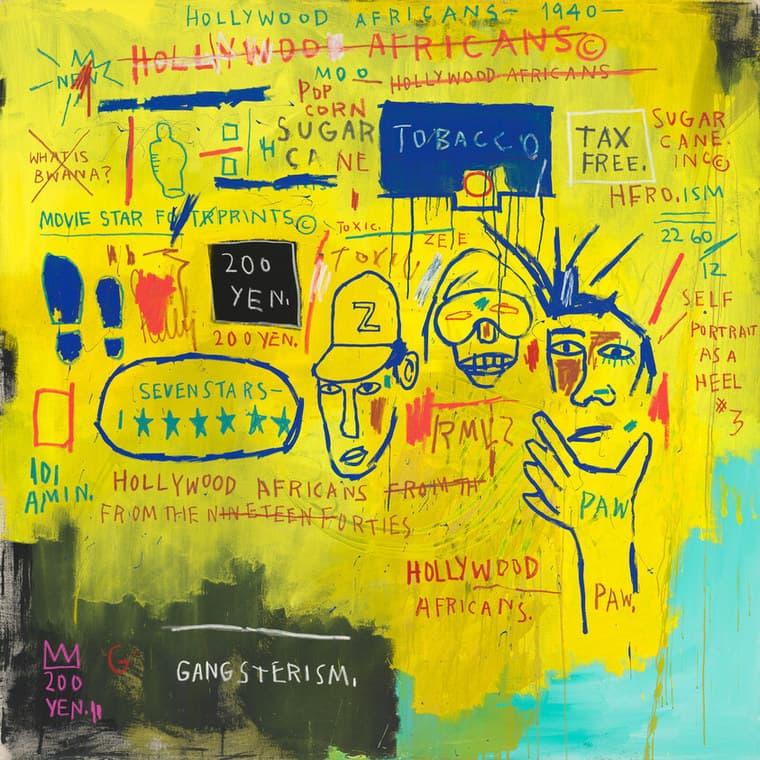
A square canvas of roughly seven feet, painted almost entirely yellow and covered in handwriting. Three heads sit in the right half: Jean-Michel Basquiat and the two artists who travelled with him from New York to Los Angeles, the rap musician Rammellzee and the painter Toxic. Around them are the words SUGAR CANE, TOBACCO, GANGSTERISM, MOVIE STAR FOOTPRINTS and WHAT IS BWANA?, many of them crossed out. The Whitney Museum of American Art reads them as the limited roles old Hollywood left to Black actors.
- 1983
- Acrylic and oil stick on canvas
- Whitney Museum of American ArtNew York, United States
About Jean-Michel Basquiat
What the painting shows
The ground is chrome yellow, brushed unevenly so the canvas shows through at the edges. A band of dark olive and black runs across the bottom left, and a patch of pale turquoise fills the bottom right corner.
Three heads occupy the right half. The leftmost wears a blue cap with a large Z drawn on it and has a long blue-outlined face. The middle head is a skull with round goggles over its eyes and a grid of square teeth. The right head has spiked blue hair, a brown face with one black eye and one teal eye, and a blue hand raised beside its cheek. A blue oval below them holds the words SEVEN STARS and a row of seven teal stars.
The left half is given over to writing and to two flat blue shoe prints. A teal outline of an Oscar statuette stands between them and the text. A black panel near the centre carries the words 200 YEN. in white, with 200 YEN. repeated below it in red.
The canvas is 213.5 by 213.4 centimetres — 84 1/16 by 84 inches, so very slightly taller than it is wide rather than exactly square.
The lettering, as it is written
Across the top, in teal: HOLLYWOOD AFRICANS— 1940—. Below it in red capitals, HOLLYWOOD AFRICANS© struck through by one long red line. Below that again, MOo, then HOLLYWOOD AFRICANS in red, struck through a second time.
The middle band carries POP CORN in red, SUGAR CANE in grey and red with a blue bar drawn through it above and below, TOBACCO in pale blue on a dark blue panel, TAX FREE. inside a white-drawn box, SUGAR CANE. INC© in red, and HERO.ISM with HERO in red and ISM in teal, twice underlined.
At the left, WHAT IS BWANA? in red under a large red X, and MOVIE STAR FOOTPRINTS© in teal with a blue scribble dragged through the middle of FOOTPRINTS. TOXIC. appears twice, once small in red and once large in brown. Beside the right-hand head, in teal, 22 60 above 12 — the digits of his birthday, 22 December 1960, written out of order rather than in the row the museum's label describes.
Under those numerals, in red: SELF · PORTRAIT AS A HEEL, with a starred 3 below. Across the lower third, HOLLYWOOD AFRICANS FROM TH — the last two words crossed out — then FROM THE NINETEEN FURTIES, with NINETEEN struck through and FORTIES misspelled as FURTIES. Lower still, HOLLYWOOD AFRICANS. again in red, PAW in teal and PAW, in red, and IDI AMIN. at the left edge. On the dark band at the bottom, in white: GANGSTERISM, under a white rule, with a three-point crown and 200 YEN.!! in magenta beside it.
Jean-Michel Basquiat explained the crossings-out, in a sentence the Whitney prints on its own record: "I cross out words so you will see them more; the fact that they are obscured makes you want to read them."
Painted in Los Angeles
The Whitney records that the painting was made during an extended visit to Los Angeles in 1983. Fred Hoffman, who produced a silkscreen print with Jean-Michel Basquiat in California, dates the stay from November 1982 and places the painting more precisely: it was produced in Venice, in the ground-floor studio Larry Gagosian had built below his house.
Hoffman wrote his account for the Los Angeles Times in 2005. He describes a twenty-one-year-old working away from the New York art world. The second Gagosian show, he writes, referenced famous boxers, musicians and Hollywood films and the roles played in them by blacks. He reads Hollywood Africans as depicting Jean-Michel Basquiat with Toxic and Rammellzee, "essentially placing their black footprints into the history of Hollywood at Grauman's Chinese Theatre".
The two flat blue shoe prints on the canvas and the words MOVIE STAR FOOTPRINTS© above them are that forecourt, where film actors press their hands and feet into the concrete.
The trio called themselves the Hollywood Africans. The Whitney treats the title as a statement aimed back at the film industry, and reads the phrases scattered across the yellow — Sugar Cane, Tobacco, Gangsterism, What is Bwana? — as the parts old Hollywood movies had available for Black actors.
Where it is
Douglas S. Cramer, the American television producer, gave the painting to the Whitney Museum of American Art in 1984, the year after it was made. It carries the accession number 84.23 and the Whitney lists it as on view on Floor 7.
The painting has no recorded Paris exhibition history. Jean-Michel Basquiat showed in Paris at the Galerie Daniel Templon in 1987 and at the Galerie Yvon Lambert in January 1988. The Centre Pompidou holds his Slave Auction of 1982. Hollywood Africans has been in New York since 1984.
Close reading
Reading the work, detail by detail
Seven feet of chrome yellow covered in handwriting. Read the title as it is written four times over, then the trades named across the middle, the numerals of a birthday at the right edge, and the misspelling near the bottom that has never been corrected.
1.The title, written twice at the top
The transcription is HOLLYWOOD AFRICANS— 1940— in teal, then HOLLYWOOD AFRICANS© in red with a strikethrough. The copyright mark is drawn by hand. The date 1940 sets the film industry the painting is about a full generation before it was made.
2.WHAT IS BWANA?
Bwana is the Swahili word for master or sir, and it is what African characters were made to call white men in Hollywood jungle pictures. Jean-Michel Basquiat writes the question and then crosses it out with a single X taller than the words.
3.SUGAR CANE, struck above and below
Two heavy blue strikes bracket the words rather than cross them, which leaves SUGAR CANE readable between them. The same phrase reappears at the right of the canvas as SUGAR CANE. INC© with a copyright mark, turning a crop into a company.
4.TOBACCO on its blue panel
TOBACCO is the only word given a panel of its own, painted over rather than written on the yellow ground. Sugar and tobacco are the two plantation crops of the Atlantic slave trade, and they are the two words on the canvas that get the most paint.
5.TAX FREE. and HERO.ISM
The transcription is TAX FREE. in its box, SUGAR CANE. INC© beside it, and HERO.ISM beneath. HERO and ISM are written in different colours with a full stop between them, so the word is split into a person and a doctrine.
6.22 60, 12, and SELF PORTRAIT AS A HEEL
Jean-Michel Basquiat was born on 22 December 1960, and the Whitney identifies these numerals as his birth date. They are not in the order the museum's label gives: 22 and 60 share the upper line and 12 sits below them. SELF · PORTRAIT AS A HEEL runs directly underneath.
7.MOVIE STAR FOOTPRINTS and the two shoe prints
The two shoe soles below the words are painted as solid blue shapes with the heel separated from the ball of the foot. Fred Hoffman, who worked with Jean-Michel Basquiat in California, reads the painting as the three of them placing their footprints into the history of Hollywood at Grauman's Chinese Theatre.
8.200 YEN., twice
The same amount is written twice, once in white on black and once in red beneath. A third instance appears in magenta at the bottom left corner of the canvas, beside a drawn crown, followed by two exclamation marks.
9.The three heads
The Whitney identifies the trio as Jean-Michel Basquiat with the rap musician Rammellzee and the painter Toxic. The three heads are drawn in three different ways — outlined, skeletal and modelled — and only the rightmost has a hand.
10.FROM THE NINETEEN FURTIES
The transcription is HOLLYWOOD AFRICANS FROM TH, crossed out, then FROM THE NINETEEN FURTIES. Forties is spelled FURTIES. The misspelling is left as he wrote it, and NINETEEN is struck through while FURTIES is not.
11.GANGSTERISM, on the dark band
GANGSTERISM, is the only word written on the dark band, and the only one on the canvas in plain white with nothing struck through it. A white line is drawn above it like an underline placed on the wrong side.
12.The crown at the bottom left
The crown is drawn small and pushed into the corner rather than placed over any figure. The magenta it is drawn in is used nowhere else on the canvas except for the 200 YEN. written beneath it.
Timeline
1982
Jean-Michel Basquiat arrives in Venice, California, in November, and paints in the studio Larry Gagosian had built below his house, according to Fred Hoffman, who worked with him there.
1983
Painted in Venice during that stay, alongside the other works for his second exhibition with Larry Gagosian. The Whitney records the visit as an extended stay in Los Angeles in 1983.
1984
Given to the Whitney Museum of American Art by Douglas S. Cramer, as accession number 84.23.
1988
Jean-Michel Basquiat dies of a heroin overdose in Manhattan on 12 August, aged twenty-seven.
2026
On view at the Whitney Museum of American Art, Floor 7.
Where to see it
Whitney Museum of American Art
New York, United States
A public viewing address has not yet been confirmed for this holding.
The Whitney lists the painting as on view on Floor 7. Museums rotate their walls, so check the record before travelling.
Frequently asked questions
Where is Hollywood Africans by Basquiat?
The Whitney Museum of American Art in New York, accession number 84.23, listed as on view on Floor 7. It was a gift from the television producer Douglas S. Cramer in 1984.
Who are the three figures in Hollywood Africans?
Jean-Michel Basquiat and two artists from New York: the rap musician Rammellzee and the painter Toxic. The Whitney identifies the trio on the right of the canvas and notes that the numerals 12, 22 and 60 are the artist's birth date. Fred Hoffman, who worked with him in Venice, California, gives the same three figures.
What words are written on Hollywood Africans?
Among them SUGAR CANE, TOBACCO, POP CORN, TAX FREE., GANGSTERISM, HERO.ISM, MOVIE STAR FOOTPRINTS©, WHAT IS BWANA?, IDI AMIN., SEVEN STARS, 200 YEN. and SELF PORTRAIT AS A HEEL. The title is written four times over. FROM THE NINETEEN FURTIES appears near the bottom, with FORTIES spelled FURTIES and NINETEEN struck through.
Why did Basquiat cross out words in Hollywood Africans?
To make them harder to ignore. The Whitney quotes him directly: "I cross out words so you will see them more; the fact that they are obscured makes you want to read them." The museum reads the crossings-out as a picture of exclusion and excision as well.
What does Hollywood Africans mean?
It was what Jean-Michel Basquiat, Rammellzee and Toxic called themselves in Los Angeles in 1983, as a statement against the stereotyped parts Hollywood gave Black actors. The Whitney places the painting in a series of works dealing with those stereotypes in the entertainment industry.
How big is Hollywood Africans?
213.5 by 213.4 centimetres — 84 1/16 by 84 inches. It reads as square and is very slightly taller than it is wide.
More by Jean-Michel Basquiat
If you like Jean-Michel Basquiat
Explore painters from the same movements and circles.
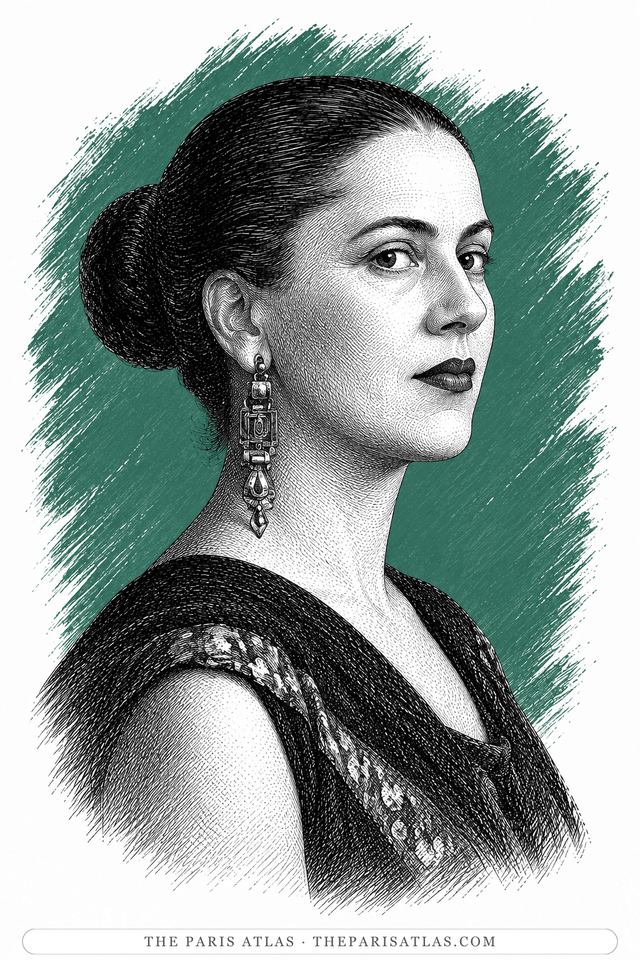
Tarsila do Amaral
Brazilian painter who spent the 1920s moving between São Paulo and Paris, studied Cubism under André Lhote, Albert Gleizes and Fernand Léger, and used what she learned to paint Brazilian towns, railways, plants and bodies. Her 1928 painting Abaporu prompted the manifesto that gave the Anthropophagic movement its name.
View artist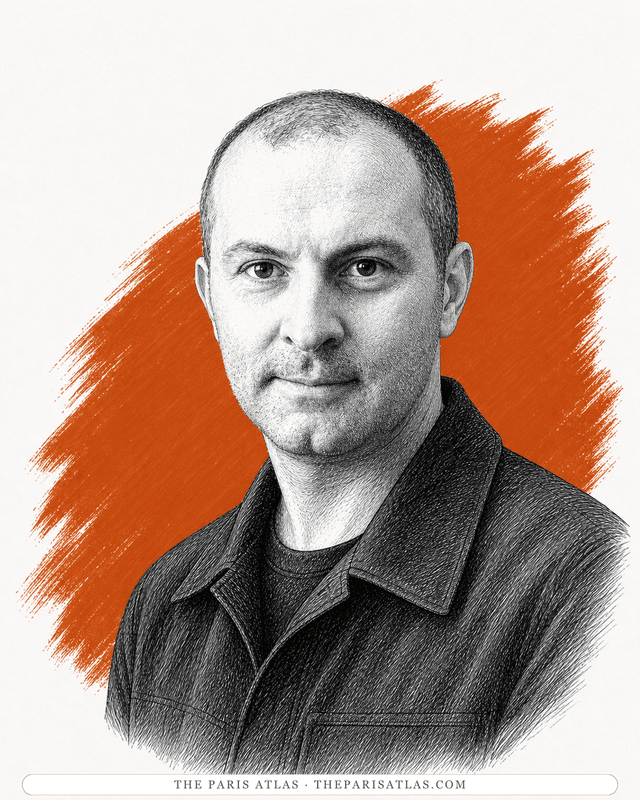
Arman
French-American artist, lifelong friend of Yves Klein, and a founder of New Realism.
View artist
Jean Arp
Strasbourg-born sculptor and poet — Hans in German, Jean in French, both all his life — who co-founded Dada at the Cabaret Voltaire in 1916, composed collages by dropping torn paper 'according to the laws of chance', and settled at Meudon outside Paris in a house his wife Sophie Taeuber-Arp designed.
View artist
References
The sources below include collection records, catalogues, scholarly research, and primary materials that informed this page. They document Hollywood Africans, its making, and its place in cultural history.


1Jean-Michel Basquiat, Hollywood Africans (1983) — collection record, 84.23
WebsiteWhitney Museum of American Art, New YorkUsed forThe Whitney's object record: title, date, medium, dimensions, accession number, credit line, on-view floor, the Artestar rights line, the identification of Rammellzee and Toxic, and the artist's own sentence about crossing out words.

2Basquiat's L.A.
PeriodicalLos Angeles Times, 2005Used forFred Hoffman's first-hand account of Jean-Michel Basquiat in Venice, California, from November 1982: the studio below Larry Gagosian's house, the second Gagosian show, and Hollywood Africans as the artist with Toxic and Rammellzee at Grauman's Chinese Theatre.
3Jean-Michel Basquiat (6 March – 14 May 2019) — exhibition page with the artist's exhibition chronology
WebsiteThe Brant Foundation Art Study Center, New YorkUsed forThe exhibition chronology, for the Los Angeles shows and the Paris exhibitions of 1987 and 1988.
4Jean-Michel Basquiat — artist page and collection holdings
WebsiteThe Broad, Los AngelesUsed forThe Broad's artist page, for the SAMO years and the scale of his output.
5Jean-Michel Basquiat — artist page of the licensing agency named in the museums' credit lines
WebsiteArtestar, New YorkUsed forArtestar's artist page for Jean-Michel Basquiat, the licensing agent named in the Whitney's rights line.
These references provide the documented foundation for this work's history and interpretation. Claim-level citations remain attached to the specific claims they support.
 Explore more resources