Horn Players
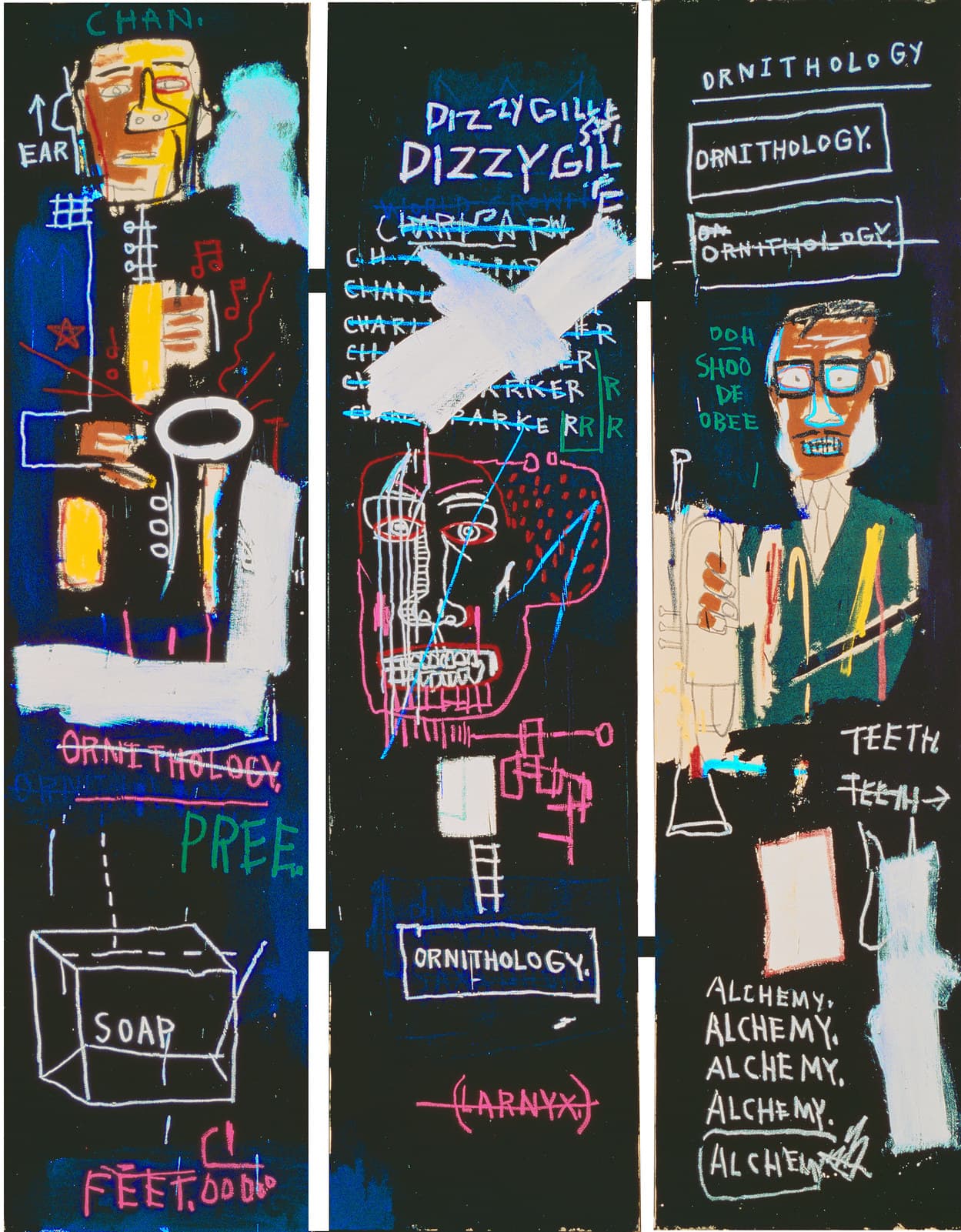
Three tall black panels hung side by side, with Charlie Parker on the left, Dizzy Gillespie on the right, and a pink and red head between them. The word ORNITHOLOGY appears four times, ALCHEMY five, and the name CHARLIE PARKER is written down the middle panel six or seven times over, each one crossed out with a blue line. The Broad in Los Angeles calls the painting an homage to the two musicians, whose bebop runs through the history of modern jazz.
- 1983
- Acrylic and oilstick on three canvas panels mounted on wood supports
- The BroadLos Angeles, United States
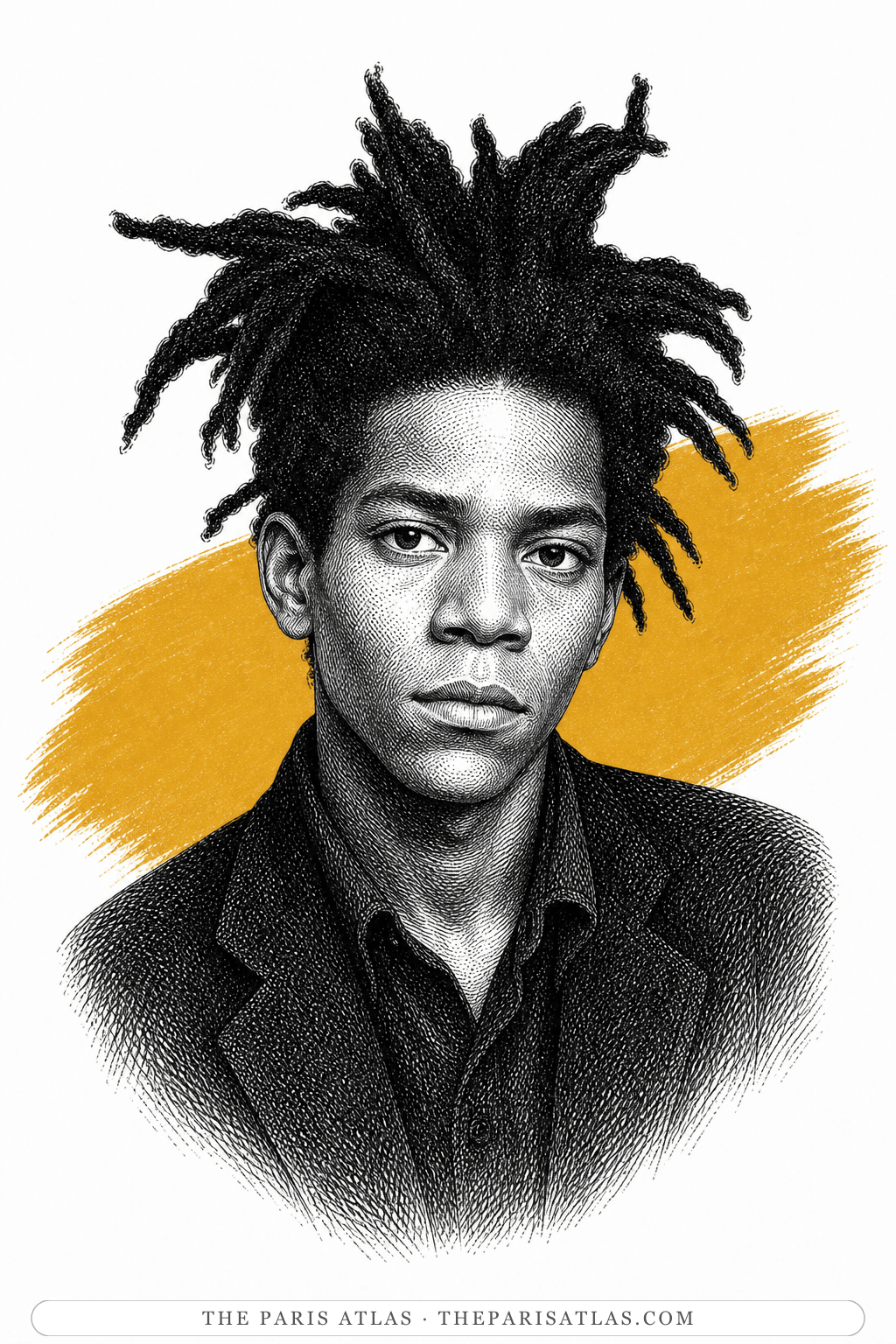
About Jean-Michel Basquiat
What the painting shows
The work is three separate canvas panels on wood supports, hung with narrow gaps between them, each one taller than it is wide. The ground on all three is near-black, with deep blue worked into the left panel.
On the left panel a figure stands with a pale yellow and orange face, a black jacket, and a white-ringed mouthpiece and horn across the body. Musical notes, a red star and short red strokes are drawn around the head. The word CHAN. is written in green above it.
The middle panel is dominated by a head drawn in hot pink and red outline, with black hollows for eyes, a ribbed white brow and a mouth of white teeth. A broad white X is painted across the upper part of the panel, over the writing beneath it. Below the head, a pink drawn diagram runs down towards a white-drawn box.
On the right panel sits a man in heavy black spectacles, a green jacket and a white collar, painted with a brown-orange face and blue teeth, a trumpet lifted to the left of him. Above him the word ORNITHOLOGY runs across the top, underlined, with two drawn rectangles below it.
Together the three panels measure 243.8 by 190.5 centimetres, about 96 by 75 inches.
The lettering, as it is written
Left panel, from the top: CHAN. in green; EAR in blue beside an upward arrow; ORNITHOLOGY. in pink, struck through by a single white line with a ghost of the same word in blue underneath it; PREE. in green; SOAP in white on the front face of a drawn open box; and FEET.OODOO in pink along the bottom, the letters shrinking as they go.
Middle panel: DIZZYGILLESPIE written twice in white on blue, the name running out of room at the right edge both times and wrapping downwards. Under it the name CHARLIE PARKER is written six or seven times in a column, each one struck out with a cyan line, and breaking across the panel edge as it repeats. Green Rs stand at the right of the last two lines. At the bottom, ORNITHOLOGY. inside a drawn white rectangle, and below that (LARNYX.) in pink with a long pink line through it — LARYNX, spelled LARNYX.
Right panel: ORNITHOLOGY in white with a long rule under it; ORNITHOLOGY. inside a drawn rectangle; then, inside a second rectangle, a small crossed-out OR above ORNITHOLOGY. struck through by a horizontal line. In green beside the head: DOH, underlined, then SHOO, DE, OBEE. Lower down: TEETH in white, then TEETH again crossed out with an arrow pointing right. Along the bottom, ALCHEMY. written four times in a column, then (ALCHEMY a fifth time inside a drawn box and scribbled over.
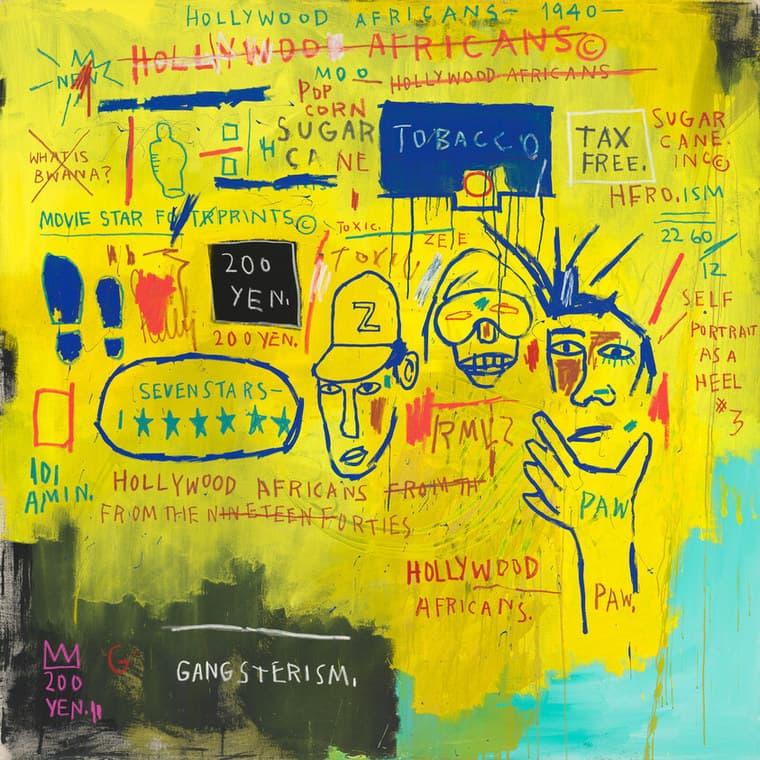
Jean-Michel Basquiat described the method in a sentence the Whitney Museum of American Art prints on its record for another of his paintings: "I cross out words so you will see them more; the fact that they are obscured makes you want to read them."
Charlie Parker and Dizzy Gillespie
The Broad identifies the two figures: Charlie Parker with his alto saxophone on the left, Dizzy Gillespie with his trumpet on the right. The museum calls them among the best jazz musicians ever, and says their bebop resonates loudly through the history of modern jazz.
Ornithology is Charlie Parker's, a jazz standard recorded in 1946, and The Broad notes that it is referenced in the middle section of the painting. Charlie Parker was called Bird, which is where a composition named after the study of birds comes from.
Chan is Chan Parker, whom Charlie Parker called his wife and who was with him in his last years. Pree was their daughter. Richard Williams, writing in the Guardian in 2010, records that she died in hospital in the early hours of 6 March 1954 after a long illness, and that her father was in Los Angeles when the news reached him. Charlie Parker died in March 1955, aged thirty-four.
Neither name is explained by any museum record. Both are written on the left panel, the one with the saxophone, in green.
The Broad says Jean-Michel Basquiat was an avid jazz listener and a musician himself, and reads the painting as showing the relationship between his improvisational way of painting and the alchemy of jazz composition. The word ALCHEMY is written five times on the right panel.
Where it is
The Broad in Los Angeles owns the painting and lists it as on view. Its accession number is F-BASQ-1P97.23 and the museum gives the accession date as 18 March 1983, the year the work was made.
The painting has no recorded Paris exhibition history. Jean-Michel Basquiat himself showed at the Galerie Daniel Templon in Paris in 1987 and at the Galerie Yvon Lambert in January 1988, and the Centre Pompidou holds his Slave Auction of 1982. That connection is the painter's rather than these three panels'.
Close reading
Reading the work, detail by detail
Three panels hung side by side, with a saxophone player on the left and a trumpeter on the right. Follow the names written and struck out down the middle, the word ORNITHOLOGY as it repeats across all three, and the misspelled larynx at the foot of the centre.
1.CHAN. over the saxophonist
The transcription is CHAN., with a full stop. Chan Parker was with Charlie Parker in his last years, and her name is written directly above the head The Broad identifies as his. Green is used for only two words on the panel.
2.EAR and the arrow
EAR is written beside an arrow pointing up towards the side of the head, in the way an anatomical plate labels a part. Jean-Michel Basquiat copied out anatomical diagrams throughout his work, and the label here names a musician's ear.
3.ORNITHOLOGY. struck out, and PREE.
The word is written twice on top of itself, in blue and then in pink, and struck through once in white. Ornithology is Charlie Parker's 1946 standard. PREE. below it is the name of his daughter, who died in hospital on 6 March 1954.
4.The SOAP box
The box is drawn in perspective with its flaps open and nothing inside. A dashed line falls from the pink writing above straight into the opening. SOAP is written in the same white as the box itself.
5.FEET.OODOO
The transcription is FEET.OODOO, run together with a single full stop after FEET and the trailing letters diminishing towards the right edge. It is the lowest writing on the panel and the only line to run off into smaller characters.
6.DIZZYGILLESPIE, twice
The name is written as one word, with no gap between the nickname and the surname. Both times Jean-Michel Basquiat misjudges the width of the panel, and both times the final letters turn a corner and continue down the right edge.
7.CHARLIE PARKER, struck out six times
Every repetition is crossed out, and the name breaks across the panel in a different place each time. A wide white X is painted over the column afterwards, covering several lines completely. Green Rs stand at the end of the last two.
8.The head in pink and red
The head is drawn in line only, with no filled areas except the teeth and a patch of red dots at the right of the cranium. A thin blue line runs diagonally across it from the top right to the jaw, laid over the drawing rather than through it.
9.(LARNYX.)
The transcription is (LARNYX.), with the N and the Y in the order he wrote them. The word is larynx, the voice box, and it is bracketed, punctuated and then crossed out in one line. The spelling is left as it stands.
10.ORNITHOLOGY, three times on the right panel
The word is written three times in a stack, each version treated differently: underlined, boxed, then boxed and struck out. The final line begins with an OR that is crossed out before the full word is written again beneath it.
11.DOH SHOO DE OBEE and the trumpeter
The transcription is DOH SHOO DE OBEE, written down the panel one word to a line with a rule under the first. It is scat, sung syllables with no meaning, set beside the head The Broad identifies as Dizzy Gillespie.
12.TEETH, then TEETH crossed out
The word is written twice, the second one crossed out and given an arrow pointing off the edge of the panel. The trumpeter below has his teeth painted blue and bared, which is what the arrow points away from.
13.ALCHEMY, five times
The transcription is ALCHEMY. four times, then (ALCHEMY a fifth time in a drawn box and scratched out. The Broad describes the painting as showing the relationship between his improvisational painting and the alchemy of jazz composition.
Timeline
1946
Charlie Parker records Ornithology, the standard The Broad says is referenced in the middle of the painting.
1954
Pree, the daughter of Charlie Parker and Chan Parker, dies in hospital in the early hours of 6 March after a long illness.
1955
Charlie Parker dies in March, aged thirty-four.
1983
Painted in acrylic and oilstick on three canvas panels mounted on wood supports. The Broad gives its accession date as 18 March 1983 and the number F-BASQ-1P97.23.
1988
Jean-Michel Basquiat dies of a heroin overdose in Manhattan on 12 August, aged twenty-seven.
2026
Listed by The Broad as on view in Los Angeles.
Where to see it
The Broad
Los Angeles, United States
A public viewing address has not yet been confirmed for this holding.
The Broad lists the painting as on view and gives its accession date as 18 March 1983. Museums rotate their walls, so check the record before travelling.
Frequently asked questions
Who is in Basquiat's Horn Players?
Charlie Parker on the left, with his alto saxophone, and Dizzy Gillespie on the right, with his trumpet. The Broad identifies both, and their names are written on the canvas — DIZZYGILLESPIE twice across the top of the middle panel, CHARLIE PARKER six or seven times down it, every repetition crossed out.
What does Ornithology mean in Horn Players?
It is a Charlie Parker jazz standard, recorded in 1946, and The Broad says it is referenced in the middle section of the painting. The word is written four times across the three panels, twice inside drawn boxes and twice struck through. Charlie Parker's nickname was Bird.
Is Horn Players one painting or three?
Three. The Broad catalogues it as acrylic and oilstick on three canvas panels mounted on wood supports, hung side by side with narrow gaps showing between them. Together they measure 243.8 by 190.5 centimetres.
Who are Chan and Pree in Horn Players?
Chan Parker was with Charlie Parker in his last years, and Pree was their daughter, who died in hospital on 6 March 1954. CHAN. is written in green at the top of the left panel and PREE. in green lower down. No museum record explains either name.
What does LARNYX mean on Horn Players?
It is larynx, the voice box, written with the N and the Y swapped — (LARNYX.) in pink at the foot of the middle panel, with a long pink line struck through it. Jean-Michel Basquiat's misspellings are left as he wrote them.
Where can you see Horn Players?
The Broad in Los Angeles, accession number F-BASQ-1P97.23, listed by the museum as on view. The Broad owns thirteen works by Jean-Michel Basquiat.
More by Jean-Michel Basquiat
If you like Jean-Michel Basquiat
Explore painters from the same movements and circles.
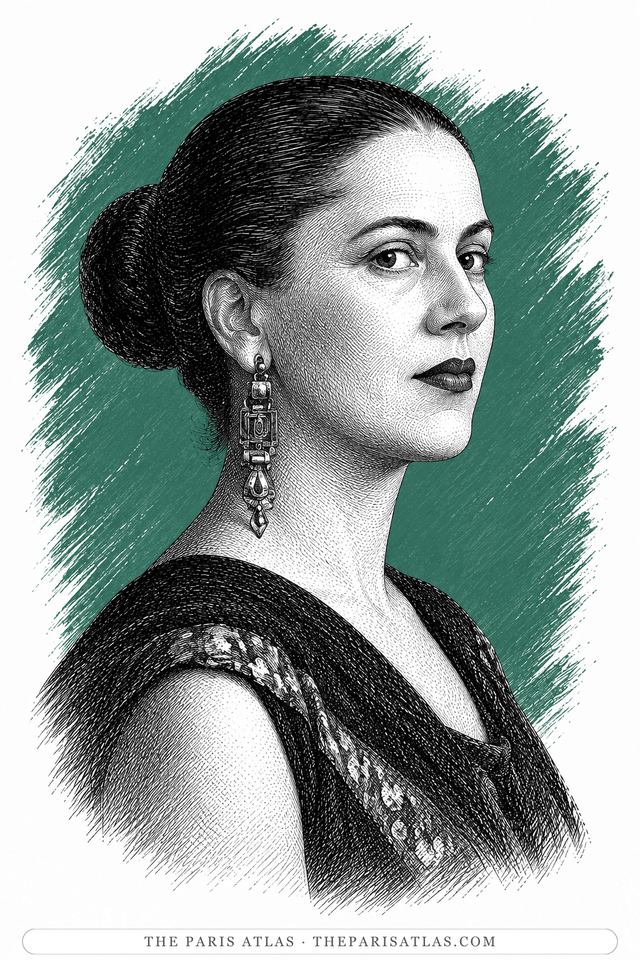
Tarsila do Amaral
Brazilian painter who spent the 1920s moving between São Paulo and Paris, studied Cubism under André Lhote, Albert Gleizes and Fernand Léger, and used what she learned to paint Brazilian towns, railways, plants and bodies. Her 1928 painting Abaporu prompted the manifesto that gave the Anthropophagic movement its name.
View artist
Arman
French-American artist, lifelong friend of Yves Klein, and a founder of New Realism.
View artist
Jean Arp
Strasbourg-born sculptor and poet — Hans in German, Jean in French, both all his life — who co-founded Dada at the Cabaret Voltaire in 1916, composed collages by dropping torn paper 'according to the laws of chance', and settled at Meudon outside Paris in a house his wife Sophie Taeuber-Arp designed.
View artist
References
The sources below include collection records, catalogues, scholarly research, and primary materials that informed this page. They document Horn Players, its making, and its place in cultural history.

1Jean-Michel Basquiat, Horn Players (1983) — object record, F-BASQ-1P97.23
WebsiteThe Broad, Los AngelesUsed forThe Broad's object record: title, year, the three-panel medium, dimensions, accession number and date, the on-view status, the Artestar credit line, and the museum's note on Charlie Parker, Dizzy Gillespie and Ornithology.
2Jean-Michel Basquiat, Hollywood Africans (1983) — collection record, 84.23
WebsiteWhitney Museum of American Art, New YorkUsed forThe Whitney's object record, which quotes Jean-Michel Basquiat on why he crossed words out.

3Charlie Parker: a genius distilled
PeriodicalThe Guardian, 2010Used forRichard Williams on Charlie Parker's last years: the death of his daughter Pree on 6 March 1954, his telegrams to Chan, and his age of thirty-four at his own death.
4Jean-Michel Basquiat (6 March – 14 May 2019) — exhibition page with the artist's exhibition chronology
WebsiteThe Brant Foundation Art Study Center, New YorkUsed forThe exhibition chronology, for the Paris exhibitions of 1987 and 1988.
5Jean-Michel Basquiat — artist page of the licensing agency named in the museums' credit lines
WebsiteArtestar, New YorkUsed forArtestar's artist page for Jean-Michel Basquiat, the licensing agent named in the museum credit lines.
These references provide the documented foundation for this work's history and interpretation. Claim-level citations remain attached to the specific claims they support.
 Explore more resources