Slave Auction
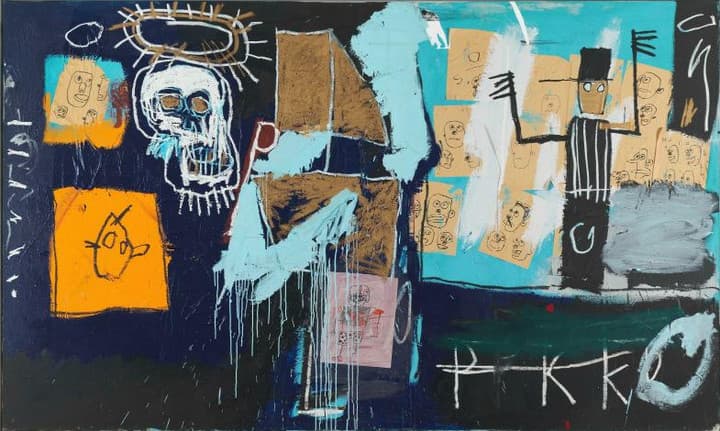
A canvas three metres wide, built from crumpled paper glued to the surface and then drawn and painted over in oil stick and acrylic. A white skull under a ring of thorns holds the left half. At the right a figure in a striped jacket and a tall black hat stands with both arms out, in front of a wall of pasted papers each carrying a drawn face. The Centre Pompidou reads the picture as being about oppressed minorities and, more directly, the slave trade. The Musée national d'art moderne has held it since 1993.
- 1982
- Collage of crumpled papers, oil stick and acrylic paint on canvas
- Centre Pompidou, Musée national d'art moderneParis, France
About Jean-Michel Basquiat
What the painting shows
The left half is almost black. A white skull sits in it, drawn in thick outline with two brown eye sockets, a ribbed jaw and pale blue drips running from the chin. Above the skull is a closed ring of brown and ochre with short spikes radiating from it, the crown of thorns the Centre Pompidou names in its own notice.
Below and beside the skull are two pasted rectangles. The upper one is tan paper laid over a patch of turquoise and orange, and three small faces are drawn on it in pencil. The lower one is a solid orange panel with a single large face drawn on it in black, its eyes two circles and its mouth a row of short strokes.
The middle of the canvas is taken up by two brown and gold shapes with hard edges, one above the other, and by a curtain of white paint running down from them in long drips. A pink sheet is pasted low in the centre, with a faint figure drawn on it in pencil and red.
The right half is pale turquoise. A figure stands there in a black-and-white vertically striped jacket and a tall black hat, both arms held out level, its face a tan rectangle with two white eyes. It stands on a grey block. Behind and around it, a wall of tan papers is pasted to the canvas, and on almost every one a face has been drawn in pencil.
Along the bottom right, four white capitals are painted on the dark ground and struck through by one long white line. The first reads as a P or an R, the next two as K, and the fourth trails off into a tail; a thick pale ring is painted at the end of the row. They do not resolve into a word. A column of short white strokes runs up the far left edge in the same way.
The canvas is 183 by 305.5 centimetres, about six feet by ten.
What the museum says it is about
The Centre Pompidou's notice states the subject plainly: oppressed minorities and, more directly, the slave trade. It points to two things in the picture as carrying that — a golden ship and the skull with its crown of thorns — and reads both as evoking the sacrifice of Black people.
The notice goes further into the surface. It sets the threatening teeth against the haggard faces of the excluded, hears New Orleans music hall in the picture, and reads the insects as the torment of the cotton fields. It describes the method as a deliberate roughness that juxtaposes drawing, painting and collage without ranking any of them.
Jean-Michel Basquiat was born in Brooklyn in 1960 to Gérard Basquiat, an accountant from Haiti, and Matilde Andrades, whose parents were Puerto Rican. The museum's notice names that descent when it describes what the painting is doing.
How it reached Paris
The Société des Amis du Musée national d'art moderne, the association of the museum's private supporters, gave the painting to the collection in 1993. It carries the inventory number AM 1993-99.
The gift came five years after Jean-Michel Basquiat died, and in the same year that the Musée-Galerie de la Seita, the Paris exhibition space run by the French state tobacco company, showed Peinture, dessin, écriture. Paris had been showing him steadily since 1989.
He had been in the city himself in January 1988 for an exhibition at the Galerie Yvon Lambert, seven months before his death, after showing at the Galerie Daniel Templon in 1987. Whether Slave Auction was in either show is not recorded in any source the atlas has found.
Seeing it
The Centre Pompidou closed in 2025 for a transformation running to 2030, and the museum's own pages now direct visitors elsewhere for its programme.
The painting belongs to the Musée national d'art moderne inside the Centre Pompidou, which is France's national museum of modern art. Ownership is not the same as display, and a collection of that size never has everything on the wall at once.
Close reading
Reading the work, detail by detail
A canvas three metres wide, half in darkness and half in turquoise. Begin with the ring of thorns and the skull beneath it, cross the pasted papers and the white drips at the centre, then reach the striped figure with its arms out and the row of struck-through capitals along the bottom.
1.The crown of thorns
The ring is drawn as a flattened oval, seen from slightly above, with spikes projecting from every side. The Centre Pompidou's own notice names it a crown of thorns, and reads the skull below it as evoking the sacrifice of Black people.
2.The skull
The skull is drawn in a single heavy white line and then filled, with the two eye sockets left brown rather than black. The pale blue below the jaw is wet paint that has run, not a drawn beard.
3.The face on the orange panel
The drawing is reduced to five or six lines on a flat orange field, at a much larger scale than the pencilled faces elsewhere on the canvas. Orange paint has been brushed up to the drawn lines rather than under them.
4.The wall of pasted faces
Each sheet carries one or two faces, drawn small and quickly in pencil, and the sheets are crumpled where they were pressed down. Counted across the right half there are more than a dozen of them, which is what turns the passage into a crowd.
5.The figure in the striped jacket
The figure is the only whole standing body on the canvas, and the only one wearing clothing that is described rather than blocked in. A white curl that reads as a G is drawn on its black lower body, and it stands on a grey slab rather than on the ground.
6.The white drips
The drips are the longest continuous marks on the canvas and run almost a third of its height. They were poured after the collage was laid down, because they cross the pasted edges rather than stopping at them.
7.The pink sheet
The drawing on the pink sheet is the quietest thing in the picture and the hardest to see, sitting under the white paint that has run down over it. Its head and shoulders repeat the skull at the far left at a fraction of the size.
8.The struck-through capitals
The first form reads as a P or an R, the next two as K, and the fourth trails off into a descending tail. One white line is drawn straight through all four. They do not resolve into a word in the museum's reproduction, and the Centre Pompidou's notice does not transcribe them.
9.The marks up the left edge
The strokes are spaced like writing and change shape from one to the next, which is why they read as a word set on end. None of them resolves, and the column stops before it reaches the top of the canvas.
Timeline
1982
Painted, in crumpled paper collage, oil stick and acrylic on a canvas three metres wide, in a year the Brant Foundation chronology records as holding eight solo exhibitions for Jean-Michel Basquiat.
1987
Jean-Michel Basquiat shows at the Galerie Daniel Templon in Paris.
1988
He travels to Paris in January for his exhibition at the Galerie Yvon Lambert, and dies in Manhattan on 12 August, aged twenty-seven.
1993
Given to the Musée national d'art moderne by the Société des Amis du Musée national d'art moderne, and inventoried as AM 1993-99.
2025
The Centre Pompidou closes for a transformation running to 2030.
Where to see it
Centre Pompidou, Musée national d'art moderne
Paris, France
A public viewing address has not yet been confirmed for this holding.
The Centre Pompidou closed in 2025 for a transformation running to 2030. Check the museum's record before travelling.
Frequently asked questions
Is there a Basquiat in a Paris museum?
Yes. The Centre Pompidou holds Slave Auction, painted in 1982 — crumpled paper collage, oil stick and acrylic on canvas, 183 by 305.5 centimetres, inventory number AM 1993-99. The museum's friends' association gave it to the Musée national d'art moderne in 1993, and it has been in Paris ever since.
What is Slave Auction about?
The Centre Pompidou's own notice says oppressed minorities and, more directly, the slave trade. It names a golden ship and a skull crowned with thorns as the images carrying that, and reads them as evoking the sacrifice of Black people.
What is Slave Auction made of?
Crumpled papers glued to the canvas, then worked over in oil stick and acrylic paint. Oil stick is oil paint bound into a thick crayon you draw with directly, which is why the lines on the surface look drawn rather than brushed.
How big is Slave Auction?
183 by 305.5 centimetres — about six feet high and ten feet wide. The Centre Pompidou catalogues it as a painting, though crumpled paper is glued across the surface under the paint.
Can you see Slave Auction at the Centre Pompidou?
Not at present. The Centre Pompidou closed in 2025 for a transformation running to 2030, and its programme has moved elsewhere in the meantime. Check the museum's record before travelling.
How did a Basquiat get into the French national collection?
As a gift. The Société des Amis du Musée national d'art moderne, the association of the museum's private supporters, gave Slave Auction to the collection in 1993, five years after Jean-Michel Basquiat died. It was not bought by the French state.
More by Jean-Michel Basquiat
If you like Jean-Michel Basquiat
Explore painters from the same movements and circles.
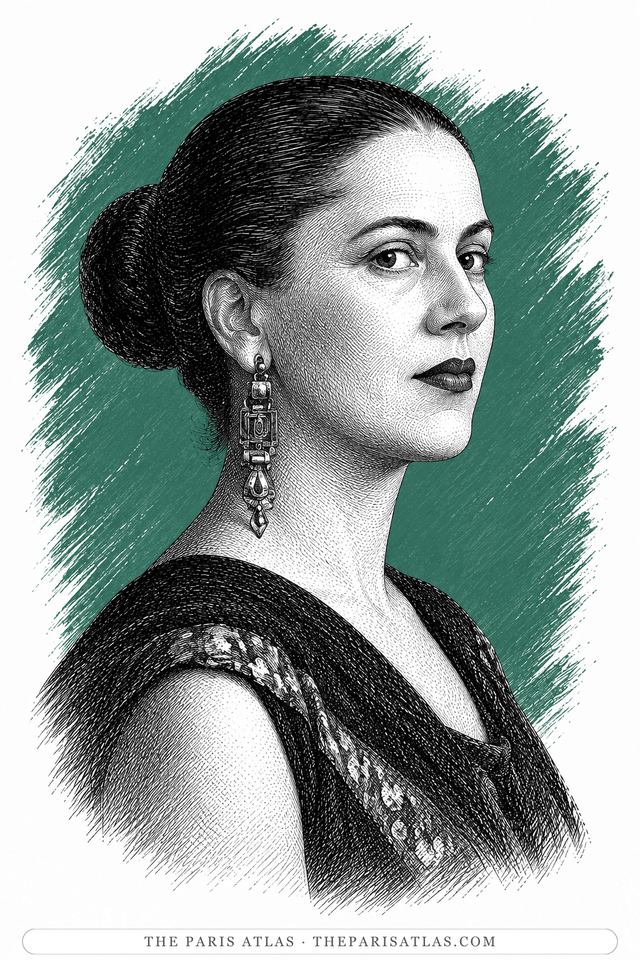
Tarsila do Amaral
Brazilian painter who spent the 1920s moving between São Paulo and Paris, studied Cubism under André Lhote, Albert Gleizes and Fernand Léger, and used what she learned to paint Brazilian towns, railways, plants and bodies. Her 1928 painting Abaporu prompted the manifesto that gave the Anthropophagic movement its name.
View artist
Arman
French-American artist, lifelong friend of Yves Klein, and a founder of New Realism.
View artist
Jean Arp
Strasbourg-born sculptor and poet — Hans in German, Jean in French, both all his life — who co-founded Dada at the Cabaret Voltaire in 1916, composed collages by dropping torn paper 'according to the laws of chance', and settled at Meudon outside Paris in a house his wife Sophie Taeuber-Arp designed.
View artist
References
The sources below include collection records, catalogues, scholarly research, and primary materials that informed this page. They document Slave Auction, its making, and its place in cultural history.

1Jean-Michel Basquiat, Slave Auction (1982) — notice d'œuvre, Musée national d'art moderne
WebsiteCentre PompidouUsed forThe museum's catalogue notice: the French title, date, technique, dimensions, inventory number, the 1993 donation, the Artestar credit line, and the reading of the golden ship and the crowned skull.
22025-2030, Centre Pompidou is transforming itself!
WebsiteCentre PompidouUsed forThe museum's own page for the 2025–2030 closure and transformation.
3Jean-Michel Basquiat — artist page and collection holdings
WebsiteThe Broad, Los AngelesUsed forThe Broad's artist page, for the Brooklyn birth and the Haitian and Puerto Rican descent named in the Pompidou notice.
4Jean-Michel Basquiat (6 March – 14 May 2019) — exhibition page with the artist's exhibition chronology
WebsiteThe Brant Foundation Art Study Center, New YorkUsed forThe exhibition chronology: the eight solo shows of 1982, the Paris exhibitions of 1987 and 1988, and the posthumous Paris shows.
5Jean-Michel Basquiat — artist page of the licensing agency named in the museums' credit lines
WebsiteArtestar, New YorkUsed forArtestar's artist page for Jean-Michel Basquiat, the licensing agent named on the Pompidou notice.
These references provide the documented foundation for this work's history and interpretation. Claim-level citations remain attached to the specific claims they support.
 Explore more resources