Articulated Lair
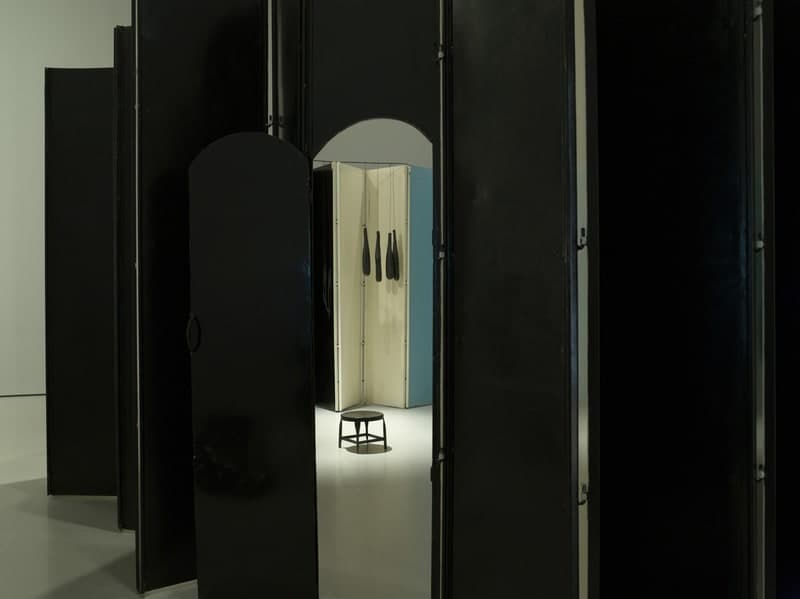
Tall black steel panels are hinged together into a folding wall that closes around a small room. Inside it a stool stands alone on a pale floor and a cluster of black rubber shapes hangs on threads against a cream-coloured screen. Louise Bourgeois made Articulated Lair in 1986, and The Museum of Modern Art in New York has held it since 1993.
- 1986
- Painted steel, rubber, and metal
- The Museum of Modern ArtNew York, United States
About Louise Bourgeois
What the work is made of
The Museum of Modern Art gives the materials as painted steel, rubber and metal, and the size as variable, overall approximately 281.7 by 655.7 by 490.2 centimetres. The panels are hinged, so the enclosure is set up differently in different rooms; the catalogue records that openly rather than fixing a single measurement.
Each panel is a tall sheet of steel painted matt black, some with a rounded top and some square, and the hinges show as vertical pins along every join. One panel carries a dark oval handle. The outer faces are unbroken black and take a low sheen from the gallery lighting.
Inside, the surfaces change. A screen of cream-painted panels folds around one corner, one section next to it is painted a flat pale blue, and the floor inside is white. Against the cream screen hangs a group of four black rubber shapes on thin threads, each tapering from a narrow top to a heavy rounded end, like weights or pendulums.
A small dark stool with a round seat and four splayed legs stands on the white floor and casts a single shadow. It is the only furniture.
Lair was already a word she used
The Easton Foundation dates the lair as a form in her work to 1964, when Louise Bourgeois showed new plaster and latex sculptures at the Stable Gallery in New York after eleven years without a solo exhibition. Those pieces were hollow, organic and enclosing, and lair is the word attached to them.
Articulated adds the hinges. The room is not a single moulded shell but a chain of flat steel plates that pivot against one another, so it can be opened out, closed up, or set at any angle between.
The result is an enclosure a person could stand in and would then be surrounded by. The one stool inside sets the scale and the occupancy: room for one.
It comes immediately before the Cells
The Museum of Modern Art's chronology names Articulated Lair as a precursor to the Cells, the room-sized enclosures Louise Bourgeois made in numbers through the 1990s and 2000s. The relationship is direct: a built room, salvaged industrial materials, a small number of objects inside, and a viewer kept mostly outside.
What is different is what is in it. The Cells hold her own clothes, her parents' tapestry fragments, mirrors, perfume bottles and carved marble hands. Articulated Lair holds a stool and four hanging rubber forms, and nothing else.
She was seventy-five in 1986, four years after The Museum of Modern Art's retrospective, and working at a scale her Brooklyn studio had made possible since 1980.
How the Museum of Modern Art got it
The museum accessioned the work on 8 March 1993 as number 40.1993, in the Department of Painting and Sculpture, and classifies it as an installation.
The credit line names two donors and a debt: Gift of Lily Auchincloss; and of the artist in honor of Deborah Wye (by exchange). Deborah Wye had curated the museum's 1982 Louise Bourgeois retrospective, its first for a woman artist, and went on to compile the catalogue raisonné of her prints in 1994.
Close reading
Reading the work, detail by detail
The photograph is taken from outside the enclosure and looks through a gap between two black panels. Most of the work is the black steel wall filling the frame; the interior is a narrow lit slot in the middle, so only part of what is inside can be seen.
1.The opening is arched at the top
The gap the camera looks through is closed at the top by a panel that curves to a rounded arch. That arch is the only shaped edge in the photograph. Everything else is straight steel.
2.Four black rubber shapes hang on threads
Four black forms hang inside on thin threads, each narrow at the top and swelling to a heavy rounded end. They hang at slightly different heights and do not touch the screen behind them. Their shadows fall on the cream panel below.
3.One inner section is painted pale blue
Beside the cream screen one section of the interior is painted a flat pale blue. The outside of the work is black throughout, so the colour exists only for whoever is standing inside. It is visible here only because the gap lines up with it.
4.A single stool stands on the white floor
One stool stands inside, with a round seat, four splayed legs and a low stretcher between them. It casts a single soft shadow on the white floor. It is the only furniture in view and it seats one person.
5.The panels are hinged, not welded
A hinge pin shows as a short vertical cylinder on the panel edge, with a narrow bright line of light down the joint. The Museum of Modern Art records the dimensions as variable for this reason: the hinged panels are set at a different angle in every room.
6.The outside gives nothing away
A panel with a rounded top stands closest to the camera, its face unbroken matt black with a low sheen and a dark oval handle set into it. From outside, the enclosure is a blank wall. The pale gallery floor runs along its foot.
Timeline
1964
Louise Bourgeois shows organically shaped plaster sculptures at the Stable Gallery in New York, introducing the lair as a form in her work.
1980
She buys a large loft in Brooklyn for a studio, which lets her work at architectural scale.
1982
The Museum of Modern Art gives her a retrospective curated by Deborah Wye, its first for a woman artist.
1986
She makes Articulated Lair, which The Museum of Modern Art later names a precursor to the Cells.
1991
She shows the first six Cells at the Carnegie International in Pittsburgh.
1993
The Museum of Modern Art accessions Articulated Lair on 8 March as 40.1993.
1994
Deborah Wye and Carol Smith publish the catalogue raisonné of her prints, and The Museum of Modern Art opens The Prints of Louise Bourgeois.
Where to see it
The Museum of Modern Art
11 West 53 Street, New York, NY 10019, United States
A room-sized installation, so not permanently on view. The museum's online record is the place to check before travelling.
Plan your visit on the museum’s official website (opens in a new tab)Frequently asked questions
Where is Articulated Lair?
The Museum of Modern Art in New York owns it, accession number 40.1993, in the Department of Painting and Sculpture. It is a large installation rather than a permanently hung work, so check the museum's record before travelling.
What is Articulated Lair made of?
Painted steel, rubber and metal. The museum gives the dimensions as variable, overall approximately 281.7 by 655.7 by 490.2 centimetres, because the steel panels are hinged and the enclosure is arranged differently in different rooms.
What is inside Articulated Lair?
A small stool with a round seat, standing alone on a white floor, and a cluster of black rubber shapes hanging on threads against a cream-painted screen, each tapering to a heavy rounded end. One inner section is painted pale blue. There is nothing else.
Why is it called a lair?
Lair is a word already attached to her work. The Easton Foundation dates it to 1964, when Louise Bourgeois showed hollow, enclosing plaster and latex sculptures at the Stable Gallery in New York. Articulated describes the hinges, which let the steel panels pivot and the room open or close.
How is Articulated Lair related to the Cells?
The Museum of Modern Art's chronology calls it a precursor to them. Both are built rooms made from industrial materials, holding a few objects, that a viewer looks into rather than occupies. The Cells, from 1991 onward, fill that room with her own possessions; Articulated Lair holds a stool and four rubber forms.
Who was Lily Auchincloss, and who is Deborah Wye?
Lily Auchincloss was a New York collector and a trustee of The Museum of Modern Art; the credit line records her gift. Deborah Wye is the curator who organised the museum's 1982 Louise Bourgeois retrospective, its first for a woman artist, and the work was given partly in her honour.
More by Louise Bourgeois
If you like Louise Bourgeois
Explore sculptors from the same movements and circles.
Arman
French-American artist, lifelong friend of Yves Klein, and a founder of New Realism.
View artist
Jean Arp
Strasbourg-born sculptor and poet — Hans in German, Jean in French, both all his life — who co-founded Dada at the Cabaret Voltaire in 1916, composed collages by dropping torn paper 'according to the laws of chance', and settled at Meudon outside Paris in a house his wife Sophie Taeuber-Arp designed.
View artist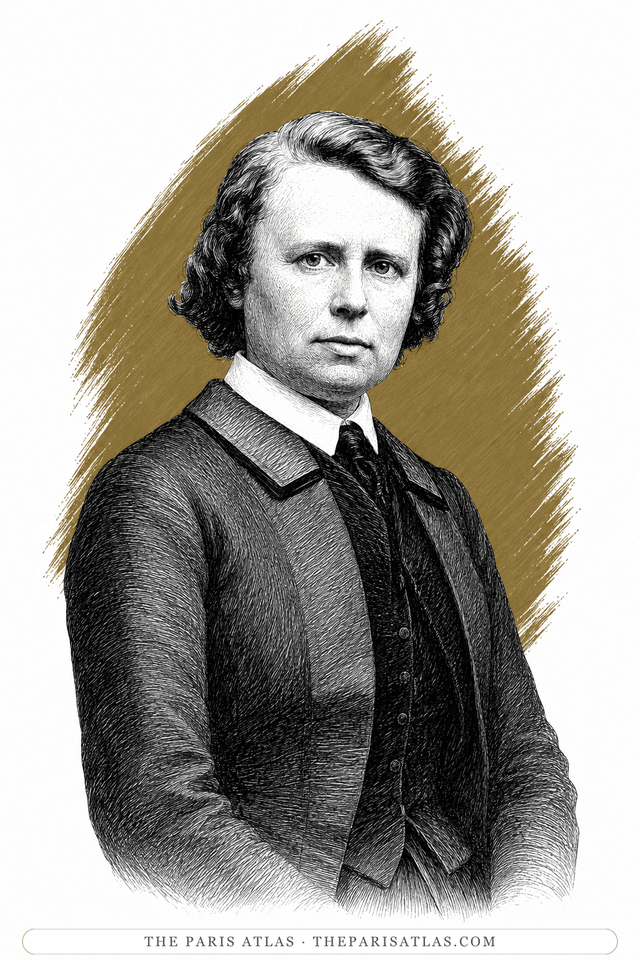
Rosa Bonheur
At the horse markets of Paris and in her studio beside the forest of Fontainebleau, Rosa Bonheur gave animals the presence of great portrait subjects. The success of The Horse Fair helped her build a life shaped by her work, financial independence, and the women she loved.
View artist
References
The sources below include collection records, catalogues, scholarly research, and primary materials that informed this page. They document Articulated Lair, its making, and its place in cultural history.


1Louise Bourgeois, Articulated Lair, 1986, accession 40.1993
Official recordThe Museum of Modern Art, New YorkUsed forThe holding museum's record: materials, the variable dimensions, the credit line, the classification as an installation and the accession date of 8 March 1993.
2The Museum of Modern Art collection dataset
Official recordThe Museum of Modern ArtUsed forThe museum's published collection data, the form in which the catalogue fields were checked while its website was unreachable.

3Louise Bourgeois: The Complete Prints & Books — Chronology
WebsiteThe Museum of Modern Art, New YorkUsed forArticulated Lair named as a precursor to the Cells, the Brooklyn studio of 1980, the 1982 retrospective curated by Deborah Wye, and the 1991 Carnegie International.
4Louise Bourgeois — The Easton Foundation
WebsiteThe Easton Foundation, New YorkUsed forThe 1964 Stable Gallery exhibition that introduced the lair as a sculptural form.
These references provide the documented foundation for this work's history and interpretation. Claim-level citations remain attached to the specific claims they support.
 Explore more resources