Femme Maison
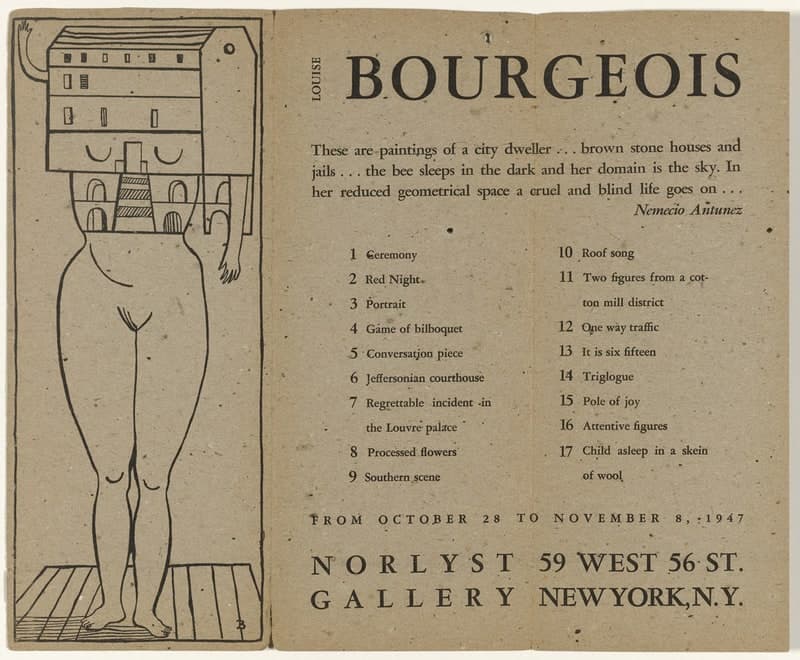
A naked woman stands with a tall house in place of her head and shoulders, one hand waving out of the roofline. Louise Bourgeois printed the image as a line block on the folded announcement for her exhibition of paintings at the Norlyst Gallery in New York, which ran from 28 October to 8 November 1947. The right-hand leaf lists the seventeen paintings by title. The Museum of Modern Art holds the sheet as 448.2010.
- 1947
- Line block
- The Museum of Modern ArtNew York, United States
About Louise Bourgeois
What the sheet shows
The printed sheet is a single fold, 24 by 30 centimetres opened out and 24 by 9.8 centimetres closed. The drawn image occupies the left leaf, printed in black line on brown paper at 23.3 by 9.3 centimetres, inside a ruled border.
The figure is drawn in a few unbroken lines. A woman's body stands frontally, naked, with the hips and legs given as two long curves and the pubic hair as three short strokes. Above the hips there is no torso, chest or head: a four-storey building sits there instead, drawn in perspective with a pitched roof, three ranks of small window openings and a round window in the gable at the right.
Two curved lines are drawn on the lowest storey of the house, where the woman's breasts would be, with a small stepped form between them. One arm comes out of the left side of the building near the roof with the fingers spread, as if waving. The other hangs down at the right. The feet stand on hatched floorboards.
It is an exhibition announcement
The right-hand leaf carries the artist's name in large type, LOUISE BOURGEOIS, then an epigraph, then a numbered list of seventeen paintings, then the dates and the address.
The epigraph reads: These are paintings of a city dweller … brown stone houses and jails … the bee sleeps in the dark and her domain is the sky. In her reduced geometrical space a cruel and blind life goes on … It is signed Nemecio Antunez, the spelling used on the sheet; the Chilean painter usually appears as Nemesio Antúnez.
The first nine titles run: Ceremony; Red Night; Portrait; Game of bilboquet; Conversation piece; Jeffersonian courthouse; Regrettable incident in the Louvre palace; Processed flowers; Southern scene.
The second column runs: Roof song; Two figures from a cotton mill district; One way traffic; It is six fifteen; Triglogue; Pole of joy; Attentive figures; Child asleep in a skein of wool.
The imprint below reads FROM OCTOBER 28 TO NOVEMBER 8, 1947 and NORLYST 59 WEST 56 ST. GALLERY NEW YORK, N.Y. The Museum of Modern Art's chronology confirms the Norlyst show as a solo exhibition of paintings in 1947, two years after her first at the Bertha Schaefer Gallery.
Woman house
Femme maison is French for woman house, and it is also close to the French for housewife, femme au foyer. Louise Bourgeois made a group of these figures in 1946 and 1947, in paintings and on paper, each one a woman whose upper body has been replaced by a building.
She had left Paris for New York nine years earlier, was married to the art historian Robert Goldwater, and was raising three sons. The Museum of Modern Art's chronology records that she was working mainly on painting, drawing and printmaking at this point, and worked at Stanley William Hayter's Atelier 17 in New York from 1946.
“Printmaking, instead of being a reproductive medium, was for me a creative medium.”
The image outlived the exhibition it advertised. The Museum of Modern Art records that a 1947 Femme Maison drawing became a symbol of the women's art movement and was used on the cover of Lucy R. Lippard's From the Center: Feminist Essays on Women's Art in 1976. Louise Bourgeois returned to the motif in a small edition of photogravures in 1984.
The houses behind the house
Louise Bourgeois grew up inside a family business run out of the family's homes. The Museum of Modern Art's chronology places the Bourgeois family at Choisy-le-Roi outside Paris from 1912 to 1919, with the tapestry restoration workshop behind the house, and at Antony from 1919, with the workshop set up there.
From 1923 she drew the missing sections of damaged tapestries for the workshop. The Easton Foundation records that her father, Louis Bourgeois, kept the family's English tutor, Sadie Gordon Richmond, as his mistress in the household for roughly a decade, from 1922.
Louise Bourgeois treated that household as her subject matter for seventy years, and said so plainly. A woman with a house instead of a head is an early statement of it, made when she was thirty-five.
Close reading
Reading the work, detail by detail
The sheet is photographed flat and opened out, so both leaves are in view with the vertical fold down the middle. The drawing is on the left leaf and the exhibition text on the right, printed in black on brown paper against a white ground.
1.A four-storey house replaces the head
The building is drawn in light perspective, with a pitched roof ruled in parallel lines and a round window in the gable at the right. Three ranks of small rectangular openings serve as windows. It sits directly on the woman's hips with no neck and no shoulders.
2.A hand comes out of the roofline
A thin arm comes out of the left side of the building just under the roof, ending in a hand with the fingers spread. The gesture reads as waving. It is the only part of the figure above the hips that is human.
3.The body below is drawn in a few lines
Below the house the drawing is bare: two long curves for the hips and legs, one shallow line across the belly, and three short strokes for pubic hair. The feet stand flat on hatched floorboards. Nothing is shaded and nothing is corrected.
4.The epigraph is signed Nemecio Antunez
Four lines of type read: These are paintings of a city dweller … brown stone houses and jails … the bee sleeps in the dark and her domain is the sky. In her reduced geometrical space a cruel and blind life goes on … The signature below is set in italic.
5.Seventeen paintings, listed by title
The list runs in two columns, one to nine on the left and ten to seventeen on the right. Number seven is Regrettable incident in the Louvre palace, number two is Red Night and number seventeen is Child asleep in a skein of wool. Two titles wrap onto a second line.
6.The dates and the address close the sheet
The bottom of the right leaf gives the run of the exhibition, 28 October to 8 November 1947, then the gallery in large spaced capitals: NORLYST 59 WEST 56 ST. GALLERY NEW YORK, N.Y. The paper is speckled and the fold runs through the type.
Timeline
1912–1919
The Bourgeois family lives at Choisy-le-Roi outside Paris with the tapestry restoration workshop behind the house.
1922
Sadie Gordon Richmond joins the household as the children's English tutor, and becomes Louis Bourgeois's mistress.
1938
Louise Bourgeois marries Robert Goldwater and moves from Paris to New York.
1945
Her first solo exhibition of paintings opens at the Bertha Schaefer Gallery in New York.
1946
She begins working at Stanley William Hayter's Atelier 17, the print workshop moved from Paris to New York during the war.
1947
Paintings are shown at the Norlyst Gallery, 59 West 56th Street, from 28 October to 8 November, with this Femme Maison printed on the announcement.
1976
A 1947 Femme Maison appears on the cover of Lucy R. Lippard's From the Center: Feminist Essays on Women's Art.
1984
She makes a small edition of Femme Maison photogravures based on the 1947 drawing and a related painting.
2010
The Museum of Modern Art accessions the sheet on 9 June as 448.2010, a gift of the artist.
Where to see it
The Museum of Modern Art
11 West 53 Street, New York, NY 10019, United States
A work on paper, so not permanently on view. The museum's online record is the place to check before travelling.
Plan your visit on the museum’s official website (opens in a new tab)Frequently asked questions
What does Femme Maison mean?
Woman house, in French. It also sits close to femme au foyer, the French for housewife. Louise Bourgeois made a group of these figures in 1946 and 1947: a woman's body whose head and upper torso have been replaced by a building.
Where is the 1947 Femme Maison?
The Museum of Modern Art in New York holds this sheet as accession 448.2010, in the Department of Drawings and Prints, a gift of the artist. Works on paper are not permanently displayed, so check the museum's record before travelling.
What is a line block?
A relief printing plate made photomechanically from a pen drawing, used for printing line art alongside type. It is the commercial process an announcement or a magazine would have used in 1947, which is why the drawing and the exhibition text are printed together on one sheet.
What was the Norlyst Gallery exhibition?
A solo show of seventeen paintings by Louise Bourgeois at the Norlyst Gallery, 59 West 56th Street, New York, from 28 October to 8 November 1947. The titles are printed on the announcement and include Red Night, Jeffersonian courthouse and Regrettable incident in the Louvre palace.
Who wrote the text on the announcement?
It is signed Nemecio Antunez on the sheet, the spelling used there; the Chilean painter is usually written Nemesio Antúnez. The lines read, in part: These are paintings of a city dweller … brown stone houses and jails … the bee sleeps in the dark and her domain is the sky.
Why is Femme Maison associated with feminist art?
Because of how it was reused. The Museum of Modern Art records that a 1947 Femme Maison drawing became a symbol of the women's art movement and was put on the cover of Lucy R. Lippard's From the Center: Feminist Essays on Women's Art in 1976, nearly thirty years after Louise Bourgeois drew it.
More by Louise Bourgeois
If you like Louise Bourgeois
Explore painters from the same movements and circles.
Arman
French-American artist, lifelong friend of Yves Klein, and a founder of New Realism.
View artist
Jean Arp
Strasbourg-born sculptor and poet — Hans in German, Jean in French, both all his life — who co-founded Dada at the Cabaret Voltaire in 1916, composed collages by dropping torn paper 'according to the laws of chance', and settled at Meudon outside Paris in a house his wife Sophie Taeuber-Arp designed.
View artist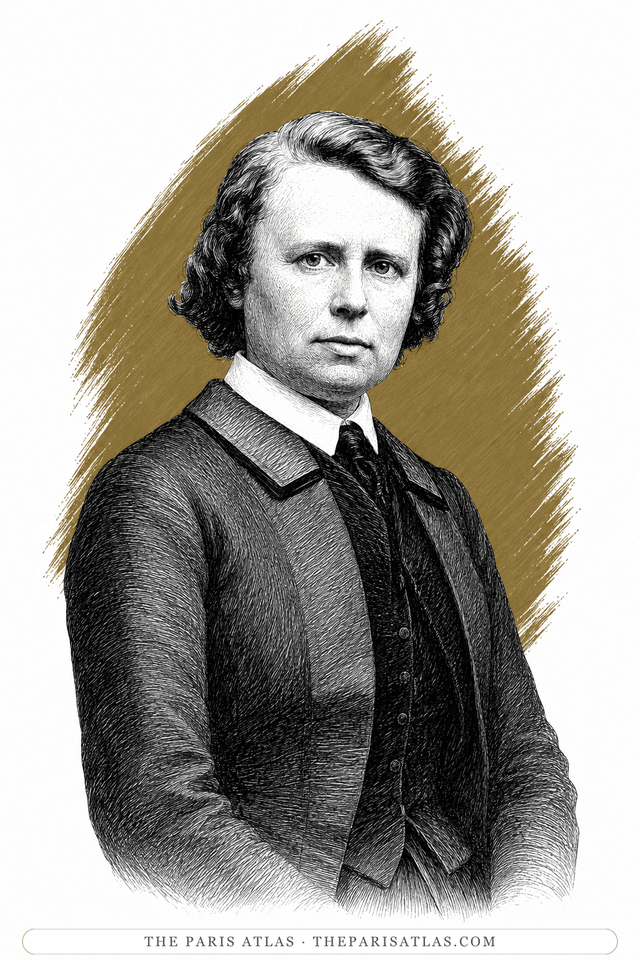
Rosa Bonheur
At the horse markets of Paris and in her studio beside the forest of Fontainebleau, Rosa Bonheur gave animals the presence of great portrait subjects. The success of The Horse Fair helped her build a life shaped by her work, financial independence, and the women she loved.
View artist
References
The sources below include collection records, catalogues, scholarly research, and primary materials that informed this page. They document Femme Maison, its making, and its place in cultural history.

1Louise Bourgeois, Femme Maison, 1947, accession 448.2010
Official recordThe Museum of Modern Art, New YorkUsed forThe holding museum's record: the line block medium, the composition, open and folded sheet sizes, the credit line and the accession date of 9 June 2010.
2The Museum of Modern Art collection dataset
Official recordThe Museum of Modern ArtUsed forThe museum's published collection data, the form in which the catalogue fields were checked while its website was unreachable.

3Louise Bourgeois: The Complete Prints & Books — Chronology
WebsiteThe Museum of Modern Art, New YorkUsed forThe Norlyst Gallery exhibition of 1947, the Bertha Schaefer show of 1945, Atelier 17 from 1946, the Choisy-le-Roi and Antony workshops, and the Femme Maison drawing's reuse on Lucy R. Lippard's 1976 cover.
4A Drama of the Self: Louise Bourgeois as Printmaker
Exhibition catalogueThe Museum of Modern Art, New York, 1994Used forLouise Bourgeois on printmaking as a creative rather than a reproductive medium, quoted here.
5Louise Bourgeois — The Easton Foundation
WebsiteThe Easton Foundation, New YorkUsed forSadie Gordon Richmond in the household from 1922, the 1938 marriage and move to New York, and the early focus on painting and printmaking.
These references provide the documented foundation for this work's history and interpretation. Claim-level citations remain attached to the specific claims they support.
 Explore more resources