Maman
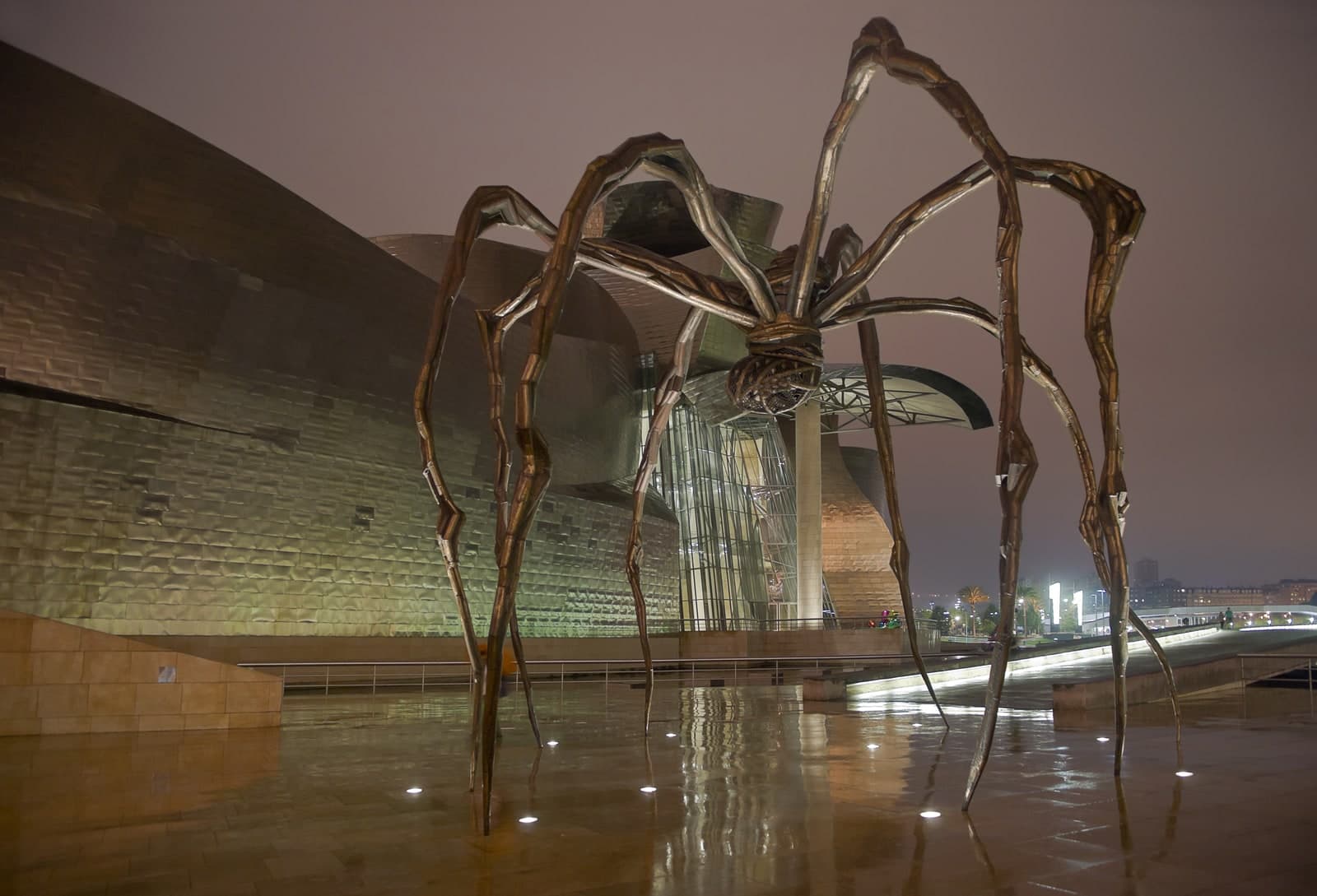
A bronze spider nine metres tall stands on eight thin legs, its body held high enough for a visitor to walk underneath. A wire-mesh sac of marble eggs hangs beneath the abdomen. Louise Bourgeois made the steel original in 1999 for the opening of Tate Modern, and six bronze casts followed. The Guggenheim Museum Bilbao owns cast 2 of 6, made in 2001, and keeps it outdoors beside the footbridge.
- 1999, cast 2001
- Bronze, marble, and stainless steel
- Guggenheim Museum BilbaoBilbao, Spain
About Louise Bourgeois
What the sculpture is made of
Eight legs rise from the ground, bend at a high apex and come down again, holding the body about six metres up. Each leg is ribbed and tapers to a point that touches the paving. The Guggenheim Museum Bilbao gives the materials as bronze, marble and stainless steel, and the size as 927 by 891 by 1023 centimetres.
The body has two parts. A spiralling, ribbed abdomen sits above a collar, and below it hangs a sac of wire mesh with marble eggs inside. Tate, which owns the steel original, counts seventeen white and grey marble eggs in that version and records that the bronze casts have pinker eggs.
Tate also gives the original's weight as about 3,658 kilograms and its size as 9,271 by 8,915 by 10,236 millimetres. Louise Bourgeois built it at a scale that only works outdoors or in an industrial building.
Which cast the Guggenheim Bilbao owns
There is one steel Maman and six bronzes. Louise Bourgeois made the steel version in 1999 for the Turbine Hall at Tate Modern, which opened in May 2000, and presented it to Tate in 2008. It carries the accession number T12625.
The bronze edition came afterwards. The Guggenheim Museum Bilbao's cast is number 2 of 6, with an artist's proof also in the edition, and it was cast in 2001. The museum lists it in its permanent collection under the credit line Guggenheim Bilbao Museoa.
Other casts stand at the National Gallery of Canada in Ottawa, at Roppongi Hills in Tokyo, and elsewhere. Anyone writing or searching for Maman is dealing with several objects, not one, and they are in different countries and different metals.
Louise Bourgeois said the spider was her mother
Maman is French for mummy, the word a child uses. Louise Bourgeois wrote a short text to accompany Ode à ma mère, a suite of nine drypoints published in Paris in 1995 by Éditions du Solstice, and Tate quotes it in its catalogue entry for the sculpture.
“The friend (the spider – why the spider?) because my best friend was my mother and she was deliberate, clever, patient, soothing, reasonable, dainty, subtle, indispensable, neat, and as useful as a spider. She could also defend herself, and me, by refusing to answer ‘stupid’, inquisitive, embarrassing, personal questions. I shall never tire of representing her.”
Joséphine Bourgeois ran the family's tapestry restoration workshop, so the comparison is literal on one side: a weaver who repaired torn things. The sculpture is also nine metres of bronze on spiked feet, and Louise Bourgeois did not ask anyone to choose between the two readings.
The motif goes back much further than the bronzes. Tate traces it to a small ink and charcoal drawing of 1947, and Louise Bourgeois returned to it in drawings of 1994 before the first Spider sculptures of that year.
The workshop the spider comes from
Louise Bourgeois was born in Paris on 25 December 1911 to Louis Bourgeois and Joséphine Fauriaux, who dealt in antique tapestries and restored them. The Museum of Modern Art's chronology places the family at Choisy-le-Roi, outside Paris, from 1912 to 1919, with the restoration workshop behind the house. In 1919 they moved to Antony and set the workshop up there.
From 1923 the child worked in it. The Museum of Modern Art records that she drew the missing elements on the tapestries waiting to be repaired. She was asked to supply, in ink, the parts of a woven picture that had worn away.
The Easton Foundation, which Louise Bourgeois established and which holds her archive, gives the same account and names the workshop as the source of her lifelong subject matter. She left Paris for New York in 1938 and lived there until her death in 2010.
Where the Bilbao cast stands
The Guggenheim Museum Bilbao keeps its Maman outdoors, on the terrace beside the footbridge, and lists it as currently on view. The spider stands on open paving with the museum's titanium cladding behind it and the La Salve bridge overhead.
That siting changes the encounter. A visitor walks under the body and looks up at the egg sac from below, which is the angle Louise Bourgeois designed the piece to be met from.
Nothing of the kind stands permanently in Paris, the city Louise Bourgeois was born in and made spiders about.
Close reading
Reading the work, detail by detail
The Guggenheim Bilbao cast is photographed at night from ground level, close enough that the legs run out of the frame at either side. The whole spider is in view, and so are the museum wall, the wet plaza and the city lights behind it.
1.The body is seen from underneath
The camera is under the sculpture, so the body reads as a coiled, ribbed mass with the eight legs gathered into a collar below it. There is no head and nothing that could be a face. The titanium panels of the museum fill the space behind.
2.The egg sac hangs open at head height
A basket of wire mesh hangs below the abdomen, held in ribs that echo the spiral above. Small nippled bulges stand out of the mesh in clusters. Tate records seventeen marble eggs inside the steel original; at this angle and this resolution the eggs themselves are not separately legible.
3.Each leg peaks well above the body
The legs do not run straight out from the body. Each rises to a sharp apex above it and then turns down, in two ribbed sections joined at the top. The night sky behind them is a flat overcast brown, with no stars and no detail.
4.The far legs come down over the city
On the right of the frame two legs taper as they descend, thinning towards the tips. Behind them the photograph shows a lit riverside walkway, palm trees, apartment blocks and a person walking. The sculpture is outdoors in a working city, not in a gallery.
5.The feet are points on wet paving
Each leg ends in a point that touches the paving without any base or plinth. The stone is wet and reflects the whole spider. Small round uplights are sunk into the ground beside the feet, which is what casts the light up the legs in this photograph.
6.The museum wall closes the left of the frame
Frank Gehry's titanium cladding runs up the left of the photograph in overlapping scales, curving away at the top. The Guggenheim Museum Bilbao sites this cast outdoors beside the footbridge, so its building is always part of the view.
Timeline
1911
Louise Bourgeois is born in Paris on 25 December, to parents who deal in and restore antique tapestries.
1912–1919
The family lives at Choisy-le-Roi outside Paris with the tapestry restoration workshop behind the house, then moves to Antony.
1947
Louise Bourgeois draws a spider in ink and charcoal, the first appearance of the motif in her work.
1994
She installs her first large-scale Spider at the Brooklyn Museum.
1995
Éditions du Solstice publishes Ode à ma mère in Paris, nine drypoints with her text naming the spider as her mother.
1999
She makes Maman in steel and marble for the inaugural installation of the Turbine Hall at Tate Modern.
2000
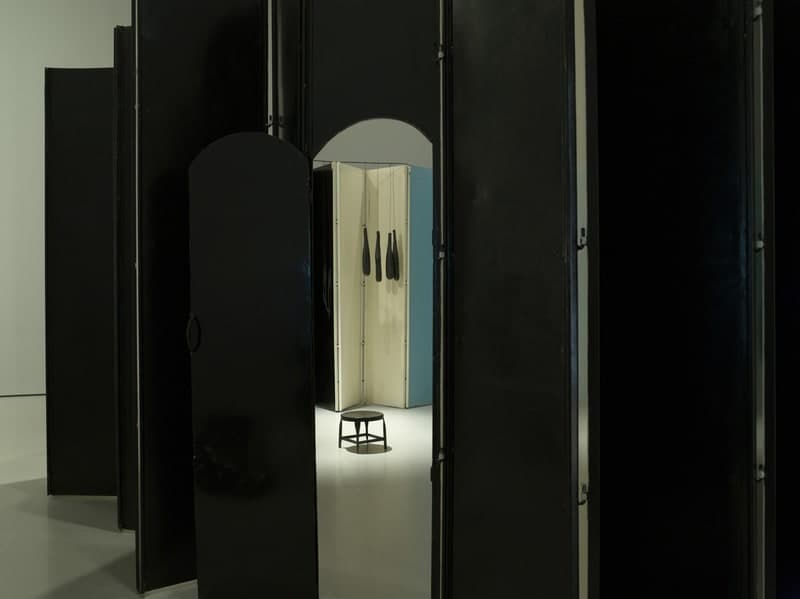
Maman goes on show at Tate Modern's opening in May, on the bridge above her three steel towers I Do, I Undo and I Redo.
2001
The Guggenheim Museum Bilbao's bronze cast, number 2 of an edition of 6, is cast.
2008
Louise Bourgeois presents the steel original to Tate, where it is accessioned as T12625.
Where to see it
Guggenheim Museum Bilbao
Bilbao, Spain
A public viewing address has not yet been confirmed for this holding.
Cast 2 of 6, cast in 2001. Shown outdoors beside the footbridge and listed as on view; the steel original of 1999 belongs to Tate in London and is a different object.
Frequently asked questions
Where is the Maman at the Guggenheim Bilbao, and is it the original?
It stands outdoors beside the footbridge at the Guggenheim Museum Bilbao and is on view in the permanent collection. It is not the original. It is bronze, marble and stainless steel, cast in 2001 as number 2 of an edition of 6. The original is the steel version of 1999, which belongs to Tate in London.
How many Maman sculptures are there?
One steel original and six bronze casts, plus an artist's proof. Tate holds the steel original, accession T12625. The Guggenheim Museum Bilbao holds cast 2 of 6. Others stand at the National Gallery of Canada in Ottawa and at Roppongi Hills in Tokyo, among other places.
How big is Maman?
The Guggenheim Museum Bilbao gives 927 by 891 by 1023 centimetres, so a little over nine metres tall. Tate gives the steel original as 9,271 by 8,915 by 10,236 millimetres and weighs it at about 3,658 kilograms.
Why did Louise Bourgeois call the spider Maman?
Maman is the French word a child uses for mother. Louise Bourgeois said the spider was her own mother, Joséphine Bourgeois, who ran the family's tapestry restoration workshop. In the text she wrote for Ode à ma mère in 1995 she called her mother deliberate, clever, patient and as useful as a spider, and said she would never tire of representing her.
What is inside the sac under Maman's body?
Marble eggs, held in a wire mesh. Tate counts seventeen white and grey marble eggs in the steel original and records that the eggs in the bronze casts are pinker in tone. The sac hangs at head height over anyone standing under the sculpture.
When did Louise Bourgeois make the first Maman?
In 1999, when she was eighty-seven, for the opening of Tate Modern in London the following May. She had first drawn a spider in 1947 and made her first Spider sculptures in 1994.
More by Louise Bourgeois
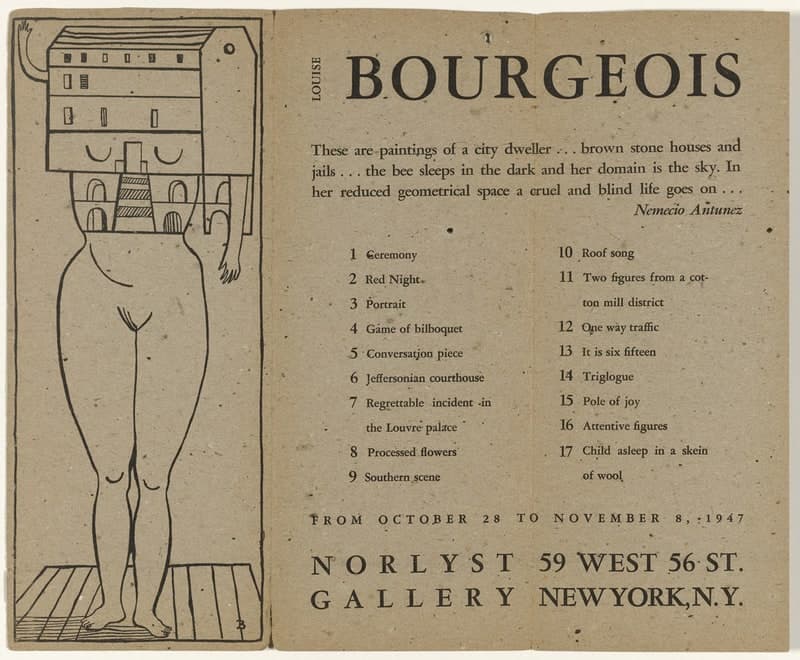
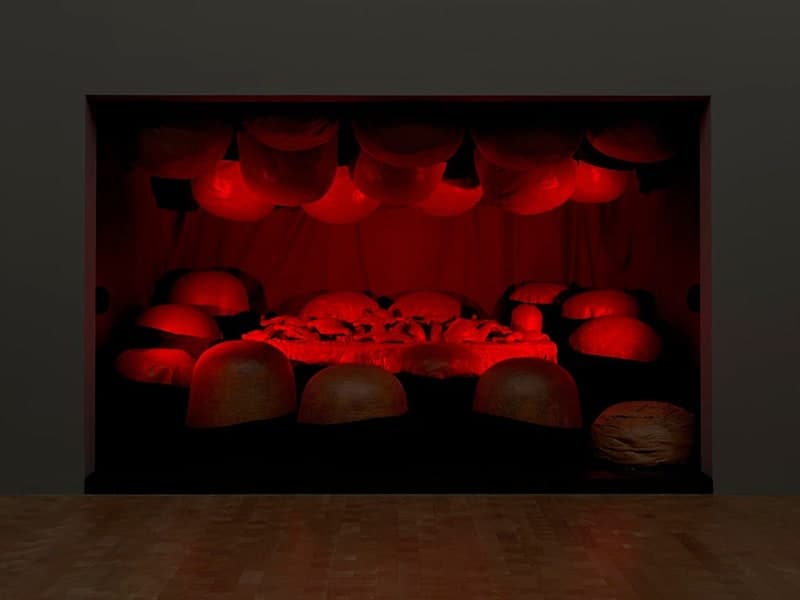
If you like Louise Bourgeois
Explore sculptors from the same movements and circles.
Arman
French-American artist, lifelong friend of Yves Klein, and a founder of New Realism.
View artist
Jean Arp
Strasbourg-born sculptor and poet — Hans in German, Jean in French, both all his life — who co-founded Dada at the Cabaret Voltaire in 1916, composed collages by dropping torn paper 'according to the laws of chance', and settled at Meudon outside Paris in a house his wife Sophie Taeuber-Arp designed.
View artist
Rosa Bonheur
At the horse markets of Paris and in her studio beside the forest of Fontainebleau, Rosa Bonheur gave animals the presence of great portrait subjects. The success of The Horse Fair helped her build a life shaped by her work, financial independence, and the women she loved.
View artist
References
The sources below include collection records, catalogues, scholarly research, and primary materials that informed this page. They document Maman, its making, and its place in cultural history.


1Louise Bourgeois, Maman, 1999 — Guggenheim Museum Bilbao Collection
Official recordGuggenheim Museum BilbaoUsed forThe Bilbao cast: materials, dimensions, cast year 2001, edition 2/6 with an artist's proof, credit line and outdoor siting beside the footbridge.
2Louise Bourgeois, Maman 1999, accession T12625
Official recordTate, LondonUsed forThe steel original: medium, dimensions, weight, the 2008 acquisition, the seventeen marble eggs, the edition of six bronzes, the 1947 drawing, and the text from Ode à ma mère quoted here.

3Louise Bourgeois: The Complete Prints & Books — Chronology
WebsiteThe Museum of Modern Art, New YorkUsed forChoisy-le-Roi from 1912 to 1919 with the workshop behind the house, the move to Antony in 1919, the tapestry drawing from 1923, and the first large Spider at the Brooklyn Museum in 1994.
4Louise Bourgeois — The Easton Foundation
WebsiteThe Easton Foundation, New YorkUsed forThe family tapestry business, the 1938 move to New York, and the Turbine Hall commission of 2000.
These references provide the documented foundation for this work's history and interpretation. Claim-level citations remain attached to the specific claims they support.
 Explore more resources