The Destruction of the Father
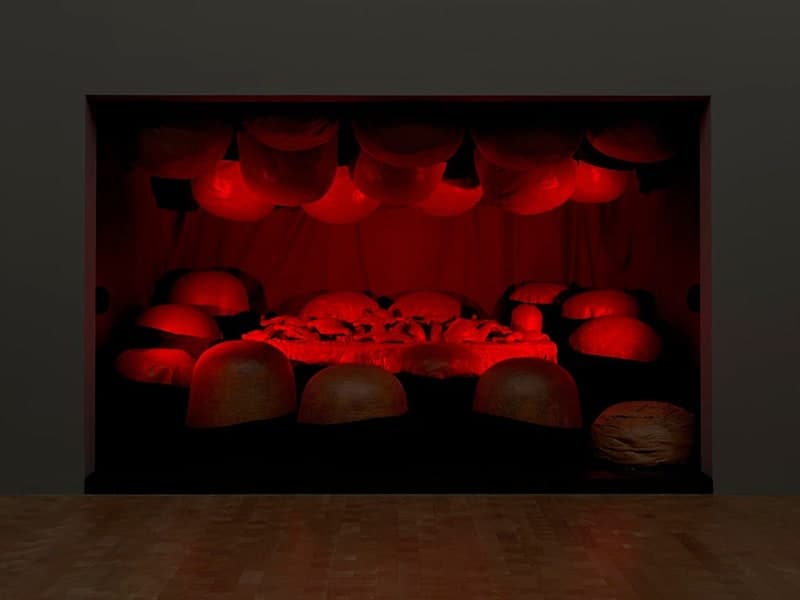
A chamber about 2.4 metres high is packed with soft bulbous forms above and below and lit throughout in red. In the middle is a low table carrying shapes that read as meat. Louise Bourgeois made it in 1974, the year after her husband died, and showed it in New York at 112 Greene Street. Glenstone, in Potomac, Maryland, owns it.
- 1974
- Latex, plaster, wood, fabric, and red light
- Glenstone MuseumPotomac, Maryland, United States
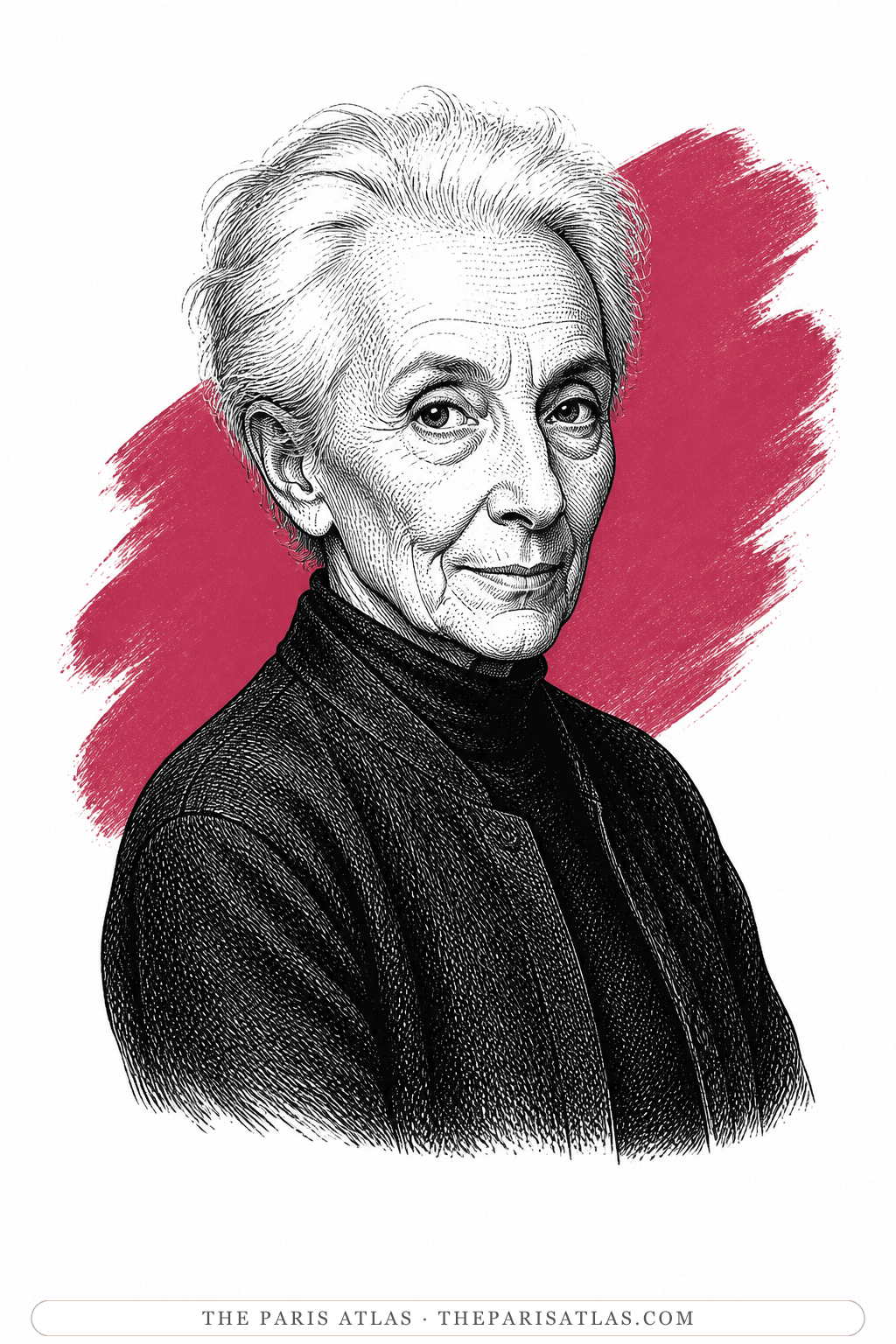
About Louise Bourgeois
What the work shows
The piece is an open-fronted box with a wooden edge, 237.81 by 362.27 by 248.6 centimetres. Glenstone gives the materials as latex, plaster, wood, fabric and red light. The light is listed as a material because the chamber has no other illumination.
Rounded forms hang from the ceiling in a close row, each about the size of a human head and lit red from below. A matching row sits on the floor across the front, and those are lit less, so they read as dull brown domes rather than red ones. Fabric hangs at the back in loose folds.
A low platform runs across the centre. On it lies a heap of small shapes with the texture of cast flesh, brightly lit and indistinct. One pale lump sits apart at the right, out of the red light and the colour of unpainted plaster.
The account Louise Bourgeois gave of it
Louise Bourgeois described the work as a scene at a dinner table. In her account the father talks and talks about himself, the family listens, and eventually the children pull him onto the table, take him apart and eat him. Robert Storr sets out the same account in his 2016 book on her life and work.
The subject was her own father. Louis Bourgeois kept the family's English tutor, Sadie Gordon Richmond, as his mistress inside the household for about a decade, and The Museum of Modern Art's chronology dates her presence there from 1922 to 1932. Louise Bourgeois treated that arrangement as the central fact of her childhood for the rest of her life.
She was sixty-two when she made it, and she had been in analysis since 1952. She had said very little of this in public before.
1974: the year after Robert Goldwater died
Louise Bourgeois married the American art historian Robert Goldwater in 1938 and moved with him to New York. He died in March 1973.
The Museum of Modern Art's chronology records that she showed The Destruction of the Father the following year, in an exhibition called Louise Bourgeois: Sculpture 1970–1974, at the artists' space in SoHo that everyone called 112 Greene Street. The chronology prints the address as 112 Green Street; the Easton Foundation prints it as 112 Greene Street.
That exhibition is the point her reputation turns on. Wide recognition still took another eight years, until The Museum of Modern Art gave her a retrospective in 1982, curated by Deborah Wye, the museum's first for a woman artist.
The forms went on into the later work
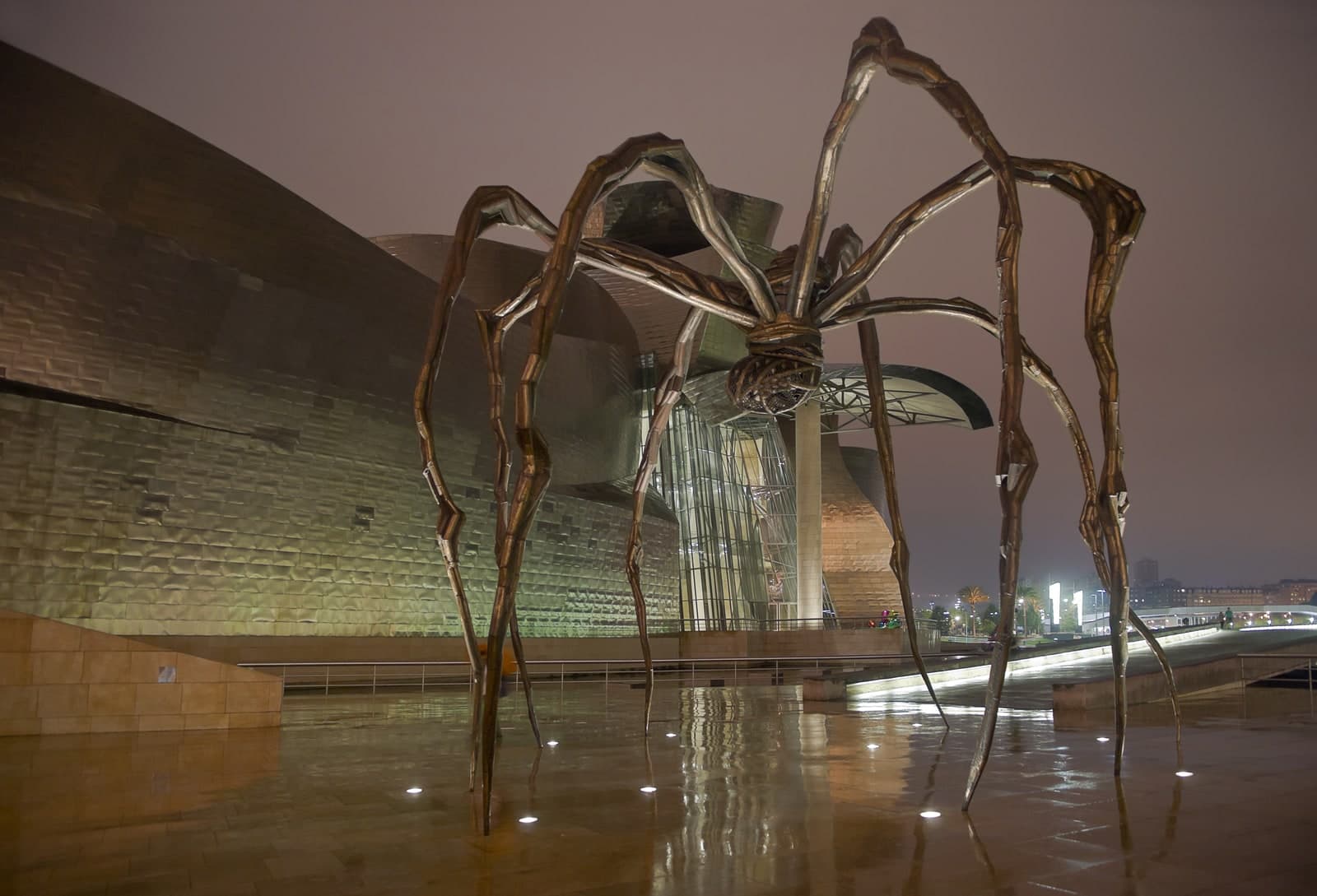
The clustered soft bulges in the ceiling and floor of the chamber are the same shapes Louise Bourgeois had been making in plaster and latex since the mid-1960s. Tate, describing Maman, traces those breast-like bulges from Avenza of 1968–69 through The Destruction of the Father and into the wire mesh of the spider's egg sac thirty years later.
The enclosure is the other inheritance. A room the viewer looks into rather than enters is the format she would build about sixty times from the late 1980s onward, in the works she called Cells.
Glenstone showed the work in Louise Bourgeois: To Unravel a Torment from 10 May 2018 to 30 June 2019, with nearly thirty pieces from its own collection. The exhibition then travelled to Museum Voorlinden in the Netherlands.
Close reading
Reading the work, detail by detail
The chamber is photographed square on from the front, in a darkened gallery, with the grey wall and the parquet floor visible around it. Everything inside is lit by the work's own red light, so the photograph records that light rather than correcting it.
1.The ceiling is packed with hanging forms
A close row of rounded forms hangs from the ceiling, each roughly the size of a head, with a lit rim underneath and shadow above. They are cast in latex and plaster over the whole width. Nothing above them is visible from this angle.
2.The table carries a heap of shapes
A low platform crosses the middle of the chamber and is the brightest thing in the photograph. On it lies a heap of small shapes with the texture of cast flesh, none of them separately readable. Louise Bourgeois described the work as a dinner table.
3.The front row is left in shadow
Along the front of the floor sits a second row of domes, larger than those on the ceiling. They fall outside the red light and read as dull brown. They also block the lower half of the interior from the viewer's eye.
4.One pale form sits apart at the right
At the lower right a single form sits on its own, wrinkled and the colour of unpainted plaster. No red falls on it. It is the only element in the photograph that shows its material plainly.
5.Fabric hangs behind everything
The back of the chamber is hung with fabric in loose vertical folds. Glenstone lists fabric among the materials, with latex, plaster, wood and red light. The folds catch the red and give the space its only sense of depth.
6.The work is a box in a gallery wall
At the left of the photograph the chamber stops at a plain wooden edge and the gallery wall takes over, unlit and grey. The parquet floor runs along the bottom of the frame. The piece is a fixed open-fronted box, not a room to walk into.
Timeline
1922
Sadie Gordon Richmond joins the Bourgeois household in Paris as the children's English tutor, and becomes Louis Bourgeois's mistress; she stays until 1932.
1938
Louise Bourgeois marries Robert Goldwater and moves from Paris to New York.
1952
She begins psychoanalysis, and continues intensively until 1966.
1964
She shows organically shaped plaster sculptures at the Stable Gallery in New York, and introduces the lair as a form.
1973
Robert Goldwater dies in March.
1974
The Destruction of the Father is shown in Louise Bourgeois: Sculpture 1970–1974 at 112 Greene Street in New York.
1982
The Museum of Modern Art gives Louise Bourgeois a retrospective curated by Deborah Wye, its first for a woman artist.
2018–2019
Glenstone shows the work in Louise Bourgeois: To Unravel a Torment, which then travels to Museum Voorlinden.
Where to see it
Glenstone Museum
Potomac, Maryland, United States
A public viewing address has not yet been confirmed for this holding.
Glenstone shows its collection in rotation and admission is free but timed. Check the museum's record before travelling.
Frequently asked questions
Where can you see The Destruction of the Father?
At Glenstone, 12100 Glen Road, Potomac, Maryland, which owns it. Admission is free and timed. Glenstone rotates its collection, so the work is not always installed; its online record is the place to check before travelling.
What is The Destruction of the Father made of?
Latex, plaster, wood, fabric and red light, at 237.81 by 362.27 by 248.6 centimetres. Glenstone lists the red light as one of the materials, because the chamber has no other light in it.
What is The Destruction of the Father about?
Louise Bourgeois described it as a dinner table. In her own account the father talks about himself at length, and the children finally drag him onto the table, dismember him and eat him. Her father, Louis Bourgeois, had kept the family's English tutor as his mistress in the house through her childhood.
When did Louise Bourgeois make The Destruction of the Father?
In 1974, at sixty-two, the year after her husband the art historian Robert Goldwater died in March 1973. It was shown that year in Louise Bourgeois: Sculpture 1970–1974 at 112 Greene Street in New York.
Is The Destruction of the Father a sculpture or an installation?
Both terms are used. The Museum of Modern Art's chronology calls it a room-sized installation piece; Glenstone catalogues it with materials and dimensions like any other sculpture. It is a single fixed chamber rather than a set of parts arranged differently each time.
How does The Destruction of the Father connect to the spiders?
Through the bulges. The soft clustered forms packed into its ceiling and floor run from Avenza of 1968–69 through this work and into the wire-mesh egg sac of Maman in 1999, a line Tate sets out in its catalogue entry for the spider.
More by Louise Bourgeois
If you like Louise Bourgeois
Explore sculptors from the same movements and circles.
Arman
French-American artist, lifelong friend of Yves Klein, and a founder of New Realism.
View artist
Jean Arp
Strasbourg-born sculptor and poet — Hans in German, Jean in French, both all his life — who co-founded Dada at the Cabaret Voltaire in 1916, composed collages by dropping torn paper 'according to the laws of chance', and settled at Meudon outside Paris in a house his wife Sophie Taeuber-Arp designed.
View artist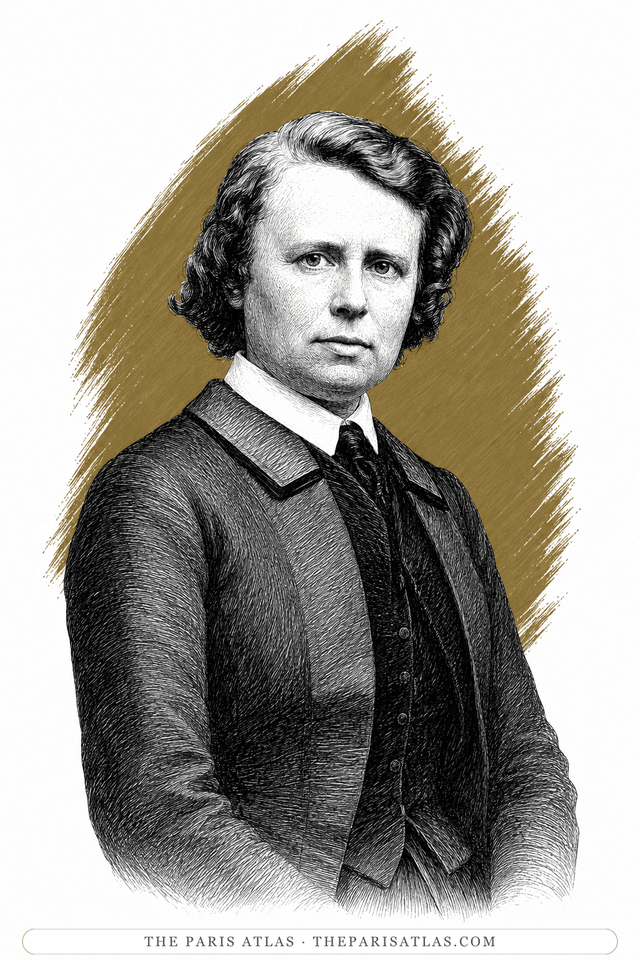
Rosa Bonheur
At the horse markets of Paris and in her studio beside the forest of Fontainebleau, Rosa Bonheur gave animals the presence of great portrait subjects. The success of The Horse Fair helped her build a life shaped by her work, financial independence, and the women she loved.
View artist
References
The sources below include collection records, catalogues, scholarly research, and primary materials that informed this page. They document The Destruction of the Father, its making, and its place in cultural history.

1Louise Bourgeois, The Destruction of the Father, 1974 — collection record
Official recordGlenstone Museum, Potomac, MarylandUsed forThe holding museum's record: materials including the red light, dimensions, the photographer Ron Amstutz and the printed rights line.

2Louise Bourgeois: The Complete Prints & Books — Chronology
WebsiteThe Museum of Modern Art, New YorkUsed forThe 1974 exhibition Louise Bourgeois: Sculpture 1970–1974 and its address, the death of Robert Goldwater in 1973, the years of psychoanalysis, the 1964 Stable Gallery show and the 1982 retrospective.
3Louise Bourgeois — The Easton Foundation
WebsiteThe Easton Foundation, New YorkUsed forSadie Gordon Richmond in the household, the first showing at 112 Greene Street, and the 1974 date.
4Intimate Geometries: The Art and Life of Louise Bourgeois
BiographyThe Monacelli Press, 2016Used forLouise Bourgeois's own account of the work as a dinner-table scene in which the children eat the father.
5Louise Bourgeois, Maman 1999, accession T12625
Official recordTate, LondonUsed forThe line of clustered bulges from Avenza (1968–69) through this work to the egg sac of Maman.
6Louise Bourgeois — artist record and collection list
WebsiteGlenstone Museum, Potomac, MarylandUsed forGlenstone's Bourgeois holdings and the 2018–19 exhibition Louise Bourgeois: To Unravel a Torment.
These references provide the documented foundation for this work's history and interpretation. Claim-level citations remain attached to the specific claims they support.
 Explore more resources