Cell (Choisy)
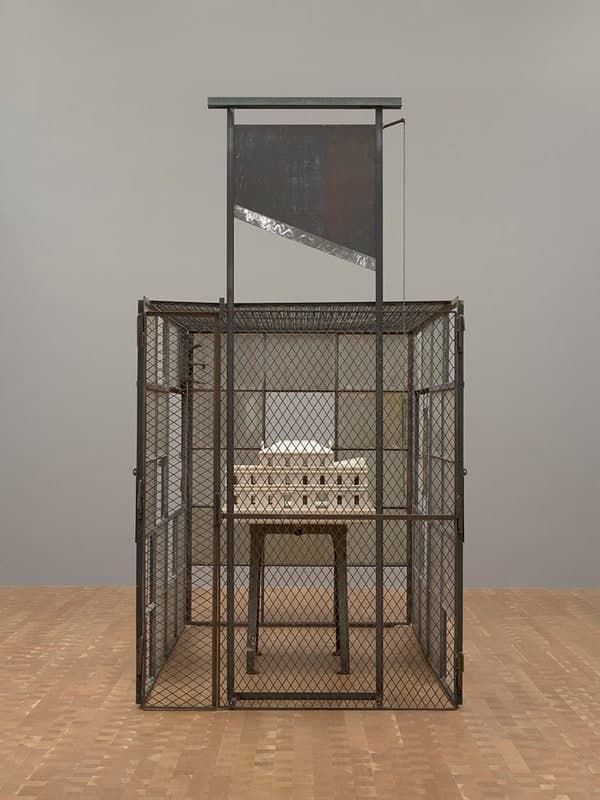
A cage of wire mesh stands about three metres high with a model of a house carved in marble on a table inside it. A guillotine is mounted on a frame directly above, its blade set diagonally and a chain hanging beside it. Louise Bourgeois made the work between 1990 and 1993 and titled it for Choisy-le-Roi, the town outside Paris where her family lived and restored tapestries. Glenstone, in Potomac, Maryland, owns it.
- 1990–1993
- Marble, metal and glass
- Glenstone MuseumPotomac, Maryland, United States
About Louise Bourgeois
What the work is made of
Glenstone gives the materials as marble, metal and glass, and the size as 306.07 by 170.18 by 241.3 centimetres. The cage is the metal: a rectangular enclosure of diamond mesh in a welded frame, with a mesh ceiling and a hinged door on one side that carries a heavy latch.
Inside, a plain table stands on the floor of the cage and a long marble house sits on it. The house has a pitched roof, a raised central block, and three ranks of small rectangular window openings cut into the stone. A pale glass panel closes part of the back wall.
Above the cage, and outside it, a separate steel frame holds an upright dark panel with a bright angled blade set across it and a chain running down one post. That is the guillotine, and it is aimed at the house.
One of the Cells
Louise Bourgeois built around sixty enclosures she called Cells. Tate dates the start of the series to 1989; the Easton Foundation and The Museum of Modern Art both date the first public showing to the Carnegie International in Pittsburgh in 1991, where she presented six of them together. Cell (Choisy) straddles that, dated 1990 to 1993.
The word carries two meanings and Louise Bourgeois used both. A cell is a room a person is locked in, and a cell is the smallest unit a living body is built from. The enclosures are usually made from salvaged doors, windows, mesh and steel, and a viewer can see in but generally cannot go in.
“The subject of pain is the business I am in. To give meaning and shape to frustration and suffering … The Cells represent different types of pain: the physical, the emotional and psychological, and the mental and intellectual.”
What Choisy-le-Roi was
Choisy-le-Roi is a town on the Seine just south-east of Paris. The Museum of Modern Art's chronology places the Bourgeois family there from 1912 to 1919, with the tapestry restoration workshop behind the house, while they kept a tapestry gallery in Paris itself. The family moved to Antony in 1919 and set the workshop up there.
Louise Bourgeois was a small child in the Choisy years. From 1923, at Antony, she was put to work drawing the missing elements on the damaged tapestries before they were rewoven.
The marble here is cold, hard and permanent, which is the opposite of the material the family worked in. A tapestry is wool and thread, and it wears away; that was the whole basis of the business.
The guillotine over the house
The blade is not hidden and not ambiguous. It hangs on its own frame directly above the marble house, angled across a dark panel, with the chain that would drop it running down one upright.
Nothing in the arrangement lets the house out. The mesh walls enclose it, the mesh ceiling closes the top, and the blade sits above the ceiling. A viewer standing outside can see all three at once, which is how Louise Bourgeois built the Cells to be read.
Glenstone shows the work under the rights line of the Easton Foundation and credits the photograph to Ron Amstutz.
Close reading
Reading the work, detail by detail
The cage is photographed square on, centred, in an empty gallery, with the grey wall behind it and a pale parquet floor beneath. The whole work is in frame, including the guillotine frame that stands above and outside the cage.
1.A guillotine stands above the cage
Above the mesh ceiling, on its own two posts, stands an upright panel of dark rusted steel. A bright silver blade is set diagonally across it, and a thin chain runs down the right post. The blade is directly over the house inside.
2.The house inside is carved in marble
Seen through the diamond mesh, the house is long and low with a pitched roof and a raised central block. Three ranks of small rectangular openings are cut into the white marble for windows. The stone reads as pale and unpolished in this light.
3.The cage has a door that is shut
The left front corner carries a hinged door in the same mesh, held by a heavy latch with a vertical pin above it. It is closed in this photograph. Louise Bourgeois built the Cells to be looked into rather than entered.
4.The house stands on a plain table
The marble sits on an ordinary four-legged table with a plain top and no decoration. A small dark object hangs under the centre of the tabletop. Behind the table a pale panel closes part of the back wall.
5.The mesh continues across the top
The enclosure is closed above as well as around. Diamond mesh runs flat across the ceiling between welded rails, so the cage has six sides. The guillotine frame passes through and above that ceiling without touching it.
6.The gallery is left visible
The photograph keeps the room in the picture. A pale parquet floor of small end-grain blocks runs to the bottom edge, and a plain grey wall rises behind. Nothing else stands in the room, so the cage carries its own scale.
Timeline
1912–1919
The Bourgeois family lives at Choisy-le-Roi outside Paris, with the tapestry restoration workshop behind the house and a gallery in the city.
1919
The family moves to Antony and sets the restoration workshop up there.
1923
Louise Bourgeois begins drawing the missing elements on the tapestries waiting to be repaired.
1989
Tate dates the beginning of the Cells to this year.
1990–1993
Cell (Choisy) is made.
1991
Louise Bourgeois shows six Cells at the Carnegie International in Pittsburgh, the first public showing of the series.
1992
She exhibits the Cell Precious Liquids at Documenta IX in Kassel.
Where to see it
Glenstone Museum
Potomac, Maryland, United States
A public viewing address has not yet been confirmed for this holding.
Glenstone shows its collection in rotation and admission is free but timed. Check the museum's record before travelling.
Frequently asked questions
What is Cell (Choisy) made of?
Marble, metal and glass, at 306.07 by 170.18 by 241.3 centimetres. The metal is a wire-mesh cage with a hinged door and a separate frame above it holding a guillotine; the marble is a model of a house standing on a table inside; glass closes part of the back wall.
What does Choisy in the title refer to?
Choisy-le-Roi, a town on the Seine just outside Paris. The Museum of Modern Art's chronology places the Bourgeois family there from 1912 to 1919, with their tapestry restoration workshop behind the house. Louise Bourgeois was born in Paris in 1911, so those were her first years.
Where can you see Cell (Choisy)?
At Glenstone, 12100 Glen Road, Potomac, Maryland, which owns it. Admission is free and timed, and the museum rotates its collection, so check its record before travelling.
How many Cells did Louise Bourgeois make?
Around sixty, over roughly seventeen years. Tate dates the start of the series to 1989 and The Museum of Modern Art dates the first public showing to the Carnegie International in Pittsburgh in 1991, where she presented six at once.
Why are they called Cells?
Because the word means both things she wanted. A cell is a room a person is shut into, and a cell is the smallest unit a living body is made of. Louise Bourgeois said the Cells represent different kinds of pain — physical, emotional and psychological, mental and intellectual.
Can you go inside Cell (Choisy)?
No. The cage has a door, but the Cells are made to be looked into rather than entered, and museums show them closed. The whole work is legible from outside: the house, the mesh around it and the blade above it are all visible at once.
More by Louise Bourgeois
If you like Louise Bourgeois
Explore sculptors from the same movements and circles.
Arman
French-American artist, lifelong friend of Yves Klein, and a founder of New Realism.
View artist
Jean Arp
Strasbourg-born sculptor and poet — Hans in German, Jean in French, both all his life — who co-founded Dada at the Cabaret Voltaire in 1916, composed collages by dropping torn paper 'according to the laws of chance', and settled at Meudon outside Paris in a house his wife Sophie Taeuber-Arp designed.
View artist
Rosa Bonheur
At the horse markets of Paris and in her studio beside the forest of Fontainebleau, Rosa Bonheur gave animals the presence of great portrait subjects. The success of The Horse Fair helped her build a life shaped by her work, financial independence, and the women she loved.
View artist
References
The sources below include collection records, catalogues, scholarly research, and primary materials that informed this page. They document Cell (Choisy), its making, and its place in cultural history.


1Louise Bourgeois, Cell (Choisy), 1990–1993 — collection record
Official recordGlenstone Museum, Potomac, MarylandUsed forThe holding museum's record: materials, dimensions, the 1990–1993 date, the photographer Ron Amstutz and the printed rights line.

2Louise Bourgeois: The Complete Prints & Books — Chronology
WebsiteThe Museum of Modern Art, New YorkUsed forChoisy-le-Roi from 1912 to 1919 with the workshop behind the house, the move to Antony, the tapestry drawing from 1923, the six Cells at the 1991 Carnegie International and Precious Liquids at Documenta IX.
3Louise Bourgeois, Cell (Eyes and Mirrors) 1989–93, accession T06899
Official recordTate, LondonUsed forTate's account of the Cells, their salvaged materials, the 1989 start date, and the passage quoted here in which Louise Bourgeois names the kinds of pain they hold.
4Louise Bourgeois — The Easton Foundation
WebsiteThe Easton Foundation, New YorkUsed forThe first showing of the Cells in 1991 and the family tapestry business.
5Louise Bourgeois — artist record and collection list
WebsiteGlenstone Museum, Potomac, MarylandUsed forGlenstone's Bourgeois holdings, which include Cell I and Cell III of 1991 alongside this work.
These references provide the documented foundation for this work's history and interpretation. Claim-level citations remain attached to the specific claims they support.
 Explore more resources