Blue Dancers
by Edgar Degas
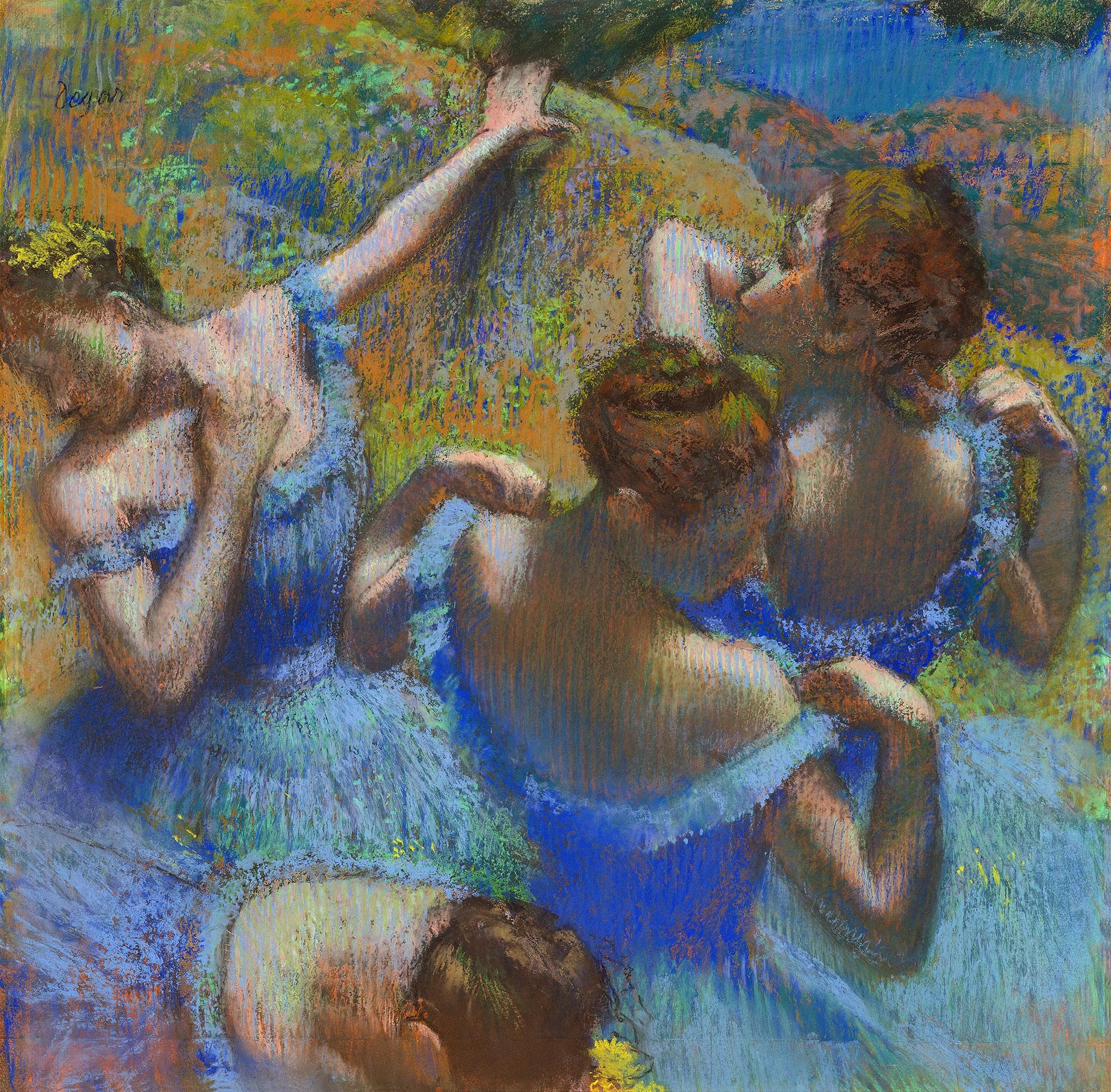
Four dancers in blue costumes fill a square sheet, pulling at shoulder straps and looking down at their shoes in the wings of a theater. The Pushkin State Museum of Fine Arts in Moscow, which has owned it since 1948, suggests the four figures may be one dancer drawn in four successive movements. Edgar Degas made it in pastel around 1898.
- circa 1898
- Pastel on paper
- Pushkin State Museum of Fine ArtsMoscow, Russia
About Edgar Degas
What the pastel shows
Four dancers in pale blue bodices and skirts are packed into a square sheet with almost no space between them. One at the upper left reaches across to her shoulder strap with one hand and throws the other arm straight up. One at the right pulls at her own strap with her head turned away. A third bends forward at the center and a fourth is cut off at the bottom edge, seen from above as a head and shoulders.
Nothing here is a performance. They are adjusting costumes, checking a shoe, waiting. Behind them is a mass of orange, green and yellow that reads as painted scenery rather than as a room, and there is no floor, no horizon and no stage edge to stand on.
The pastel is laid on in short strokes running in different directions. The Pushkin State Museum of Fine Arts describes them as merging into streams of blue shadow in the costumes and scattering as reflected light in the dancers' hair.
One dancer, or four?
The Pushkin Museum's own catalogue entry proposes that the sheet may show a single dancer four times over: tying her shoe, adjusting her dress, checking her costume, standing in the wings. On that reading the four figures are four moments rather than four people.
That is the museum's suggestion, not a documented fact about how Degas worked on this particular sheet. It fits what he was doing in these years. Harvard Art Museums records that for a charcoal and pastel study of dancers dated 1899, Degas took a counterproof of the drawing and also traced it to make a second version with small changes. That sheet, the museum adds, belongs to a group in which the same figures are rearranged, isolated and repeated.
How Degas worked in pastel
From the 1880s Degas used pastel more than oil, and he built the late sheets in layers rather than mixing colors before they reached the paper. The Museo Nacional Thyssen-Bornemisza's technical study of one of his pastels found rapid strokes whose soft effects come from colors sitting side by side rather than being blended together.
Fixing each layer was what made the method possible. The Thyssen study records that Degas worked with the painter and chemist Luigi Chialiva, who devised a fixative that held one layer in place while the next went on and left the surface matte rather than glossy.
The art historian Kathryn Brown has shown how far the physical construction went in the late work. Degas drew on smooth tracing paper and used fixative to build up density. He enlarged compositions by pinning sheets together, mounting them on card, and carrying figures across the joins.
How it reached Moscow
The pastel belonged to Sergei Shchukin, the Moscow textile merchant who assembled one of the largest collections of modern French painting in Europe before 1918. He hung it in the large drawing room of his house.
The painter Maurice Denis saw it there when he visited Moscow in 1909, and the Pushkin Museum quotes his reaction.
“There is a most superb, resonant and new blue Degas in the large drawing room.”
Shchukin's collection was nationalized after 1918 and went into the State Museum of New Western Art. That museum was closed in 1948 and its holdings split between Moscow and Leningrad. Blue Dancers has been at the Pushkin State Museum of Fine Arts since then, with the inventory number Zh-3273.
Not the painting in Paris
There is a second Degas called Danseuses bleues, and the two are often mixed up. The Paris one is an oil on canvas of about 1890, 85 by 75.5 centimeters, at the Musée d'Orsay with the inventory number RF 1951 10. It shows dancers in the wings with figures in yellow costumes behind them, almost merging into the scenery.
The French Ministry of Culture's Joconde record traces that canvas from the first Degas studio sale of 1918 to a Paris collector named Danthon, and then to Dr. Albert Charpentier and his wife, who gave it to the national museums in 1951. In English it is usually called Dancers in Blue, which is the safest way to keep the two apart.
Close reading
Reading the work, detail by detail
Four figures fill a square sheet with no floor under them and no stage in front of them. The details follow each dancer and the scenery behind, and ask the question the Pushkin State Museum of Fine Arts raises: whether this is four women or one woman four times.
1.The dancer at the upper left reaches across
Her arm comes across her chest toward the opposite shoulder, a gesture for fixing a strap rather than for dancing. The Pushkin State Museum of Fine Arts reads the whole sheet as a sequence of these small offstage adjustments.
2.One bare arm rises to the top edge
The arm belongs to the dancer at the upper left, whose other hand is at her shoulder strap. It runs up out of the group with the hand bent back at the wrist, and the fingers stop just inside the top edge of the paper rather than being cut by it.
3.The dancer at the right pulls at her strap
Her head is turned so far that the face is almost lost, and her hand is at the shoulder of the bodice. Degas gives her hair the same broken color as the scenery, so figure and background share a surface.
4.The central dancer bends away from the viewer
She is seen from behind and above, bending toward her own costume. The Pushkin Museum describes the pastel strokes here as scattering into reflected light in the dancer's hair.
5.A fourth dancer is cut off at the bottom
Only a head and a shoulder reach the bottom edge, seen from above. If the four figures are one dancer in four moments, as the Pushkin Museum suggests, this is the moment closest to the floor.
6.Orange and green stand in for scenery
Nothing behind the dancers resolves into a set, a wall or a floor. The orange sits against the blue of the costumes, and that contrast is what separates the figures from the background.
Timeline
circa 1898
Degas makes the pastel on a square sheet of paper, 65 by 65 centimeters.
1909
Maurice Denis sees it in Sergei Shchukin's house in Moscow and writes about the blue.
1918
Shchukin's collection is nationalized and later absorbed into the State Museum of New Western Art.
1948
The State Museum of New Western Art is dissolved and the pastel passes to the Pushkin State Museum of Fine Arts, inventory Zh-3273.
Where to see it
Pushkin State Museum of Fine Arts
Moscow, Russia
A public viewing address has not yet been confirmed for this holding.
Frequently asked questions
Where is Degas's Blue Dancers?
At the Pushkin State Museum of Fine Arts in Moscow, inventory number Zh-3273. It is pastel on paper, 65 by 65 centimeters, and the museum dates it to about 1898. It has been there since 1948.
Is Blue Dancers a painting or a pastel?
A pastel on paper. The Pushkin Museum states this plainly, and its entry for a different Degas in the same collection, Dancer Posing for a Photographer, describes that one as the museum's only Degas oil painting.
How many dancers are in Blue Dancers?
Four figures are visible, but the Pushkin Museum suggests they may be one dancer drawn four times over, tying a shoe, adjusting her dress, checking her costume and standing in the wings. Degas was tracing and repeating single figures across sheets in exactly these years.
Are the dancers performing in Blue Dancers?
No. They are backstage, pulling at shoulder straps and looking down at their costumes. The Pushkin Museum notes that Degas was drawn to the offstage routine rather than to the spectacle of the ballet itself.
Is Blue Dancers the same as the Danseuses bleues in Paris?
No, and the two are easy to confuse. The Musée d'Orsay holds a separate oil on canvas called Danseuses bleues, about 1890, 85 by 75.5 centimeters, inventory RF 1951 10, usually given in English as Dancers in Blue. It came to the French state in 1951 as a gift from Dr. Albert Charpentier and his wife.
How did Blue Dancers get to Russia?
Through Sergei Shchukin, the Moscow merchant who bought modern French painting on a large scale before 1918. Maurice Denis saw the pastel hanging in Shchukin's drawing room in 1909. The collection was nationalized, went to the State Museum of New Western Art, and was divided up when that museum closed in 1948.
More by Edgar Degas
If you like Edgar Degas
Explore painters from the same movements and circles.
Gustave Caillebotte
Painter of Haussmann's geometry and the group's organizer-financier; his bequest of Impressionist paintings forced the French state to take the movement in.
View artist
Mary Cassatt
Mary Cassatt was an American painter and printmaker known for her depictions of women and children. Based in France for the last fifty-two years of her life, she was the only American to exhibit with the original French Impressionist group, participating in four of its eight exhibitions. Edgar Degas invited her to exhibit with the group in 1877 after the Salon jury rejected her submissions.
View artist
Paul Cézanne
Painter between Impressionism and everything after — shown in the independents' exhibitions, emulated by the Cubists, and present at the Orangerie through 15 works in the Walter-Guillaume collection.
View artist
References
The sources below include collection records, catalogues, scholarly research, and primary materials that informed this page. They document Blue Dancers, its making, and its place in cultural history.


1Edgar Degas, Blue Dancers, circa 1898, inventory Zh-3273
WebsitePushkin State Museum of Fine Arts, MoscowUsed forWeb source consulted for documented facts and historical context presented on the Blue Dancers page.

2Joconde notice 000PE003807: Danseuses bleues, Edgar Degas, RF 1951 10
Official recordMinistère de la Culture, Plateforme ouverte du patrimoineUsed forOfficial record used to verify names, dates, institutional details, or other factual information on this page.
3Edgar Degas, Dancers, Nude Study (1899), accession 2002.303
WebsiteHarvard Art MuseumsUsed forWeb source consulted for documented facts and historical context presented on the Blue Dancers page.
4Degas in Pieces: Form and Fragment in the Late Bather Pastels
PeriodicalNineteenth-Century Art Worldwide, 2018Used forContemporary reporting or criticism used to document the historical reception and context of Blue Dancers.
5Edgar Degas, At the Milliner's: technical study of a pastel
WebsiteMuseo Nacional Thyssen-BornemiszaUsed forWeb source consulted for documented facts and historical context presented on the Blue Dancers page.
6Danseuses bleues, MS 1227, in the Degas catalogue raisonné
Official recordFondation Wildenstein Plattner Jr.Used forOfficial record used to verify names, dates, institutional details, or other factual information on this page.
7Degas et la vie quotidienne des danseuses de l'Opéra
WebsiteL'Histoire par l'image, Ministère de la Culture, 2009Used forWeb source consulted for documented facts and historical context presented on the Blue Dancers page.
These references provide the documented foundation for this work's history and interpretation. Claim-level citations remain attached to the specific claims they support.
 Explore more resources