The Dance Class
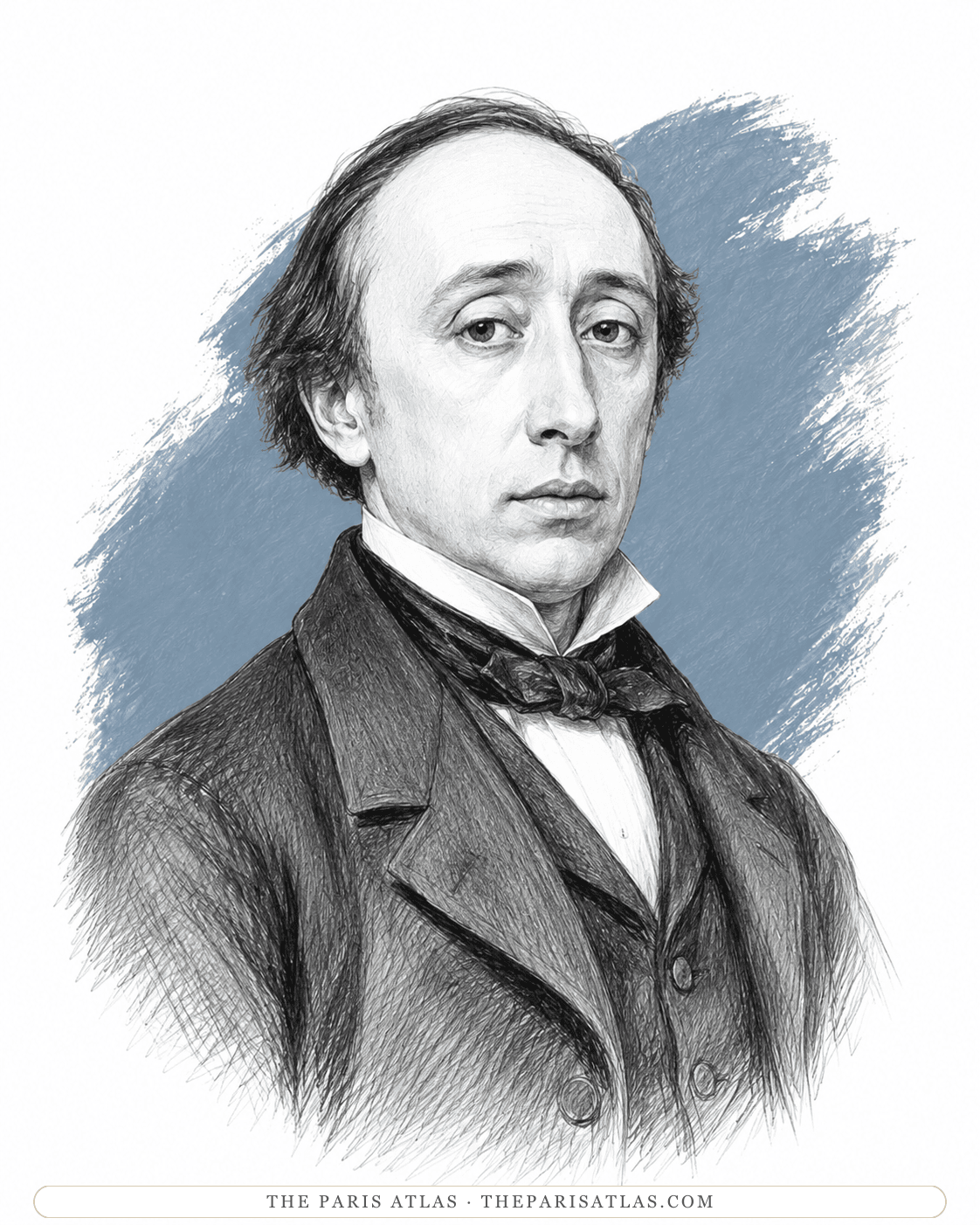
by Edgar Degas
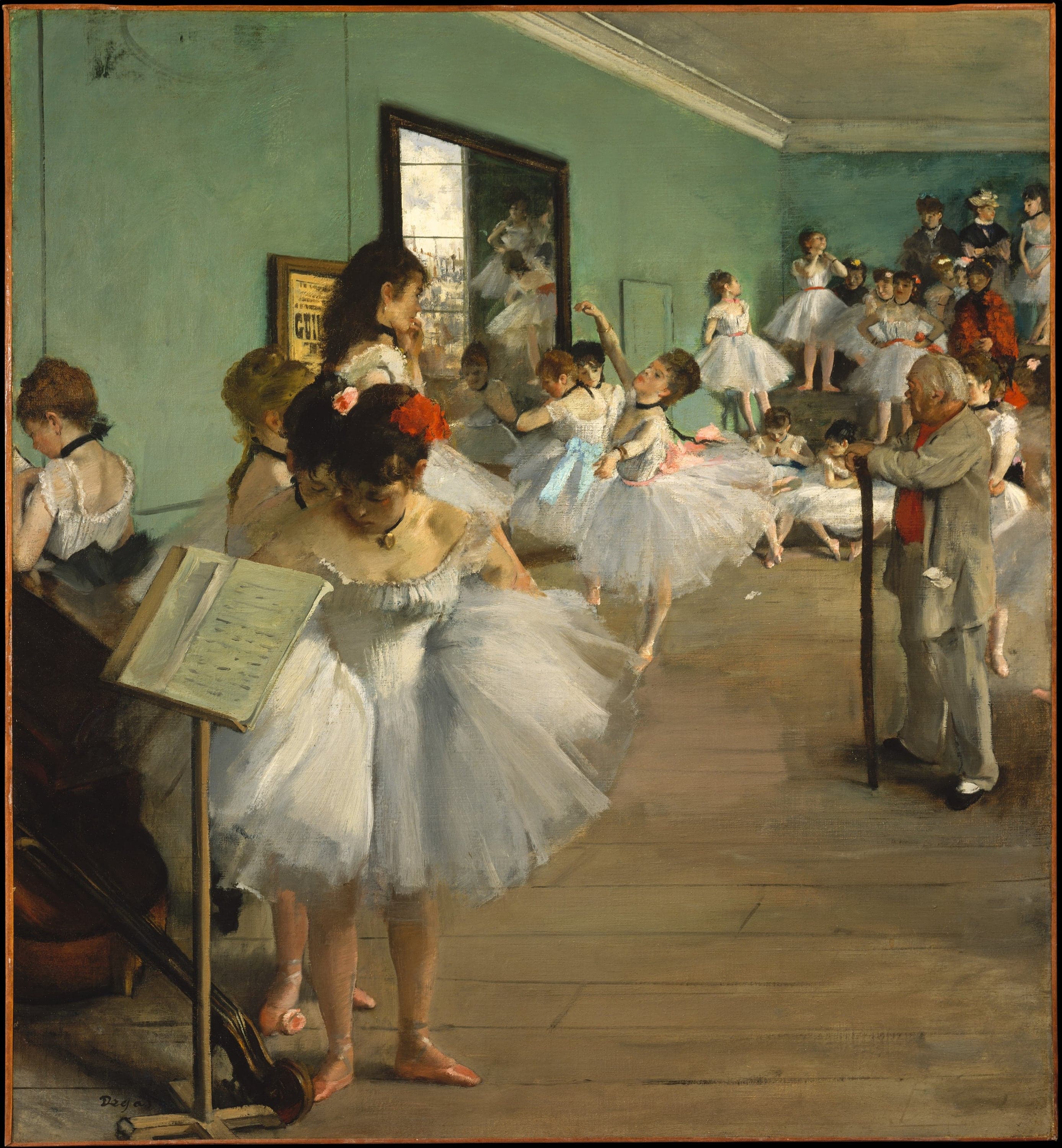
Edgar Degas painted a ballet examination in progress: one dancer holds a pose for the retired ballet master Jules Perrot while about two dozen others wait, stretch and talk. The opera singer Jean-Baptiste Faure commissioned it and lent it to the second Impressionist exhibition in 1876. It is at the Metropolitan Museum of Art in New York.
- 1874
- Oil on canvas
- The Metropolitan Museum of ArtNew York, United States
About Edgar Degas
What the painting shows
A rehearsal room runs away from the viewer in pale green and brown. At the right, an old man in a light suit stands in profile with both hands resting on a long cane, a red shirt showing at his chest. He is Jules Perrot, born in 1810, and he is watching one dancer hold a pose in the middle of the floor. The Metropolitan Museum of Art counts some twenty-four women in the room, dancers and the mothers who chaperoned them.
Almost nobody is dancing. A dancer in the foreground bends over and scratches her back. Another leans on the piano. Two sit on the low step with their toes pointed out of habit. At the back, chaperones in hats and dark coats stand and sit on a raised platform among the waiting dancers. The Metropolitan Museum's catalogue entry describes the effect as a flurry of small activity around the two figures who are actually working.
Degas cut the picture open at both edges. A double bass is sliced by the left border, its scroll and pegs pushed into the corner. A dancer at the far right is reduced to about a third of a figure. The museum reads both croppings as ideas Degas took from Japanese woodblock prints, which were reaching Paris in quantity in these years.
A singer paid for it
In 1873 the opera baritone Jean-Baptiste Faure asked Degas for a picture of dancers of the Opera ballet at an examination or a class. Faure was already buying Impressionist paintings and eventually held the largest collection of Degas's work in France. The canvas reached him in November 1874 and he paid five thousand francs for it.
Faure is not in the painting, but the wall points at him. To the left of the mirror hangs a framed poster for Gioachino Rossini's opera Guillaume Tell, the work Faure was most praised for singing. The Metropolitan Museum reads the poster as a tribute to the man who paid.
In April 1876 Faure lent the picture to the second Impressionist exhibition, where it hung under the title Examen de danse. It stayed with him until 1898, when he sold it to the dealer Durand-Ruel for ten thousand francs. Durand-Ruel moved it to New York and sold it that April for twenty-five thousand dollars.
A room that had already burned down
The setting no longer existed when Degas painted it. The Paris Opera's house on the rue Le Peletier burned down in 1873, in a fire whose cause was never established. The company rehearsed at the Salle Ventadour until Charles Garnier's new opera house opened in January 1875.
Degas set the scene in the burned building anyway. Jill DeVonyar and Richard Kendall, who worked through the Paris Opera's own records, have tentatively identified the room as one in the dormer story of the old house. The art historian Robert L. Herbert called the whole image a pure invention rather than a room Degas copied.
Details of dress point the same way. The red and pink carnations in the dancers' hair, the colored sashes, and the black ribbon chokers with lockets were not what girls wore to practice. The Metropolitan Museum notes that they belong to a dress rehearsal or a final examination rather than an ordinary class.
Who Jules Perrot was
Jules Perrot joined the Paris Opera as a dancer at twenty, in 1830. His contract was not renewed in 1835, and he spent the next decades performing and staging ballets across Europe, including eleven years as ballet master at the Imperial theaters in Saint Petersburg from 1849. He came back to Paris in 1861.
By 1874 he was sixty-four, retired from the stage, and teaching classes at the Opera. Degas painted him in strict profile, facing left into the room toward the dancer he is judging, with a bald crown fringed with gray, a heavy jaw and a red shirt under the pale jacket. A charcoal drawing of Perrot connected to the painting is at the Fitzwilliam Museum in Cambridge.
The near-twin in Paris
There are two Degas paintings of this subject in this format, and they are often confused. Degas began the Paris one, La classe de danse, in late 1873 for the same patron. He revised it, set it aside, and started the New York canvas in the autumn of 1874. The Paris picture was probably finished after it, in 1875 or 1876, and is now at the Musée d'Orsay.
The Metropolitan Museum lists the differences. Its own picture has a mirror reflecting rooftops and chimneys outside; the Paris version replaces that stretch of wall with a wide decorated doorway. The chaperones are gone from the Paris picture. The two dark-haired dancers standing with hands on hips on the platform at the back of the New York room become a single dancer in Paris, facing into the room.
X-radiographs taken at the Metropolitan Museum show that the New York canvas was also reworked. The mirror changed size. The central dancer moved. The head and feet of the dancer at front left were repositioned, and the second dancer from the left was added late.
“more beautiful than any Ver Meer I ever saw”
Close reading
Reading the work, detail by detail
Two figures are working and everyone else is waiting. The details follow the examination at the center, the teacher who is judging it, and the props along the edges that tell you which building this is and who paid for the picture.
1.The ballet master leans on his cane
Jules Perrot was sixty-four in 1874 and had stopped dancing long before. Degas painted him in profile, facing the dancer under examination, with his weight forward on the cane and a red shirt showing under the pale jacket.
2.One dancer holds the pose being judged
She is seen from the back, left arm up, chin lifted, the bow of her pink sash toward the viewer. This is the only classical position anyone in the room is holding, and the title the picture hung under in 1876 was Examen de danse, a dance examination.
3.The foreground dancer reaches behind her back
She is closest to the viewer and she is doing nothing balletic at all. Degas placed the unglamorous gesture at the front of the picture and pushed the examination into the middle distance behind her.
4.A poster for Guillaume Tell on the wall
Gioachino Rossini's Guillaume Tell was the opera in which Jean-Baptiste Faure had been most admired, and Faure commissioned this canvas. The Metropolitan Museum of Art reads the poster as a nod to the man who was paying.
5.The mirror shows rooftops and chimneys
The reflection is the only view out of the room, and it carries a working city of roofs and smokestacks. The Musée d'Orsay's version of the same scene has a wide decorated doorway in this stretch of wall instead.
6.A double bass sliced by the frame
The instrument enters at a steep angle and is cut off by the canvas edge, with no player attached to it. The Metropolitan Museum treats this cropping, and the dancer reduced to a third of a figure at the right edge, as ideas Degas took from Japanese prints.
Timeline
1873
Jean-Baptiste Faure commissions a dance picture from Edgar Degas. The Paris Opera's house on the rue Le Peletier, where Degas had watched classes, burns down the same year.
1874
Degas paints the canvas and signs it at lower left. Faure receives it in November and pays five thousand francs.
1876
Faure lends it to the second Impressionist exhibition in April, where it is catalogued as Examen de danse.
1898
Faure sells it to Durand-Ruel in Paris in February for ten thousand francs. Durand-Ruel's New York branch sells it in April for twenty-five thousand dollars to Colonel Oliver H. Payne.
1917
It passes to Payne's nephew, Harry Payne Bingham, in New York.
1986
It enters the Metropolitan Museum of Art as the bequest of Mrs. Harry Payne Bingham, accession 1987.47.1.
Where to see it
The Metropolitan Museum of Art
1000 Fifth Avenue, New York, NY 10028, United States
The Metropolitan Museum lists the painting in Gallery 815.
Plan your visit on the museum’s official website (opens in a new tab)Frequently asked questions
Where is Degas's The Dance Class?
At the Metropolitan Museum of Art in New York, accession number 1987.47.1, listed in Gallery 815. It arrived in 1986 as the bequest of Mrs. Harry Payne Bingham. A second, very similar painting of the same subject is at the Musée d'Orsay in Paris.
What is happening in The Dance Class?
A ballet examination. One dancer holds a pose for the ballet master Jules Perrot while the rest of the class waits. The Metropolitan Museum counts about twenty-four women in the room, dancers and the mothers who accompanied them, and the title it hung under in 1876 was Examen de danse.
Who is the man with the stick in The Dance Class?
Jules Perrot, born in 1810, a dancer and choreographer who was ballet master at the Imperial theaters in Saint Petersburg from 1849 to 1860. He returned to Paris in 1861 and was teaching at the Opera in 1874, aged sixty-four. Degas painted him in profile, facing the dancer, with both hands resting on a long cane.
Why is there a Guillaume Tell poster in the painting?
Because of who paid for the picture. The opera baritone Jean-Baptiste Faure commissioned it in 1873, and Rossini's Guillaume Tell was the opera in which he had been most admired. The Metropolitan Museum reads the framed poster on the rehearsal-room wall as a tribute to him.
Is the room in The Dance Class a real room?
Not one Degas could have stood in that year. He set the scene in the Paris Opera's house on the rue Le Peletier, which had burned down in 1873. Jill DeVonyar and Richard Kendall have tentatively placed it in the dormer story of that building, and the art historian Robert L. Herbert called the image a pure invention.
How big is The Dance Class, and is it signed?
It measures 83.5 by 77.2 centimeters, so it is nearly square, and it is signed Degas at lower left. The medium is oil on canvas.
What is the difference between the New York and Paris versions?
The Metropolitan Museum's picture has a mirror reflecting rooftops and chimneys; the Musée d'Orsay's has a wide decorated doorway in that stretch of wall instead. The chaperones on the bleachers are absent in Paris, and the two dancers standing with hands on hips at the back of the New York room become one dancer there. Degas began the Paris canvas first, in late 1873, and probably finished it last.
More by Edgar Degas
If you like Edgar Degas
Explore painters from the same movements and circles.
Gustave Caillebotte
Painter of Haussmann's geometry and the group's organizer-financier; his bequest of Impressionist paintings forced the French state to take the movement in.
View artist
Mary Cassatt
Mary Cassatt was an American painter and printmaker known for her depictions of women and children. Based in France for the last fifty-two years of her life, she was the only American to exhibit with the original French Impressionist group, participating in four of its eight exhibitions. Edgar Degas invited her to exhibit with the group in 1877 after the Salon jury rejected her submissions.
View artist
Paul Cézanne
Painter between Impressionism and everything after — shown in the independents' exhibitions, emulated by the Cubists, and present at the Orangerie through 15 works in the Walter-Guillaume collection.
View artist
References
The sources below include collection records, catalogues, scholarly research, and primary materials that informed this page. They document The Dance Class, its making, and its place in cultural history.


1Edgar Degas, The Dance Class (1874), accession 1987.47.1
WebsiteThe Metropolitan Museum of ArtUsed forWeb source consulted for documented facts and historical context presented on the The Dance Class page.
2Edgar Degas (1834–1917): Painting and Drawing
WebsiteThe Metropolitan Museum of ArtUsed forWeb source consulted for documented facts and historical context presented on the The Dance Class page.
31876 — Deuxième exposition impressionniste
WebsiteMinistère de la CultureUsed forWeb source consulted for documented facts and historical context presented on the The Dance Class page.
4The Paris Opera in the 19th century
WebsiteOpéra national de ParisUsed forWeb source consulted for documented facts and historical context presented on the The Dance Class page.
5Degas at the Opéra
WebsiteMusée d'OrsayUsed forWeb source consulted for documented facts and historical context presented on the The Dance Class page.
These references provide the documented foundation for this work's history and interpretation. Claim-level citations remain attached to the specific claims they support.
 Explore more resources