Little Dancer Aged Fourteen
by Edgar Degas
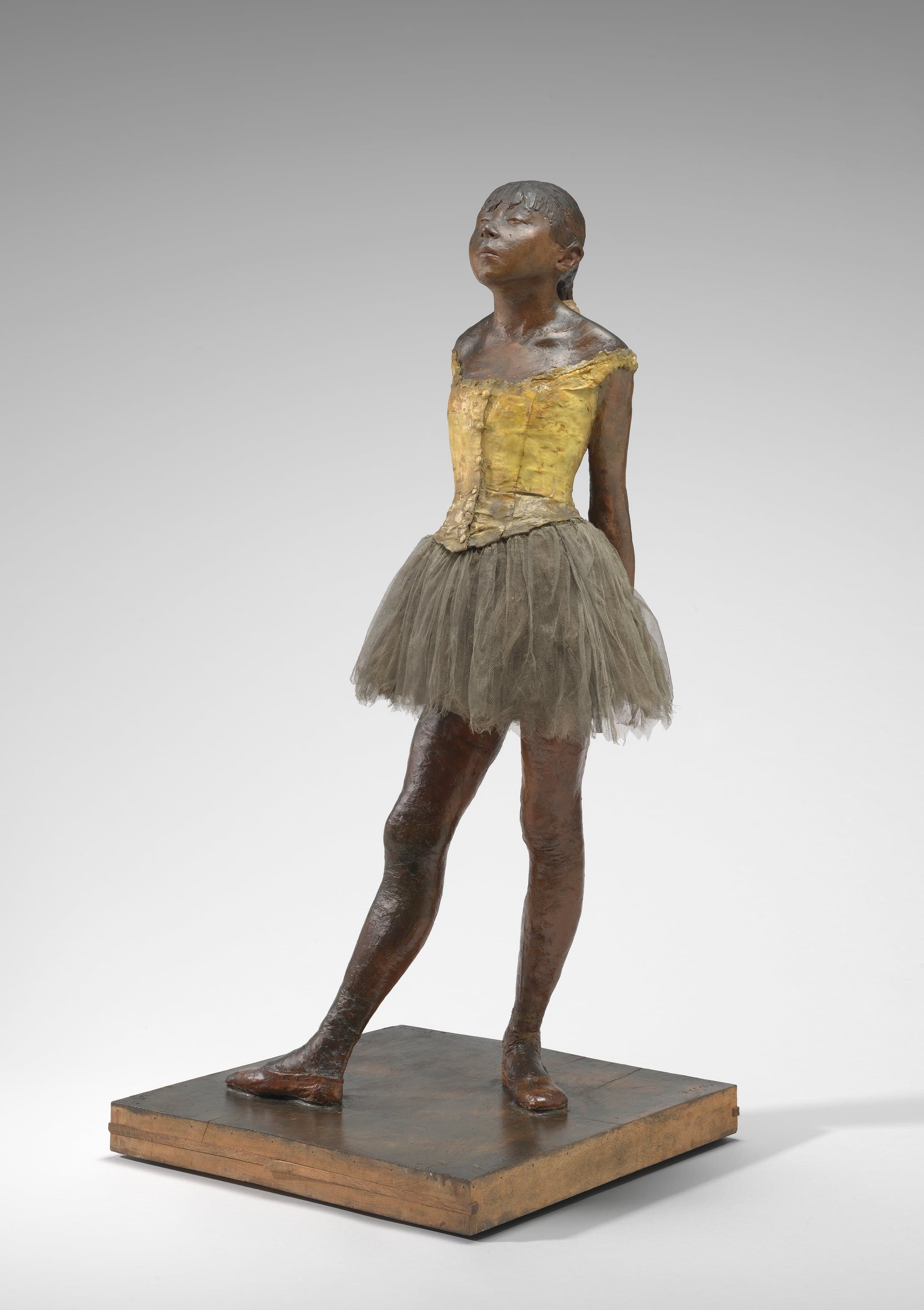
Edgar Degas modeled a ballet student just under a meter tall in tinted beeswax, then dressed the figure in a real bodice, tutu, slippers and hair ribbon. It was the only sculpture he showed in public, at the sixth Impressionist exhibition in April 1881, and reviewers called it ugly. The original wax is at the National Gallery of Art in Washington.
- 1878–1881
- Pigmented beeswax, clay, metal armature, rope, paintbrushes, human hair, silk and linen ribbon, cotton faille bodice, cotton and silk tutu, linen slippers, on a wooden base
- National Gallery of ArtWashington, United States
About Edgar Degas
What the sculpture is made of
The figure stands about 99 centimeters high without its base, which makes her roughly two-thirds life size. She is built on a metal armature packed out with rope and clay, and modeled in beeswax tinted the color of skin. Degas left paintbrushes inside the body as part of the structure.
The clothes are real cloth, not modeled wax. The National Gallery of Art lists a cotton faille bodice, a tutu of cotton and silk, linen slippers, and silk and linen ribbon. The hair is human hair, tied with a ribbon at the back. Degas signed the wooden base at the proper left back corner.
Most sculpture of the 1870s was cast in bronze or carved in marble. This one is wax, cloth, rope and hair.
Marie van Goethem
The model was Marie van Goethem, born on 7 June 1865 and a student at the Paris Opera's École de Danse. By 1880 she was a professional dancer in the company. The Metropolitan Museum of Art records that Degas made repeated studies of her before modeling the figure.
Her pose is a fourth position, right leg forward and turned out, with her hands clasped behind her back and her chin lifted. The arms pull down and back, the head tips up, and the body is held rigidly to the front.
The reviews of April 1881
Degas announced the statuette for the fifth Impressionist exhibition in 1880 and did not deliver it. He sent it to the sixth exhibition instead, which ran from 2 April to 1 May 1881 at 35 boulevard des Capucines in Paris. Even there it arrived late: the French Ministry of Culture's account records that it was not on show until 16 April.
It stood in a glass case. The Metropolitan Museum of Art notes that the effect reminded viewers of the wax figures at Madame Tussaud's in London, and of the dressed mannequins shown at the Paris Exposition Universelle of 1879.
The critic Paul Mantz, writing in Le Temps on 23 April 1881, called Degas the only real sculptor among the independents and described the work as realism carried to excess. Joris-Karl Huysmans took the opposite view of the same quality.
“la seule tentative vraiment moderne que je connaisse, dans la sculpture”
Others attacked the girl's face. Jules Claretie wrote of a vicious muzzle, and Henry Trianon called the figure a type of horror and bestiality. Degas had used the same French word, museau, in a verse of his own about dancers, telling them to leap without the useless help of beauty.
The bronzes came later
Degas never sold the wax. The collector Louisine Havemeyer saw it in 1881 and tried to buy it in 1903; he refused. He talked about having it cast in bronze because the wax was deteriorating, and nothing was done in his lifetime.
He died in September 1917. His heirs — his brother René De Gas and four of his sister Marguerite's children — put the studio waxes in the hands of the Hébrard foundry in Paris. Seventy-two of them were cast in editions of twenty, plus one set for the heirs and one for the foundry. The Little Dancer was the seventy-third and was handled separately.
Hébrard's chief founder, Albino Palazzolo, made two plasters from the wax, now at the Joslyn Art Museum in Omaha and the National Gallery of Art. Those plasters produced twenty-nine known bronzes, most of them between 1922 and 1937. The Metropolitan Museum of Art's cast, made in 1922 and marked A, came from the first set, which Louisine Havemeyer bought in Paris in May 1921 on Mary Cassatt's advice.
The wax itself stayed with the Hébrard family until 1955, went to the New York dealer Knoedler, and was bought in May 1956 by Paul Mellon. It entered the National Gallery of Art with his bequest in 1999.
Close reading
Reading the work, detail by detail
The figure is tinted wax where the skin shows and real cloth everywhere else. The details follow the pose, the materials, and the plain wooden base Degas signed.
1.The chin goes up and the eyes go down
The head tips back and the lids are nearly closed, so the girl is looking at no one. Reviewers in April 1881 fixed on this face: Jules Claretie wrote of a vicious muzzle and Henry Trianon called the figure a type of horror.
2.A wax bodice built to look like cloth
The National Gallery of Art lists a cotton faille bodice under the wax. Degas coated it so that the fabric and the modeled skin meet without a seam, and the join is the point at which a viewer stops being sure what is real.
3.The tutu is actual gauze
This is cotton and silk net, not sculpture. It has dulled to gray-green over a century and a half, and the Metropolitan Museum of Art notes that the effect of dressing a wax figure in real cloth reminded 1881 viewers of waxwork shows.
4.The arms pull down and back
Both arms are drawn down and behind, the hands clasped out of sight at the small of the back. The line runs against the raised chin and stretches the whole figure between two opposite pulls.
5.The front foot is turned out in fourth position
The forward foot is turned out in a standard ballet fourth position and the slipper is linen. It is the one part of the pose taken straight from the classroom; the arms and the head are not classroom positions at all.
6.A plain wooden base carries the signature
The base is a slab of wood with visible boards rather than a carved plinth. Degas signed it at the proper left back corner, the only inscription the National Gallery of Art records on the whole sculpture.
Timeline
1878–1881
Degas models the figure in tinted beeswax over a metal armature and dresses it in real cloth.
1880
The statuette is announced for the fifth Impressionist exhibition but is not shown.
1881
It goes on view at the sixth Impressionist exhibition, 35 boulevard des Capucines, from 16 April. Paul Mantz, Joris-Karl Huysmans, Jules Claretie and Henry Trianon all write about it, and most of them dislike it.
1903
Louisine Havemeyer tries to buy the wax from Degas, who refuses to sell it.
1921
Four years after Degas's death, the first set of bronzes cast from his studio waxes is shown at the Galerie A. A. Hébrard in Paris. Louisine Havemeyer buys it on Mary Cassatt's advice.
1956
Paul Mellon buys the original wax from the New York dealer Knoedler, which had taken it on consignment from Nelly Hébrard the year before.
1999
The wax enters the National Gallery of Art in Washington by Paul Mellon's bequest, accession 1999.80.28.
Where to see it
National Gallery of Art
Washington, United States
A public viewing address has not yet been confirmed for this holding.
The original wax is at the National Gallery of Art. Bronze casts of the same figure are at the Metropolitan Museum of Art, the Musée d'Orsay and elsewhere.
Frequently asked questions
Where is the original Little Dancer Aged Fourteen?
At the National Gallery of Art in Washington, accession number 1999.80.28, in the Collection of Mr. and Mrs. Paul Mellon. That is the wax Degas made and exhibited. The bronzes in other museums, including the Metropolitan Museum of Art and the Musée d'Orsay, were cast after his death.
Who was the model for Little Dancer Aged Fourteen?
Marie van Goethem, born on 7 June 1865, a student at the Paris Opera's École de Danse who was dancing professionally in the company by 1880. Degas made a series of studies of her before modeling the figure.
What is Little Dancer Aged Fourteen made of?
Pigmented beeswax and clay over a metal armature, packed with rope and paintbrushes, on a wooden base. The clothes and hair are real: a cotton faille bodice, a tutu of cotton and silk, linen slippers, human hair, and silk and linen ribbon.
Why did people dislike Little Dancer Aged Fourteen in 1881?
Chiefly because of the girl's face and the literalness of the materials. Jules Claretie wrote of a vicious muzzle and Henry Trianon called the figure a type of horror and bestiality. Paul Mantz, who admired Degas as a sculptor, still described the work as realism carried to excess, and the glass case reminded viewers of waxwork shows rather than of sculpture.
Did Degas exhibit any other sculpture?
No. The Metropolitan Museum of Art records that the wax Little Dancer was the only sculpture Degas ever showed in public. He kept making wax figures of dancers, bathers and horses in the studio, showed them to friends, and had plaster casts made of three of them, but he exhibited none of those.
How many bronze casts of the Little Dancer exist?
Twenty-nine are known, most of them cast between 1922 and 1937 at the Hébrard foundry in Paris. They were made from two plasters that Hébrard's founder Albino Palazzolo took from the wax, and those plasters are now at the Joslyn Art Museum in Omaha and the National Gallery of Art.
How tall is Little Dancer Aged Fourteen?
98.9 centimeters without its base, and 34.7 by 35.2 centimeters in plan. The National Gallery of Art gives its weight as 49 pounds, about 22 kilograms.
More by Edgar Degas
If you like Edgar Degas
Explore sculptors from the same movements and circles.
Paul Gauguin
Stockbroker turned painter who came into art through Camille Pissarro, showed with the Impressionists, and left Europe for Polynesia.
View artist
Pierre-Auguste Renoir
Porcelain painter turned co-founder of Impressionism — the painter of the Moulin de la Galette dance and the Luncheon of the Boating Party, whose later classical turn reached Picasso and Matisse.
View artist
Arman
French-American artist, lifelong friend of Yves Klein, and a founder of New Realism.
View artist
References
The sources below include collection records, catalogues, scholarly research, and primary materials that informed this page. They document Little Dancer Aged Fourteen, its making, and its place in cultural history.


1Edgar Degas, Little Dancer Aged Fourteen (1878-1881), accession 1999.80.28
WebsiteNational Gallery of Art, WashingtonUsed forWeb source consulted for documented facts and historical context presented on the Little Dancer Aged Fourteen page.

2National Gallery of Art Open Data Program: collection object records
Official recordNational Gallery of Art, WashingtonUsed forOfficial record used to verify names, dates, institutional details, or other factual information on this page.
3Edgar Degas, The Little Fourteen-Year-Old Dancer, cast 1922, accession 29.100.370
WebsiteThe Metropolitan Museum of ArtUsed forWeb source consulted for documented facts and historical context presented on the Little Dancer Aged Fourteen page.
41881 — Sixième exposition impressionniste
WebsiteMinistère de la CultureUsed forWeb source consulted for documented facts and historical context presented on the Little Dancer Aged Fourteen page.
5Edgar Degas: About the Artist
WebsiteClark Art InstituteUsed forWeb source consulted for documented facts and historical context presented on the Little Dancer Aged Fourteen page.
These references provide the documented foundation for this work's history and interpretation. Claim-level citations remain attached to the specific claims they support.
 Explore more resources