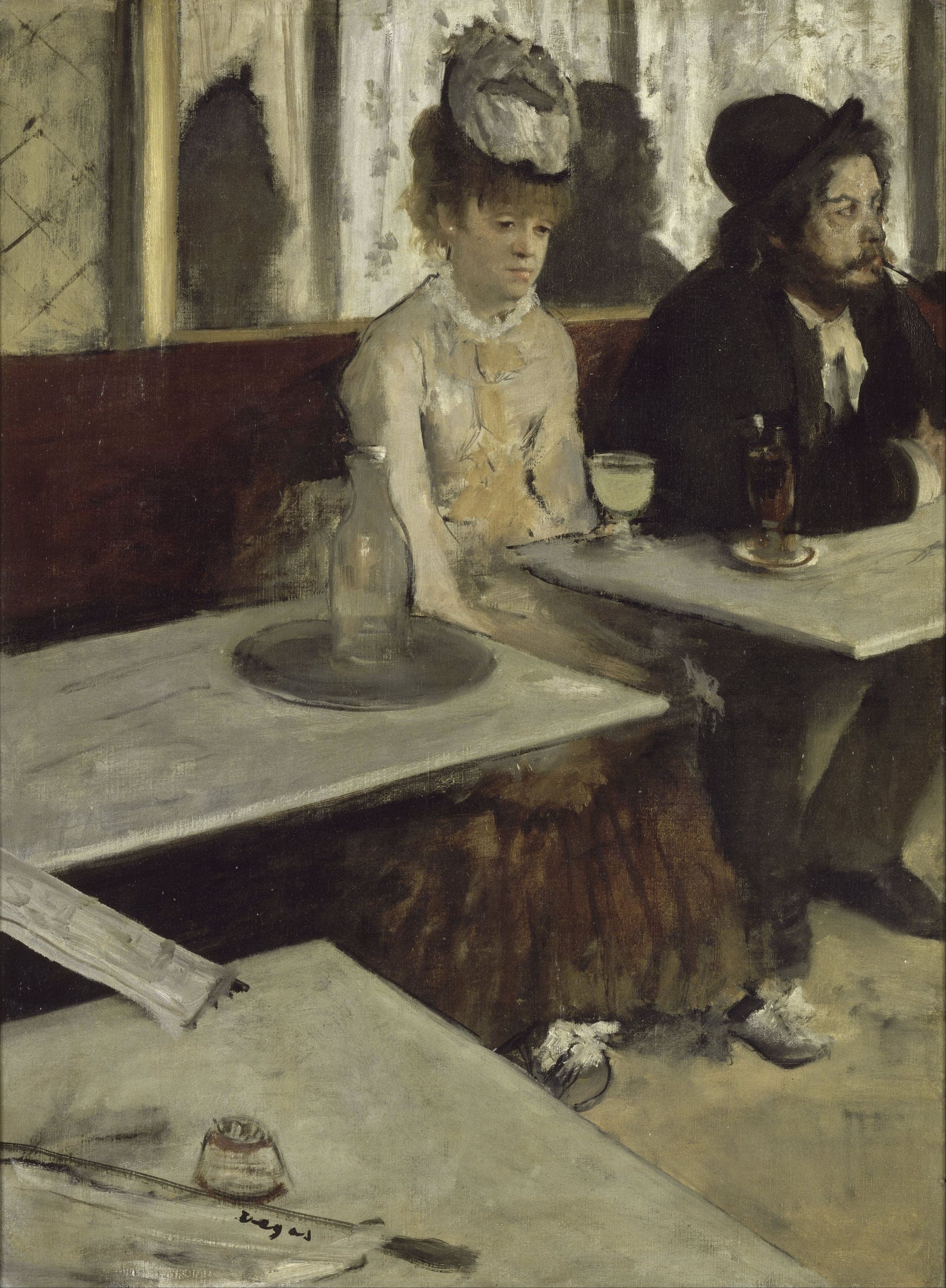
L'Absinthe
by Edgar Degas
A woman with a glass of absinthe and a man with a pipe sit side by side in a Paris café, looking at nothing and not at each other. Edgar Degas painted the actress Ellen Andrée and the printmaker Marcellin Desboutin in about 1875, and the picture caused a two-month argument in the London press when it was shown in 1893 under the title L'Absinthe. It is at the Musée d'Orsay in Paris.
- 1875–1876
- Oil on canvas
- Musée d'OrsayParis, France
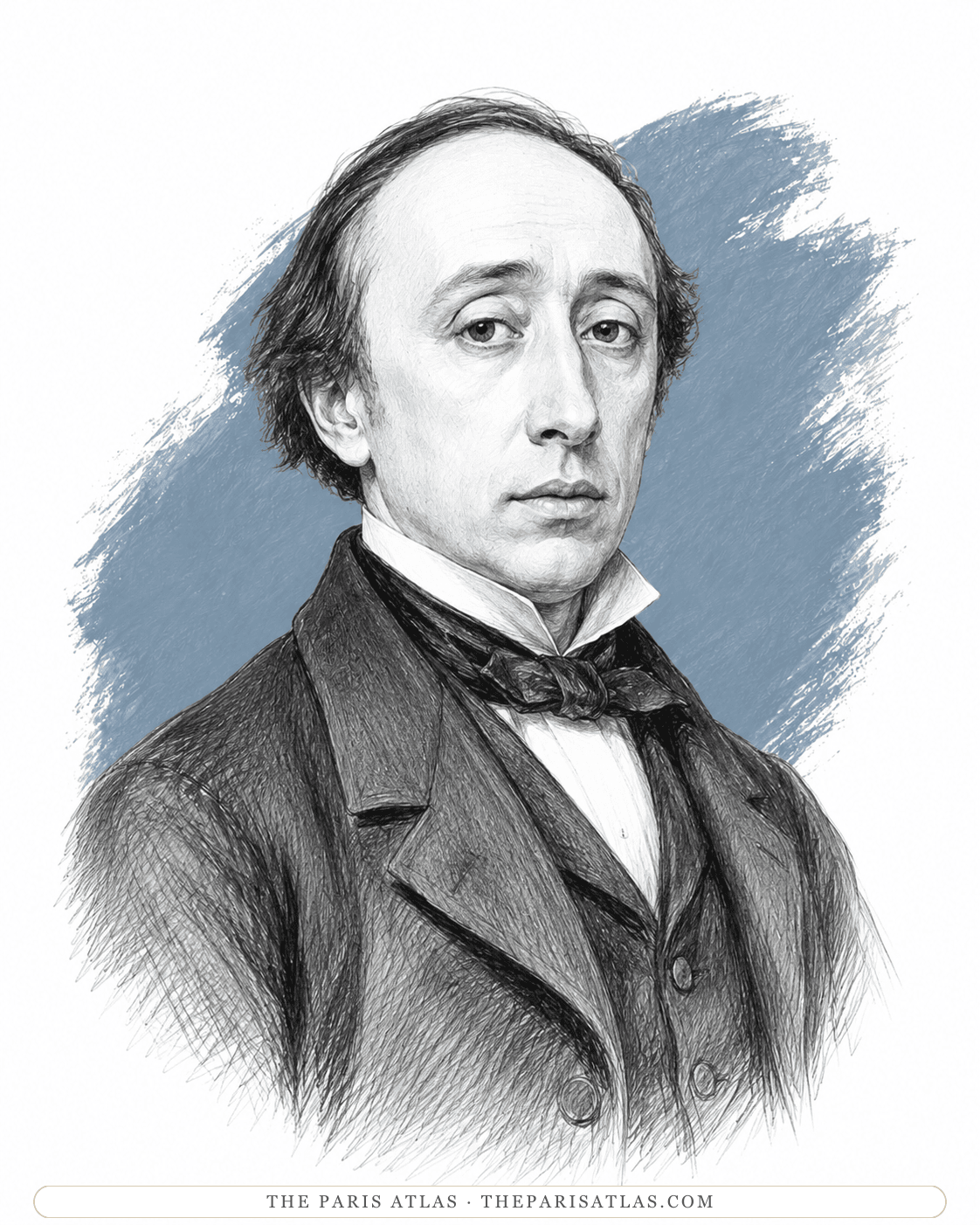
About Edgar Degas
What the painting shows
Two people share a banquette at the back of a café. The woman stares down and ahead with her shoulders slumped, a hat on her fair hair, a tall glass of cloudy pale-green absinthe on the table in front of her. The man beside her, bearded and in a black hat, has a pipe in his mouth and is looking away out of the frame to the right.
Between them and the viewer, two marble tabletops run into the foreground at a sharp angle, one behind the other. A carafe of water stands on a tray on the far table, and the woman's hand rests on its edge. The near table carries only a small match stand, and a folded newspaper on its wooden rod bridges the gap between the two at the lower left.
Behind the two figures, a mirror runs along the wall and gives back two dark silhouettes and a stretch of window. The colors are close to a single tone, gray, brown and dull white, with the drink and the woman's dress the only pale notes. Degas signed the canvas at the bottom, toward the left.
The two sitters and the café
The woman is Ellen Andrée, an actress who modeled for several painters of the circle. Auguste Renoir put her in Luncheon of the Boating Party, and Degas drew and printed her more than once; the Art Institute of Chicago holds both a monotype portrait of her from about 1876 and a drypoint of 1879.
The man is Marcellin Gilbert Desboutin, born in 1823, a painter and drypoint printmaker who made portraits of Degas and of Berthe Morisot. The Musée d'Orsay names both sitters and identifies the room as the Nouvelle Athènes, the café on the place Pigalle where the Impressionist painters met.
The museum also says the picture was made in the studio rather than in the café, and that the snapshot effect was carefully built. The off-center framing, the empty space, and the cropping of the man's pipe and hand were borrowed from Japanese prints.
The title was changed in London
Degas called it Au Café, or In a Café. That is the title George Moore printed in 1893 when the argument was under way, and the Musée d'Orsay still catalogues the painting as Dans un café, with L'absinthe listed as the other title.
The name L'Absinthe belongs to London. The canvas went to England almost at once: the dealer Charles W. Deschamps had it in 1876, and Captain Henry Hill of Brighton bought it and kept it until his death. It sold again at Christie's in February 1892, at the second Henry Hill sale, and reached the Glasgow collector Arthur Kay.
Kay lent it to the Grafton Galleries in London in 1893, where it hung as number 258 under the new title. Kay later wrote that he had sold the picture and then gone back to the dealer within forty-eight hours to buy it again. After the row he sold it for good, in April 1893, to the Paris dealers Martin and Camentron.
The row of 1893
The Spectator's art critic, Dugald Sutherland MacColl, saw the painting at the Grafton on 25 February 1893 and made it the test case for everything he believed about criticism.
“But L'Absinthe, by Degas, is the inexhaustible picture, the one that draws you back, and back again. It sets a standard by which too many of the would-be 'decorative' inventions in the exhibition are cruelly judged. It is what they call 'a repulsive subject,' two rather sodden people drinking in a café.”
A writer signing himself A Philistine answered in the Westminster Gazette and gave MacColl's position the mocking name it kept, the New Art Criticism. The painter Sir William Blake Richmond joined in, calling the picture a treatise on drink and denying it was painting at all. The illustrator Walter Crane called it a study of human degradation, male and female. The critic Harry Quilter fought MacColl through the same pages.
MacColl replied on 18 March 1893. What matters, he told the objectors, is the dignity of the performance and not the dignity of the subject, and a good master of ceremonies knows how to introduce a beggar as well as a prince. The Spectator's editor shut the correspondence down in April with a bracketed line saying the controversy must end there.
The Studio watched it all and, in its first volume that year, suggested the whole quarrel would have evaporated if the picture had been called The Frugal Repast of Genius instead.
George Moore started the argument, then took it back
The Irish writer George Moore, then art critic of The Speaker, had described the painting before the row began and reprinted the description in his book Modern Painting in 1893. He named Marcellin Desboutin, said he had known him all his life, and wrote a hostile paragraph about the woman as a social type. He ended the passage by calling the picture a lesson.
In the same book he took that sentence back. He called it the first hypocritical phrase he had ever written and said a painting is only a painting, with no moral meaning to deliver. He blamed himself for having suggested that someone in the picture was being preached at, and said that once he had, the preaching started.
He also defended Marcellin Desboutin in print. Moore wrote that Desboutin was a sober man who always came to the café alone, as Édouard Manet and Degas did, and that he was sitting there thinking about his drypoints rather than drinking with the woman beside him. The Musée d'Orsay's own notice says the painting damaged both sitters' reputations and that Degas had to state publicly that they were not alcoholics.
Where it hung before Paris
The early exhibition history is less certain than it looks. The Degas catalogue raisonné lists a possible showing at the second Impressionist exhibition in Paris in April 1876, as number 52, and marks the entry with a question mark. The French Ministry of Culture's account of that exhibition lists Degas's contributions and does not include this picture.
What is documented is that it hung at Brighton later in 1876, from Henry Hill's collection, and that it was at the third Impressionist exhibition in Paris in 1877, outside the printed catalogue. The Musée d'Orsay records the 1877 showing and gives no catalogue number for it.
Isaac de Camondo bought the painting in 1893, the year of the London argument. He left it to the French state in 1911, it was assigned to the Louvre, and it went on show there from 1914. It moved to the Jeu de Paume in 1947 and to the Musée d'Orsay in 1986.
Close reading
Reading the work, detail by detail
Half the canvas is empty furniture. The details follow the two sitters, what is on the tables in front of them, and the mirror behind, which gives back two dark shapes rather than faces.
1.Ellen Andrée looks down and nowhere
The actress Ellen Andrée sat for this figure. The Musée d'Orsay records that the picture damaged her reputation along with her neighbor's, and that Degas had to state publicly that neither of them was an alcoholic.
2.The glass that renamed the picture
The cloudy green in the glass is absinthe, and it gave the canvas the title it was given in London in 1893. Degas called the painting Au Café, and the Musée d'Orsay still catalogues it as Dans un café.
3.Marcellin Desboutin holds his pipe and looks away
The printmaker Marcellin Gilbert Desboutin is turned away from the woman beside him and out of the picture. George Moore, who knew him, wrote in 1893 that Desboutin always came to the café alone and was sitting there thinking about his drypoints.
4.Two tables zigzag into the foreground
The marble runs at a sharp diagonal across the bottom half of the canvas. A carafe of water stands on a tray on the far table, where the woman's hand rests on the edge, and the near table holds only a match stand. The bare surfaces put a physical distance between the viewer and the pair.
5.A newspaper on its wooden holder
Café newspapers were mounted on wooden rods so that customers could read them without carrying them off. This one lies across the gap between the tables and points straight out of the picture at the viewer.
6.The mirror gives back two shadows
Behind the banquette, the mirror returns two flat dark shapes with no features: one directly behind the woman's hat, the other well to the left, above the empty end of the seat.
Timeline
1875–1876
Degas paints Ellen Andrée and Marcellin Desboutin in a studio setting based on the Nouvelle Athènes café on the place Pigalle.
1876
The dealer Charles W. Deschamps has the picture in London, and Captain Henry Hill of Brighton buys it. It is shown at the Royal Pavilion Gallery in Brighton the same year.
1877
It hangs at the third Impressionist exhibition at the Durand-Ruel gallery in Paris, outside the catalogue.
1892
Sold at Christie's in London in February at the second Henry Hill sale. The Glasgow dealer Alexander Reid buys it and passes it to the collector Arthur Kay.
1893
Shown at the Grafton Galleries in London as number 258, under the new title L'Absinthe. Dugald Sutherland MacColl defends it in The Spectator, William Blake Richmond, Walter Crane and Harry Quilter attack it, and George Moore retracts his own moralizing line. Arthur Kay sells it in April; Isaac de Camondo buys it the same year.
1911
Isaac de Camondo's bequest passes to the French state and the painting is assigned to the Musée du Louvre, where it goes on view in 1914.
1986
Transferred from the Louvre to the Musée d'Orsay.
Where to see it
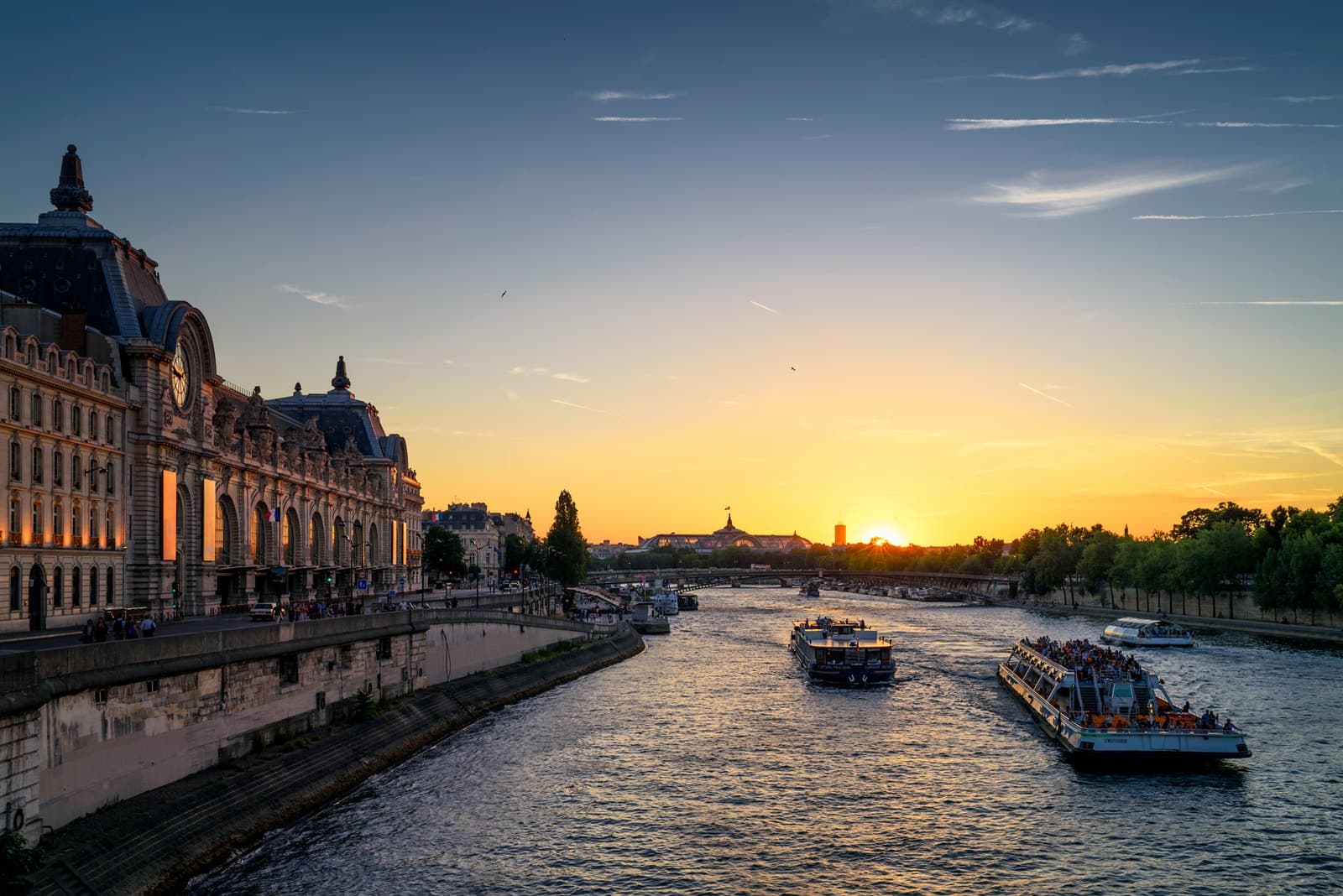
Musée d'Orsay
Esplanade Valéry Giscard d’Estaing, 75007 Paris, France
Displays and loans can change. Check whether this work is on view before making a special trip.
Plan your visitFrequently asked questions
Who are the two people in L'Absinthe?
The actress Ellen Andrée and the painter and printmaker Marcellin Gilbert Desboutin, both friends of Degas who sat for him in the studio. The Musée d'Orsay names them and records that the painting damaged their reputations, so that Degas had to say publicly that neither was an alcoholic.
Why is it called L'Absinthe?
Because of a London exhibition. Degas called the picture Au Café, and the Musée d'Orsay still catalogues it as Dans un café. It was retitled L'Absinthe when Arthur Kay lent it to the Grafton Galleries in 1893, and the new name is the one that stuck.
Where is L'Absinthe?
At the Musée d'Orsay in Paris, inventory number RF 1984. It is oil on canvas, 92 by 68.5 centimeters, and came to the French state in 1911 through the bequest of Comte Isaac de Camondo.
What was the L'Absinthe controversy of 1893?
A two-month argument in the London press about whether an ugly subject can make a good painting. Dugald Sutherland MacColl of The Spectator called it the inexhaustible picture; a writer in the Westminster Gazette signing himself A Philistine attacked him and named his position the New Art Criticism. William Blake Richmond called the canvas a treatise on drink and Walter Crane called it a study of human degradation.
What café is L'Absinthe set in?
The Nouvelle Athènes, on the place Pigalle in Paris, where the Impressionist painters gathered. The Musée d'Orsay identifies it and adds that Degas worked in the studio rather than at a café table, so the effect of a glimpse across the room was constructed.
Was L'Absinthe shown at an Impressionist exhibition?
At the third one, in Paris in 1877, outside the printed catalogue. A showing at the second exhibition in 1876 as number 52 is listed in the Degas catalogue raisonné with a question mark, and the French Ministry of Culture's list of Degas's 1876 entries does not include it.
Is the woman in L'Absinthe drinking absinthe?
The glass in front of her holds it, cloudy and pale green. The man's drink is a different matter, and George Moore argued in 1893 that Marcellin Desboutin was not drinking with her at all but sitting alone with his pipe, thinking about his drypoints.
More by Edgar Degas
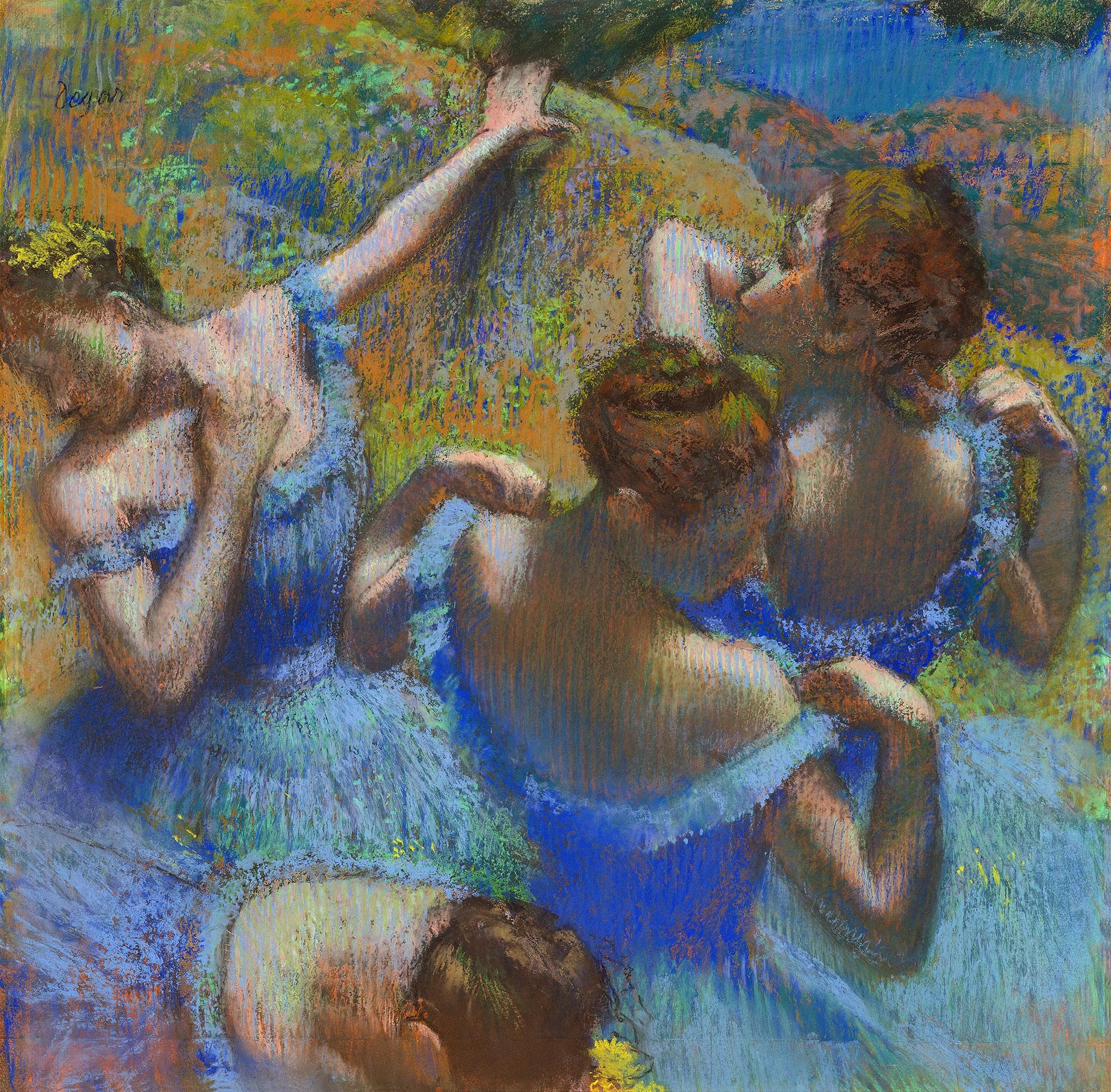
If you like Edgar Degas
Explore painters from the same movements and circles.
Gustave Caillebotte
Painter of Haussmann's geometry and the group's organizer-financier; his bequest of Impressionist paintings forced the French state to take the movement in.
View artist
Mary Cassatt
Mary Cassatt was an American painter and printmaker known for her depictions of women and children. Based in France for the last fifty-two years of her life, she was the only American to exhibit with the original French Impressionist group, participating in four of its eight exhibitions. Edgar Degas invited her to exhibit with the group in 1877 after the Salon jury rejected her submissions.
View artist
Paul Cézanne
Painter between Impressionism and everything after — shown in the independents' exhibitions, emulated by the Cubists, and present at the Orangerie through 15 works in the Walter-Guillaume collection.
View artist
References
The sources below include collection records, catalogues, scholarly research, and primary materials that informed this page. They document L'Absinthe, its making, and its place in cultural history.

1Edgar Degas, Dans un café, also called L'absinthe, RF 1984
WebsiteMusée d'OrsayUsed forWeb source consulted for documented facts and historical context presented on the L'Absinthe page.

2Au café ou L'Absinthe, MS 917, in the Degas catalogue raisonné
Official recordFondation Wildenstein Plattner Jr.Used forOfficial record used to verify names, dates, institutional details, or other factual information on this page.
3Art — The Grafton Gallery
PeriodicalThe Spectator, 1893Used forContemporary reporting or criticism used to document the historical reception and context of L'Absinthe.
4Art — The Standard of the Philistine
PeriodicalThe Spectator, 1893Used forContemporary reporting or criticism used to document the historical reception and context of L'Absinthe.
5Modern Painting
EssaysWalter Scott, Limited, London, 1893Used forPublished analysis and historical context used in preparing the L'Absinthe page.
6The Studio: An Illustrated Magazine of Fine and Applied Art, volume 1
PeriodicalThe Studio, 1893Used forContemporary reporting or criticism used to document the historical reception and context of L'Absinthe.
7Arthur Kay
WebsiteGlasgow Museums Art Donors, 2018Used forWeb source consulted for documented facts and historical context presented on the L'Absinthe page.
8Un regard sur l'alcoolisme: Dans un café, dit aussi L'Absinthe
WebsiteL'Histoire par l'image, Ministère de la Culture, 2008Used forWeb source consulted for documented facts and historical context presented on the L'Absinthe page.
91876 — Deuxième exposition impressionniste
WebsiteMinistère de la CultureUsed forWeb source consulted for documented facts and historical context presented on the L'Absinthe page.
10The drink that fuelled a nation's art
PeriodicalTate Etc., 2005Used forContemporary reporting or criticism used to document the historical reception and context of L'Absinthe.
These references provide the documented foundation for this work's history and interpretation. Claim-level citations remain attached to the specific claims they support.
 Explore more resources