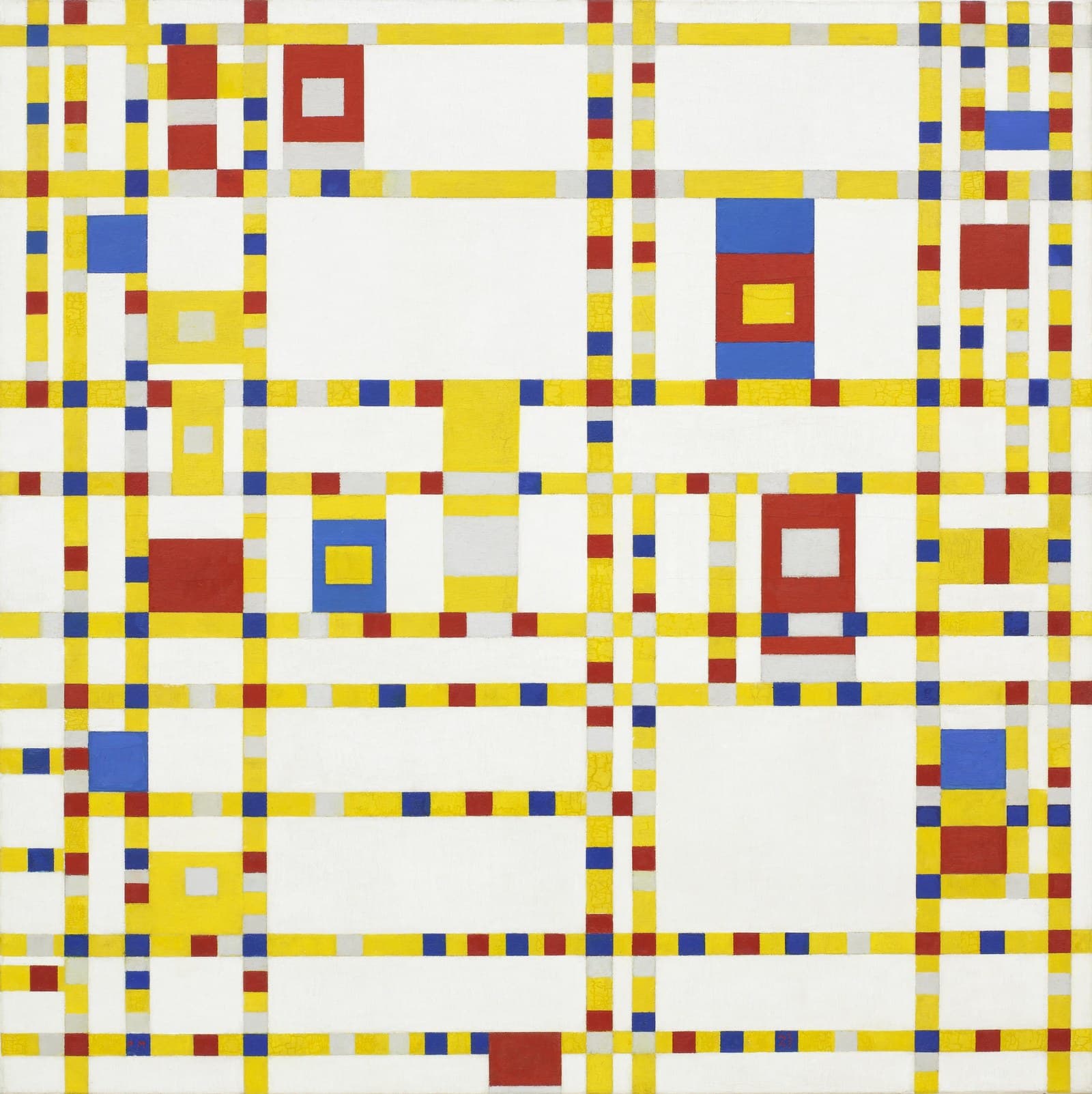
Piet Mondrian painted Broadway Boogie Woogie in New York in 1942 and 1943, two years after leaving wartime Europe. Yellow bands cross a white square canvas, broken by small blocks of red, blue and grey. The heavy black lines of his earlier work are gone. It is at the Museum of Modern Art in New York.
Broadway Boogie Woogie is an abstract oil painting made by Piet Mondrian in New York in 1942 and 1943. Its intersecting bands and small colored blocks translate the energy of urban movement and music into a nonrepresentational composition. The square canvas belongs to the Museum of Modern Art in New York.
A Different Kind of Grid
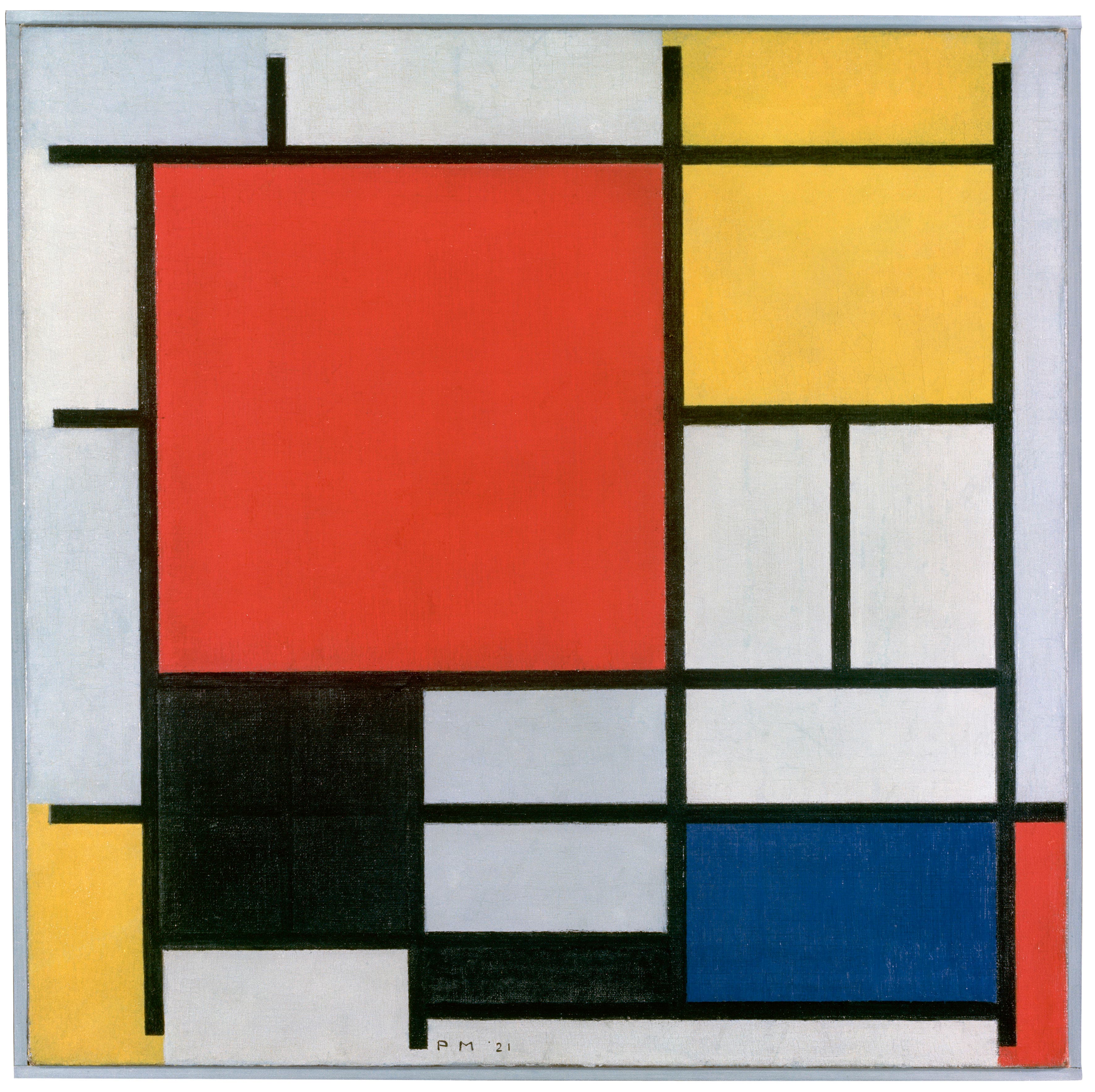
The painting uses horizontal and vertical bands interrupted by red, blue, gray, and other contrasting blocks. Yellow establishes much of the network, while white areas open between the intersections. Unlike the heavy black divisions familiar from many earlier Mondrian paintings, these bands can appear to pulse as the eye moves along them.
The reference to New York does not make the picture a literal street map. Its relationship to the city is rhythmic rather than topographical. Repetition, interruption, crossing, and variation suggest movement without depicting cars, pedestrians, buildings, or musicians.
New York and Boogie-Woogie
Mondrian arrived in New York in 1940, escaping wartime Europe. The city and the boogie-woogie music he encountered there offered powerful stimuli for his late work. A painter often associated with austerity responded to an environment of traffic, dance, and syncopated sound.
The title's musical reference is especially useful because it discourages the assumption that geometry must be static. A repeated structure can generate movement when accents shift within it. The small variations prevent the eye from settling into a mechanically uniform pattern, suggesting an analogy between visual composition and musical timing.
A Late Experiment, Not a Final Formula
Mondrian continued developing these ideas in Victory Boogie Woogie, a different painting left unfinished at his death in 1944. The Kunstmuseum Den Haag's account describes his repeated revisions, including extensive use of colored tape to test and alter relationships. What appeared nearly complete on one studio visit could be substantially rearranged by the next.
That later work should not be confused with Broadway Boogie Woogie. Together, however, they show an artist still testing the possibilities of his visual language rather than merely reproducing an established signature style. The final years of his career brought new instability and freedom into an approach often misunderstood as rigidly predetermined.
Historical Importance
The two boogie-woogie paintings make clear that abstraction did not require separation from contemporary life. Mondrian could respond to a metropolis through relations of scale, contrast, density, and rhythm rather than through recognizable imagery. His late work sought an active balance between order and change, connecting the freedom of abstract art with the experience of the modern city.
Close reading
Reading the work, detail by detail
Mondrian builds the painting from yellow bands, small colored interruptions, and larger enclosed rectangles. These views compare the spacing and size of those parts to show how an apparently regular grid produces an uneven visual rhythm.
1.A yellow line breaks into short intervals
The yellow band runs across the canvas, but small red, blue, and gray blocks repeatedly interrupt it. The intervals are unequal. Looking along the band therefore involves short pauses and changes of pace rather than a smooth continuous sweep. The repeated line and its local variations work together.
2.A red rectangle contains a smaller white one
A pale square sits inside a larger red rectangle. The outer rectangle is connected to the surrounding grid, while the smaller center feels enclosed. This arrangement creates a second scale of organization within one area: a compact shape can be read on its own and as part of the larger network.
3.Three colors stack inside one block
Blue shapes cap the red rectangle above and below, and a small yellow square occupies its center. The colors form a vertical unit within the surrounding yellow lines. Because the central square repeats the color of the grid, the enclosed form is connected to the bands around it as well as separated from them.
4.A blue square interrupts the narrow bands
The blue square is wider than the narrow bands leading toward it. Its yellow center reverses the usual arrangement of small blue marks inside a yellow line. That change in proportion makes this area stand out without introducing a new color or a different family of shapes.
5.The unpainted-looking space has a shape too
The broad white area is bounded by bands on all sides. Its relative emptiness gives the eye room to pause between denser passages. The unequal size of the surrounding white spaces matters as much as the colored marks: each opening changes the spacing of the grid that encloses it.
6.The right side gathers several scales
At the lower right, larger blue and red blocks gather beside narrow lines and much smaller squares. The eye can follow the vertical stack or turn along a crossing band. These competing directions make the corner active, even though every edge remains horizontal or vertical.
Piet Mondrian arrives in New York, having left wartime Europe.
1942
He begins Broadway Boogie Woogie, replacing the heavy black divisions of his earlier work with yellow bands broken by small coloured blocks.
1943
The painting is completed and enters the collection of the Museum of Modern Art.
1944
Mondrian dies, leaving Victory Boogie Woogie unfinished after repeated rearrangement with coloured tape.
Where to see it
Museum of Modern Art
New York, United States
A public viewing address has not yet been confirmed for this holding.
Held by the Museum of Modern Art. Gallery displays change, so check the museum's own object record before making a special visit.
Frequently asked questions
What does Broadway Boogie Woogie represent?
Not a street map of New York. Yellow bands cross the canvas, interrupted by small blocks of red, blue and grey, with white opening between them. The link to the city is rhythmic rather than topographical: repetition, interruption and crossing suggest movement without showing cars, buildings or people.
Why is it called Boogie Woogie?
Piet Mondrian arrived in New York in 1940 and encountered boogie-woogie music there. The title matters because it warns against assuming geometry has to be static. Accents shifting inside a repeated structure produce movement, which is what the small colour blocks do to the eye.
How is it different from Mondrian's earlier paintings?
The heavy black lines are gone. Yellow bands carry the structure instead, and small blocks of colour interrupt them, so the grid appears to pulse rather than hold still. It is a square canvas, 127 centimetres on each side.
What is Victory Boogie Woogie?
A different, later painting, left unfinished when Mondrian died in 1944. He revised it constantly, using coloured tape to test relationships, so a version that looked nearly complete on one studio visit could be rearranged by the next. It is at the Kunstmuseum Den Haag, and should not be confused with Broadway Boogie Woogie.
Where is Broadway Boogie Woogie now?
At the Museum of Modern Art in New York. Gallery displays change, so check the museum's own object record before making a special visit.
In the atlas
What the graph records about this work — every claim carries its citation.
Piet Mondrian painted Broadway Boogie Woogie in New York in 1942 and 1943, after leaving wartime Europe. The heavy black lines of his earlier grids give way to yellow bands broken by small coloured blocks, so a repeated structure produces movement instead of stillness.
Explore painters from the same movements and circles.
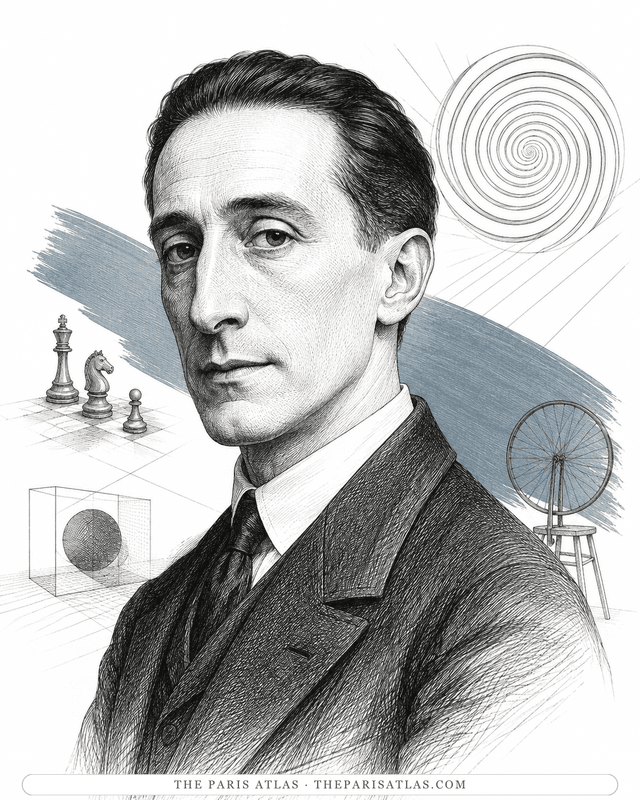
Marcel Duchamp
The century's quietest revolutionary — readymades, the abandonment of painting, chess on a Paris rooftop in Entr'acte, and one anemic film of spinning puns signed Rrose Sélavy.
Brazilian painter who spent the 1920s moving between São Paulo and Paris, studied Cubism under André Lhote, Albert Gleizes and Fernand Léger, and used what she learned to paint Brazilian towns, railways, plants and bodies. Her 1928 painting Abaporu prompted the manifesto that gave the Anthropophagic movement its name.
The sources below include collection records, catalogues, scholarly research, and primary materials that informed this page. They document Broadway Boogie Woogie, its making, and its place in cultural history.
The holding museum's record: the 1942 to 1943 dates, the 127 by 127 cm square canvas, Mondrian's 1940 arrival in New York, and the boogie-woogie music behind the title.
These references provide the documented foundation for this work's history and interpretation. Claim-level citations remain attached to the specific claims they support.


 View source