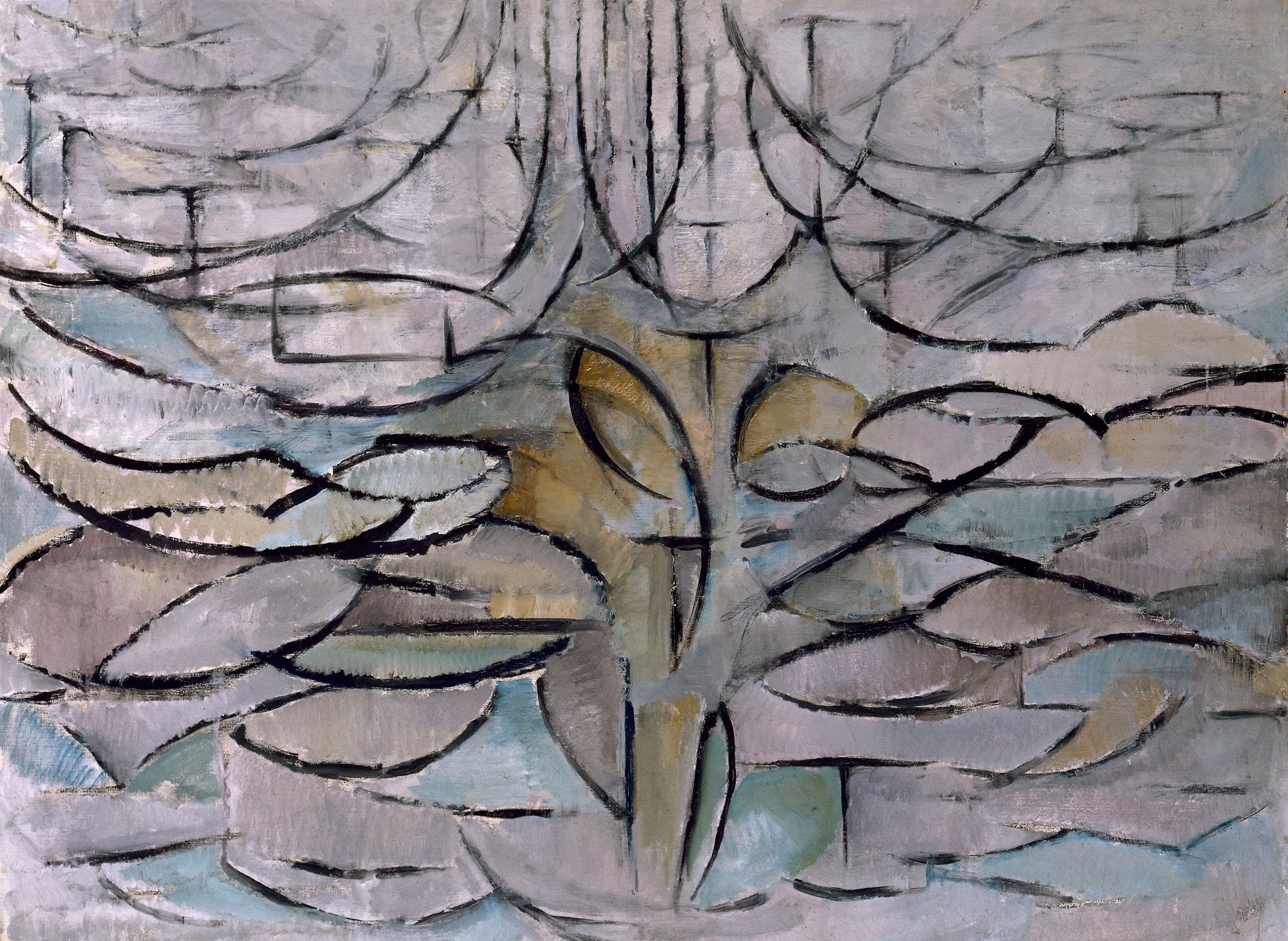
A bare tree fills the canvas from edge to edge, its branches laid in as long dark arcs across a field of short grey strokes. Piet Mondrian painted it in 1911, in the months before he left the Netherlands for Paris, and took almost all the colour out: the picture is black, white and grey. The Kunstmuseum Den Haag holds it and calls it The Grey Tree.
One tree, seen from close to, with no ground line and no sky above the crown. The trunk rises just left of centre and forks about a quarter of the way down from the top. From that fork the limbs sweep out sideways in long curves that run off all four edges of the canvas. Nothing in the picture is smaller than a branch: there are no leaves, no bark texture, no birds, no horizon.
The spaces between the branches are not left empty. Mondrian filled each one with short parallel strokes of pale grey, laid in fans that follow the curve of whichever branch they sit against. In the lower third the strokes change direction and become stacked horizontal dashes, which read as a hedge or a bank behind the trunk.
The canvas is 79.7 by 109.1 centimetres, a little over two and a half feet by three and a half. The signature is at the lower left, in capitals, and reads P. MONDRIAN.
The year he gave up colour
The Kunstmuseum Den Haag sets the painting in a specific and unsettled year. Mondrian visited Paris in the spring of 1911 and was so taken with it that he decided to move. He spent the rest of that year preparing to go. After the summer he broke off his engagement, which the museum reads as choosing his life as an artist outright.
He was thirty-nine, had a reputation as one of the best Dutch landscape painters then working, and had just come off a much-discussed exhibition. He left all of it. The Grey Tree was painted during those chaotic months before his departure, and he moved to Paris in January 1912.
The museum makes the point through a comparison with Evolution, a large triptych he had painted earlier the same year. Against that, the change of palette is drastic. Lush colour has given way to shades of black, white and grey. The museum calls it a return to the basics, to drawing.
What Cubism gave him
Mondrian reduces the tree to what the museum calls its essence, and it credits Cubism with the pressure behind that. The timing is awkward and the museum says so: during his short spring visit to Paris, Cubism was the talk of the day, but no work by Pablo Picasso or Georges Braque was actually on view.
He saw it properly at home. An exhibition at the Stedelijk Museum in Amsterdam in the autumn of 1911, which Mondrian helped organise, put Cubist painting in front of Dutch artists for the first time. The museum describes the lesson he took from it: a painting's meaning need no longer be carried by literal symbolism, because colour and line can carry it instead.
What Mondrian made of that is not what Picasso and Georges Braque made of it. The Kunstmuseum Den Haag, writing about its 2014 exhibition Mondrian and Cubism, puts the difference plainly. For Picasso, Cubism was a way of playing games with the public and with other painters. Mondrian took it far more seriously, as a way of using colour and line to reach the essence of art and beauty.
One tree, painted again and again
The Grey Tree is the middle term of a sequence the Kunstmuseum Den Haag can show almost complete. Before it comes Avond (Evening): The Red Tree, painted between 1908 and 1910, where the same kind of bare tree is set in blue against red. After it comes Flowering Apple Tree of 1912, in which the branches have flattened into curved lenses and the trunk has nearly gone.
A preparatory drawing survives in the same collection. Boom: studie voor De grijze boom is black chalk on paper, 58.4 by 86.5 centimetres, made in 1911 and given to the museum by the Vrienden van Kunstmuseum Den Haag. Hans Janssen, the museum's curator of modern art, argued in 2014 that Mondrian worked this way throughout: the abstract compositions after 1911 start from the play of lines in earlier figurative drawings.
Close reading
Reading the work, detail by detail
Piet Mondrian painted The Grey Tree in 1911 in black, white and grey, and at arm's length it reads as one continuous web. Close in it separates into two kinds of mark: long dark branch strokes laid with a loaded brush, and short pale strokes that fill every gap between them. The bristle tracks are legible throughout, and the lower third turns into stacked horizontal dashes.
1.He signed it with the Paris spelling
The signature sits in a pale band at the lower left and reads P. MONDRIAN., in small capitals, with a full stop after the initial and another after the name. It is the single-a spelling he used in France, on a canvas painted in the Netherlands before the move. To the left of it the paint thins to a warm ochre smear where the ground shows.
2.The trunk forks near the top
The trunk rises just left of centre and splits about a quarter of the way down from the top edge. It is painted as a broad grey band with a darker contour running down each side, so it reads as round rather than flat. The pale strokes packed around it curve to follow the limbs.
3.The branches have a lighter core
A long branch runs across the picture with a lighter grey stroke drawn along the inside of its dark outline. The effect is a tube rather than a line, and Mondrian repeats it on every limb thick enough to carry it. Below it, the pale strokes are already squaring up into blocks.
4.Three branches crossing
Three branches converge at a shallow angle and leave a pointed pocket of pale strokes between them. Mondrian does not draw the crossing as one branch passing in front of another. He lets the dark strokes merge into a single mass, which is why the picture reads as a web and not as a tree in depth.
5.Every gap is filled with fanned strokes
The pale areas are not washed in. They are built from short strokes of a flat brush, set side by side in fans that follow the curve of whichever branch they lie against. Each stroke keeps its bristle tracks, so the surface reads as combed even where nothing is drawn.
6.The longest branch leaves the canvas
One branch sweeps left in a shallow curve and runs straight off the edge of the canvas. It does not taper or end. Mondrian cropped the tree rather than fitting it to the picture, which is why no part of the crown's outline appears anywhere in the painting.
7.The twigs thin to a whip at the upper right
At the upper right the branches narrow to thin whipping strokes, some no wider than a bristle. Between them the pale fans open out and get broader. A small rust-coloured mark sits among them, one of very few warm notes anywhere in the picture.
8.The darkest passage is a knot of crossings
Several heavy branches overlap here until the paint is almost black. It is the darkest passage in the canvas and it sits left of centre, not at the trunk. Directly above it a pale stroke has been dragged with a splayed brush, leaving a row of fine ridges.
9.The foot of the trunk
The trunk meets the ground as a dark vertical band with a blunt black mark at its foot. There is no root and no shadow. A broad pale stroke runs across underneath it, and from that line down the whole picture changes character.
10.The bottom third is stacked dashes
Below the branches the strokes stop curving and lie down flat. They are short horizontals of pale grey laid in rows over a darker ground, stacked like courses of brickwork. Read on their own they are the most nearly abstract thing in the painting.
11.A splayed brush leaves a scalloped edge
At the lower right the pale strokes end in a row of fine scallops, left by a brush whose bristles had splayed. Mondrian kept the mark rather than working over it. Tiny warm specks show through in the gaps where the ground was never covered.
12.Bare canvas along the top edge
A strip of warm tan runs along the top edge where the paint was never taken to the canvas edge. It is the only place in the picture where the ground can be seen uncovered over any distance. The grey beside it is brushed so thin that the weave counts through it.
13.The corner is barely painted
In the top left corner the grey is dragged out until the canvas texture dominates the paint. A single dark speck interrupts it. Mondrian gave the corners of this canvas less attention than any other part of it, which is worth knowing before the grids, where the corners carry as much as the centre.
Timeline
1908–1910
Paints Avond (Evening): The Red Tree, the first of the bare-tree canvases now at the Kunstmuseum Den Haag.
Spring 1911
Visits Paris and decides to move there. Cubism is being discussed everywhere, but no work by Pablo Picasso or Georges Braque is on show.
Autumn 1911
Helps organise an exhibition at the Stedelijk Museum in Amsterdam that brings Cubist painting to Dutch artists.
After summer 1911
Breaks off his engagement while preparing to leave the Netherlands.
1911
Paints The Grey Tree, along with a black chalk study for it, during the months before his departure.
January 1912
Moves to Paris.
From 1950
The collector Salomon B. Slijper and Louis Wijsenbeek, director of the museum from 1950 to 1976, lay the foundations of the Mondrian collection. The painting is credited to Slijper's bequest.
Where to see it
Kunstmuseum Den Haag
The Hague, Netherlands
A public viewing address has not yet been confirmed for this holding.
Gallery displays change, and the museum rotates its Mondrian holdings. Check the museum's own object record before making a special visit.
Frequently asked questions
Where is The Grey Tree?
At the Kunstmuseum Den Haag in The Hague, object number 0334314, in the bequest of Salomon B. Slijper. The museum holds the largest collection of Mondrian's work in the world. Gallery displays change, so check the museum's own record before travelling to see it.
Why is The Grey Tree grey?
Because Mondrian stripped the colour out deliberately in 1911. The Kunstmuseum Den Haag compares it with Evolution, painted earlier that year, and describes the change of palette as drastic: lush colour replaced by shades of black, white and grey. The museum calls it a return to the basics, to drawing.
Is The Grey Tree a Cubist painting?
It is the point where Cubism reaches Mondrian's work, but it is not Cubism as Pablo Picasso and Georges Braque were painting it. They broke a subject into overlapping facets. Mondrian dissolved this tree into a web of curved lines, keeping the branch structure legible while giving up everything else.
How big is The Grey Tree?
79.7 by 109.1 centimetres, oil on canvas — roughly two feet seven by three feet seven. The Kunstmuseum Den Haag dates it to 1911.
Is it called The Grey Tree or Gray Tree?
The Kunstmuseum Den Haag, which owns it, prints The Grey Tree on its English collection page and De grijze boom in Dutch. Gray Tree, with the American spelling, is the form used on Wikimedia Commons and in a good deal of English writing about Mondrian. All three name the same 1911 canvas.
Did Mondrian paint other trees?
Many, and the Kunstmuseum Den Haag holds a run of them. Avond (Evening): The Red Tree came first, painted between 1908 and 1910. The Grey Tree followed in 1911, and Flowering Apple Tree in 1912, by which point the branches have become curved lenses and the trunk has almost disappeared.
In the atlas
What the graph records about this work — every claim carries its citation.
Piet Mondrian reduced a bare tree to a web of curved lines in 1911, in black, white and grey. The Kunstmuseum Den Haag attributes the change to Cubism, seen at a Stedelijk Museum exhibition in Amsterdam that autumn rather than in Paris.
— The Grey Tree — collection page; Mondrian and Cubism — Paris 1912–1914, exhibition
Explore painters from the same movements and circles.
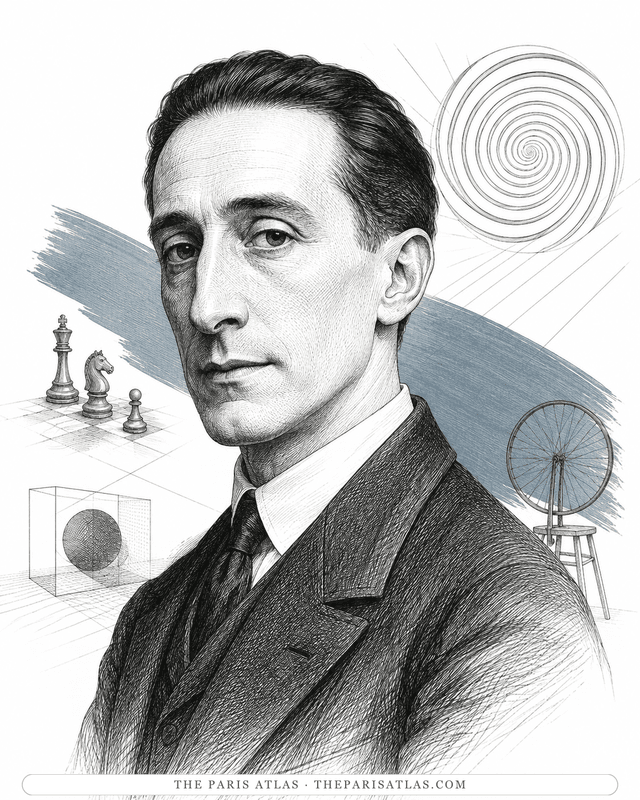
Marcel Duchamp
The century's quietest revolutionary — readymades, the abandonment of painting, chess on a Paris rooftop in Entr'acte, and one anemic film of spinning puns signed Rrose Sélavy.
Brazilian painter who spent the 1920s moving between São Paulo and Paris, studied Cubism under André Lhote, Albert Gleizes and Fernand Léger, and used what she learned to paint Brazilian towns, railways, plants and bodies. Her 1928 painting Abaporu prompted the manifesto that gave the Anthropophagic movement its name.
The sources below include collection records, catalogues, scholarly research, and primary materials that informed this page. They document The Grey Tree, its making, and its place in cultural history.
1The Grey Tree — collection page
Website
Kunstmuseum Den Haag
Used for
The holding museum's record: the 1911 date, the 79.7 by 109.1 cm canvas, the Slijper bequest, the broken engagement, the comparison with Evolution and the 1911 Stedelijk exhibition.
3Mondrian and Cubism — Paris 1912–1914, exhibition
Website
Kunstmuseum Den Haag
Used for
The museum's account of Mondrian's Paris years, the January 1912 move, and Hans Janssen's argument that the abstract compositions start from earlier figurative drawings.
These references provide the documented foundation for this work's history and interpretation. Claim-level citations remain attached to the specific claims they support.




 View source