Associated with · 1933
Modern Art
Piet Mondrian painted the square canvas in 1933 and intended it to hang as a lozenge, writing instructions on the back. The Kunstmuseum Den Haag calls it atypical in his work for using only yellow and white.
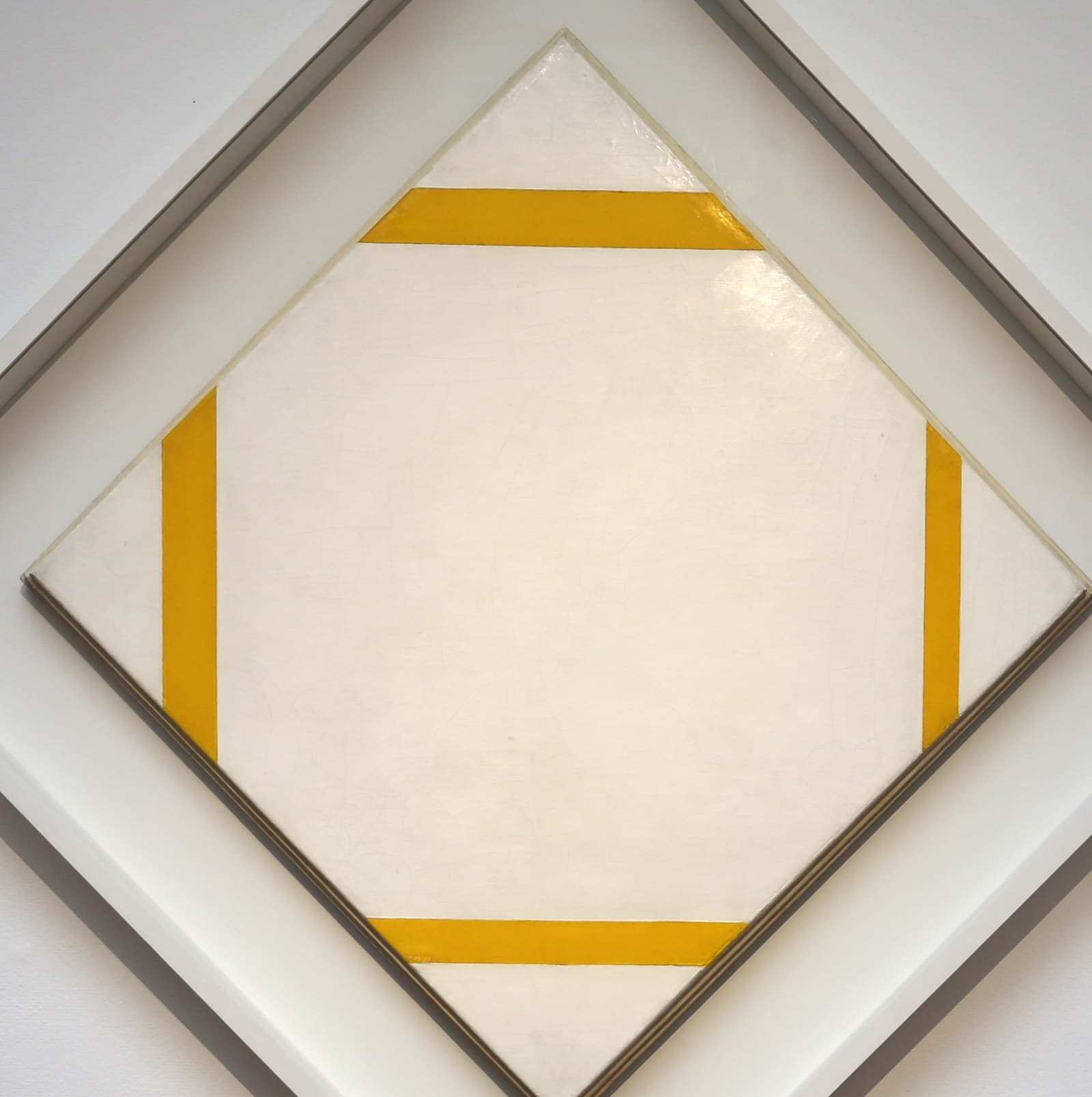
A square canvas hung on its corner, so it reads as a diamond, with four yellow lines across an off-white ground and no black anywhere. Piet Mondrian painted it in 1933, and the Kunstmuseum Den Haag calls it atypical in his work for using only yellow and white. The painting reached the museum the same year, bought by a subscription that the painter Charley Toorop organised among his admirers.
Four yellow lines on white, and nothing else. Two of them run horizontally, one near the top point of the diamond and one near the bottom; two run vertically, one near the left point and one near the right. Every line begins at one canvas edge and ends at another, cutting a triangle off each of the four corners.
The four lines never touch. The white they enclose is a single large eight-sided field in the middle of the picture, with four white triangles around it at the points. Because the support is square but hung on its corner, the lines run horizontally and vertically for the viewer while the canvas edges run at forty-five degrees.
The Kunstmuseum Den Haag describes the surface as smooth and off-white, without the black lines that give most of Mondrian's other work its structure. It also puts the awkwardness of the yellow bands well: they are just too thin to be planes and too thick to be simply lines. The museum adds that yellow and white differ little in tonal value, and yet the contrast looks strong.
None of the four lines is mechanically ruled. Each has one crisper edge and one where the yellow runs slightly into the white, and a faint darker line can be seen along some of the boundaries where the edge was set before the colour was laid in. The bands change width along their length.
The yellow itself is not even. It is a deep chrome yellow with ochre in it, laid solidly in the middle of each band and thinning towards the ends, where the white ground shows through the colour. The canvas weave reads through the paint across the whole surface, and a fine craquelure runs over the white.
The painting carries its own narrow moulding, a stepped dark strip fixed tight to the canvas edge, and hangs inside a separate modern white box frame. Mondrian was anxious enough about the hanging to write instructions on the back, according to the Kunstmuseum Den Haag, because the picture only works as a lozenge.
The painting came into the collection in 1933 through the painter Charley Toorop. With friends among artists and architects, she organised a collection to mark Piet Mondrian's sixtieth birthday. The plan was to buy a canvas by Mondrian and give it to a museum.
It went to the Gemeentemuseum in The Hague, which at first did not know what to do with it. The museum's own account is blunt about that: when the building opened in 1935 the painting hung in one of the stairwells, along with other abstract canvases by Bart van der Leck, Theo van Doesburg and others.
The credit line still records who paid. The museum prints it as a gift of the admirers of the artist represented by Charley Toorop.
The museum's English page heads the record Lozenge Composition with Yellow Lines. The Dutch text on the same page calls it Compositie met gele lijnen — Composition with Yellow Lines, with no reference to the diamond format. Both name the 1933 canvas, object number 0332044.
The measurements make the format explicit. The stretcher is 80.2 centimetres high and 79.9 wide, so it is very nearly a true square, and the museum also records the diagonal at 112.9 centimetres because that is the dimension a wall has to accommodate.
Close reading
Four yellow bands on an off-white square hung on its corner, and nothing else. Every measurement below is taken from the reproduction published here. The bands are neither the same width as one another nor rectangular: each is a trapezoid, because the canvas edges that cut its ends run at forty-five degrees. The photograph carries a raking sheen across the upper right, so brightness differences there are the gallery lighting rather than the paint.
1.The top band is cut by the canvas edge
The upper band ends in a clean diagonal where the canvas edge crosses it. It is not tapered or faded out; the edge of the support does the cutting. Beyond it runs a pale strip of moulding fixed tight against the canvas.
2.And cut again at the other end
At the other end the same band is cut by the opposite canvas edge, so the band is a trapezoid rather than a rectangle. Measured on the published file, its lower long edge runs about a quarter further than its upper one. The white above carries a broad sheen of reflected gallery light.
3.The left band is the widest of the four
The left vertical band is the widest of the four. On the published file it measures about eighty pixels across against fifty-three for the band on the right, so it is roughly half as wide again. A fine darker line runs along one edge where the boundary was set before the colour went in.
4.The right band is the narrowest
The band on the right is the narrowest of the four. Its left edge is crisp and its right edge softer, where the yellow thins and the ground begins to show through the colour. The asymmetry with the left band is far larger than any distortion the camera introduces.
5.The bottom band is thinner than the top
Measured down the same column, the lower horizontal band is about sixty-four pixels thick against eighty-four for the upper one. That is roughly a third thinner. The white above it reads warmer than the white below, though the lighting makes that comparison less reliable than the widths.
6.The corner is where the frame shows
At the bottom point the moulding meets itself at a right angle. It is a narrow strip of two or three fine steps, dark brown with a paler line catching the light along each step. It is fixed directly to the canvas, inside the separate white box frame the museum hangs it in.
7.The top corner triangle
Above the upper band is a white triangle with no mark in it at all. The reflection running across it is light on varnish, not paint. Each of the four bands cuts a triangle like this one off a corner, and the four triangles differ in size because the four bands sit at different distances from their corners.
8.The middle field is a warm off-white
The large field in the middle photographs as a warm cream rather than a white. Fine cracks run across it in a loose net, and the weave of the canvas reads through the paint. The Kunstmuseum Den Haag describes the surface as smooth and off-white, without the black lines that structure the rest of Mondrian's work.
9.The left corner, and two frames
At the left point, two framings are visible at once: the painting's own narrow moulding, tight to the canvas, and behind it the deep white box the museum hangs it in. The moulding reads pale along the upper edges and dark along the lower ones, because the light falls on the steps from above.
10.Each band meets two different edges
The upper end of the right band is cut by the upper-right canvas edge; its lower end is cut by the lower-right one. Every band crosses from one edge of the diamond to a different edge, and none of the four ever touches another. The white they enclose is therefore a single eight-sided field.
11.The upper left edge
Along the upper-left edge the moulding runs as a straight pale diagonal beside a white field with nothing in it. The paint goes right up to the moulding. Mondrian's concern was that the picture be hung this way round, and the Kunstmuseum Den Haag records that he wrote instructions on the back.
12.The moulding in raking light
Seen along the lower-left edge, the moulding separates into two or three parallel steps, each catching a thin line of light. It is a strip frame rather than a picture frame: it holds the edge of the canvas and adds no width to the picture. The white beside it shows the same craquelure as the centre.
1933
Painted. The Kunstmuseum Den Haag records only yellow and white in it, and no black lines.
1933
Charley Toorop and friends among artists and architects raise money to buy a Mondrian for a museum, marking his sixtieth birthday. The painting enters the Gemeentemuseum Den Haag.
1935
Hangs in one of the stairwells when the museum's building opens, with abstract canvases by Bart van der Leck and Theo van Doesburg.
Kunstmuseum Den Haag
The Hague, Netherlands
A public viewing address has not yet been confirmed for this holding.
Gallery displays change, and the museum rotates its Mondrian holdings. Check the museum's own object record before making a special visit.
At the Kunstmuseum Den Haag in The Hague, object number 0332044. The credit line reads: gift of the admirers of the artist represented by Charley Toorop. Displays change, so check the museum's own record before travelling to see it.
Because Mondrian intended it that way, and the lines only make sense in that position. The support is a square, 80.2 by 79.9 centimetres, hung on one corner so that the four yellow lines run horizontally and vertically while the canvas edges run diagonally. The Kunstmuseum Den Haag records that he wrote hanging instructions on the back.
Mondrian left them out. The Kunstmuseum Den Haag calls the painting atypical in his work for using only yellow and white, with a smooth off-white surface and none of the black that structures most of his other paintings. The museum adds that yellow and white are close in tonal value, and yet the contrast reads as strong.
Four. Two horizontal, near the top and bottom points of the diamond, and two vertical, near the left and right points. Each runs from one canvas edge to another and cuts a triangle off a corner, and none of the four touches any of the others.
80.2 centimetres high by 79.9 wide, with a diagonal of 112.9 centimetres — the measurement that matters, since it hangs on its corner. Oil on canvas, dated 1933 by the Kunstmuseum Den Haag.
By public subscription in 1933. The painter Charley Toorop, with friends among artists and architects, raised money to buy a canvas by Mondrian and present it to a museum, marking his sixtieth birthday. The Gemeentemuseum Den Haag did not at first know how to place it, and hung it in a stairwell when the building opened in 1935.
Associated with · 1933
Piet Mondrian painted the square canvas in 1933 and intended it to hang as a lozenge, writing instructions on the back. The Kunstmuseum Den Haag calls it atypical in his work for using only yellow and white.
Explore painters from the same movements and circles.
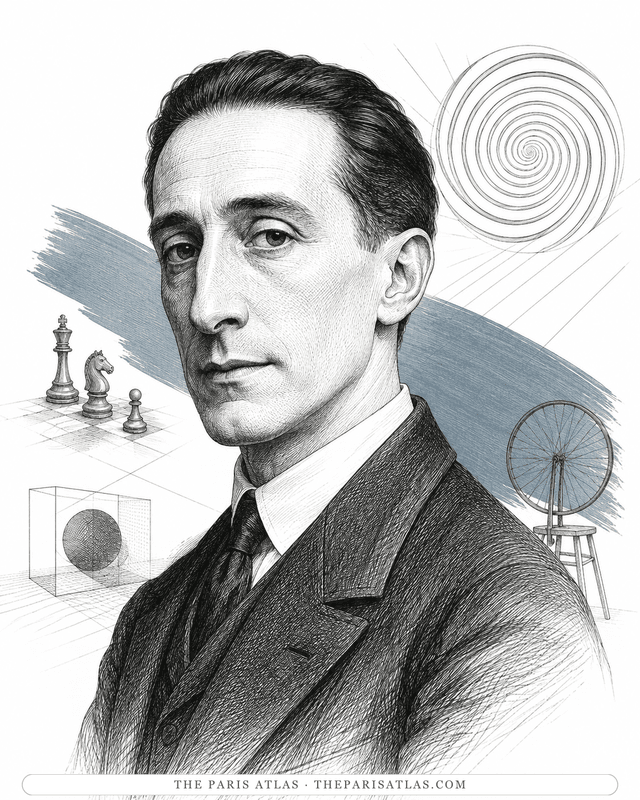
The century's quietest revolutionary — readymades, the abandonment of painting, chess on a Paris rooftop in Entr'acte, and one anemic film of spinning puns signed Rrose Sélavy.
View artist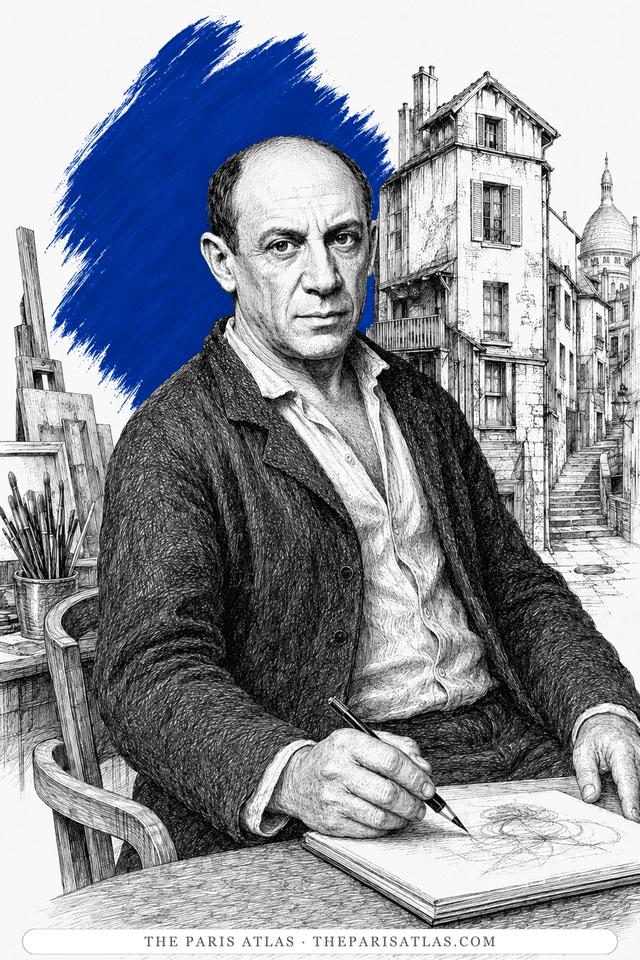
The painter whose canvases papered the walls of 27 rue de Fleurus before the writers arrived — the salon's resident modern master.
View artist
Brazilian painter who spent the 1920s moving between São Paulo and Paris, studied Cubism under André Lhote, Albert Gleizes and Fernand Léger, and used what she learned to paint Brazilian towns, railways, plants and bodies. Her 1928 painting Abaporu prompted the manifesto that gave the Anthropophagic movement its name.
View artistThe sources below include collection records, catalogues, scholarly research, and primary materials that informed this page. They document Lozenge Composition with Yellow Lines, its making, and its place in cultural history.


The holding museum's record: the 1933 date, the 80.2 by 79.9 cm canvas and its 112.9 cm diagonal, Charley Toorop's subscription, the 1935 stairwell hanging, the hanging instructions on the back, and the absence of black lines.
The black-lined grid this painting leaves behind, and the museum's statement that Mondrian's colours are never quite primary.
De Stijl, neoplasticism, and Theo van Doesburg's part in it.
Mondrian's life dates and the arc from figuration to abstraction.
These references provide the documented foundation for this work's history and interpretation. Claim-level citations remain attached to the specific claims they support.
 Explore more resources