Associated with · 1912
Cubism
Painted in 1912, the year Piet Mondrian moved to Paris to work through Cubism. Only the trunk and its fork survive as a tree; the rest is tiers of pointed ovals, with two drawn rectangles at the upper left.
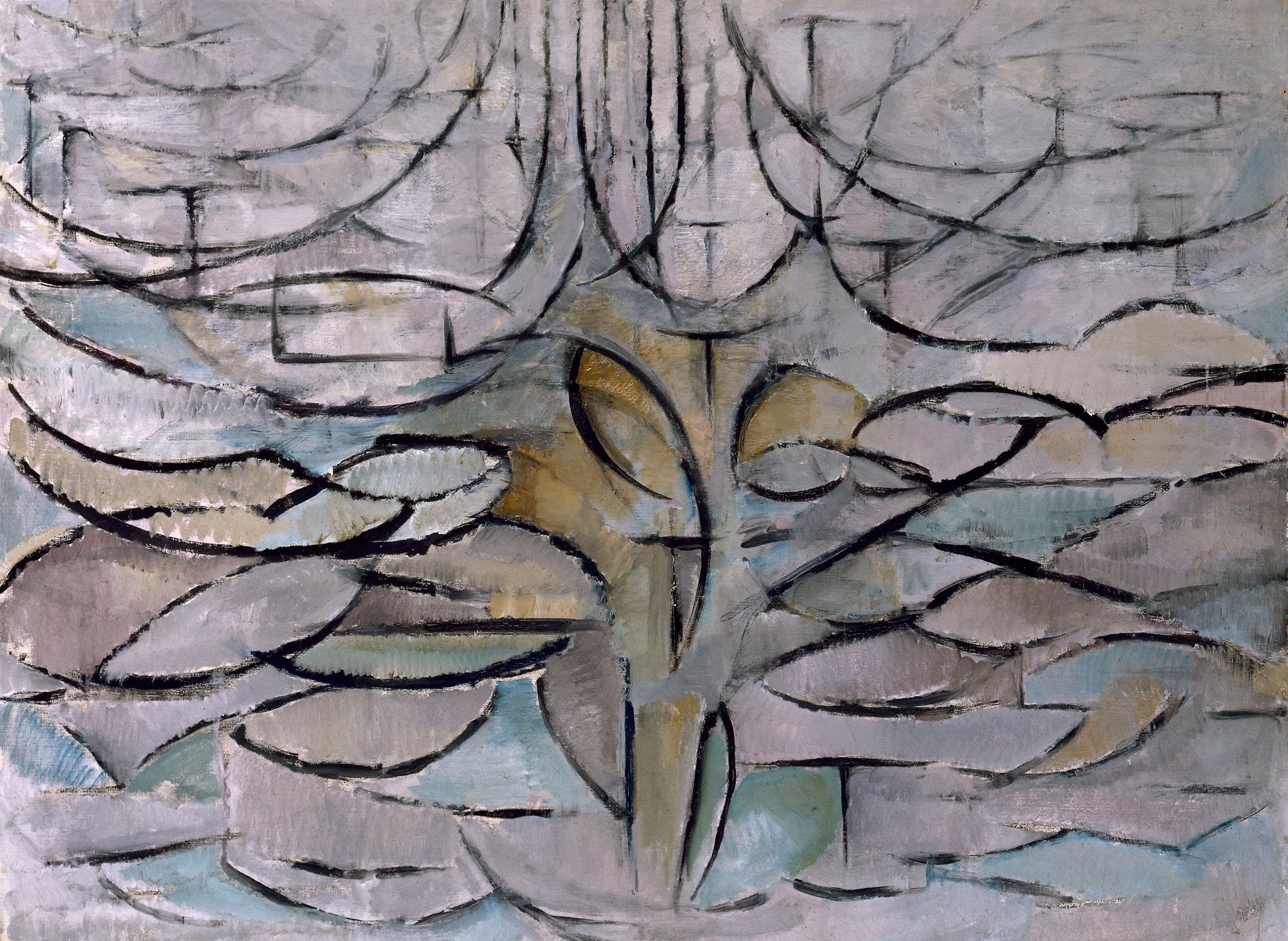
Painted a year after The Grey Tree, and almost the same size, so the two hang as a pair. The tree is still there but barely: a narrow ochre trunk at the bottom centre, a short fork above it, and everything else converted into tiers of curved lens shapes in mauve-grey, sage and pale blue-green. The Kunstmuseum Den Haag dates it to 1912, the year Piet Mondrian moved to Paris.
The surface is filled with pointed oval shapes, each outlined in a broken black line, stacked in horizontal tiers across the canvas. They read as a tree in blossom rather than as a tree: rows of curved shapes at the height branches would be, with nothing that could be called a twig.
At the centre bottom a narrow wedge of olive-ochre rises from the bottom edge and widens as it goes. About two-thirds of the way up it splits into a short Y. That wedge and that fork are the trunk, and they are the last recognisable piece of the subject.
The colour is not grey. The ground is a mauve-grey that shifts towards lilac in the lower half, the trunk and two large lens shapes beside it are ochre, and pale blue-green runs along the bottom edge and the lower right. The canvas is 78.5 by 107.5 centimetres, within two centimetres of The Grey Tree on both sides.
Set the two canvases side by side and the loss is easy to itemise. In The Grey Tree the trunk, the fork and every separate limb can be traced from root to tip, and the branches run off all four edges. In Flowering Apple Tree the trunk has shrunk to a wedge about a tenth of the picture's width, and the fork has become a single short Y. No branch can be followed for more than a few centimetres before it turns into an outline round a shape.
What Mondrian kept is the rhythm. The tiers of lenses sit at the heights the branches occupied in the earlier painting, and they thin and spread towards the top exactly as a crown does. He kept the spread and threw away the thing that was spreading.
One more thing changed, and it is the one that mattered later. Among all the curves, at the upper left, a rectangle is drawn in black — a horizontal along the top, a short vertical dropping at one end, a horizontal along the bottom, a stub rising at the other. A second, flatter one sits below it. They are the first straight-sided, right-angled shapes in the sequence.
Mondrian moved to Paris in January 1912 to work through Cubism, and took a studio at 26 rue du Départ beside the Gare Montparnasse. The Kunstmuseum Den Haag dates Flowering Apple Tree to that year.
In June 1914 he came back to the Netherlands and showed sixteen compositions painted in Paris over the previous two years at the Walrecht gallery in The Hague. The museum's own account of that exhibition says it showed how far he had travelled from the Dutch art of his time in two short years.
The museum's English collection page calls it Flowering Apple Tree. Its Dutch page calls it Bloeiende appelboom. The museum's own photograph of the painting carries a different English title inside the file: the embedded caption reads Blossoming apple tree, with the dimensions given as 78,5 x 107,5 cm and the date 1912. Wikimedia Commons follows that second form.
The Dutch title needs care as well. The Kunstmuseum Den Haag holds a second Bloeiende appelboom, painted in 1957 by Vilmos Huszár, in oil on hardboard and 60 by 52 centimetres. It is object number 0333408 and has nothing to do with Mondrian.
Close reading
A year after The Grey Tree, the same subject has been taken apart. Flowering Apple Tree keeps a trunk about a tenth of the picture's width and converts everything else into tiers of pointed ovals outlined in broken black. The colour comes back with it: mauve-grey, olive and golden ochre, sage and pale blue-green. Two drawn rectangles at the upper left are the first right angles in the sequence.
1.The trunk is all that is left
A narrow wedge of olive-khaki rises from the bottom edge and widens as it climbs. Its left contour is navy blue rather than black, its right contour black. A band of brighter golden ochre runs up inside it. This wedge is the last piece of the tree that can still be named.
2.Two ochre lenses at the centre
The two largest warm shapes in the painting sit either side of the fork, each a pointed oval outlined in a heavy black curve. Their centres are greyed down and their edges are pure golden ochre. Everything else in the upper half is grey, so these two carry the whole warm weight of the picture.
3.The first right angle
Among the curves, at the upper left, Mondrian drew a rectangle: a horizontal with a short vertical dropping from one end and another rising at the far end. A second, flatter one sits below it. They are painted with a dry brush and they wobble, and they are the earliest straight-sided, right-angled shapes in the tree sequence.
4.A lens the size of a branch
This single mauve-grey oval fills the space one limb occupied in The Grey Tree. The black outline around it is broken in three places and thickens where the brush pressed. Nothing inside it describes bark, leaf or blossom; it is a shape at the height a branch would be.
5.A lens combed into ridges
One lens has been dragged into a row of fine parallel ridges, like the inside of a scallop shell. The ridges run across the shape rather than along it. Mondrian used the same combing in the pale fans of The Grey Tree, so a mark invented for foliage has survived into a picture that no longer shows any.
6.Pale blue-green along the bottom
A wedge of pale blue-green sits at the lower left, laid in with vertical strokes that keep their bristle tracks. The same colour appears again at the lower right and along the bottom edge. It is the coolest note in the painting, and it appears nowhere above the halfway line.
7.The tiers flatten as they rise
Towards the top the ovals stretch and flatten until they are little more than long shallow arcs. The black outlines thin with them. A single near-vertical dark line drops through the group, the only one in this part of the canvas.
8.The palest shape is at the right
The lightest shape in the painting sits well right of centre, a cream lens whose lower edge breaks into fine ridges. A small ochre fleck sits against it. Mondrian balanced the picture by weight rather than by symmetry, and the palest and the warmest shapes are on opposite sides of the trunk.
9.Sage and mauve side by side
A sage-green shape meets a mauve-grey one along a broken black line. Both are painted thin enough for the weave to count through. The grey here is not neutral: it carries enough red to read as lilac beside the green.
10.The tiers stack towards the bottom right
At the lower right the lenses stack in flat tiers with very little space between them. The black outlines run almost horizontally. Below them a band of pale blue-green closes the picture off, doing the job the stacked dashes do in The Grey Tree.
11.Thin vertical drags at the bottom edge
Thin dark verticals run down to the bottom edge through a mauve ground laid on so thinly that the weave shows everywhere. They are the ends of the trunk's contours, carried past the last shape. The paint stops a few millimetres short of the edge.
12.Ochre survives at the left edge
Patches of ochre survive at the left edge, under two black arcs that run off the canvas. They are the same colour as the trunk, at the far side of the picture from it. The grey around them is thin enough to show the weave.
1911
Paints The Grey Tree, the canvas Flowering Apple Tree follows a year later, together with a black chalk study for it.
January 1912
Moves to Paris and takes a studio at 26 rue du Départ.
1912
Paints Flowering Apple Tree. The Kunstmuseum Den Haag records no other date for it.
June 1914
Returns to the Netherlands and shows sixteen compositions painted in Paris at the Walrecht gallery in The Hague.
2014
The Gemeentemuseum Den Haag marks a century since the Walrecht show with Mondrian and Cubism – Paris 1912–1914, held with the Museum of Modern Art in New York.
Kunstmuseum Den Haag
The Hague, Netherlands
A public viewing address has not yet been confirmed for this holding.
Gallery displays change, and the museum rotates its Mondrian holdings. Check the museum's own object record before making a special visit.
At the Kunstmuseum Den Haag in The Hague, object number 0332113. The museum's collection page credits it simply to Kunstmuseum Den Haag, with no donor named, unlike The Grey Tree beside it. Displays change, so check the museum's own record before travelling.
Yes, but only in two places. A narrow ochre wedge rises from the bottom centre and forks into a short Y about two-thirds of the way up, and that is the trunk. Everything above it has been converted into tiers of curved lens shapes with no traceable branches.
The Grey Tree of 1911 keeps every limb traceable and is painted in black, white and grey. Flowering Apple Tree of 1912 keeps only the trunk and the fork, replaces the branches with rows of curved lenses, and brings back colour — mauve-grey, ochre and pale blue-green. The two canvases are within two centimetres of each other in both dimensions.
78.5 by 107.5 centimetres, oil on canvas, dated 1912 by the Kunstmuseum Den Haag.
Both, by the same museum. The Kunstmuseum Den Haag prints Flowering Apple Tree on its English collection page, while the caption embedded in its own photograph of the painting reads Blossoming apple tree. The Dutch title is Bloeiende appelboom.
The Kunstmuseum Den Haag dates it to 1912, the year Mondrian moved to Paris in January and took the studio at 26 rue du Départ. The museum's collection record does not state a place of making.
Associated with · 1912
Painted in 1912, the year Piet Mondrian moved to Paris to work through Cubism. Only the trunk and its fork survive as a tree; the rest is tiers of pointed ovals, with two drawn rectangles at the upper left.
Explore painters from the same movements and circles.
The century's quietest revolutionary — readymades, the abandonment of painting, chess on a Paris rooftop in Entr'acte, and one anemic film of spinning puns signed Rrose Sélavy.
View artist
The painter whose canvases papered the walls of 27 rue de Fleurus before the writers arrived — the salon's resident modern master.
View artist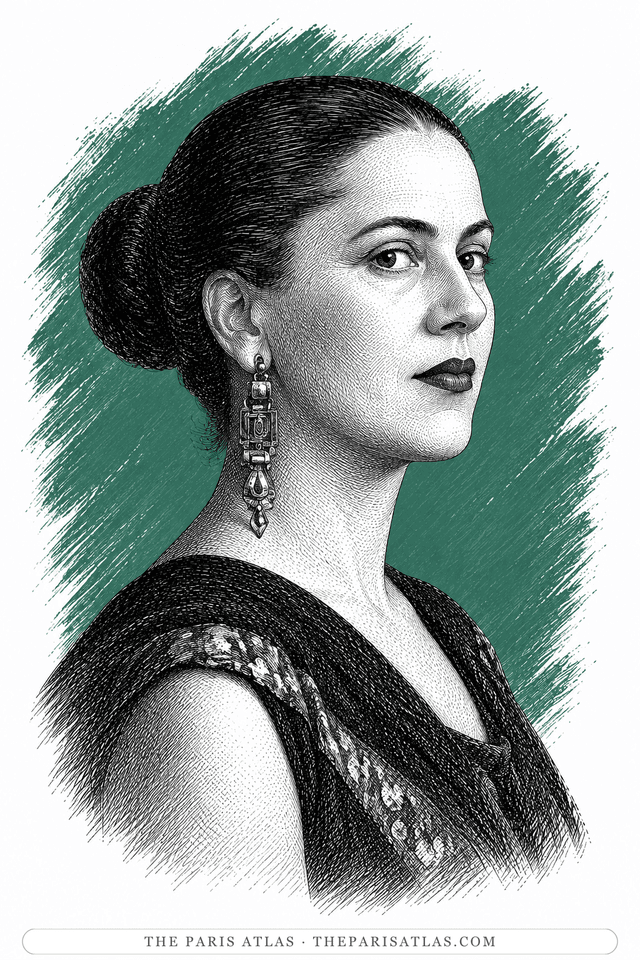
Brazilian painter who spent the 1920s moving between São Paulo and Paris, studied Cubism under André Lhote, Albert Gleizes and Fernand Léger, and used what she learned to paint Brazilian towns, railways, plants and bodies. Her 1928 painting Abaporu prompted the manifesto that gave the Anthropophagic movement its name.
View artistThe sources below include collection records, catalogues, scholarly research, and primary materials that informed this page. They document Flowering Apple Tree, its making, and its place in cultural history.


The holding museum's record: the 1912 date, the 78.5 by 107.5 cm canvas, the object number and the credit line.
The 1911 canvas this one follows, and the museum's account of the year before the Paris move.
The January 1912 move to Paris, the June 1914 Walrecht gallery exhibition of sixteen Paris compositions, and the 2014 centenary show held with the Museum of Modern Art.
The studio at 26 rue du Départ beside the Gare Montparnasse.
These references provide the documented foundation for this work's history and interpretation. Claim-level citations remain attached to the specific claims they support.
 Explore more resources