Andy Warhol painted Campbell's Soup Cans in 1962: thirty-two canvases, one for each variety of soup the company then sold. They were made by hand, before the silkscreens he became known for. The dealer Irving Blum bought the whole set back for $1,000 to keep it together, and the Museum of Modern Art acquired it in 1996.
Campbell's Soup Cans is a group of thirty-two paintings made by Andy Warhol in 1962. Each canvas depicts a different variety of Campbell's soup, giving an ordinary supermarket product the sustained attention traditionally associated with more elevated artistic subjects. The complete group belongs to the Museum of Modern Art in New York.
Why Thirty-Two Paintings?
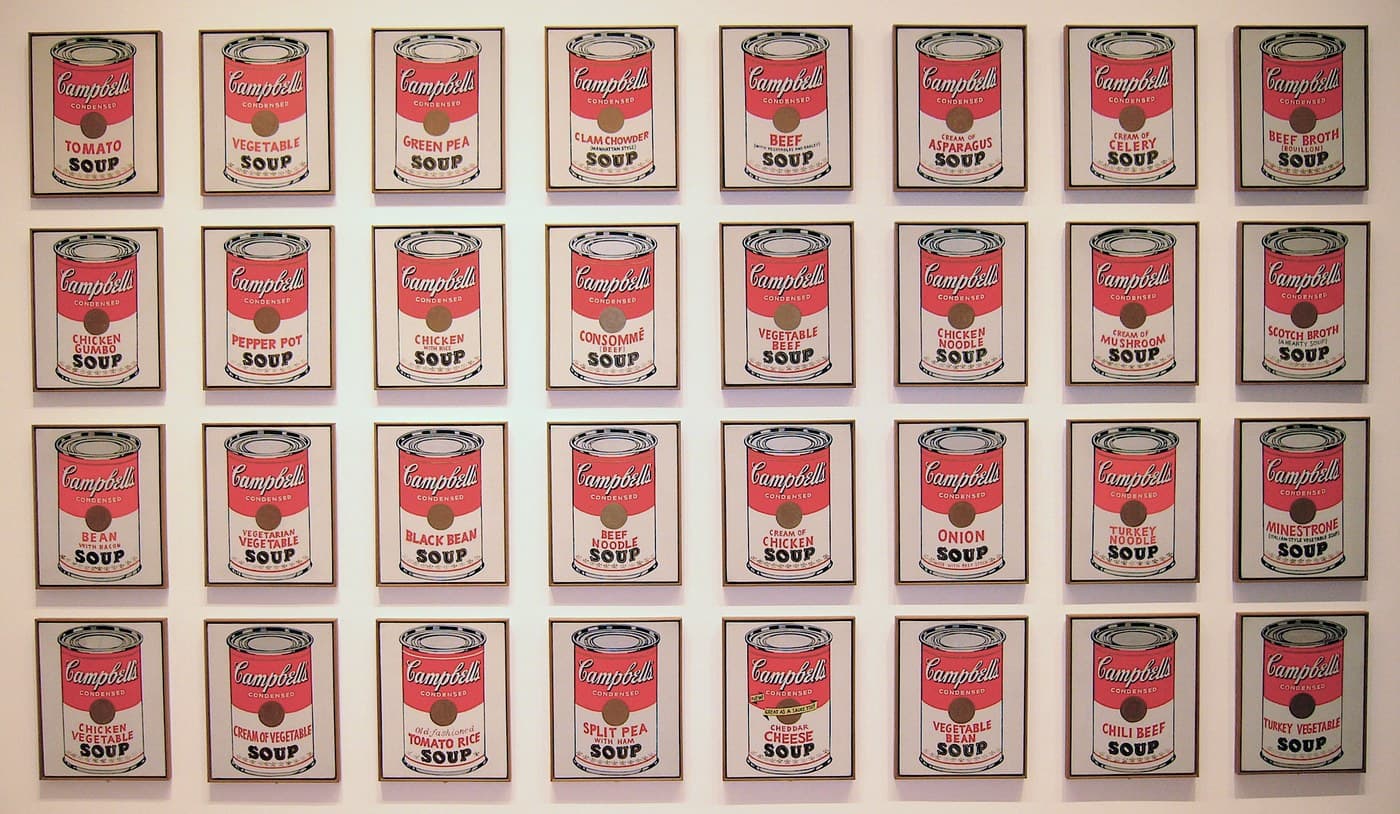
The number corresponded to the varieties of soup represented in the project. Their similar packaging produces an immediate impression of uniformity, while the names on the labels distinguish one product from another. The work therefore sets repetition against minor differences rather than presenting thirty-two completely identical images.
This structure allows the familiar commercial design to become strangely insistent. A can ordinarily receives only enough attention for a shopper to recognize and choose it. Warhol turns that quick encounter into something prolonged, making standardized packaging the subject of concentrated looking.
Painted by Hand, Not Silkscreened
The original 1962 canvases were made by hand, despite their association with mechanical repetition. Stamped details and other repeated procedures helped create consistency, but the paintings retain variations in their execution. They should not be confused with Warhol's later soup-can screenprints.
Close examination reveals differences in red paint, metallic tops, decorative patterns, and individual details. These irregularities complicate the apparent industrial uniformity. The paintings look toward mass production while remaining physical objects that were individually worked on.
The Exhibition That Nearly Broke Up the Set
The paintings were first exhibited together at the Ferus Gallery in Los Angeles in 1962, arranged along ledges that recalled shop shelving. Gallery director Irving Blum initially sold several canvases separately, including one to the actor Dennis Hopper. Before the exhibition ended, however, he decided that the group needed to remain intact.
Blum reclaimed the sold paintings and bought all thirty-two from Warhol for $1,000, paid in installments. That decision preserved the work's serial structure. In 1996, MoMA acquired the group through a combination of purchase and partial gift from Blum. Its survival as a complete ensemble depended partly on a dealer recognizing that the relationship between the canvases mattered as much as any individual image.
Meaning and Historical Importance
The work occupies a pivotal position between Warhol's commercial-art background and the practice for which he became internationally known. Soon afterward, silkscreen offered a more directly mechanical means of repeating and varying images. The soup cans stand at the threshold of that development: handmade paintings deliberately approaching the appearance of standardized goods.
Their significance does not depend on choosing one simple verdict about consumer culture. The familiar labels can seem affectionate, impersonal, reassuring, or monotonous. What remains consistent is the relocation of commercial imagery into sustained artistic attention, challenging the assumption that an ambitious painting requires an exceptional or traditionally prestigious subject.
Close reading
Reading the work, detail by detail
The reproduction shows all thirty-two canvases in a museum grid. These details compare individual labels and repeated arrangements within that installation, separating Warhol's painted cans from the frames, wall, and shadows around them.
1.Two labels share the same structure
The two cans share a red upper label, white lower label, gold medallion, and the large word Soup. Changing the variety name requires only a small part of the design to change. Seen side by side, the canvases make that combination of repetition and difference immediately visible.
2.Ellipses give the flat cans volume
Nested ellipses describe the lids, while curved lines mark the lower rims. These simple conventions make each can appear cylindrical against its flat pale background. The surrounding red and white areas remain broad and graphic, so a small number of curved edges carries much of the illusion of volume.
3.Variety names change the spacing
The variety names occupy different numbers of lines and different widths. Some labels need smaller qualifying words, while others leave more white space. Close attention to this typography reveals variation inside a design that can look identical when the entire grid is seen at once.
4.The medallion holds a fixed position
A small gold medallion sits at the boundary between red and white on each can. Its repeated position helps stabilize the label when the words beneath it change. The medallions also create a second, smaller sequence across a row, inside the larger repetition of the canvases themselves.
5.One yellow banner breaks the red-and-white pattern
A narrow yellow banner above Cheddar Cheese adds a color accent absent from many neighboring labels. The addition is small enough to fit the standard package design but large enough to attract attention once noticed. The grid encourages comparison, making this minor variation easier to find.
6.The wall keeps the thirty-two units separate
Visible frames and strips of wall separate the painted cans into individual objects. Shadows belong to the photographed installation, not to the printed designs on the labels. The regular hanging arrangement presents the canvases as a group while preserving the boundaries of each painting.
Andy Warhol paints thirty-two canvases by hand, one for each variety of Campbell's soup then sold.
1962
The set is shown at the Ferus Gallery in Los Angeles, arranged on ledges like shop shelving. The director Irving Blum sells several canvases separately, one of them to the actor Dennis Hopper.
1962
Before the show closes, Blum reclaims the sold canvases and buys all thirty-two from Warhol for $1,000, paid in instalments, so the set stays together.
1996
The Museum of Modern Art acquires the complete group, through purchase and a partial gift from Blum.
Where to see it
Museum of Modern Art
New York, United States
A public viewing address has not yet been confirmed for this holding.
Acquired complete by the Museum of Modern Art in 1996. Gallery displays change, so check the museum's own object record before making a special visit.
Frequently asked questions
Why are there thirty-two Campbell's Soup Cans?
One canvas for each variety of soup the company sold at the time. The packaging is near-identical across all thirty-two, so the differences come down to the names on the labels. The work sets repetition against small differences rather than showing the same image thirty-two times.
Are the Campbell's Soup Cans silkscreens?
No. The original 1962 canvases were painted by hand. Warhol used stamped details and repeated procedures to keep them consistent, but close looking shows variation in the red paint, the metallic tops and the decorative patterns. His soup-can screenprints came later and are a different thing.
How big is each canvas?
50.8 by 40.6 centimetres, so 20 by 16 inches. That is the measurement of each individual painting, not of the whole arrangement of thirty-two.
Who kept the set of thirty-two together?
Irving Blum, director of the Ferus Gallery in Los Angeles, where they were first shown in 1962. He had already sold several canvases separately, one to the actor Dennis Hopper. Before the exhibition closed he changed his mind, took the sold ones back, and bought all thirty-two from Warhol for $1,000 in instalments.
Where are the Campbell's Soup Cans now?
At the Museum of Modern Art in New York, which acquired the complete group in 1996 through purchase and a partial gift from Irving Blum. Gallery displays change, so check the museum's own object record before making a special visit.
In the atlas
What the graph records about this work — every claim carries its citation.
Andy Warhol painted thirty-two canvases by hand in 1962, one for each variety of Campbell's soup then sold. They approach the look of standardized goods while remaining individually worked objects, and they sit just before the silkscreens that made repetition mechanical.
— Andy Warhol, Campbell's Soup Cans — collection record; Hillary Reder, Serial & Singular: Andy Warhol's Campbell's Soup Cans
Explore painters from the same movements and circles.
Marcel Duchamp
The century's quietest revolutionary — readymades, the abandonment of painting, chess on a Paris rooftop in Entr'acte, and one anemic film of spinning puns signed Rrose Sélavy.
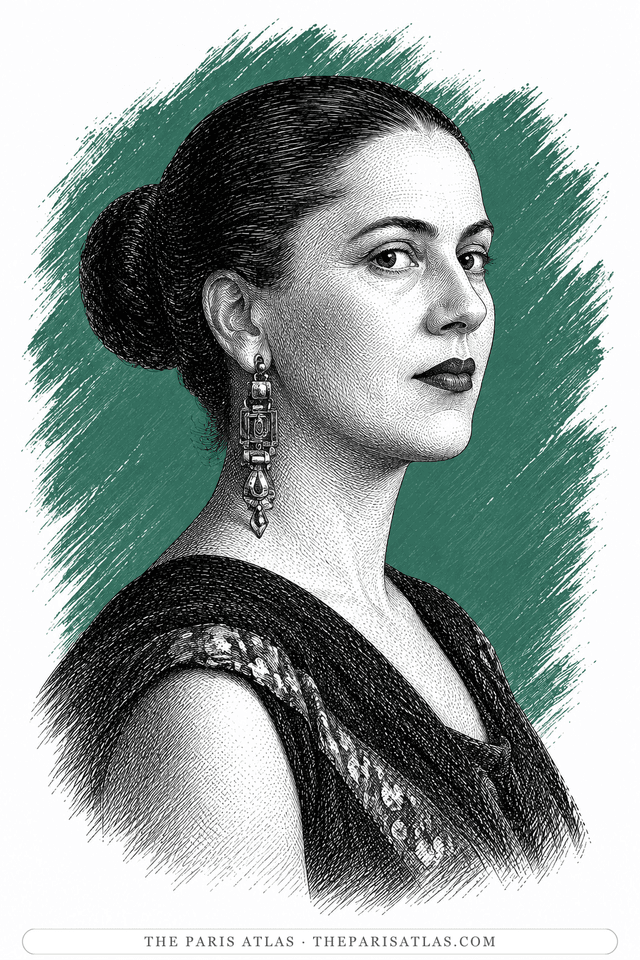
Brazilian painter who spent the 1920s moving between São Paulo and Paris, studied Cubism under André Lhote, Albert Gleizes and Fernand Léger, and used what she learned to paint Brazilian towns, railways, plants and bodies. Her 1928 painting Abaporu prompted the manifesto that gave the Anthropophagic movement its name.
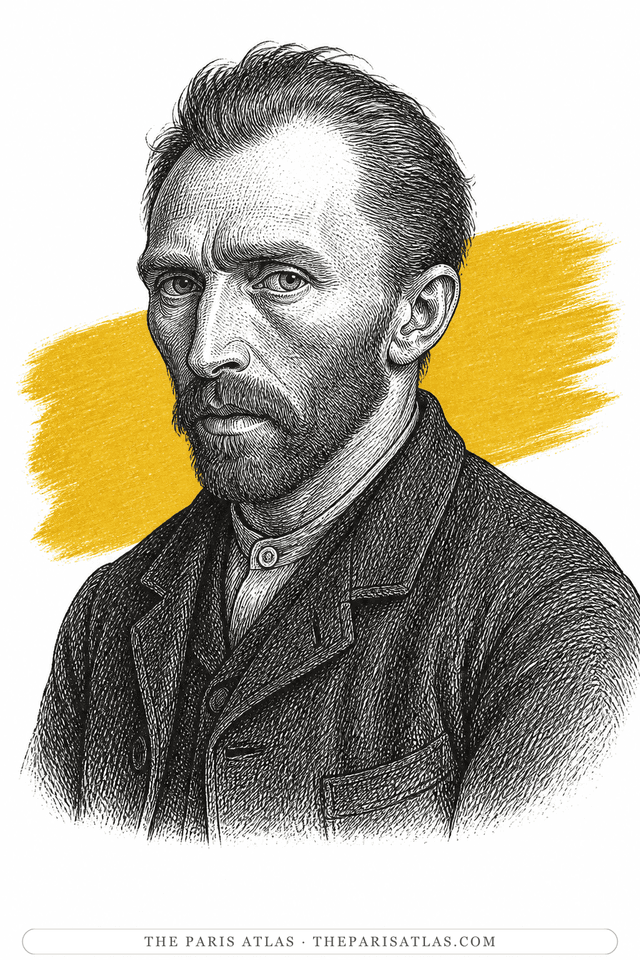
Dutch painter who lived in Montmartre with his brother Theo from March 1886 to February 1888 — the two years in which his dark Dutch palette turned into colour. He painted more than 200 pictures in Paris and died at Auvers-sur-Oise, north of the city, in 1890.
The sources below include collection records, catalogues, scholarly research, and primary materials that informed this page. They document Campbell's Soup Cans, its making, and its place in cultural history.
1Andy Warhol, Campbell's Soup Cans — collection record
Website
The Museum of Modern Art
Used for
The holding museum's record: the 1962 date, the thirty-two canvases at 50.8 by 40.6 cm each, and the 1996 acquisition.
2Serial & Singular: Andy Warhol's Campbell's Soup Cans
Website
The Museum of Modern Art
Used for
Hillary Reder on the handmade execution, the visible variations between canvases, the 1962 Ferus Gallery show, and Irving Blum buying the set back for $1,000.
These references provide the documented foundation for this work's history and interpretation. Claim-level citations remain attached to the specific claims they support.




 View source