Mao
by Andy Warhol
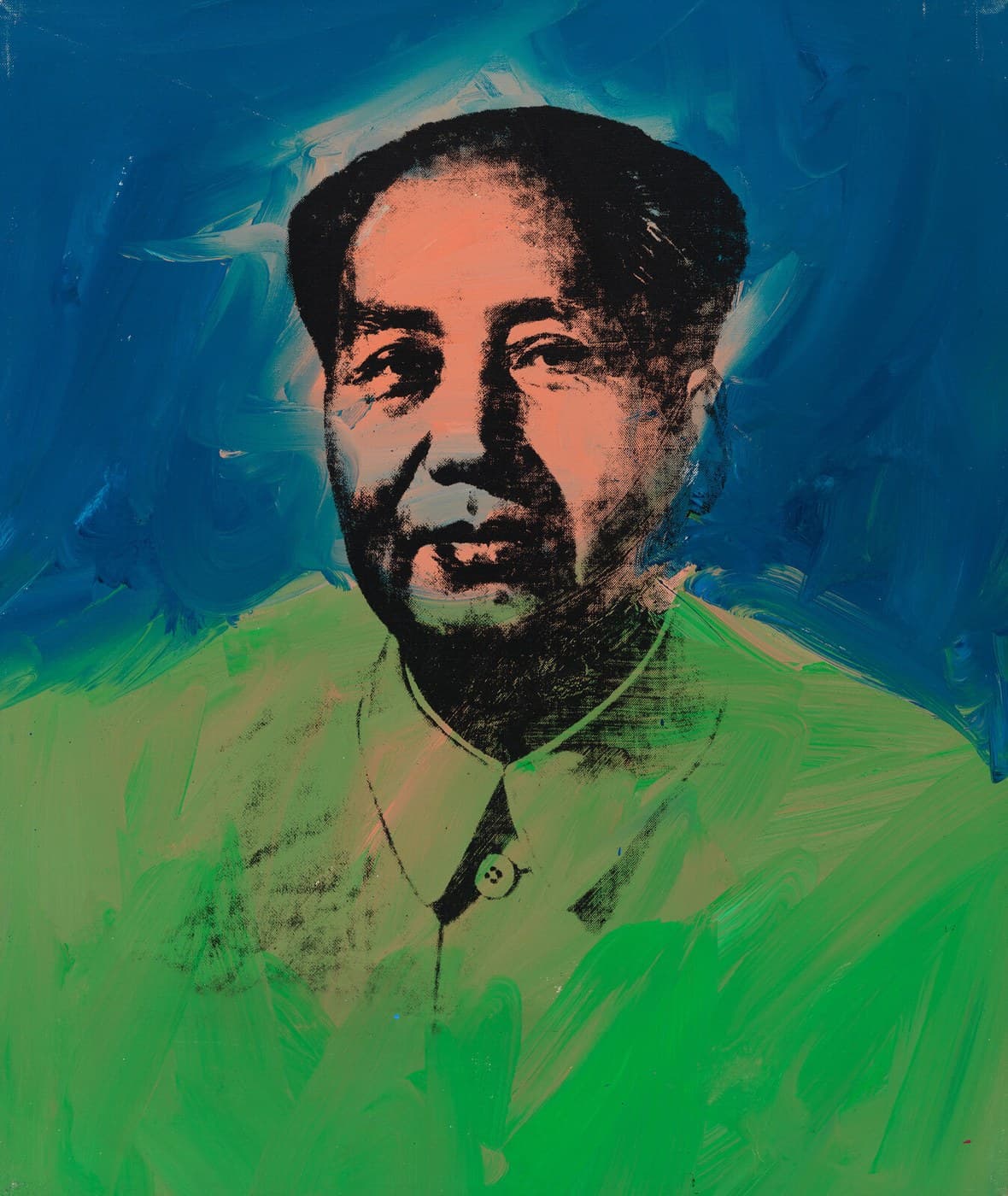
A head-and-shoulders portrait of Mao Zedong, small enough to hold in two hands, with a cobalt blue ground and a bright green tunic laid on in broad brushstrokes and the photographic image screened in black on top. The paint and the photograph do not line up, and on the right-hand side the blue covers a cheek the screen still draws. The source is the frontispiece portrait of the Little Red Book, whose photographer no institution can name. Andy Warhol made about 199 Mao paintings in 1972 and 1973; this is one of the small ones.
- 1973
- Acrylic and screenprint on linen
- Whitney Museum of American ArtNew York, United States
About Andy Warhol
What the painting shows
Mao Zedong, head and shoulders, facing forward. The background is cobalt blue, brushed on in broad curving strokes of two blues with pale streaks where the brush ran dry. The tunic is a bright acid green over a duller olive, brushed in long diagonals that reach the bottom edge of the canvas. The face is salmon. Over all of it the photograph is printed in black.
The tunic has a stand collar, drawn as a thin black line, and one button is legible at the point of the V made by the opening, printed as a circle with small dots for the thread holes. A small black oval sits on the chin below the lower lip, which is the mole that appears in the photograph.
The canvas is 66.5 by 55.9 centimetres — 26 3/16 by 22 inches, about the size of a large sheet of paper. That matters, because the Mao paintings are usually seen in reproduction at the scale of the largest ones, which are nearly fifteen feet high.
The photograph underneath, and its missing author
The black layer is a photographic portrait of Mao Zedong reproduced through a screen. Tate's catalogue entry for its Mao prints identifies the source: "In 1972 Warhol used a photograph of Chairman Mao, taken from the frontispiece of Quotations from Chairman Mao-Tse Tung" — the book known in English as the Little Red Book — "as the basis for a series of paintings, prints and wallpaper." The 1966 English edition confirms the placement. Its cover is blank red with an embossed title and star, and the portrait is a full page following the title page. It carries no caption, no credit line and no photographer's name.
Tate is not consistent about this. Its printmaking page says Warhol used a photograph "from the cover of the Little Red Book", which the book itself contradicts; its scholarly catalogue entry says frontispiece, and that is right. The catalogue entry also dates the book to 1960, which is too early.
The Metropolitan Museum of Art owns the official portrait photograph itself — Chairman Mao, 1964, a gelatin silver print, accession number 2011.368 — and catalogues the artist as "Unknown", Chinese. It names Chen Shilin in a separate role, as the retoucher, not as the photographer. That is as close as any institution gets, and it is a statement that the author is not known rather than a name.
Warhol's practice through the 1960s and 1970s was to take a photograph somebody else had made and print it. In 2023 the Supreme Court decided Andy Warhol Foundation for the Visual Arts, Inc. v. Goldsmith on that question, over a photograph of the musician Prince taken by Lynn Goldsmith. The Court's ruling turned on a commercial licence rather than on the paintings.
Why Mao, and when
Richard Nixon went to the People's Republic of China from 21 to 28 February 1972, the first serving American president to do so. Warhol began the first group of eleven Mao paintings the following month, in March 1972.
The curator Jessica Beck, formerly of The Andy Warhol Museum, records where the subject came from, quoting Bob Colacello's Holy Terror. The dealer Bruno Bischofberger suggested that Warhol paint the most important figure of the twentieth century, and proposed Albert Einstein. Warhol answered: "That's a good idea. But I was just reading in Life magazine that the most famous person in the world today is Chairman Mao. Shouldn't it be the most famous person, Bruno?"
The interest predates the trip. In a telephone call of September 1971, quoted by his biographer Blake Gopnik, Warhol said of Chinese imagery: "They don't believe in creativity. The only picture they ever have is of Mao Tse-tung. It's great. It looks like a silkscreen."
Paint first, photograph second
The Andy Warhol Museum describes his method as "the process of underpainting before adding the final photographic silkscreen print", and defines registration as "the process of lining up the image on the screen to the underpainting". On this canvas the two are not lined up, and the order of operations is visible everywhere on the surface.
On the right-hand side of the face the salmon stops well inside the printed contour and the blue of the background runs up over the cheek, so the ear is printed onto blue rather than onto flesh colour. Across the left cheek and temple, broad pale blue-white strokes wide enough to show their bristles run straight across the boundary of the printed face. Streaks of peach are dragged out into the blue background, following the brush, because the flesh colour was still wet when the blue went over it.
The same thing happens at the shoulder. A strip of salmon survives along the right shoulder between the green and the blue, where both were brushed over a broad patch of flesh colour from either side and did not meet. Below the chin the green comes up over the salmon, so streaks of pink show through the collar.
The Art Institute of Chicago, writing about its own monumental Mao, describes the same handling: "garish colors are applied to Mao's face like makeup. The gestural handling of color in the portrait shows Warhol at his most painterly." Warhol was less reverent about it. Gopnik records that he called the brushwork "hand jobs" and "abstract pseudo-painting", and said he could do it without even thinking.
The photographic image itself is a coarse halftone. At the eyes the dots are large enough to count one by one, and the eyebrows are simply where enough of them touch to read as solid. Along the shoulder the black thins to scattered dots and the green shows through, in a break that follows the direction of the pull rather than any edge in the photograph. The catalogue raisonné describes the first eleven paintings as run without cleaning ink build-up from the screen, so that they fade out across the group. The last of that run is a black print on bare canvas, with no colour under it at all.
One of about 199
Warhol made roughly 199 Mao paintings between 1972 and 1973, in five set sizes, a figure the Metropolitan Museum of Art states in its own object text. He worked the subject in prints and wallpaper as well, which is why a bare title and a bare date do not identify one.
The sizes run from 12 by 10 inches up to 176 1/2 by 136 1/2 inches, which is 448.3 by 346.7 centimetres. The Art Institute of Chicago and the Metropolitan Museum of Art give that measurement identically for the two giants they each own. The Whitney's canvas sits in the small group, second smallest of the series, above only the miniatures.
The Whitney also owns the prints. Mao Tse-Tung, a portfolio of ten screenprints of 1972, is accession numbers 74.96.1 to 74.96.10. Those were printed by Styria Studio in New York in an edition of 250; the Whitney's set is an artist's proof, 46 of 50. Its own catalogue credits Peter M. Brant as publisher, which Tate's catalogue entry says is an error carried over from the standard print catalogue — Tate gives the publishers as Castelli Graphics and Multiples Inc.
The prints came first to the public. The Leo Castelli Gallery's own archive records Andy Warhol: Mao Prints at 420 West Broadway from 9 to 25 November 1972, and lists no Warhol exhibition of Mao paintings at all.
Paris, February 1974
The Mao paintings had their first major showing in Paris. The Art Institute of Chicago's registrarial record for its giant Mao opens its exhibition history with a single line: "Paris, Musee Galliera, Andy Warhol Mao, Feb. 23–Mar. 18, 1974, no cat." The prints catalogue raisonné gives the same dates independently, in its entry for the Mao wallpaper, which was printed by Bill Miller's Wallpaper Studio in New York for that exhibition.
The Musée Galliera on the avenue Pierre Ier de Serbie was then a City of Paris museum used for temporary exhibitions, including contemporary art; it had not yet become the fashion museum it is today. Because no catalogue was published, no checklist survives and the number of works cannot be stated. Bob Colacello, who was there, describes giant portraits in the main hall against walls papered in the purple-and-white Mao wallpaper, smaller rooms of medium-sized Mao paintings and the prints, and one room holding a hundred miniature Maos.
The French state bought a Warhol Mao the same year. The Centre Pompidou holds Mao, 1973, graphite on paper, 92 by 92.5 centimetres, signed and dated on the reverse, recorded as "Achat de l'Etat, 1974" with the inventory number AM 1974-18. Whether the purchase followed the Galliera exhibition is not stated anywhere.
What critics said
Three of the monumental Maos hung in Andy Warhol: Portraits of the 70s at the Whitney from November 1979 to January 1980, and the reviews were hostile. Hilton Kramer, in The New York Times of 23 November 1979, called the works "embellished photographic blowups—mainly silk-screened images sporting gaudy color and smeary brushwork", found the result "shallow and boring", and wrote that Warhol's work "belongs less to the history of painting than to the history of publicity".
Robert Hughes was harsher in Time on 3 December 1979. Warhol's admirers claimed he had revived the social portrait, Hughes wrote, but "it would be nearer the truth to say that he has zipped its corpse into a Halston, painted its eyelids and propped it in the back of a limo, where it moves but cannot speak".
The catalogue of that same exhibition carried the opposite view. Robert Rosenblum, writing on "Andy Warhol: Court Painter to the 70s", said that "Warhol has located the chairman in some otherworldly blue heaven, a secular deity of staggering dimensions who calmly and omnipotently watches over us earthlings".
No conservation or technical study of the Mao paintings appears to have been published. The earliest scholarly treatment is Anne Rorimer's "Andy Warhol's Mao, 1973" in the Bulletin of the Art Institute of Chicago of May–June 1975, written within a year of the Paris exhibition.
How it reached the Whitney
The painting was given to the Whitney Museum of American Art by Mr. and Mrs. Peter M. Brant. Its accession number is 76.44, and the museum's numbering — 68.25 for a 1968 purchase, 2002.272 for a 2002 gift — puts the accession in 1976. The Brants had already given the museum the print portfolio, 74.96.1 to .10, two years earlier.
They gave elsewhere too. The Metropolitan Museum of Art's monumental Mao of 1972 is a gift of Mr. and Mrs. Peter M. Brant, 1977; its print portfolio is their gift of 1974; the Museum of Modern Art and the National Gallery of Art hold portfolios from the same source. Much of the Mao material in American public collections arrived through them.
The Whitney publishes no interpretive text on this painting: no wall label, no visual description, no exhibition history. The only descriptive line on its record is machine-generated. Where the paintings were made is also unrecorded, though the Factory was at 33 Union Square West from 1967 until the move to 860 Broadway in 1974, which places the Maos there.
The museum's photograph of the painting was taken on 18 June 2012 by Robert Gerhardt and Denis Y. Suspitsyn. Andy Warhol died in 1987 and the work is in copyright; the Whitney prints "© The Andy Warhol Foundation for the Visual Arts, Inc. / Licensed by Artists Rights Society (ARS), New York" on its record. The reproduction here is shown reduced under fair use for commentary and excluded from commercial reuse.
Close reading
Reading the work, detail by detail
A head-and-shoulders portrait of Mao Zedong, with the photograph printed in black over colour that was brushed on first. The hand painting and the photograph do not line up, and the places where they miss each other are the subject of most of what follows.
1.The dots the face is made of
The whole photographic image is a coarse halftone. At the eyes the dots are large enough to count, and the eyebrows are where enough of them touch to read as solid black. Nothing in the face is drawn by hand.
2.Where the flesh colour stops
The salmon was brushed on as a loose shape and the photograph printed over it. On this side the salmon stops well inside the face and the blue of the background covers the cheek, so the ear is printed onto blue.
3.Blue-white strokes across the cheek
Pale blue-white paint was brushed across the left cheek and temple in strokes wide enough to show their bristles. The strokes run across the boundary of the printed face rather than stopping at it.
4.The nose
The nose keeps its salmon along the bridge. The nostrils and the shadow under them print as one black mass, and a short pale blue stroke sits directly beneath it, put down before the printing.
5.The mouth
The mouth is closed and the lower lip keeps its salmon. Below it the shadow prints solid. The green of the jacket comes up under the chin, so the lower edge of the face sits on green rather than on flesh colour.
6.The mole on the chin
A small black oval sits on the chin below the lip. It is the mole that appears in the photograph, and it printed as a solid shape when the tones around it had already broken into dots.
7.The top of the head
The hair prints as a dense field of dots whose upper edge is soft and broken. A pale blue-white halo was brushed into the background above it. The salmon of the forehead ends on a painted curve that does not follow the hairline.
8.The collar of the tunic
The tunic has a stand collar, printed as a thin line. Green was brushed over the area afterwards and streaks of the salmon used for the face show through it, so the flesh colour runs on under the clothing.
9.The button
One button is legible on the front of the tunic, at the point of the V made by the opening. It prints as a circle with small dots for the thread holes and a short horizontal tick beside it.
10.The green of the tunic
The green was brushed on in long diagonal strokes, a bright acid green over a duller olive. In the thinnest passages the weave of the canvas shows through. No printing reaches this corner at all.
11.The blue of the background
The background is two blues brushed wet into wet in broad curving strokes. Pale streaks run through it where the brush ran dry, and the weave of the canvas shows in the thinner passages.
12.The pink seam at the shoulder
A strip of salmon survives along the right shoulder between the green and the blue. The flesh colour was brushed on across a wide area first, and the green and the blue were laid over it from either side without meeting.
13.Flesh colour dragged into the blue
Peach streaks run through the blue background, following the brush. The flesh colour was still wet when the blue went on, and the brush carried it out into the field beside the head.
14.Where the screen broke up
Along the shoulder the halftone thins to scattered dots and the green comes through. The break follows the direction of the pull rather than any edge in the photograph, so it happened while the ink was being pushed through.
15.The top edge
The blue runs to the top edge of the canvas and over it, with a lighter teal streak crossing the strip. A thin pale line at the very edge is where the paint thinned at the turn of the stretcher.
Timeline
1971
In a telephone call of September, Warhol says of Chinese imagery: "The only picture they ever have is of Mao Tse-tung. It's great. It looks like a silkscreen."
1972
Richard Nixon visits the People's Republic of China from 21 to 28 February, the first serving American president to do so.
1972
Warhol begins the first group of eleven Mao paintings in March, at the Factory on 33 Union Square West, working from the frontispiece portrait of the Little Red Book.
1972
Andy Warhol: Mao Prints opens at the Leo Castelli Gallery, 420 West Broadway, 9 to 25 November.
1973
Andy Warhol paints the Whitney's Mao: colour brushed on by hand, the photographic image screened over it in black.
1974
Andy Warhol Mao opens at the Musée Galliera in Paris, 23 February to 18 March, with no catalogue. The French state buys a Warhol Mao drawing the same year.
1976
Given to the Whitney Museum of American Art by Mr. and Mrs. Peter M. Brant. Accession number 76.44.
1979–80
Monumental Maos hang in Andy Warhol: Portraits of the 70s at the Whitney. Hilton Kramer and Robert Hughes both attack the show; the catalogue carries Robert Rosenblum's defence of it.
2012
Photographed for the museum's collection records on 18 June by Robert Gerhardt and Denis Y. Suspitsyn.
Where to see it
Whitney Museum of American Art
New York, United States
A public viewing address has not yet been confirmed for this holding.
Gallery displays change, so check the museum's own object record before making a special visit.
Frequently asked questions
How big is the Whitney's Mao by Andy Warhol?
66.5 by 55.9 centimetres, or 26 3/16 by 22 inches. That is the second-smallest of the five sizes Warhol used for the series, and far smaller than the monumental Maos, which measure 448.3 by 346.7 centimetres.
Whose photograph is the Mao image?
Nobody can say. The source is the frontispiece portrait in Quotations from Chairman Mao Tse-tung, the Little Red Book, which carries no caption and no photographer's credit. The Metropolitan Museum of Art owns the official portrait photograph, accession number 2011.368, and catalogues the artist as "Unknown", naming Chen Shilin only as the retoucher.
How did Andy Warhol make the Mao paintings?
Colour first, photograph second. The Andy Warhol Museum calls the method underpainting before the photographic silkscreen. The blue ground, the green tunic and the salmon face were brushed on by hand, and the photographic image was screened in black over the top without being lined up to them.
Why does the colour not line up with the face in Warhol's Mao?
Because the hand-painted colour was laid down as a loose shape and the screen went over it unregistered. On the right side of the face the salmon stops inside the printed contour and the background blue runs over the cheek, so the ear is printed onto blue. Peach streaks are dragged out into the blue where the flesh colour was still wet.
How many Mao paintings did Andy Warhol make?
About 199, in five set sizes, between 1972 and 1973 — the figure the Metropolitan Museum of Art gives. He also made a portfolio of ten screenprints in 1972 and a wallpaper in 1974. The Whitney Museum of American Art holds one Mao painting and one set of the prints, accession numbers 74.96.1 to 74.96.10.
Where were the Mao paintings first exhibited?
The prints came first, at the Leo Castelli Gallery in New York from 9 to 25 November 1972. The paintings had their first major showing in Paris, at the Musée Galliera from 23 February to 18 March 1974, in rooms papered with Warhol's own Mao wallpaper. No catalogue was published, so no checklist survives.
Where is Andy Warhol's Mao of 1973?
The Whitney Museum of American Art in New York, accession number 76.44, a gift of Mr. and Mrs. Peter M. Brant. Gallery displays change, so check the museum's own object record before making a special visit.
More by Andy Warhol
If you like Andy Warhol
Explore painters from the same movements and circles.
Marcel Duchamp
The century's quietest revolutionary — readymades, the abandonment of painting, chess on a Paris rooftop in Entr'acte, and one anemic film of spinning puns signed Rrose Sélavy.
View artist
Tarsila do Amaral
Brazilian painter who spent the 1920s moving between São Paulo and Paris, studied Cubism under André Lhote, Albert Gleizes and Fernand Léger, and used what she learned to paint Brazilian towns, railways, plants and bodies. Her 1928 painting Abaporu prompted the manifesto that gave the Anthropophagic movement its name.
View artist
Vincent van Gogh
Dutch painter who lived in Montmartre with his brother Theo from March 1886 to February 1888 — the two years in which his dark Dutch palette turned into colour. He painted more than 200 pictures in Paris and died at Auvers-sur-Oise, north of the city, in 1890.
View artist
References
The sources below include collection records, catalogues, scholarly research, and primary materials that informed this page. They document Mao, its making, and its place in cultural history.


1Andy Warhol, Mao (1973) — object record, 76.44
Official recordWhitney Museum of American Art, New YorkUsed forThe holding museum's object record: the 1973 date, the medium, the dimensions, the accession number, the credit line and the Artists Rights Society notice. It carries no wall label, no visual description and no exhibition history.
2Andy Warhol, Mao-Tse Tung 1972, P77073–P77082 — catalogue entry, The Tate Gallery 1984–86: Illustrated Catalogue of Acquisitions (London, 1988), p. 469
Exhibition catalogueTate, LondonUsed forTate's catalogue entry identifying the frontispiece of the Little Red Book as the source, and correcting the standard print catalogue on the publishers of the 1972 portfolio.

3Quotations from Chairman Mao Tse-tung
NonfictionForeign Languages Press, Peking, 1966Used forThe 1966 English edition, whose full-page frontispiece portrait carries no caption, no credit line and no photographer's name.
4Chairman Mao (1964), gelatin silver print — object record, 2011.368
Official recordMetropolitan Museum of Art, New YorkUsed forThe official portrait photograph, catalogued by the Metropolitan Museum of Art with the artist as Unknown and Chen Shilin credited only as retoucher.
5Andy Warhol, Mao (1972) — object record, 1974.230
Official recordArt Institute of ChicagoUsed forThe Art Institute's monumental Mao: the 448.3 by 346.7 cm measurement, the curatorial description of colour applied like makeup, and the registrarial exhibition history whose first line records the 1974 Musée Galliera show with no catalogue.
6Mao in the Land of Warhol
PeriodicalGagosian QuarterlyUsed forJessica Beck on the March 1972 start, the Bruno Bischofberger exchange as Bob Colacello records it, and the 1979 reviews by Hilton Kramer and Robert Hughes alongside Robert Rosenblum's catalogue essay.
7Art: Mirror, Mirror on the Wall
PeriodicalTIME, 3 December 1979Used forRobert Hughes's review of Andy Warhol: Portraits of the 70s, read at the publisher's own archive.
8Andy Warhol, Mao Prints, 420 West Broadway, 9–25 November 1972 — gallery exhibition archive
ArchiveCastelli Gallery, New YorkUsed forThe gallery's own record of Andy Warhol: Mao Prints, 420 West Broadway, 9 to 25 November 1972.
9Rapprochement with China, 1972
Official recordOffice of the Historian, United States Department of StateUsed forThe dates of Richard Nixon's visit to the People's Republic of China, 21 to 28 February 1972.
10Andy Warhol, Mao (1973), mine graphite sur papier — object record, AM 1974-18
Official recordCentre Pompidou, Musée national d'art moderne, ParisUsed forThe Mao drawing of 1973 bought by the French state in 1974.

11Underpainting and photographic silkscreen printing
WebsiteThe Andy Warhol Museum, PittsburghUsed forThe Andy Warhol Museum on underpainting before the photographic silkscreen, and its definition of registration.
12Andy Warhol—From A to B and Back Again (12 November 2018 – 31 March 2019)
WebsiteWhitney Museum of American Art, New YorkUsed forThe Whitney's 2018–19 retrospective, whose installation captions place the painting with the Mao screenprints and the 1972 Factory Diary film Andy Paints Mao.
13Whitney Museum of American Art open-access collection dataset, artworks.csv
Official recordWhitney Museum of American Art, New YorkUsed forThe museum's open collection data, which lists one Mao painting and the separate 1972 portfolio of ten Mao Tse-Tung screenprints, 74.96.1 to 74.96.10.
14Images and permissions
WebsiteWhitney Museum of American Art, New YorkUsed forThe Whitney's requirement that clearance be obtained from Artists Rights Society before it will agree to publication of an image carrying that credit.
15Represented artists
WebsiteArtists Rights Society, New YorkUsed forWeb source consulted for documented facts and historical context presented on the Mao page.
16Andy Warhol Foundation for the Visual Arts, Inc. v. Goldsmith, No. 21-869, decided 18 May 2023
Official recordSupreme Court of the United StatesUsed forThe 2023 decision on what an artist owes the photographer whose image he copies.
17Warhol
BiographyEcco / HarperCollins, 2020Used forBlake Gopnik's biography, for the September 1971 remark about Chinese imagery and for Warhol's own words about the brushwork on the Maos.
These references provide the documented foundation for this work's history and interpretation. Claim-level citations remain attached to the specific claims they support.
 Explore more resources