Nine Jackies
by Andy Warhol
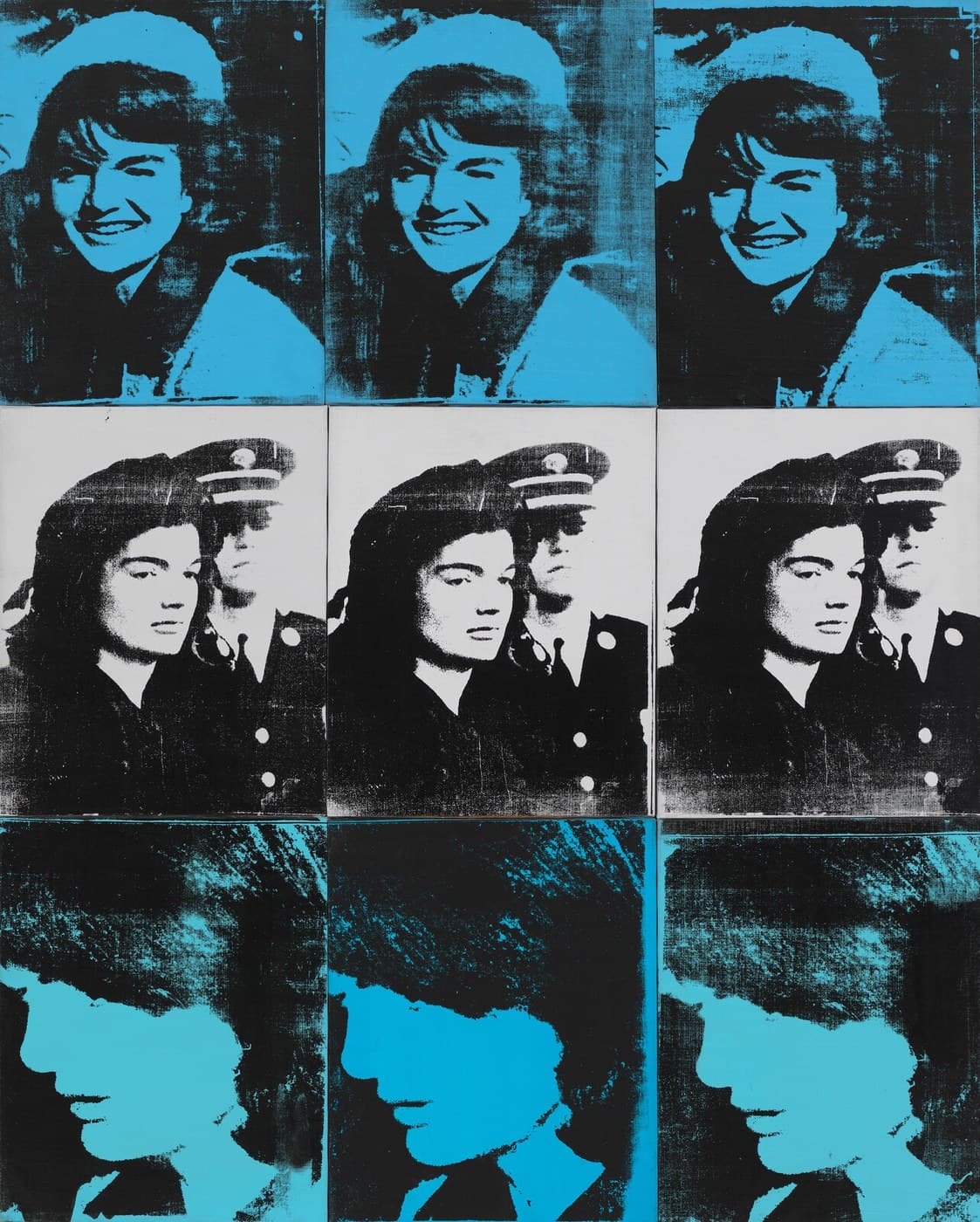
Nine canvases in three rows of three, carrying three photographs of Jacqueline Kennedy taken around the assassination of President John F. Kennedy on 22 November 1963. Each photograph is printed three times across its row. Andy Warhol took all three from newspapers, cropped them down to her head, and screened them onto linen. The Metropolitan Museum of Art owns a second painting of the same title and format, so the two need telling apart. This one belongs to the Whitney Museum of American Art.
- 1964
- Acrylic, oil, and screenprint on linen
- Whitney Museum of American ArtNew York, United States
About Andy Warhol
What the painting shows
Three rows of three panels. The top row shows Jacqueline Kennedy smiling, turned three-quarters away, printed in black on turquoise; a shoulder and part of a second head sit behind her at the right, which the Whitney Museum of American Art identifies as John F. Kennedy. The middle row is printed on a light neutral grey and shows her in front of a man in a military peaked cap, his tunic reduced to a solid black field with the buttons surviving as round white voids. The bottom row is a close-up of her head in left profile, her face left as flat turquoise against black.
Each row is one photograph repeated three times, so the work holds nine panels and three images. The museum dates the top-row photograph to Dallas, Texas, shortly before the shooting. The middle-row photograph comes from the ceremony in which the president's flag-draped coffin was carried to the Capitol. The bottom-row photograph was taken at the swearing-in of Lyndon B. Johnson aboard Air Force One, at which she stood beside him.
The nine canvases are separate. At every junction the paint runs over the wrapped edge of one canvas and stops, and a line of shadow falls between it and the next. Overall the work is 153.4 by 122.6 centimetres, about five feet by four.
Where the photographs came from, and who made them
All three began as press pictures. The Whitney's label states that Andy Warhol "appropriated newspaper photographs of Jacqueline Kennedy", and its visual description adds that he "pulled images of her directly from the newspaper, carefully cropping them to eliminate everything but Jackie's image". He then, in the museum's words, "photo-mechanically transferred the images of Jackie onto silkscreens, which were then printed onto canvas".
The catalogue raisonné of his paintings records eight source photographs behind the whole group of Jackie paintings at this size. Two show her arrival in Dallas with the president, two are profiles from the swearing-in, and four come from the funeral. Of those four, two show her veiled and two do not. The Andy Warhol Museum holds a composite sheet of those eight images, captioned with the photographers. Four are credited to Life magazine: Fred Ward, George Silk, Henri Dauman and Art Rickerby. Two are credited to the Keystone agency, and two are marked "Photographer/Source Unknown".
That list is the closest thing to an answer that exists, and it does not resolve the Whitney's three panels. No museum holding a Jackie painting names the photographer of any individual image: not the Whitney, not the Metropolitan Museum of Art, not the Walker Art Center, not the Art Institute of Chicago. The swearing-in aboard Air Force One was photographed by Cecil Stoughton, John F. Kennedy's White House photographer, and the Library of Congress catalogues his frame of it. Whether Warhol's bottom-row image is Stoughton's is not documented, and the one published attribution sheet marks those slots unknown.
The authorship question is not academic. The Whitney itself notes how far these sources were from his usual ones: they are "closely cropped, voyeuristic newspaper pictures" and they "differ from the glossy publicity stills that the artist typically used as the basis for his work". A publicity still is issued to be reprinted. A news photograph of a widow is not. In 2023 the Supreme Court took up what an artist owes the photographer he copies, in Andy Warhol Foundation for the Visual Arts, Inc. v. Goldsmith.
Two screens, one of them reversed
The catalogue raisonné records that the series was printed from two screens, each carrying all eight images, and that one screen was the mirror of the other. That let Warhol print any of the eight either way round, which is why heads face opposite directions between panels across the group. An invoice from the silkscreen maker dated 4 February 1964 fixes the earliest date for the series. Warhol's instruction to him survives: "Please make like in line very black and white."
The order of work was colour first, photograph second. The Andy Warhol Museum describes the method as "the process of underpainting before adding the final photographic silkscreen print", and defines registration as "the process of lining up the image on the screen to the underpainting". The coloured grounds here went on before anything was printed, and the black went over them.
The same screen produced very different panels. In the top row the black covers roughly sixty-two per cent of the left panel, forty-two per cent of the middle one and sixty-four per cent of the right one, measured across the whole panel. The bottom row reverses that order: its middle panel is the most inked of all nine, at about sixty-six per cent, and its right-hand panel the least, at about fifty-five. At the top right of each bottom-row panel the black opens into a diagonal fan of streaks where the ink gave out.
The middle row is the steady one. Its three panels sit within a value or two of each other on the ground and within about a percentage point on ink coverage. Six of the nine panels use one turquoise, the same in the top row and the bottom; what changes between them is the black laid over it.
Nine canvases, joined
Museums describe these multi-panel works as assemblies rather than single canvases. The Art Institute of Chicago gives the medium of its Twelve Jackies as "Silkscreen ink on primed linen, twelve joined canvases". The Metropolitan Museum of Art catalogues its own Nine Jackies under nine consecutive accession numbers, 1983.606.14 to 1983.606.22, and records a stretcher depth of three quarters of an inch. How the panels are fastened is not published for any of them.
The nearest published account of the problem concerns a sister work. In March 2019 the Whitney's associate conservator Matthew Skopek, with the intern Sara Kornhauser, described treating Ethel Scull 36 Times of 1963. It "looks like one giant canvas" but is "36 individual smaller ones that need to be carefully mounted together". They had been attached to four cleats, one per row, and because "most of the canvases are not quite a perfect square" the rows came out crooked. All thirty-six were removed and remounted on a single strainer.
No conservation or technical study of Nine Jackies, or of any Jackie painting, appears to have been published.
A correction to the panel measurements
The Whitney gives the work overall as 60 3/8 by 48 1/4 inches and each panel as "16 1/8 × 20 1/16 in. (41 × 51 cm)". Those two lines cannot both be read height-first. Three panels of 16 1/8 inches stacked give 48 3/8 inches, a foot short of the stated height.
Read the other way round the arithmetic works. Three panels of 20 1/16 inches stacked give 60 3/16 inches and three of 16 1/8 inches side by side give 48 3/8, which is the overall size within a fraction. Each panel therefore stands 20 1/16 inches tall and 16 1/8 inches wide.
Two further records confirm it. The museum's own visual description says "each twenty inches tall by sixteen inches wide". The Metropolitan Museum of Art's Nine Jackies gives each component as 50.80 by 40.64 centimetres, which is 20 by 16 inches in portrait format. The panel size is a module across the group: a single Jackie is 20 by 16, Twelve Jackies is three of them by four, and Sixteen Jackies is four by four.
Which Nine Jackies this is
There are two paintings called Nine Jackies, both from 1964, both three rows of three, and both about 60 3/8 inches tall. The Metropolitan Museum of Art's, accession numbers 1983.606.14 to .22, is catalogued as acrylic and silkscreen on canvas and came as a gift of Halston in 1983. The Whitney's, accession number 2002.273, is catalogued as acrylic, oil, and screenprint on linen and came from The American Contemporary Art Foundation, Inc., Leonard A. Lauder, President.
Warhol assembled the same panels into many other configurations: single Jackies, a triptych, Four Jackies, Twelve Jackies, Sixteen Jackies and round ones in gold paint. Auction records put the total number of Jackie paintings at 302.
1964, and how the Jackies were first shown
The Jackie paintings belong to the stretch of work Warhol made from 1962 onward in which the subject was death in public: car crashes, an electric chair, a suicide, the aftermath of a political killing. The Whitney describes Nine Jackies as combining "two of his signature themes—celebrities and fatal disasters". When the museum hung it in its 2018–19 retrospective it put it in a room with Orange Car Crash Fourteen Times of 1963, Crowd of 1963 and Saturday Disaster of 1964.
The Jackies never received an exhibition of their own. The catalogue raisonné records that forty-nine Jackie canvases went to the Leo Castelli Gallery in New York in early December 1964. Warhol's Flowers exhibition was hanging in the front rooms. Forty-two of the Jackies were hung together as a single painting filling a wall in the back gallery.
Contemporary press on them is close to non-existent. The catalogue raisonné identifies one notice, in Newsweek on 7 December 1964. No named hostile review of the Jackie paintings from the 1960s has surfaced. The criticism that exists is later: Rainer Crone in 1970 called Jacqueline Kennedy "the woman whose feelings were reproduced in all the media to such an extent that no better historical document on the exhibitionism of American emotional values is conceivable".
In the Whitney's audio guide the historian John Hellmann, professor of English at Ohio State University and the author of The Kennedy Obsession: The American Myth of J.F.K., sets the work against the machinery that produced the images. John F. Kennedy ran for president, Hellmann says, in the first year in which nearly every American household was reported to own a television. Jacqueline Kennedy planned her husband's funeral, proposed the eternal flame at his grave, and put the riderless horse in the procession.
The museum's reading of the result is a formal one. "By using photographs from before and after the event," the label says, "Warhol created a modern history painting in which the murder of a president is unseen yet tragically present." Nothing violent is shown. The three photographs are a smile, a ceremony and a face.
How it reached the Whitney
The painting came to the Whitney Museum of American Art in 2002 as a gift of The American Contemporary Art Foundation, Inc., Leonard A. Lauder, President. Its accession number is 2002.273. It went on show almost at once, in An American Legacy, A Gift to New York, which ran from 24 October 2002 to 26 January 2003 and was curated by Marla Prather.
The museum has shown it repeatedly since. Among those displays were Pop/Concept in 2004, Full House in 2006, Artists Making Photographs in 2009, Sinister Pop in 2012–13 and Human Interest in 2016–17. It hung again in Andy Warhol—From A to B and Back Again, from 12 November 2018 to 31 March 2019.
The museum's photograph of it was taken on 24 April 2017 by Denis Y. Suspitsyn. Andy Warhol died in 1987 and the work is in copyright; the Whitney prints "© The Andy Warhol Foundation for the Visual Arts, Inc. / Licensed by Artists Rights Society (ARS), New York" on its record. The reproduction here is shown reduced under fair use for commentary and excluded from commercial reuse.
Close reading
Reading the work, detail by detail
Nine separate canvases, three rows of three, carrying three photographs of Jacqueline Kennedy — one from before her husband's assassination and two from after it. Each photograph is printed three times across its row. Start with the top row, where the same image comes out three different weights.
1.Nine canvases, not one
The work is nine stretched canvases pushed together, not one canvas divided into nine. At every junction the colour runs over the wrapped edge of each canvas and stops, and a dark line of shadow falls between them.
2.The smiling photograph
The top row carries a photograph taken in Dallas shortly before the shooting. She is smiling, turned three-quarters away, and a shoulder and part of a second head sit behind her on the right. The Whitney identifies that partly visible face as John F. Kennedy's.
3.The lightest panel of the top row
The middle panel of the top row took the least black. Measured across the panel, about forty-two per cent of it is dark, against roughly sixty-two and sixty-four per cent for the panels either side of it.
4.The heaviest panel of the top row
The right panel of the top row is the most inked. Its ground has closed to near-solid black and the turquoise survives only as flecks and as small round voids where bubbles sat under the ink.
5.The pale middle row
The middle row is printed on a light neutral grey, close to an off-white. Sampled at the same point in each of the three panels the ground reads within a few values of itself, so the row is consistent where the blue rows are not.
6.The officer's cap
A uniformed man stands behind her in the middle row. His peaked cap carries a round pale badge on the crown and two light bands across the peak. His eyes print as two dark bars under it.
7.The buttons on the uniform
The uniform prints as a solid black field, and the buttons survive only as round white voids where the screen blocked. Two run down the front of the tunic and a third sits higher, on the shoulder.
8.Where the middle row starved
A mottled band runs along the bottom of each middle-row panel where the ink ran out before the squeegee reached the edge. The band is a different width on each of the three panels.
9.The profile in the bottom row
The bottom row reverses the others. Her face is left as flat turquoise and the black surrounds it, so the forehead, nose, lips and chin read as a single contour. No eye is printed.
10.The drag of the squeegee
At the top right of each bottom-row panel the black opens into a diagonal fan of streaks. The marks run in one direction across the panel and record the pass of the squeegee as the ink gave out.
11.The heaviest panel of the bottom row
The middle panel of the bottom row is the most inked of the nine, at about sixty-six per cent dark. The right panel of the same row is the least, at about fifty-five per cent. The order is the opposite of the top row's.
12.One blue, six panels
The six blue panels use one turquoise. Sampled at its most saturated in each panel the colour holds between roughly 35 and 55 red, 182 and 208 green, 215 and 239 blue. What varies between panels is the black over it.
13.Colour over the canvas edge
The turquoise was put on before the panels were assembled, and it carries over each canvas's wrapped side. Where two panels meet, two of these strips sit side by side with a shadow between them.
14.The join between two rows
The horizontal joins are as visible as the vertical ones. The pale grey of the middle row ends at a wrapped edge and the bottom row begins with a thin bright turquoise line along the top of its own canvas.
15.The shape of a single panel
Each panel stands taller than it is wide. Three of them stacked make the work about five feet high and three side by side make it about four feet across, which is how the nine reach 60 3/8 by 48 1/4 inches overall.
Timeline
1963
President John F. Kennedy is killed in Dallas on 22 November. Lyndon B. Johnson is sworn in aboard Air Force One the same day, with Jacqueline Kennedy beside him.
1964
An invoice from the silkscreen maker dated 4 February fixes the earliest date for the series. Warhol's note to him reads: "Please make like in line very black and white."
1964
Andy Warhol paints Nine Jackies in New York, from three newspaper photographs cropped to her head and transferred photo-mechanically to silkscreen.
1964
In early December forty-nine Jackie canvases go to the Leo Castelli Gallery in New York; forty-two are hung as one painting across a wall of the back gallery while the Flowers show occupies the front rooms.
2002
Given to the Whitney Museum of American Art by The American Contemporary Art Foundation, Inc., Leonard A. Lauder, President. Accession number 2002.273.
2002–03
Shown in An American Legacy, A Gift to New York at the Whitney, 24 October 2002 to 26 January 2003, curated by Marla Prather.
2017
Photographed for the museum's collection records on 24 April by Denis Y. Suspitsyn.
2018–19
Hangs in Andy Warhol—From A to B and Back Again at the Whitney, in a room with Orange Car Crash Fourteen Times, Crowd and Saturday Disaster.
Where to see it
Whitney Museum of American Art
New York, United States
A public viewing address has not yet been confirmed for this holding.
Gallery displays change, so check the museum's own object record before making a special visit.
Frequently asked questions
How many images are in Nine Jackies?
Three, not nine. The work holds nine panels in three rows of three, and each row repeats a single photograph three times. The Whitney Museum of American Art states it the same way in its visual description of the painting.
What are the three photographs in Nine Jackies?
The Whitney dates the top-row photograph to Dallas shortly before the assassination of President John F. Kennedy on 22 November 1963, with his face partly visible behind her. The middle row comes from the ceremony in which his flag-draped coffin was carried to the Capitol. The bottom row is cropped from a photograph taken at the swearing-in of Lyndon B. Johnson aboard Air Force One.
Who took the photographs Andy Warhol used for the Jackie paintings?
No museum names the photographer of any individual panel. The Andy Warhol Museum holds a sheet of the eight source photographs behind the series. Its caption credits four to Life magazine photographers: Fred Ward, George Silk, Henri Dauman and Art Rickerby. Two go to the Keystone agency and two to an unknown source. Cecil Stoughton photographed the Air Force One swearing-in, but no document establishes that Warhol's image is his.
Is Nine Jackies one canvas or nine?
Nine. Each panel is a separate stretched canvas, painted and printed before assembly, and the colour carries over each canvas's wrapped edge. The Art Institute of Chicago describes its Twelve Jackies as "twelve joined canvases", and the Metropolitan Museum of Art catalogues its own Nine Jackies under nine consecutive accession numbers.
How big is each panel of Nine Jackies?
Each stands about 51 centimetres tall and 41 centimetres wide, which is 20 1/16 by 16 1/8 inches. The Whitney's catalogue line prints those figures in the opposite order from its overall dimensions. Only this reading gives the stated overall size of 60 3/8 by 48 1/4 inches, and the Metropolitan Museum of Art's Nine Jackies records the same 20 by 16 inch panel.
Are there two paintings called Nine Jackies?
Yes. The Whitney's, accession number 2002.273, is acrylic, oil, and screenprint on linen, given in 2002 by The American Contemporary Art Foundation, Inc., Leonard A. Lauder, President. The Metropolitan Museum of Art's, accession numbers 1983.606.14 to .22, is acrylic and silkscreen on canvas and came as a gift of Halston in 1983. Both are 1964 and both are three rows of three.
Where is Nine Jackies?
The Whitney Museum of American Art in New York, accession number 2002.273. Gallery displays change, so check the museum's own object record before making a special visit.
More by Andy Warhol
If you like Andy Warhol
Explore painters from the same movements and circles.
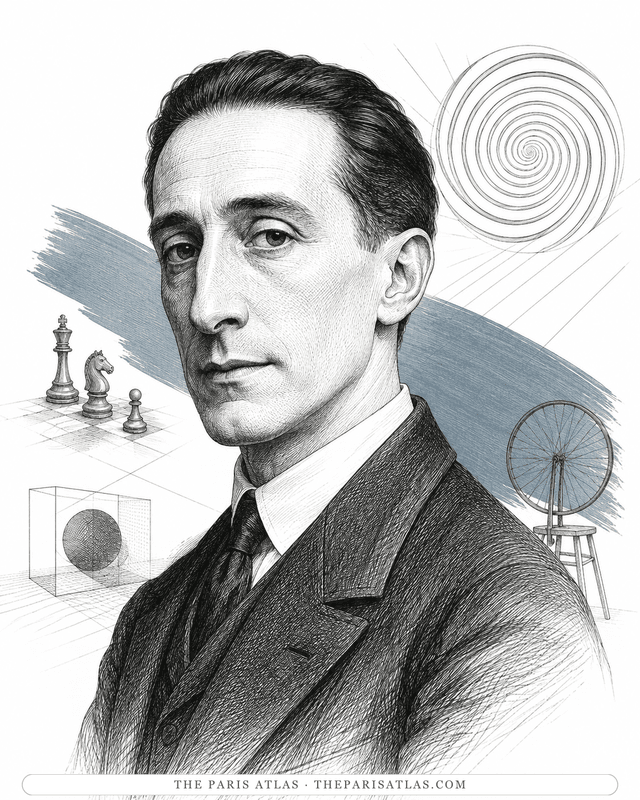
Marcel Duchamp
The century's quietest revolutionary — readymades, the abandonment of painting, chess on a Paris rooftop in Entr'acte, and one anemic film of spinning puns signed Rrose Sélavy.
View artist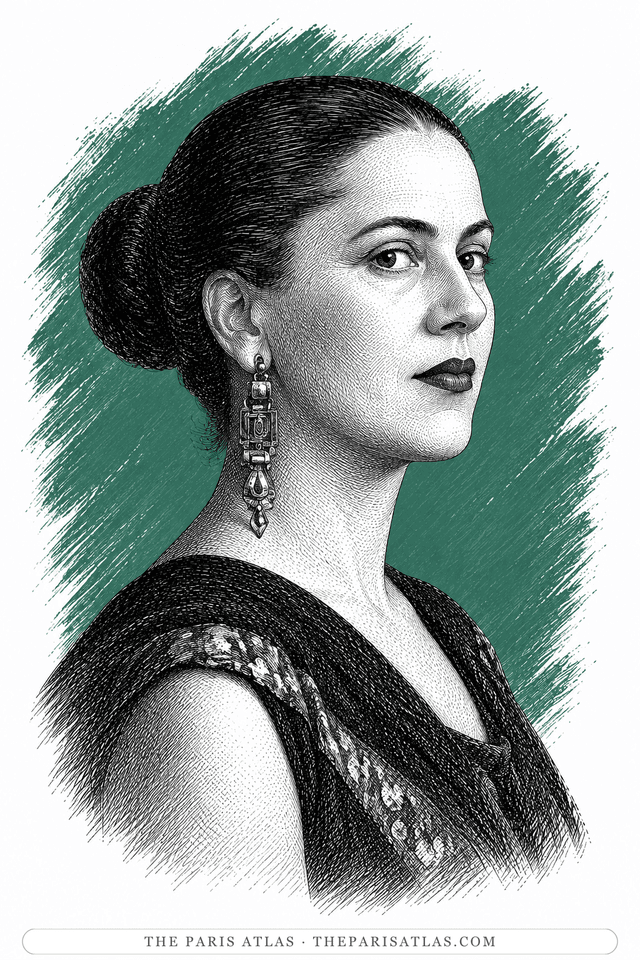
Tarsila do Amaral
Brazilian painter who spent the 1920s moving between São Paulo and Paris, studied Cubism under André Lhote, Albert Gleizes and Fernand Léger, and used what she learned to paint Brazilian towns, railways, plants and bodies. Her 1928 painting Abaporu prompted the manifesto that gave the Anthropophagic movement its name.
View artist
Vincent van Gogh
Dutch painter who lived in Montmartre with his brother Theo from March 1886 to February 1888 — the two years in which his dark Dutch palette turned into colour. He painted more than 200 pictures in Paris and died at Auvers-sur-Oise, north of the city, in 1890.
View artist
References
The sources below include collection records, catalogues, scholarly research, and primary materials that informed this page. They document Nine Jackies, its making, and its place in cultural history.

1Andy Warhol, Nine Jackies (1964) — object record, 2002.273
Official recordWhitney Museum of American Art, New YorkUsed forThe holding museum's object record: the 1964 date, the medium, the overall and per-panel dimensions, the accession number, the credit line, the Artists Rights Society notice, the label naming the three source photographs and the photo-mechanical transfer, the visual description of the three rows, the exhibition history, and the audio guide in which John Hellmann discusses the Kennedy image.
2Andy Warhol, Nine Jackies (1964) — object record, 1983.606.14–.22
Official recordMetropolitan Museum of Art, New YorkUsed forThe second painting of the same title and format, catalogued under nine consecutive accession numbers, whose per-component measurement of 50.80 by 40.64 cm settles the orientation of the panel.
3Andy Warhol, Twelve Jackies (1964) — object record, 2015.124
Official recordArt Institute of ChicagoUsed forThe Art Institute's medium line for a related work, "Silkscreen ink on primed linen, twelve joined canvases".

4Warhol Women: Forty Jackies
WebsiteLévy GorvyUsed forQuotes the catalogue raisonné, with page citations, on the eight source photographs and on the two screens, one the mirror of the other.
5Andy Warhol's Sixteen Jackies — lot essay and source-photograph sheet from The Andy Warhol Museum
Exhibition catalogueChristie'sUsed forReproduces the composite source-photograph sheet held by The Andy Warhol Museum, with the caption crediting four Life photographers, two Keystone images and two of unknown source.
6Underpainting and photographic silkscreen printing
WebsiteThe Andy Warhol Museum, PittsburghUsed forThe Andy Warhol Museum on underpainting before the photographic silkscreen, and its definition of registration as lining up the screen image to the underpainting.
7Conserving Andy Warhol's Ethel Scull 36 Times
WebsiteWhitney Museum of American Art, New YorkUsed forMatthew Skopek and Sara Kornhauser on remounting the thirty-six canvases of Ethel Scull 36 Times, the nearest published conservation account of a multi-panel Warhol.
8Images and permissions
WebsiteWhitney Museum of American Art, New YorkUsed forThe Whitney's requirement that clearance be obtained from Artists Rights Society before it will agree to publication of an image carrying that credit.
9Represented artists
WebsiteArtists Rights Society, New YorkUsed forWeb source consulted for documented facts and historical context presented on the Nine Jackies page.
10Andy Warhol Foundation for the Visual Arts, Inc. v. Goldsmith, No. 21-869, decided 18 May 2023
Official recordSupreme Court of the United StatesUsed forThe 2023 decision on what an artist owes the photographer whose image he copies, argued over Andy Warhol's Prince series and Lynn Goldsmith's photograph.
11Andy Warhol—From A to B and Back Again (12 November 2018 – 31 March 2019)
WebsiteWhitney Museum of American Art, New YorkUsed forThe Whitney's 2018–19 retrospective, whose installation captions place the painting with Orange Car Crash Fourteen Times, Crowd and Saturday Disaster.
These references provide the documented foundation for this work's history and interpretation. Claim-level citations remain attached to the specific claims they support.
 Explore more resources