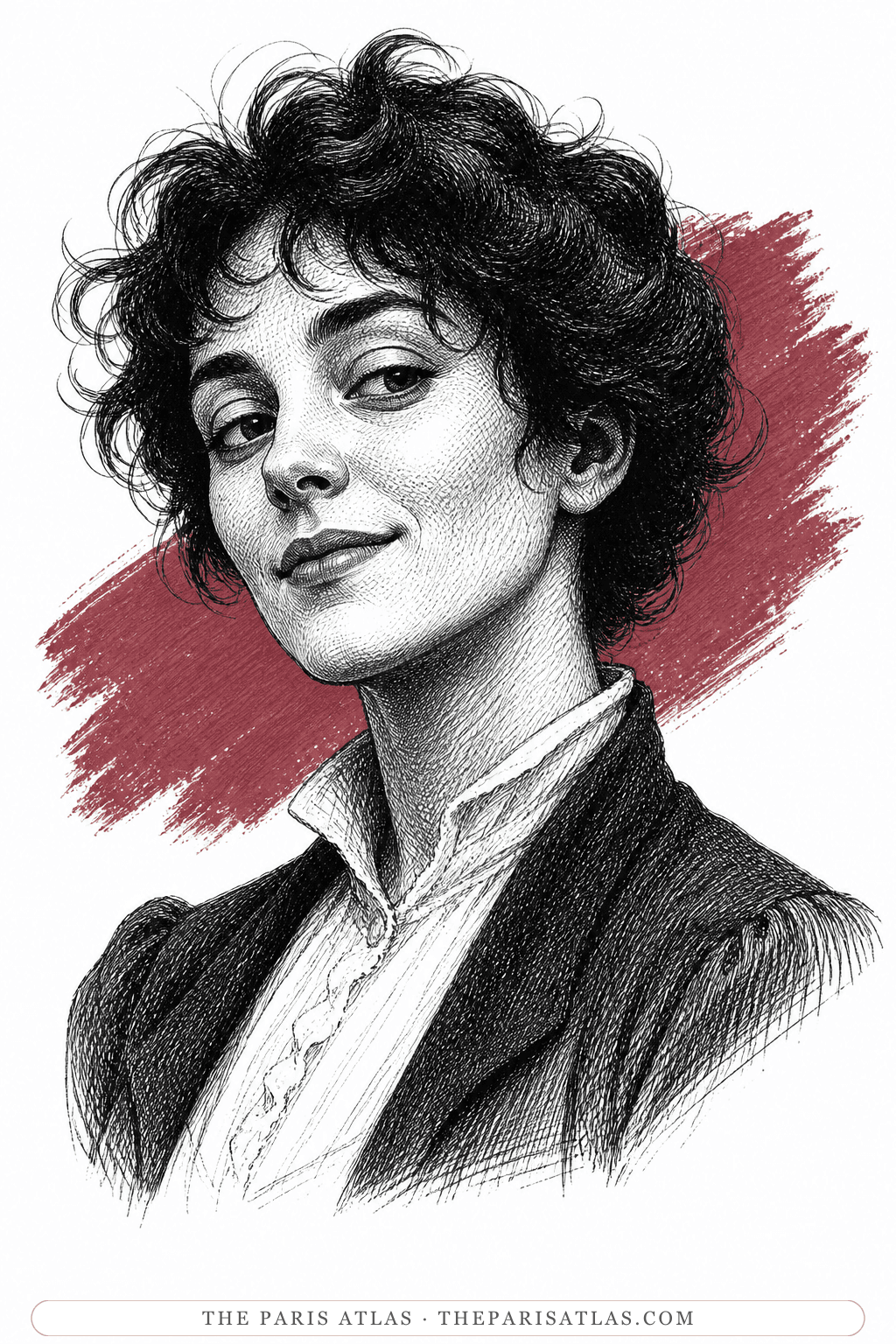
Claudine
The series' heroine, here at the margin — her freedom the model against which Annie measures her own captivity.
Renaud, and after him very little: she tells Annie that nothing in the world matters to her except one person, then corrects herself and lists warm sky, deep cushions, sweet apricots, floury chestnuts, and a roof at Montigny that will not shed its slates in a storm.
The book

At a glance
- A friend at the margin: Paris drawing rooms, the spa at Arriège, the Wagner festival at Bayreuth, and one last call at a Paris hotel
- Renaud, white-haired and much older, whom she is never willingly apart from
- An apartment on the rue de Bassano in Paris, and Montigny, the village she was raised in
- Short curly hair, a matte brown triangular face, long brown eyes Annie describes at one point as almost yellow. Strangers stare at her in the street, and Annie, watching a rival size her up, calls her the insolent creature with the short hair
- Fanchette, a white cat walked on a lead, and Mélie, an old servant who tells callers that Claudine is out while Claudine shouts from the next room that she is not
- Her husband's written instructions allow one visit only to Renaud and Claudine, a household he judges far too fanciful for a young woman whose husband is abroad
Who they are in the book
Spoiler-freeClaudine is the heroine of the three novels Colette wrote before this one, and in this one she is a guest in somebody else's book. Everyone calls her by her first name alone. She is a young married woman with cropped curly hair, a brown triangular face and long tobacco-coloured eyes, and she says whatever she is thinking in whatever room she is standing in, which is why Annie, the young wife who narrates the novel, has been permitted by her husband to call on her exactly once.
Annie meets her at a Paris tea table and then keeps meeting her: at a hotel in the Pyrenees where the whole party has gone to drink sulphur water, at the Wagner festival at Bayreuth, and finally in a Paris hotel room. Claudine is affectionate, greedy, rude to the women who deserve it, and completely absorbed in her husband Renaud, who is white-haired, much older, and never more than a room away from her. Watching the two of them together is what first shows Annie what her own marriage is missing.
She is also the only person in the novel who tells Annie the truth to her face, and the only one who offers her anything. The cost of that is set out in a letter Claudine writes later: she had once loved a woman named Rézi too completely, and Rézi had tried to come between her and Renaud, and since then Claudine has promised him — and herself — to leave attractive, unhappy, willing women alone.
How Claudine Is Portrayed
- The heroine, standing at the edgeShe is the woman the series is named for, and this book gives her no more than a friend's part in another woman's story. She has no idea she is being measured. Annie watches her the way one watches somebody who has something one has never had.
- Her marriageRenaud is white-haired, moustached and much older, with eyes Annie describes as very young. He reads her post aloud to her in bed before she has read it herself, and she does not mind. She reaches up, pulls his long moustaches down with both hands, and kisses him. Annie finds the two of them so unembarrassed that she wants to leave the room.
- The room she lives inHer Paris drawing room is furnished as a Dutch tavern: five or six dark oak cabaret tables polished by drinkers' elbows, heavy benches, stoneware jugs, a cavernous chimney hood, a fifteenth-century Virgin on the wall and a marble bust of Claudine in the corner. She says she cannot bear cheerful apartments and that in this room she is travelling.
- Things she has inventedA square silver wire grill for toasting chocolate over the fire, which the makers built with too short a handle, so she has a blister on her hand. Also a comb for carding fleas out of her cat, a pan without holes for roasting chestnuts, pineapple in absinthe, spinach tart, and the tavern drawing room itself.
- The catFanchette, white, travels with her on a lead to the spa and to Germany and is given a straw chair of her own, on the grounds that a metal one would be cold underneath. Claudine reads her Baudelaire's poems about cats and is teaching her a new one by Lucie Delarue-Mardrus. Fanchette has had nine kittens that year, and Claudine reports on their fathers.
- At the tea tableShe eats six lobster sandwiches without hurrying and says so. At a grand hotel on the Place Vendôme she refuses tea and chocolate and asks for wine at twelve sous the litre. When a thin woman warns her she will get fat, Claudine says she wishes her thighs were the size of Claudine's arms, which would please a great many people.
- The game in the spa parkShe reads the spa's own promotional brochure aloud to the party and hands out its skin diseases like bouquets, one each, saving recurrent genital herpes for the music critic Maugis. A row of respectable people behind them leaves, knocking over chairs. Claudine says they are only jealous, since they have nothing better than a chronic womb inflammation or a penny discharge.
- What she tells Annie about her marriageSitting on a bench in a Bayreuth park, she asks Annie outright whether she loves her husband, hears the answer, and tells her that she does not: that Alain looks like a stick and Annie like a wet handkerchief, that he is clumsy, a fool and a brute, and that the third time he corrected her manners Claudine would have asked him whether cuckolding him would be the done thing.
- She stops herselfIn the same conversation she puts an arm round Annie's neck, calls her by the name of a bending grass, and leans in close enough that Annie shuts her eyes. Then she is on her feet, rubbing her temples, saying it is too much, and reminding herself out loud of what she promised Renaud. For the rest of the festival she smiles at Annie from a distance and avoids being alone with her.
- MontignyThe village she grew up in, and the answer to most questions about her. She says she is happy there the way a lizard is happy on its wall, that there are days she does not come indoors between morning and night, and that she has taught Renaud how beautiful the country is and he follows her about in it.
Claudine happens to see Annie through a gunsmith's window near the arcades of the Théâtre-Français, fears what any friend would fear, and calls at her hotel. She finds Annie packed for a journey with no destination, asks the practical questions nobody else has asked her — is it a divorce you want, do you have money of your own, do you mind if it is granted against you — and then tells her to go.
Her parting advice is not practical at all. She warns Annie about the man she has not met yet, who is waiting somewhere and who has doubles and shadows and caricatures she must learn to tell him apart from. When Annie asks what happens if she grows old without meeting him, Claudine raises an arm and says he will be waiting on the other side of life.
Then she says goodbye in a way Annie does not expect. She is not staying either, she says: « Je ne reste pas, Annie. Je suis déjà partie. » She is not staying, she has already gone. Friends betray and books lie, and she no longer much cares for the useless beauty of pretending; one day she will take off the brilliant, teasing, overgrown-schoolgirl costume for good, and Paris will not see Claudine again, and she will grow old at Montigny among the trees with Renaud, who will age faster than she does. She goes out, and Annie writes the sentence the French title comes from: Claudine s'en va, Claudine is going away.
If you like Claudine and Annie


If you like Colette
Explore authors with a similar voice, perspective, and influence.

Henry Miller
The Brooklyn dropout who arrived in Paris broke at thirty-eight and wrote the exuberant, banned books that ended American censorship.
View author
Louis-Ferdinand Céline
The doctor of the Paris slums who wrote the century's blackest, funniest novel — and changed the sound of French prose.
View author
Martha Gellhorn
War correspondent who covered the Spanish Civil War, D-Day, and conflicts across five more decades; Hemingway's third wife, 1940–1945.
View author