
Moravagine
The previous year's novel and its opposite — savagery against solitude, both about a man who cannot stop.
Read our take
A jilted millionaire sails three artists to Antarctica to see what silence does to them — then comes back and buys the whaling trade.
Cendrars' strangest and most tender novel arrived in two volumes — Le Plan de l'Aiguille (1927) and Les Confessions de Dan Yack (1929). Dan Yack, a rich young Englishman wrecked by a love affair in St Petersburg, charters a ship, collects three artists — a sculptor, a musician, a poet — and maroons the party on a sub-Antarctic island to winter at the end of the world. What the ice does to them, and what Dan Yack becomes afterward, is the book: the polar experiment first, and then a long dictated confession spoken into a recording machine on a Pacific island. (Full story below; the ending is behind the accordion.)
The first volume is an adventure novel that keeps quietly turning into something else. Dan Yack's Antarctic scheme is a rich man's joke with a serious question underneath — take three men whose whole lives are made of art and remove the world they make it for — and the polar winter answers with a slowness Cendrars renders beautifully: the light, the whale-bone shore, the boredom, the drift. Where the earlier novels ran on speed, this one runs on cold, and it contains the gentlest writing he ever did.[1]
The second volume changes instrument entirely: Dan Yack, now a whaling magnate with a fortune built on the ice he once played at, sits on a Pacific island talking into a dictation machine — a novel delivered as recorded speech, decades before that was a common idea — circling the loves and losses the first volume set in motion, above all the young actress Mireille. Read together, the two make a diptych about what a man does with the rest of his life after the adventure ends, and stand a little apart from the Cendrars legend: no legionnaire's swagger, no monster on the loose, just the long human weather after the expedition. Nina Rootes' English brought both volumes over as Dan Yack.[1]
St Petersburg, before the war: Dan Yack, young, English, and enormously rich, is broken by a love affair and leaves on impulse — buying a ship and recruiting three artists, a sculptor, a musician, and a poet, to accompany him to the far southern ice. On a bleak island by the whaling grounds the four settle in for the polar winter, and the experiment does what experiments do: with no audience, no city, and no seasons to speak of, the artists come apart at different speeds while Dan Yack, the dilettante who arranged it all, discovers he is the one the emptiness suits.[1]
He returns to the world with a plan and no illusions, and turns the ice into an industry — whaling on a modern scale, a fortune made where the party had merely wintered. The second volume finds him years on, established, restless, and alone with a recording machine on a Pacific island, dictating his life: the island, the friends, the businesses, and Mireille, the young actress who becomes the great love of the confession.[1]
The confessions end where money and momentum cannot reach: Mireille, filmed and adored and ill, dies of tuberculosis, and the whaling magnate — who converted grief into an industry once already — finds the trick will not work twice. What is left is the recording: a man alone with a machine, talking, having outlived the expedition, the friends, the fortune's meaning, and the woman, still narrating because it is the only thing he has not yet lost. Cendrars gives the century's loudest life a very quiet ending.
At the start of Hivernage, a room large enough for a ship's crew is too small for four men. The repeated inventory of four beds, chairs and tables promises an orderly division of life, with canvas partitions offering each man a private corner. Yet equal provision cannot make living together easy. The absence of clocks extends that problem into time: supplies can be counted, but the days resist measurement. Cendrars turns the expedition's practical arrangements into an account of isolation within company, where abundant equipment cannot settle how the inhabitants will endure one another.
The opening recording sequence makes the machine's accuracy a source of pain. Dan Yack reads Mireille's notebook aloud, so the apparatus returns his voice where he longs to hear hers. Alternating separate cylinders for her words and his commentary cannot keep their stories neatly apart; eventually he records both together. His repeated movements between pipe, window, fire and desk interrupt any smooth account of loss. Recording preserves those attempts without resolving them. The device can repeat what has been spoken, but it cannot supply the voice that was never recorded.
Three artists, no audience, one winter — a premise that would carry a novel on its own, and here is only the first half.
The cold slows his sentences down, and what they do at that speed is the surprise of the shelf.
The dictated second volume is a genuinely strange piece of modernist architecture, and it works.
1927
Au Sans Pareil publishes the first volume, Le Plan de l'Aiguille — the Antarctic expedition, three artists marooned for a polar winter.
1929
Grasset publishes the second volume, Les Confessions de Dan Yack, a novel delivered as speech dictated into a recording machine; Nina Rootes later brought both volumes into English as Dan Yack.
1987–1990
Peter Owen publishes Nina Rootes’s English translations of the two Dan Yack volumes.


The previous year's novel and its opposite — savagery against solitude, both about a man who cannot stop.
Read our take
The other fortune built and spent at the world's edge, told at four times the speed.
Read our take
Blaise Cendrars. It appeared in two volumes — Le Plan de l'Aiguille (1927) and Les Confessions de Dan Yack (1929).
Dan Yack, a rich young Englishman wrecked by a love affair, charters a ship, gathers three artists — a sculptor, a musician, a poet — and maroons the party on a sub-Antarctic island to winter at the end of the world.
Cendrars's strangest and most tender — an adventure novel that keeps quietly turning into something else, half polar experiment and half confession.
In two volumes: the Antarctic expedition first, then a long confession Dan Yack speaks into a recording machine on a Pacific island.
It is one of Cendrars's lesser-known novels, but a favorite of readers who prize his oddest and most inventive work.
Explore authors with a similar voice, perspective, and influence.
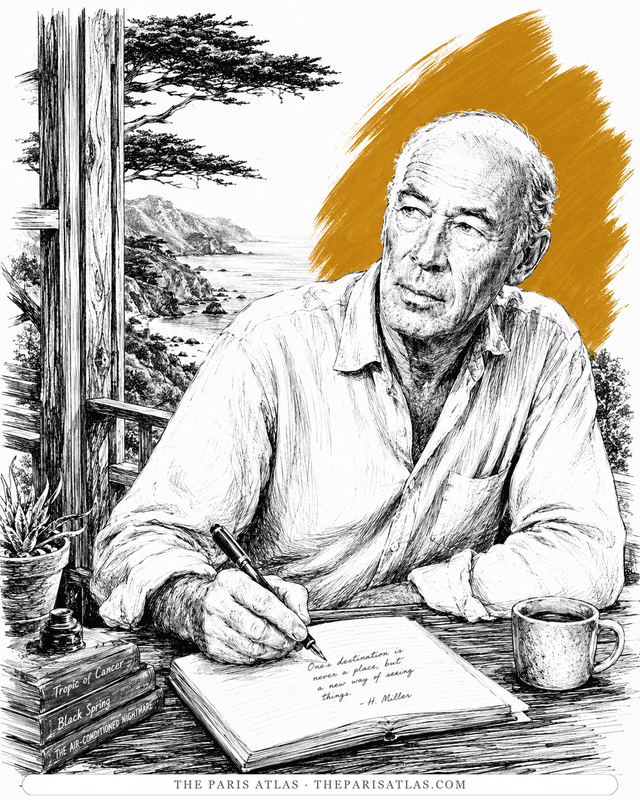
The devoted heir — Miller crowned Cendrars above every living writer, and the torrential first-person prose is the family resemblance.
View author
The other voyager at the end of the night — spoken rhythm, black exuberance, and a war wound at the center of everything.
View author
Author of The Sun Also Rises and A Moveable Feast; his pared-down style, developed in 1920s Paris, became the most imitated in American prose.
View authorThe sources below include the primary text, editions, scholarship, archival materials, and other records that informed this page. They document Dan Yack, its publication, and its place in literary history.


Selected French passages in Hivernage's opening and Rouleau un, in the June 2025 Ebooks libres et gratuits transcription containing both volumes. Not Nina Rootes's English translation, a complete-volume reading, or a first-edition collation.

The British national bibliography record verifies the 1990 Peter Owen English edition of the second Dan Yack volume.
The Swiss National Library bibliography verifies Nina Rootes as translator of both English volumes.
Used to verify Dan Yack's bibliographic context and its place within Blaise Cendrars's published work.
Used for independent archival, institutional, or historical context surrounding Blaise Cendrars and Dan Yack.
Used to cross-check chronology, publication history, and the circumstances in which Dan Yack appeared.
Used for an additional scholarly or biographical perspective on Dan Yack and Blaise Cendrars's wider career.
The primary text is the baseline reference for every book page. Additional references document publication history, interpretation, and historical context where that evidence is available.
 Explore more resources