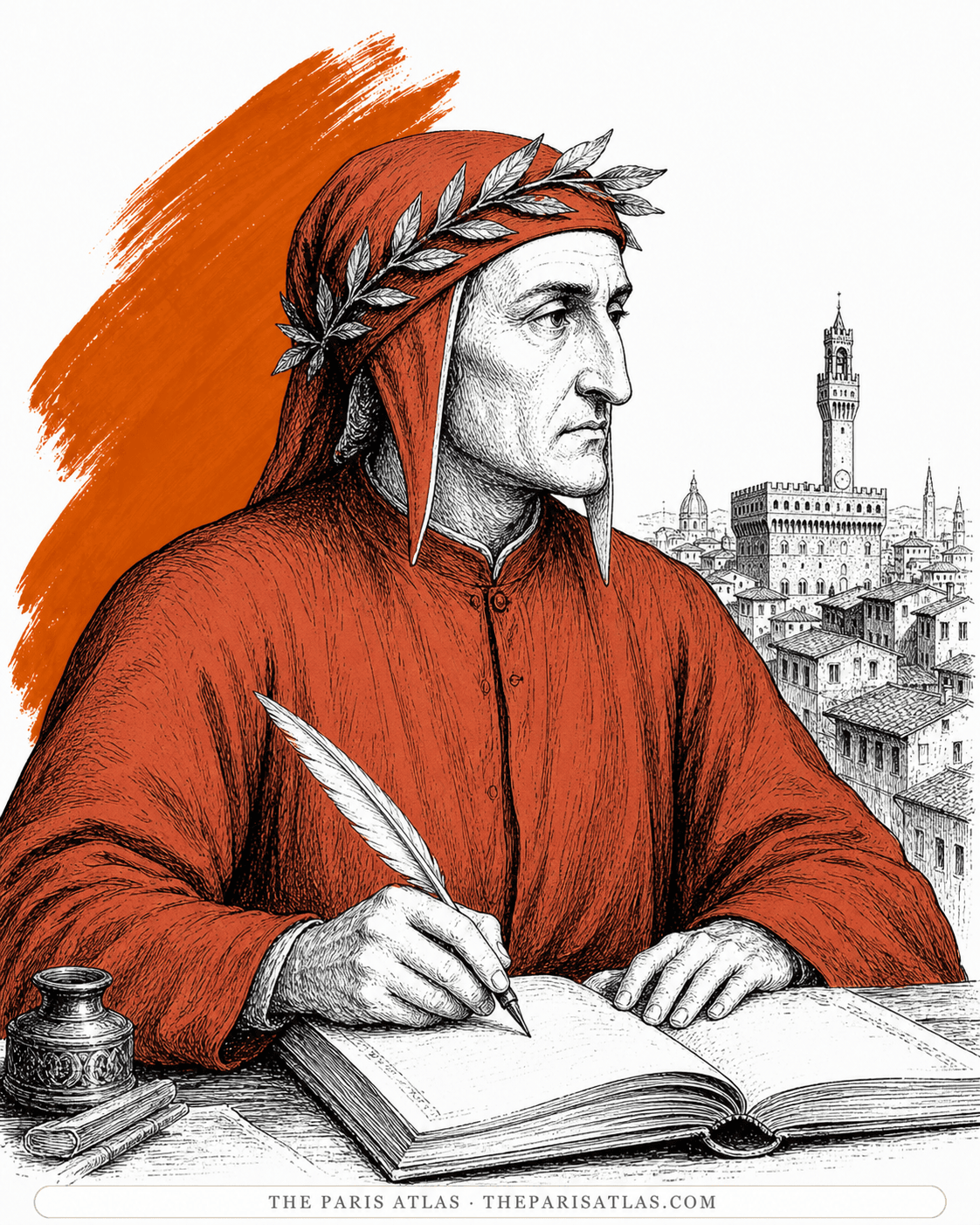
The Divine Comedy
Dante Alighieri
The Divine Comedy
The poem puts the same argument into images: Rome's two suns in Purgatorio XVI, and Virgil and Beatrice as the two guides.
Read our takeDe Monarchia
Dante Alighieri
Dante's case, in Latin prose, that the world needs one emperor and that the pope has no power to make him.
Dante Alighieri wrote De Monarchia in Latin during his exile, at a date scholars still dispute. The book asks three questions. Does the world need a single ruler over all others to have peace? Did the Roman people win that office by right? And does the emperor's authority come directly from God, or through the pope?[1] Dante answers yes, yes, and directly from God. The last answer made the book dangerous. A few years after Dante's death, a papal legate had it burned in public at Bologna.[2] The Church later put it on the Index of forbidden books and kept it there until 1881.[3]
The date is the hardest question about the book. Giovanni Boccaccio said Dante wrote it for the coming of the Emperor Henry VII to Italy, which began in 1310.[2] Edmund Gardner, writing in the Catholic Encyclopedia, thought 1309 most likely.[4] Pier Giorgio Ricci, in the Enciclopedia Dantesca, noted that every year from 1308 to Dante's death has had its supporters.[3] The Stanford Encyclopedia of Philosophy says probably after 1314.[5]
Unlike the Convivio and De vulgari eloquentia, the book was finished and circulated in Dante's lifetime. The book was little read until the late 1320s, when supporters of Louis IV of Bavaria used it to back his claim to be emperor against Pope John XXII.[5]
The first printed edition appeared in 1559 at Basel, then a Protestant city, from the press of Johannes Oporinus. Pier Giorgio Ricci notes that it had to wait that long for print.[3] F. J. Church's English translation of 1879 is public domain, and the English quotations here come from it.[1]
Book I argues that the world needs one supreme ruler. Dante begins with purpose. Humanity as a whole has a task that no single person, city or kingdom can do alone: to use its full power of understanding. Such a task needs peace, and peace needs a single ruler above all the others. The Stanford Encyclopedia of Philosophy traces the argument to Aristotle's Politics, read through Thomas Aquinas.[5]
Book II argues that the Roman people took the empire by right, not by force alone. Dante draws his evidence mainly from Roman writers. He argues that Rome's history shows God's plan at work, and that Rome always served the common good.[5][2]
Book III takes on the papacy. Dante answers the arguments used to claim that the emperor's power comes through the pope, one by one. Then he gives his own case. People have two goals: happiness in this life, and eternal life with God. So they need two guides, the emperor for the first and the pope for the second. The emperor's authority, he concludes, comes down to him from God with no one in between.[1]
The last chapter of Book III holds the argument together. A human being, Dante writes, stands between the things that die and the things that last forever, because a person is a body and a soul. So God has set two ends before humanity. One is happiness in this life, which the earthly paradise stands for. The other is eternal life, which the heavenly paradise stands for.
Each end has its own road. People reach the first through the teachings of philosophy and the moral virtues, and the second through revelation and faith, hope and charity. Each road therefore has its own guide. The pope leads mankind to eternal life. The emperor leads it to happiness in this world, so that, in F. J. Church's translation, “in this little plot of earth belonging to mortal men, life may pass in freedom and with peace.”
Dante then softens the conclusion. The emperor is not answerable to the pope for his power, but in some things he should still defer to him. “Let, therefore, Cæsar be reverent to Peter,” the book ends, “as the first-born son should be reverent to his father.” Gardner's Catholic Encyclopedia article points to this closing chapter as evidence of Dante's respect for the spiritual power of the papacy.
Dante put the same argument into The Divine Comedy as a picture. In the sixteenth canto of the Purgatorio, a soul named Marco Lombardo explains why the world has gone wrong. Rome, he says, used to have two suns, which lit up two roads, the way of the world and the way of God. In Longfellow's translation: “One has the other quenched, and to the crosier / The sword is joined.”
The crosier is a bishop's staff and the sword is the ruler's power. The two powers have been joined in one hand, and Marco says they go badly together. Edmund Gardner described the whole framework of the Comedy as the two-part scheme of De Monarchia transfigured. Virgil, standing for human philosophy, leads Dante to the earthly paradise. Beatrice leads him on to the heavenly one.
Boccaccio tells the story. Louis of Bavaria had himself crowned emperor in Rome against the wishes of Pope John XXII, and he set up a rival pope. His followers found Dante's book and used its arguments in their defence, and the little-known treatise became famous. After Louis went back to Germany, Cardinal Bertrando del Poggetto, the pope's legate in Lombardy, condemned the book as heretical and had it burned in public.
According to Boccaccio, the cardinal wanted to burn Dante's bones as well. Two men stopped him: Pino della Tosa, a Florentine knight, and Ostagio da Polenta. Both happened to be at Bologna while the matter was being discussed, and both had the cardinal's ear. Gardner's Catholic Encyclopedia article confirms that the book was burned at Bologna by order of a papal legate.
The ban outlived the cardinal by centuries. Pier Giorgio Ricci records that De Monarchia was placed on the Venetian Index, then on Pope Paul IV's Roman Index and the Index of the Council of Trent. The book stayed on the Index until 1881.
I desire not only to show the budding promise, but also to bear fruit for the general good, and to set forth truths by others unattempted.
Three great questions are asked concerning it. First, there is the doubt and the question, is it necessary for the welfare of the world? Secondly, did the Roman people take to itself by right the office of Monarchy? And thirdly, does the authority of Monarchy come from God directly, or only from some other minister or vicar of God?
Therefore man had need of two guides for his life, as he had a twofold end in life; whereof one is the Supreme Pontiff, to lead mankind to eternal life, according to the things revealed to us; and the other is the Emperor, to guide mankind to happiness in this world, in accordance with the teaching of philosophy.
A papal legate had it burned at Bologna a few years after Dante died, and it stayed on the Index of forbidden books until 1881.
The two suns of Purgatorio XVI and the popes in hell make more sense once the two guides of Book III are clear.
F. J. Church's 1879 translation is public domain on Project Gutenberg, and Book III can be read in an evening.
1310
The Emperor Henry VII comes into Italy. Boccaccio links the book to his coming.
1308–1321
Dante writes De Monarchia at a date still disputed. Proposals run from 1308 to his death.
Late 1320s
Supporters of Louis IV of Bavaria use the book against Pope John XXII, and it becomes widely known.
After 1328
Cardinal Bertrando del Poggetto, papal legate in Lombardy, has the book burned at Bologna and tries to burn Dante's bones.
1559
The first printed edition appears at Basel, from the press of Johannes Oporinus.
1879
F. J. Church's English translation is published in London.
1881
De Monarchia is removed from the Index of forbidden books.

The Divine Comedy
Dante Alighieri
The poem puts the same argument into images: Rome's two suns in Purgatorio XVI, and Virgil and Beatrice as the two guides.
Read our takeConvivio
Dante Alighieri
The fourth treatise first argues that human happiness needs a single ruler over all others.
Read our takeDe Vulgari Eloquentia
Dante Alighieri
The relationship between the emperor and the pope. Dante argues that the world needs one emperor to keep peace, that Rome held the empire by right, and that the emperor's power comes directly from God rather than through the pope.
The date is disputed. Boccaccio linked it to Henry VII's arrival in Italy in 1310. Edmund Gardner proposed 1309, Pier Giorgio Ricci noted that every year from 1308 to 1321 has had supporters, and the Stanford Encyclopedia of Philosophy says probably after 1314.
Because it denied that the emperor's power came through the pope. After supporters of Louis of Bavaria used it against Pope John XXII, the papal legate Cardinal Bertrando del Poggetto condemned it as heretical and had it burned at Bologna. Boccaccio says he tried to burn Dante's bones too.
Yes. The book was placed on the Venetian Index, then on Pope Paul IV's Roman Index and the Index of the Council of Trent. De Monarchia stayed on the Index until 1881.
The pope and the emperor. Dante says people have two goals, happiness in this life and eternal life. The pope guides them to the second through revelation, and the emperor to the first through philosophy.
Yes. F. J. Church's translation of 1879 is on Project Gutenberg, and Philip H. Wicksteed's of 1904 can be read in scans at the Internet Archive. Prue Shaw's Cambridge translation is the standard modern one.
Explore authors with a similar voice, perspective, and influence.
The doctor of the Paris slums who wrote the century's blackest, funniest novel — and changed the sound of French prose.
View author
Poet, novelist and playwright who spent sixteen years in an apartment on the Place des Vosges that is now his museum, wrote a novel about Notre-Dame that shamed France into repairing the cathedral, spent nineteen years in exile for opposing the emperor Napoleon III, and was buried in the Panthéon — the Paris monument where France buries its most honoured dead — in 1885 after a funeral that brought roughly two million people into the streets of Paris.
View author
Chilean poet of the twentieth century's most widely read love poems, who spent his whole life in his country's diplomatic service and came back to Paris three times: passing through at twenty-three in 1927, on his way to his first consular post in Burma; running the rescue of refugees from the Spanish Civil War out of a Paris office in 1939; and serving as ambassador to France for Salvador Allende, Chile's newly elected socialist president, when the Nobel Prize in Literature reached him in October 1971.
View authorThe sources below include the primary text, editions, scholarship, archival materials, and other records that informed this page. They document De Monarchia, its publication, and its place in literary history.

Boccaccio's account of the three books, the burning and the threat to Dante's bones.

Edmund G. Gardner on the date, the closing chapter, and the burning at Bologna.
Boccaccio's Italian text of the same account.

The Temple Classics volume with Philip H. Wicksteed's translation.
Longfellow's translation of Purgatorio XVI, the two suns.
Giovanni Villani's notice of Dante, which lists The Monarchy among his works.
The primary text represented by this page, used for descriptions of the work’s contents and for any quoted passages shown here.
The primary text is the baseline reference for every book page. Additional references document publication history, interpretation, and historical context where that evidence is available.
 Explore more resources