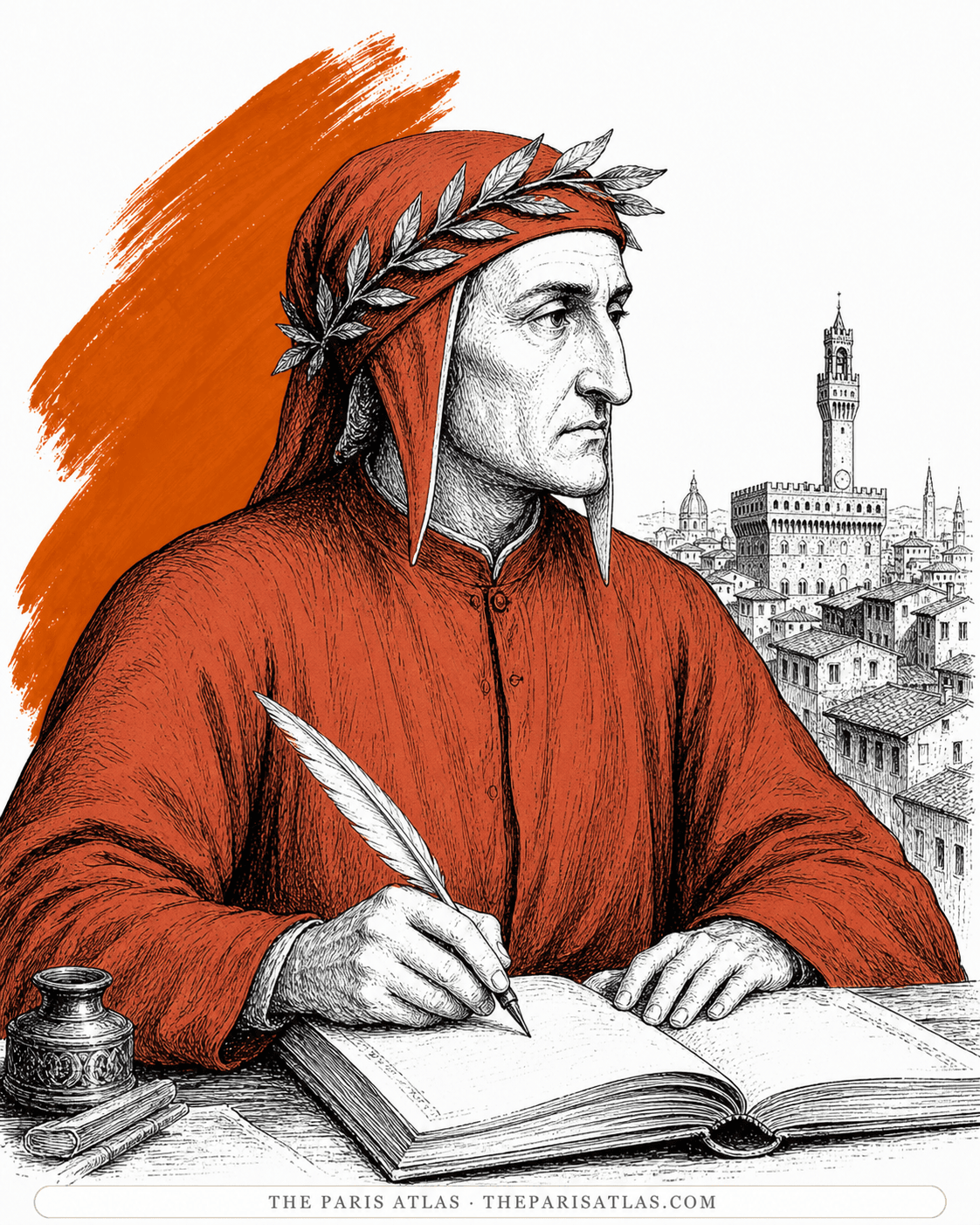
La Vita Nuova
Dante Alighieri
La Vita Nuova
The early book about Beatrice. Its last page promises to write of her what has never been written of any woman, and the Comedy keeps the promise.
Read our takeThe Divine Comedy
Dante Alighieri
A Florentine in exile walks down through hell, up a mountain and into the sky, naming the people he knew on the way.
Dante Alighieri wrote the Commedia in exile from Florence and finished it shortly before he died at Ravenna in 1321. The poem is a hundred cantos long, in three parts: Inferno, Purgatorio and Paradiso. Dante himself is the traveller. Lost in a dark wood during Easter week of 1300, he is led down through hell and up the mountain of purgatory by the Roman poet Virgil. Beatrice, the Florentine woman he had loved and lost, then takes him up through the heavens.[1] Most of the souls he meets are real people, many of them his own neighbours and enemies. When people search for Dante's Inferno, they mean the first part, with its nine circles of hell. Dante called the whole poem simply his Comedy. Giovanni Boccaccio called it divine, and by 1555 a Venice edition carried the word on its title page.[2][3]
The three parts are called canticles. The Inferno has thirty-four cantos and the other two have thirty-three each, which makes a hundred. The whole poem runs to just over 14,200 lines. Every line is in terza rima, three-line stanzas linked by rhyme, a pattern Dante adapted so thoroughly from the popular verse of his day that it is usually counted as his invention.[4][1]
Dante names the poem twice inside the Inferno. He swears to the reader “by the notes of this my Comedy” in canto XVI, and in canto XXI he mentions things “of which my Comedy cares not to sing.”[5] The Letter to Cangrande, a Latin letter to Dante's patron at Verona that has come down under Dante's name, explains the word. A comedy starts in misery and ends well. Dante's poem starts in hell and ends in paradise, and it is written in the everyday language that ordinary people speak.[6]
No one knows exactly when Dante began. Giovanni Boccaccio, who wrote the first full life of Dante some time after 1348, tells a story that seven cantos were already written before Dante was exiled in 1302. According to Boccaccio, Dante sent new cantos to Cangrande della Scala, the lord of Verona, six or eight at a time.[7] A verse letter sent to Dante in 1319 shows that the Inferno and the Purgatorio were already widely known by then.[1]
The poem was copied by hand for 150 years. The first printed edition came out at Foligno, in central Italy, in 1472.[8] English readers have three public-domain translations free online: Henry Francis Cary's blank verse of 1814, Henry Wadsworth Longfellow's line-for-line version of 1867, and Charles Eliot Norton's prose of 1891 and 1892. The English quotations here come from Longfellow, whose lines match Dante's line numbers exactly.[9][10][11]
Inferno. The poem opens: “Midway upon the journey of our life / I found myself within a forest dark.” Three beasts block Dante's way up a hill: a panther, a lion and a wolf. The ghost of Virgil appears and says he has been sent by Beatrice. They pass through a gate whose inscription ends “All hope abandon, ye who enter in!” Hell is a funnel of nine circles under the earth. The sins get worse the deeper they go.[5]
In the second circle, the lustful are blown about in an endless storm. Francesca da Rimini tells how she and her husband's brother Paolo fell in love while reading a romance together, and were killed for it. Deeper down Dante meets his old teacher Brunetto Latini and three popes. Ulysses, wrapped in flame among the false counsellors, tells the story of his last voyage past the edge of the known world. In the frozen lake at the bottom, Count Ugolino gnaws the skull of the archbishop who starved him and his sons to death.[5]
Purgatorio. Virgil and Dante climb out on the far side of the earth and reach a mountain rising from the sea. Souls who repented before death climb its seven terraces, working off one sin on each. At the top is the Garden of Eden. Beatrice arrives, and Virgil, a pagan who cannot enter heaven, quietly vanishes. Beatrice then scolds Dante hard for how he lived after her death.[1][5]
Paradiso. Beatrice takes Dante up through nine moving heavens: the Moon, the planets, the Sun, the fixed stars and the outermost sphere. Saints and scholars come out to meet him in each one. In the heaven of the Sun, Thomas Aquinas names twelve shining teachers, himself among them. One of them lectured in a street in Paris. In the heaven of Mars, Dante's great-great-grandfather Cacciaguida tells him plainly that he will be exiled.[1][5]
The Inferno ends at the centre of the earth, where Lucifer stands frozen in the ice with three faces. Each mouth chews a traitor: Judas Iscariot, and Brutus and Cassius, two of the men who killed Julius Caesar. Virgil and Dante climb down Lucifer's body, come out on the other side of the world, and the canticle closes: “Thence we came forth to rebehold the stars.”
Near the end of the Paradiso, Beatrice hands Dante over to Bernard of Clairvaux, a twelfth-century saint. Bernard prays to the Virgin Mary for him. Dante is given a moment's sight of God, which he says he cannot describe. His own words run out, and the poem ends with his will turning, like a wheel, with “The Love which moves the sun and the other stars.” All three canticles end on the word stars.
Before the first circle there is a vestibule, full of people who never took a side in life. The first circle is Limbo, where good pagans and unbaptised babies live without pain but without hope. Homer, Horace, Ovid and Lucan are there, and they welcome Dante as one of them. The next four circles punish sins of appetite. The lustful are in the second, the gluttonous in the third, the misers and the wasters in the fourth, and the angry and the sullen in the fifth, sunk in the muddy river Styx.
Below the Styx stands the walled city of Dis. Inside it the sixth circle holds the heretics in burning tombs. The seventh holds the violent, in three rings: those violent against other people, against themselves, and against God. The eighth circle, Malebolge, is ten stone ditches for the many kinds of fraud, from flatterers and fortune-tellers to corrupt politicians and forgers. The ninth is the frozen lake of Cocytus, where traitors are locked in ice.
In canto XI, Virgil explains the plan while they wait to get used to the stench rising from below. Sins of weak appetite are punished higher up. Sins of violence come next. Fraud is punished lowest, because fraud is “man’s peculiar vice” and displeases God most. Betraying someone who trusted you is worst of all, so traitors fill the ninth circle, with Judas, Brutus and Cassius in Lucifer's mouths.
In the Paradiso, Paris appears through a single street. In canto X, Thomas Aquinas points out the last of twelve lights in the heaven of the Sun. “It is the light eternal of Sigier,” he says, “Who, reading lectures in the Street of Straw, / Did syllogize invidious verities.” Dante's Italian is Vico de li Strami. Charles Eliot Norton's note to his 1892 translation identifies the man as Siger of Brabant, who lectured at Paris in the thirteenth century, in the Rue du Fouarre.
Invidious verities means truths that earned him hatred. Norton explains that Siger applied logic to questions of theology. The Stanford Encyclopedia of Philosophy describes teachers influenced by Siger, active at Bologna, who held that human reason could reach happiness by its own powers. How far Dante shared those views is still debated among Dante scholars.
Paris turns up in other places too. In the same canto of the Paradiso, Richard of Saint-Victor, a twelfth-century prior of the monastery of Saint-Victor in Paris, shines among the lights. On the first terrace of the Purgatorio, Dante meets the manuscript painter Oderisi of Gubbio and praises him as the honour of “that art / Which is in Paris called illuminating.” On the fifth terrace, Hugh Capet, who calls himself the root of the royal house of France, introduces himself with the words “I was the son of a Parisian butcher.”
Two fourteenth-century Florentines say he did. Giovanni Villani, a Florentine merchant and chronicler who called Dante “our neighbour”, wrote a short notice of him soon after his death. Villani says that after the exile Dante “went to the university at Bologna, and afterwards at Paris, and in many parts of the world.”
Giovanni Boccaccio tells more. In his life of Dante, he writes that when every road home was closed, Dante crossed the mountains into France and “made his way as best he could to Paris.” There, Boccaccio says, he gave all his time to philosophy and theology. He also tells a story that Dante once answered fourteen questions in a public debate in the Paris schools of theology. According to Boccaccio, Dante repeated every question in order, with all the arguments for and against, and then answered each one.
No document from Paris records Dante there, so the visit remains a tradition rather than a known fact. Edmund Gardner, writing on Dante for the Catholic Encyclopedia, put it carefully: Dante “is said to have gone to Paris some time between 1307 and 1309, but this is open to question.” The street in Paradiso X is the kind of detail a man who had been there might use. The street is not proof that he was.
Three Paris artists built major work on the Inferno. Eugène Delacroix was twenty-four when he showed The Barque of Dante at the Salon of 1822. The painting shows Dante and Virgil crossing the Styx in the fifth circle while the damned claw at their boat. The French state bought it straight from the exhibition, and it now hangs in the Musée du Louvre.
Gustave Doré published his illustrated Inferno with Hachette in Paris in 1861. The Bibliothèque nationale de France calls it a turning point in his career. The same year he showed three large paintings after the Divine Comedy at the Salon. He finished the Purgatorio and the Paradiso in 1868. Project Gutenberg's copy of Henry Francis Cary's translation carries Doré's plates.
In 1880 Auguste Rodin began The Gates of Hell, a bronze door for a museum in Paris that was never built. The Musée Rodin says the seated figure above the doors was first called The Poet. The figure was Dante, author of the Divine Comedy that had inspired the doors, leaning forward to look down into the circles of hell. The world now knows him as The Thinker. A cast of the Gates stands at the Musée Rodin.
Serious poems in Dante's time were written in Latin. Boccaccio says readers in his own day still asked why Dante chose Florentine instead. He gives two reasons. In Latin the poem would have helped only the learned, while in the everyday language it could reach everyone. And the great men who paid for poetry had stopped reading Latin poets at all.
Boccaccio also quotes three lines of Latin verse that he says were Dante's first attempt at the poem, beginning “Ultima regna canam”, meaning “I will sing of the furthest kingdoms.” According to Boccaccio, Dante then gave up. Feeding such a poem to modern readers would be like putting crusts of bread in the mouths of babies still at the breast. He started again in Italian. No manuscript of the Latin opening survives, so the lines rest on Boccaccio's word alone.
Midway upon the journey of our life / I found myself within a forest dark, / For the straightforward pathway had been lost.Nel mezzo del cammin di nostra vita / mi ritrovai per una selva oscura, / ché la diritta via era smarrita.
All hope abandon, ye who enter in!Lasciate ogne speranza, voi ch’intrate.
There is no greater sorrow / Than to be mindful of the happy time / In misery.Nessun maggior dolore / che ricordarsi del tempo felice / ne la miseria.
Delacroix's Barque of Dante, Doré's engravings and Rodin's Gates of Hell all start from the Inferno. Reading the poem shows what they were drawing.
Cary, Longfellow and Norton are all public domain. Longfellow keeps Dante's line numbers, so a reader can check any famous line against the Italian.
Paradiso X names the Rue du Fouarre, where Siger of Brabant taught. Florentine tradition says Dante himself studied in Paris.
Dante wrote it after Florence banished him, and he puts the city's quarrels on every page. The Paradiso even contains a prophecy of his own exile.
1300
The poem is set in Easter week of the jubilee year 1300, beginning on Good Friday.
1302
Florence sentences Dante to exile. He writes the Comedy in the years that follow, as a guest at other men's courts.
1319
A verse letter to Dante from Giovanni del Virgilio, a teacher at Bologna, shows that the Inferno and the Purgatorio are already widely known.
1321
Dante finishes the Paradiso at Ravenna and dies there in September.
After 1348
Giovanni Boccaccio writes the first formal life of Dante, calling the poem divine and reporting that Dante studied in Paris.
1472
The first printed edition appears at Foligno, in central Italy.
1555
Gabriele Giolito's Venice edition, edited by Lodovico Dolce, prints La Divina Comedia on its title page.
1822
Eugène Delacroix shows The Barque of Dante at the Paris Salon. The state buys it.
1861
Hachette publishes Gustave Doré's illustrated Inferno in Paris.
1867
Henry Wadsworth Longfellow publishes his translation in three volumes.
1880
Auguste Rodin begins The Gates of Hell. The figure above the doors, later The Thinker, is Dante.


La Vita Nuova
Dante Alighieri
The early book about Beatrice. Its last page promises to write of her what has never been written of any woman, and the Comedy keeps the promise.
Read our takeConvivio
Dante Alighieri
The philosophy Dante was teaching himself in the first years of exile, much of which moves straight into the Comedy.
Read our takeDe Monarchia
Dante Alighieri
The prose argument for an emperor independent of the pope, which the Purgatorio puts into poetry as Rome's two suns.
Read our takeDe Vulgari Eloquentia
Dante Alighieri
Dante's Latin case for writing poetry in Italian, made a few years before he wrote the Comedy in it.
Read our takeThe Inferno is the first part of The Divine Comedy. The poem has three parts: Inferno, about hell; Purgatorio, about purgatory; and Paradiso, about heaven. The Inferno is often sold and read on its own, but its story continues straight into the Purgatorio.
From the top: Limbo, the lustful, the gluttonous, the misers and wasters, the angry and sullen, the heretics, the violent, the fraudulent and the traitors. The sins get worse as the funnel narrows. Lucifer is frozen at the bottom with Judas Iscariot, Brutus and Cassius in his three mouths.
In the Middle Ages a comedy was a story that begins badly and ends well, told in a plain style. The Letter to Cangrande explains that the poem starts in hell and ends in paradise, and is written in the everyday language. Dante called it simply his Comedy. Boccaccio called it divine, and by 1555 the word was on the title page of a Venice edition.
The Roman poet Virgil, author of the Aeneid, guides him through hell and up the mountain of purgatory. Beatrice takes over at the top of the mountain and leads him through heaven. At the very end, Bernard of Clairvaux takes her place.
The Florentine chronicler Giovanni Villani and Giovanni Boccaccio both say he did, after his exile. No Paris document records him. Edmund Gardner's Catholic Encyclopedia article dates the visit to around 1307 to 1309 and calls it open to question. Paradiso X does name the Rue du Fouarre, the street where Siger of Brabant taught.
For a free text, Henry Wadsworth Longfellow's 1867 translation is public domain and keeps Dante's line numbers. Among modern translations, Allen Mandelbaum's in Everyman's Library gives the whole poem in one volume. Robin Kirkpatrick's Penguin Classics edition prints the Italian beside the English, with a full commentary.
In the last canto of the Paradiso, Bernard of Clairvaux prays to the Virgin Mary, and Dante is given a brief sight of God. He says his words fail him. The poem ends with his desire and will turning with the Love that moves the sun and the other stars.
Eugène Delacroix's The Barque of Dante, from the fifth circle, hangs in the Louvre. A cast of Auguste Rodin's Gates of Hell stands at the Musée Rodin, with Dante seated above the doors as the figure later known as The Thinker.
Explore authors with a similar voice, perspective, and influence.
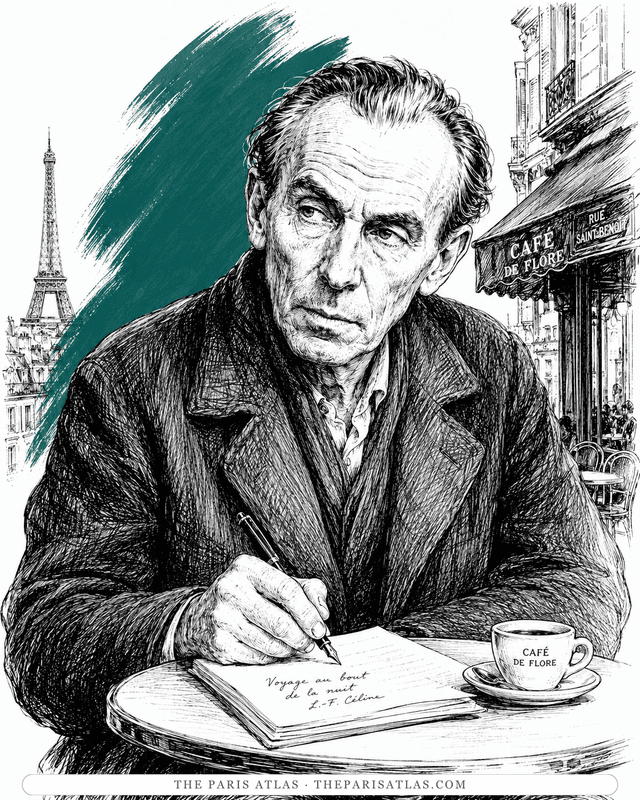
The doctor of the Paris slums who wrote the century's blackest, funniest novel — and changed the sound of French prose.
View author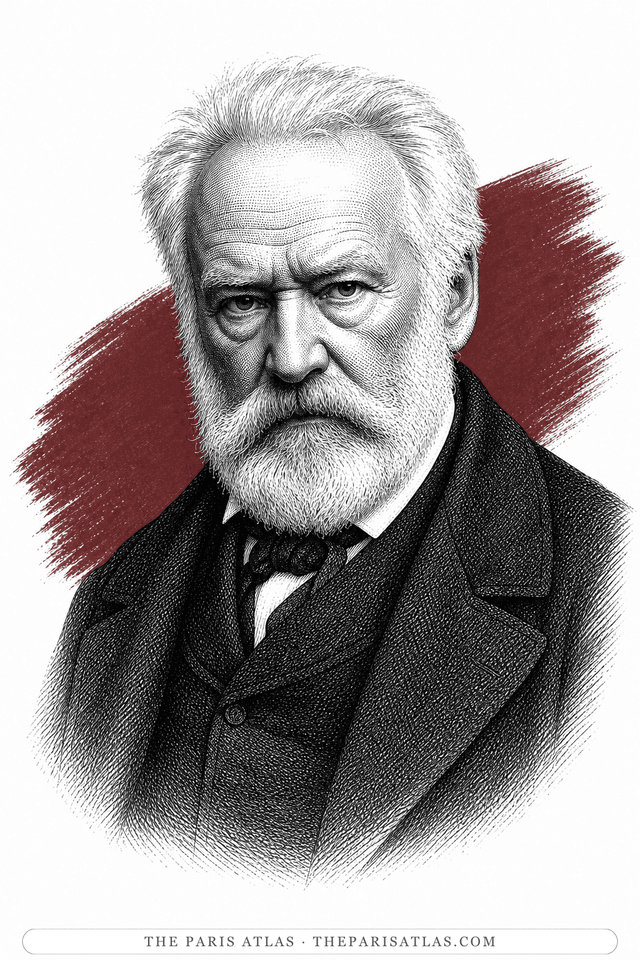
Poet, novelist and playwright who spent sixteen years in an apartment on the Place des Vosges that is now his museum, wrote a novel about Notre-Dame that shamed France into repairing the cathedral, spent nineteen years in exile for opposing the emperor Napoleon III, and was buried in the Panthéon — the Paris monument where France buries its most honoured dead — in 1885 after a funeral that brought roughly two million people into the streets of Paris.
View author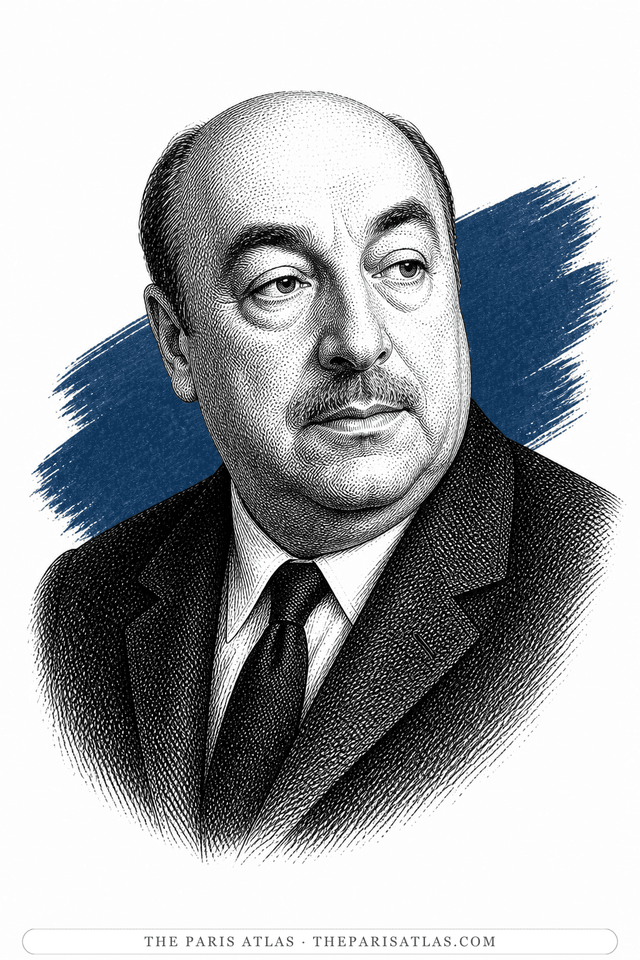
Chilean poet of the twentieth century's most widely read love poems, who spent his whole life in his country's diplomatic service and came back to Paris three times: passing through at twenty-three in 1927, on his way to his first consular post in Burma; running the rescue of refugees from the Spanish Civil War out of a Paris office in 1939; and serving as ambassador to France for Salvador Allende, Chile's newly elected socialist president, when the Nobel Prize in Literature reached him in October 1971.
View authorThe sources below include the primary text, editions, scholarship, archival materials, and other records that informed this page. They document The Divine Comedy, its publication, and its place in literary history.

Boccaccio's Italian text, including his phrase divina Comedia.
The Taylor Institution Library's early printed Dantes, including the 1555 Giolito title page reading La Divina Comedia.
The Italian text, used to check every Italian quotation by canto and line.

Philip H. Wicksteed's translation of the Letter to Cangrande, for the meaning of the word comedy.
Boccaccio's Life of Dante in a public-domain English translation: Paris, the seven cantos, the thirteen lost cantos and the choice of Italian.
Oxford's account of the early printed editions, including the first printing at Foligno in 1472.
Henry Francis Cary's translation, with Gustave Doré's plates.
The first edition of Longfellow's translation, for its date and its three volumes of notes.
Charles Eliot Norton's prose Paradiso, whose notes identify Siger of Brabant and the Rue du Fouarre.
A second Italian text, used to count the cantos and lines and to check two quotations.
Giovanni Villani's notice of Dante's death, the earliest account of his life, which sends him to Bologna and Paris.

Winthrop Wetherbee's survey of Dante's philosophy, including the followers of Siger of Brabant.
Web source consulted for documented facts and historical context presented on the The Divine Comedy page.
Web source consulted for documented facts and historical context presented on the The Divine Comedy page.
Web source consulted for documented facts and historical context presented on the The Divine Comedy page.
Web source consulted for documented facts and historical context presented on the The Divine Comedy page.
The publisher's page, used to confirm the translator and contents of ISBN 9780679433132.
The primary text represented by this page, used for descriptions of the work’s contents and for any quoted passages shown here.
The primary text is the baseline reference for every book page. Additional references document publication history, interpretation, and historical context where that evidence is available.
 Explore more resources