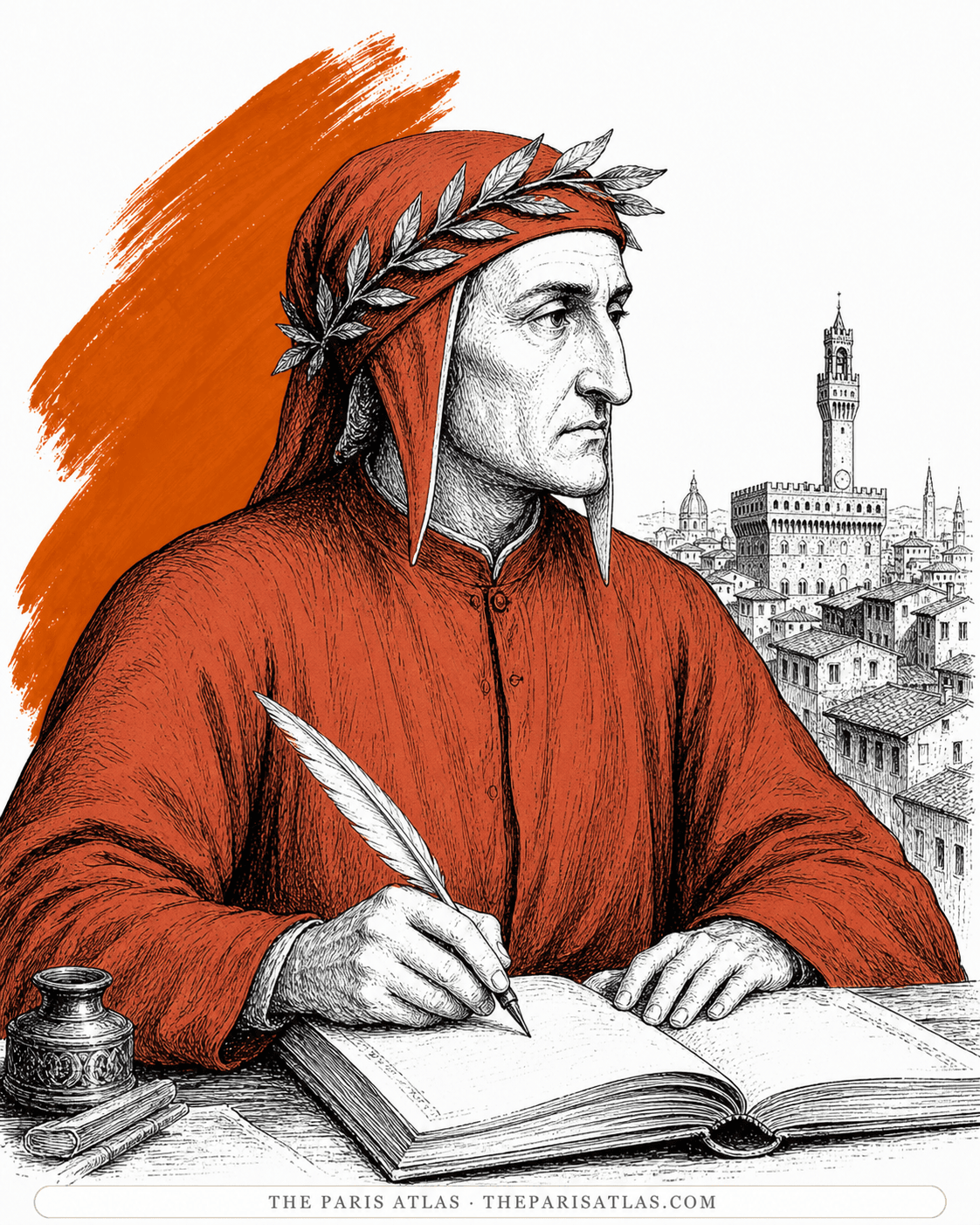
Voi che 'ntendendo il terzo ciel movete
The canzone of the second treatise, addressed to the angels who move the third heaven, the heaven of Venus. Dante's commentary reveals the lady of the poem to be Philosophy.
Convivio
Dante Alighieri
Dante's plan to serve philosophy to ordinary readers as a banquet, in Italian, with his own poems as the dishes.
Dante Alighieri wrote the Convivio in the first years of his exile, between about 1304 and 1307. The title means The Banquet. Dante planned fifteen treatises: an introduction and fourteen long commentaries, each on one of his own canzoni, the long formal songs of Italian poetry. He finished only four, and left the book unfinished.[1] The poems are the meat of the meal, he explains, and his prose is the bread that makes them digestible.[2] What the prose serves is philosophy. The book is written in Italian rather than Latin, so that readers who knew no Latin could share it, and its first treatise is largely a defence of that choice.[3]
The book opens with Aristotle: all men naturally desire knowledge. Dante then lists what keeps most people from it. Some are held back by illness or vice, and others by family duties, public business, or living far from any school. The learned few, he says, sit at a table where the bread of angels is eaten. He is not one of them. He sits at their feet, he says, gathering what falls from the table, and wants to share it.[2]
The three commentaries Dante finished are on three of his canzoni. They are Voi che 'ntendendo il terzo ciel movete, Amor che ne la mente mi ragiona, and Le dolci rime d'amor ch'i' solia.[1] The Stanford Encyclopedia of Philosophy notes that the fourth treatise, on nobility, seems to have been written later than the others and is different in tone. The fourth treatise moves away from metaphysics toward ethics and the life of society.[3]
The book did not reach print until 1490, when Francesco Bonaccorsi published it in Florence.[1] The first English translation was Elizabeth Price Sayer's The Banquet, published in London in 1887 with an introduction by Henry Morley. Sayer's version is public domain and is the source of the English quotations here.[2]
The first treatise is an introduction and a defence. Dante explains why he is writing about himself, why his prose is sometimes difficult, and why he is writing in Italian. He gives three reasons for choosing the everyday language over Latin: to avoid a mismatch between Italian poems and a Latin commentary, to reach more readers, and out of natural love for his own speech. Latin, he writes, would have served few, while Italian will serve many: princes, barons, knights and many other noble people, women as well as men, who never learned Latin. He ends by calling Italian a new sun that will rise where the old one sets.[2]
The second treatise explains Voi che 'ntendendo il terzo ciel movete, a canzone addressed to the angels who move the third heaven. Dante tells how, after Beatrice died, a compassionate lady took a place in his heart. He had mentioned her at the end of La Vita Nuova. Now he says that she was Philosophy. Grieving, he had read Boethius and Cicero for comfort and found in them a new love.[2]
The third treatise, on Amor che ne la mente mi ragiona, praises that lady at length. The commentary explains how philosophy is love of wisdom, and how that love reaches up toward God.[3] The fourth treatise, on Le dolci rime d'amor ch'i' solia, asks what nobility really is. Dante argues that human happiness needs social order under a single ruler, and adds a long digression on Rome's place in history.[3] The book stops there, with ten of the planned commentaries never written.[1]
In the third chapter of the first treatise, Dante stops to explain why people think less of him than they used to. The citizens of Florence, “the most beautiful and the most famous daughter of Rome,” threw him out. He wishes with all his heart to rest there again and end his days. Instead, in Sayer's translation, he has gone through almost every land where Italian is spoken, “a pilgrim, almost a mendicant.”
He goes on with an image of himself as a ship without sail or rudder, blown into strange ports by the dry wind of poverty. People who had only heard of him, he says, now found him less than his name. They also valued his finished work less. Dante wrote it a few years into a banishment that lasted the rest of his life.
At the end of La Vita Nuova, a young woman looks at Dante with pity from a window, and he is drawn to her. In the Convivio he tells what that lady was. Some time after Beatrice's death, he writes, he could find no comfort, so he read Boethius's Consolation of Philosophy and Cicero's essay on friendship. Reading them, he came to love Philosophy herself, and he imagined her as a gentle lady who could only look kindly.
He then went looking for her where she could really be found: in “the Schools of the Religious,” the teaching houses of the friars, and at the debates of the philosophers. Within perhaps thirty months, he says, this new love drove out every other thought. The Convivio is where Dante himself says who the lady at the window was.
Dante later put one of the Convivio's poems into The Divine Comedy. In the second canto of the Purgatorio, newly arrived souls land on the shore of the mountain. Among them is Casella, a friend whose love songs, Dante says, used to quiet all his longings. Dante asks him for a song, and Casella begins “Amor che ne la mente mi ragiona,” the canzone of the third treatise. Longfellow translates the line “Love, that within my mind discourses with me.”
The song is so sweet, Dante writes, that its sweetness still sounds inside him. Virgil and all the souls stand listening as if nothing else mattered. Then the stern old man who guards the shore rebukes them for standing still, and they scatter up the mountain.
As the Philosopher says in the beginning of the first Philosophy, “All men naturally desire Knowledge.”Sì come dice lo Filosofo nel principio de la Prima Filosofia, tutti li uomini naturalmente desiderano di sapere.
Oh, blessed are those few who sit at that table where the Bread of Angels is eaten, and wretched those who can feed only as the Sheep.Oh beati quelli pochi che seggiono a quella mensa dove lo pane de li angeli si manuca! e miseri quelli che con le pecore hanno comune cibo!
I have gone through almost all the land in which this language lives—a pilgrim, almost a mendicant—showing forth against my will the wound of Fortune.Per le parti quasi tutte a le quali questa lingua si stende, peregrino, quasi mendicando, sono andato, mostrando contra mia voglia la piaga de la fortuna.
The third chapter describes him going through Italy as a pilgrim, almost a beggar, and as a ship without a sail.
Dante returns to the lady at the window from the end of his first book and says who she really was.
Dante wrote it in Italian so that readers without Latin could join the banquet.
Elizabeth Price Sayer's 1887 translation, the first in English, is public domain and on Project Gutenberg.
The canzone of the second treatise, addressed to the angels who move the third heaven, the heaven of Venus. Dante's commentary reveals the lady of the poem to be Philosophy.
The canzone of the third treatise, in praise of the lady. Dante later has the musician Casella sing it to the souls newly arrived in purgatory, in the second canto of the Purgatorio.
The canzone of the fourth treatise, on what true nobility is. Its commentary is the longest part of the book and turns to ethics and to the need for a single ruler.
1290
Beatrice Portinari dies. In the Convivio, Dante dates his turn to philosophy to the years that followed.
1302
Florence sentences Dante to exile.
c. 1304–1307
Dante writes the Convivio, finishing four of fifteen planned treatises before abandoning it.
After 1348
Giovanni Boccaccio describes the book as a prose commentary on three canzoni that Dante meant to extend to all of them.
1490
Francesco Bonaccorsi prints the first edition in Florence.
1887
Elizabeth Price Sayer's The Banquet, the first English translation, is published in London.


La Vita Nuova
Dante Alighieri
The earlier book, whose lady at the window the Convivio explains as Philosophy.
Read our takeDe Vulgari Eloquentia
Dante Alighieri
Written in the same years, in Latin, making the case for Italian from the other side.
Read our takeThe Divine Comedy
Dante Alighieri
The poem Dante wrote after abandoning the Convivio, in which Casella sings one of its canzoni.
Read our takeDe Monarchia
Dante Alighieri
The fourth treatise's argument for a single ruler, worked out fully in Latin.
Read our takePhilosophy, served to ordinary readers as a banquet. Dante comments on three of his own canzoni, explaining first what they say on the surface and then their hidden meaning. The lady of his poems turns out to be Philosophy. The book also defends writing in Italian and asks what true nobility is.
Banquet. Dante compares learning to a meal most people are shut out of. His poems are the meat, and his prose commentary is the bread that makes them easy to eat.
Between about 1304 and 1307, in the first years of Dante's exile from Florence. He abandoned it unfinished.
No. Dante planned fifteen treatises, an introduction and fourteen commentaries on canzoni. He wrote only four, the introduction and three commentaries.
He gives three reasons in the first treatise: an Italian commentary suits Italian poems, it can reach many more readers, and he loves his own language. He calls Italian a new sun rising where the old one, Latin, sets.
Yes. Elizabeth Price Sayer's The Banquet of 1887, the first English translation, is public domain and on Project Gutenberg. Modern translations include Christopher Ryan's, Richard Lansing's and Andrew Frisardi's.
Explore authors with a similar voice, perspective, and influence.
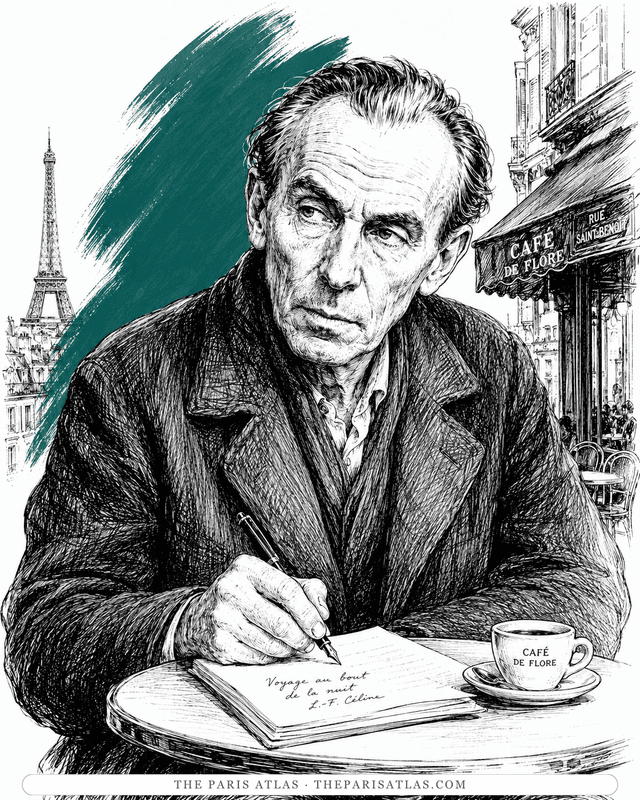
The doctor of the Paris slums who wrote the century's blackest, funniest novel — and changed the sound of French prose.
View author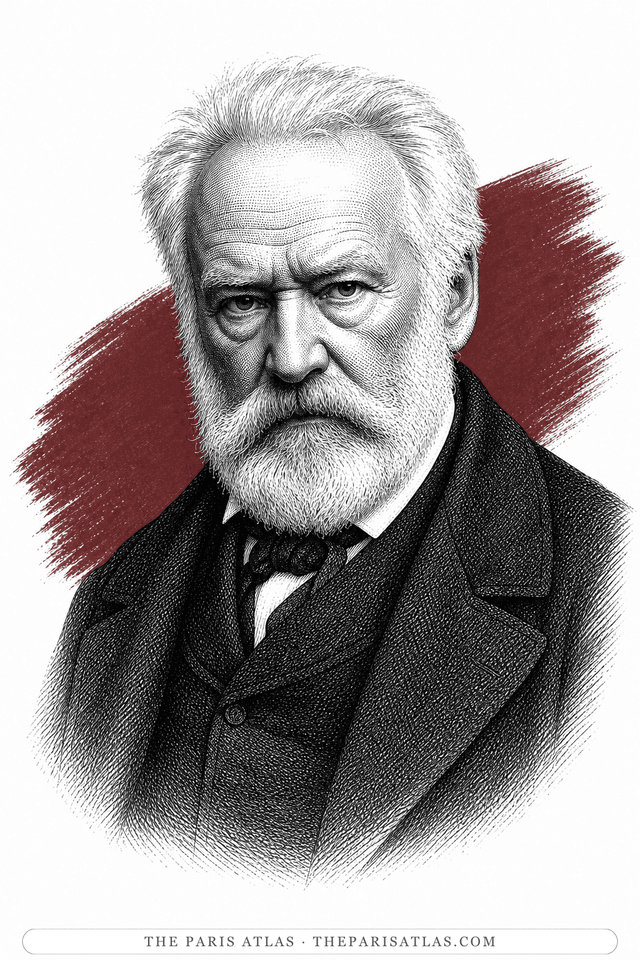
Poet, novelist and playwright who spent sixteen years in an apartment on the Place des Vosges that is now his museum, wrote a novel about Notre-Dame that shamed France into repairing the cathedral, spent nineteen years in exile for opposing the emperor Napoleon III, and was buried in the Panthéon — the Paris monument where France buries its most honoured dead — in 1885 after a funeral that brought roughly two million people into the streets of Paris.
View author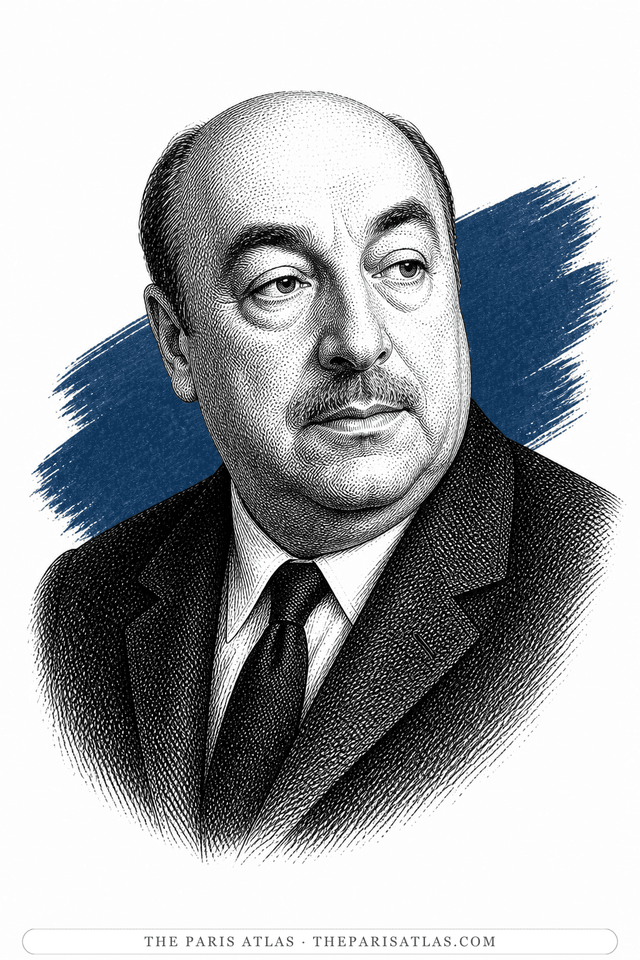
Chilean poet of the twentieth century's most widely read love poems, who spent his whole life in his country's diplomatic service and came back to Paris three times: passing through at twenty-three in 1927, on his way to his first consular post in Burma; running the rescue of refugees from the Spanish Civil War out of a Paris office in 1939; and serving as ambassador to France for Salvador Allende, Chile's newly elected socialist president, when the Nobel Prize in Literature reached him in October 1971.
View authorThe sources below include the primary text, editions, scholarship, archival materials, and other records that informed this page. They document Convivio, its publication, and its place in literary history.


Elizabeth Price Sayer's public-domain translation of 1887, the first in English, and the source of every English quotation.
The Italian text, used to check each quotation by treatise, chapter and paragraph.
Longfellow's translation of Purgatorio II, where Casella sings the canzone of the third treatise.

Boccaccio's description of the Convivio as a commentary on three canzoni.
The primary text represented by this page, used for descriptions of the work’s contents and for any quoted passages shown here.
The primary text is the baseline reference for every book page. Additional references document publication history, interpretation, and historical context where that evidence is available.
 Explore more resources