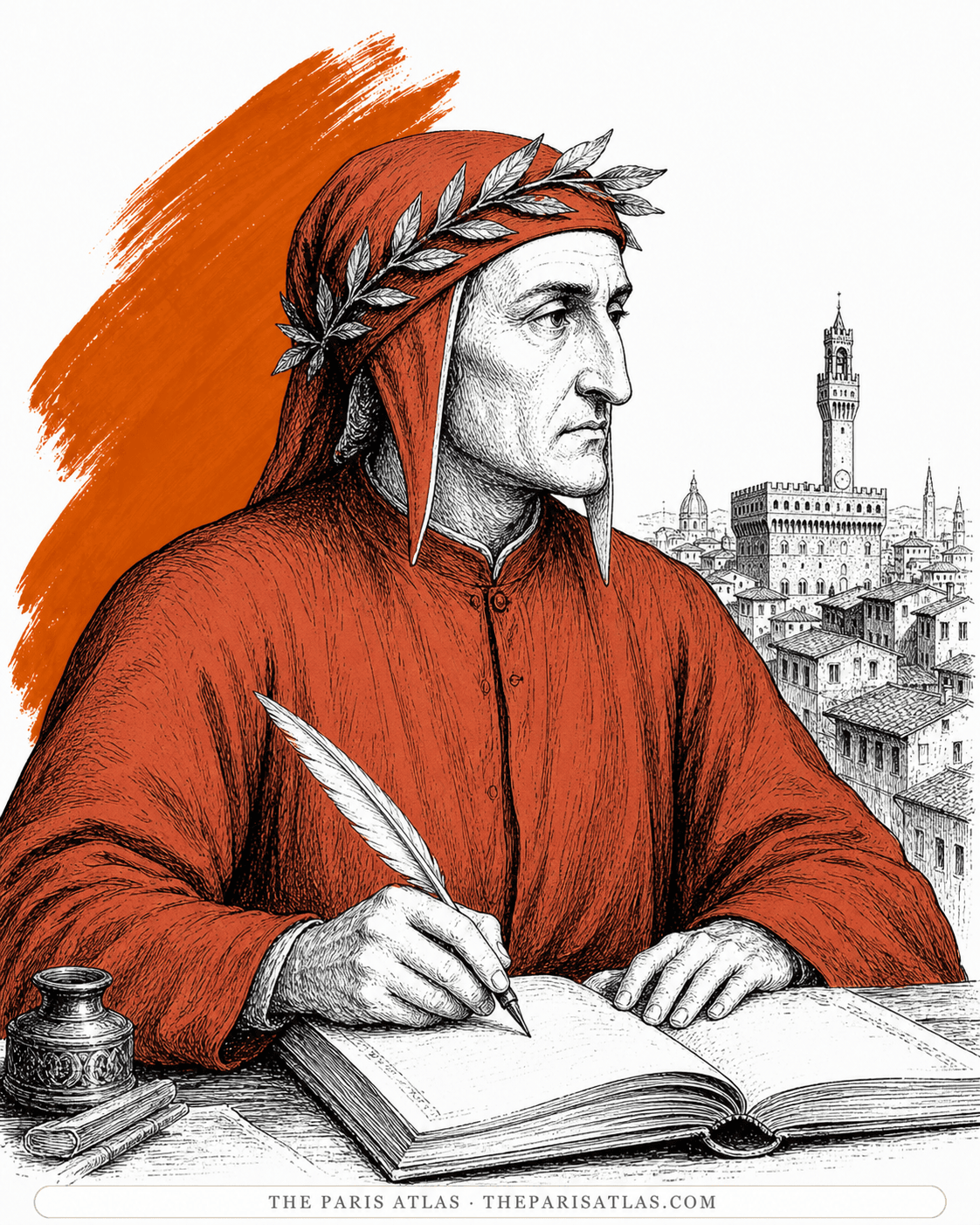
The title comes from the book's first sentence. Dante describes his memory as a book, with a heading written in Latin near its start: Incipit vita nova, “Here begins the new life.”[3] Modern Italian editions often use that Latin spelling, Vita nova. English readers mostly know it as La Vita Nuova, or The New Life.
The poems are 23 sonnets, 2 longer sonnets, a ballata, two single stanzas of canzone and 3 full canzoni, the long formal songs of Italian poetry. Dante chose them from verse he had written between about 1283 and 1293. Scholars date the finished book to 1292 or 1293, and some place it as late as 1294 or 1295. Modern editions divide the prose into 42 chapters.[1]
After most poems, Dante adds a short section explaining how it is built: where its parts begin and what each part says. Readers either skip these or find them the most revealing pages in the book. They show a young poet explaining his own technique while he is still grieving.[2]
Dante wrote the book for a friend. His first sonnet asked the poets of Florence to explain a dream, and one of the answers came from Guido Cavalcanti, whom Dante calls “the first among my friends.” Their friendship began there.[2] The book names Cavalcanti as the reader it was written for.[1]




 View source