The Paris AtlasCharting the artists, works, and places worth returning to.
  • Poet
  • Author
· Italian · 1265–1321

Dante Alighieri

Florentine poet whose Divine Comedy supplied the first subject of Rodin's Gates of Hell and the original identity of The Thinker as Dante meditating over the damned.

5 books on our shelves

Details

Lived
1265–1321
Born
Between mid-May and mid-June 1265
Birthplace
Florence, Republic of Florence
Died
13 or 14 September 1321
Place of death
Ravenna, Papal States
Nationality
Italian
Married
Gemma di Manetto Donati · c. 1285–1321
Children
Jacopo Alighieri, Pietro Alighieri, Antonia Alighieri (Sister Beatrice), Giovanni Alighieri
Roles
PoetAuthor

About Dante Alighieri

Durante di Alighiero degli Alighieri, called Dante (c. 1265–1321), was a Florentine poet, politician, and moral philosopher. He wrote the Divine Comedy in exile from his own city — a hundred-canto journey through hell, purgatory, and paradise composed in the Tuscan vernacular he was in the process of turning into the Italian literary language. He died at Ravenna in September 1321, hours after finishing the last canto of Paradiso, and was buried there. Florence has been asking for his remains back ever since.

He is one of the three writers, with Petrarch and Boccaccio, whom Italians call le tre corone — the three crowns of their fourteenth-century literature. His example authorised every subsequent European poet who chose their own spoken language over Latin. Six centuries later he was still shaping other artists' work: Auguste Rodin's Gates of Hell, commissioned in 1880, took its opening subject from Dante, and the figure that later became The Thinker was originally Dante meditating over the damned above the tympanum.

Florence, Beatrice, and the young poet

Dante was born in Florence sometime between mid-May and mid-June 1265 into a family of the minor nobility — his father Alighiero di Bellincione was a moneylender and legal expert with a modest patrimony. His mother Bella degli Abati died before he was ten; his father remarried and died before Dante was eighteen. He was educated at the Franciscan school of Santa Croce and by the Dominicans at Santa Maria Novella, and studied privately with the notary and encyclopaedist Brunetto Latini, whom he would later place, with warmth and grief, in the seventh circle of Hell.

The determining meeting of his life took place, he says, when he was nine years old and Beatrice Portinari — the daughter of a Florentine banker named Folco Portinari — was eight. He describes her arriving at a May celebration in a crimson dress and looking at him. The Vita Nuova, the collection of poems and prose he assembled in his twenties, is the record of that meeting and its sequel: he saw her again nine years later, exchanged a greetin[1]g once, and lost her when she died in June 1290 at twenty-four. She married a banker named Simone dei Bardi; Dante married Gemma Donati around the time of her death. Neither marriage is what the poems are about.

Florentine politics and the exile

Dante enrolled in the guild of physicians and apothecaries in 1295 — an administrative move that made him eligible for civic office — and rose quickly through the Florentine political system. He served on the Council of the Hundred, on smaller consulting bodies, and in June to August 1300 as one of the six Priors of Florence, the city's highest executive office. Florence at the time was split between two Guelph factions, the Whites and the Blacks; Dante was a moderate White. His priorship, which ordered the temporary exile of extremists from both factions, was later held against him.

In November 1301 the Blacks, backed by Pope Boniface VIII and Charles of Valois, took control of Florence by force. Dante was in Rome on an embassy to the Pope. In January 1302 the new Black government sentenced him in absentia for corruption and barratry: a fine and two years' exile if he returned to pay it, death at the stake if he did not. He was thirty-six. He never entered Florence again. The rest of his life — twenty years — was spent as a guest at the courts of one Italian noble house after another, working on the Divine Comedy while receiving hospitality he described in the seventeenth canto of Paradiso as knowing what it is to eat another man's salt bread.

The Divine Comedy

The Divine Comedy is a hundred cantos long, roughly 14,233 lines, written in the interlocking three-line stanza Dante invented — terza rima — and divided into three parts of thirty-three cantos each (Inferno has an extra opening canto that makes the numbers work). The frame is a first-person journey through the three regions of the medieval Christian afterlife: down the funnel of Hell, up the mountain of Purgatory, and through the nine celestial spheres of Paradise. It is set in Easter week of the year 1300 and was composed, in exile, over roughly the last fifteen years of Dante's life.

The Roman poet Virgil, dead a thousand years earlier, guides the pilgrim through Hell and up the mountain — a pagan poet leading a Christian one, since Virgil's Aeneid had already described a descent into the underworld. Beatrice takes over at the summit of Purgatory and guides the pilgrim through Paradise. The Divine Comedy is, at one level, the poem Dante had promised to write for her at the end of the Vita Nuova, when he closed that early book by saying he would speak of her again in a work no man had ever attempted.

He wrote it in the Tuscan vernacular, not in Latin. The choice was polemical — Dante had argued for the dignity of the vernacular in his unfinished De Vulgari Eloquentia — and its consequence, over the two centuries after his death, was that Tuscan became the basis of standard Italian. It is not quite true that Dante 'invented' the Italian language; it is exactly true that his Divine Comedy is why the fourteenth-century Tuscan of Florence, rather than any other dialect of the peninsula, is the language educated Italians write and speak today.

  • The Gates of Hell

    Auguste Rodin's thirty-seven-year commission — a bronze door for the future Musée des Arts Décoratifs, on a theme drawn from the Inferno.

  • The Thinker

    Originally the figure of Dante meditating above the tympanum of the Gates; enlarged and cast as an independent monument in 1904.

Verona, Ravenna, and the last cantos

The Divine Comedy was written across Dante's whole exile. He drafted the Inferno at various stopping places in northern Italy between 1308 and 1314. The Purgatorio was substantially finished by 1319 under the patronage of Cangrande della Scala at Verona — the noble whom Dante dedicated the Paradiso to and whom the Comedy's most famous prose commentary (the Epistle to Cangrande, whose Dantean authorship is still debated) instructs on how to read a poem in three simultaneous registers of meaning.

From about 1318 onward Dante lived at Ravenna at the invitation of Guido Novello da Polenta, the city's lord. His two sons Jacopo and Pietro joined him there; his wife Gemma and daughter Antonia remained in Florence. He finished the last cantos of Paradiso in Ravenna. In August 1321 Guido sent him as ambassador to Venice; Dante caught malaria on the trip back through the marshes of the Po delta and died shortly after arriving home, on the night of 13–14 September 1321.

Ravenna, Florence, and the tomb that never left

Guido buried him honourably at the church of San Pier Maggiore in Ravenna, now the Basilica of San Francesco. Florence, which had exiled him under threat of the stake, immediately began asking for his remains back. Ravenna refused. In 1519 Pope Leo X gave Florence permission to exhume the tomb — the Franciscans at Ravenna hid the bones in a monastery wall for the next three hundred years, so the exhumation opened an empty coffin. The bones were rediscovered by accident in 1865 during construction work; they are now in a small neoclassical mausoleum next to the Basilica of San Francesco, six hundred metres from the empty tomb Florence keeps for him in Santa Croce.

The Divine Comedy has been continuously read for seven hundred years — through the Renaissance commentators, through the illuminated editions Botticelli drew for Lorenzo de' Medici[2], through the Doré and Blake engravings that gave the nineteenth century its visual vocabulary for Hell, and through Rodin's Gates and Thinker at the century's end. T. S. Eliot wrote that the modern world was divided between Dante and Shakespeare and that there was no third. Every subsequent argument in Italian about the shape and dignity of Italian was already contained in Dante's decision, in 1308, to write his poem in the language he heard in the streets of Florence.

The Vita Nuova, and the other books

Before the Comedy there was the Vita Nuova, written around 1294. It is a strange, hybrid thing: twenty-five sonnets, a ballata and four canzoni, with prose between them in which Dante explains what each poem meant and what had happened to prompt it. The form is called prosimetrum, verse embedded in prose. It is where Beatrice enters his work, and where he first sets out the idea that a woman seen in the street can be the beginning of a theology.

The other books matter less to readers now but mattered enormously then. The Convivio, written in exile between about 1304 and 1307, is a philosophical commentary on his own poems. De vulgari eloquentia, written in Latin, argues for writing in Italian. The Monarchia argues that imperial authority comes directly from God and not through the pope, which is why it was later condemned and burned, and why it stayed on the Index of Prohibited Books for centuries.

Writing in Italian, and what it did to Italian

The decision that shaped a language was a decision about audience. Latin was the language of learning, and a poem in Latin would reach only people who already had access to everything. Dante wrote the Comedy in the Tuscan vernacular, the speech of Florence, and argued the case for doing so in De vulgari eloquentia.

The consequence is that a regional dialect became the basis of literary Italian. Writers who came after him worked in the language he had chosen, and largely in the form he had proved. The Tuscan of the Comedy is close enough to modern Italian that a reader today can follow it with help rather than translation. Few writers in any language have had that particular effect.

How the Comedy is built

The poem runs to 14,233 lines in a hundred cantos, arranged as three canticas of thirty-three each with one extra at the start of the Inferno to open the whole thing. It is written in terza rima, interlocking three-line stanzas rhyming aba bcb cdc, a form Dante appears to have invented for it, and one that pulls the reader forward because every stanza leaves a rhyme unresolved until the next.

Three is the organising number throughout, for the Trinity: three canticas, three-line stanzas, three beasts in the first canto, three guides. He began it around 1308 and finished it shortly before he died in 1321.

He called it a comedy in the medieval sense, meaning a work that begins in trouble and ends well, not a work that is funny. The adjective was added by other people. Boccaccio called it divine in his life of Dante in the 1350s, but it entered the title only with the Venetian edition Giolito printed in 1555, and it has stayed there ever since.

Dante in the visual arts, and why Rodin belongs to him

No poet has been drawn more often. Sandro Botticelli made a set of drawings for the Comedy in the 1480s and 1490s, including the funnel-shaped Map of Hell, and painted the profile portrait in the red cap and laurel that is still how most people picture Dante. In 1465 Domenico di Michelino painted him for Florence Cathedral, holding the open book beside the city that exiled him, a work usually described as a fresco and in fact tempera on canvas. William Blake was working on his Dante watercolours when he died in 1827, and Gustave Doré made the engravings between 1861 and 1868 that fixed the poem's imagery for the nineteenth century and after.

The Paris connection runs through two artists. Eugène Delacroix made his Salon debut in 1822 with The Barque of Dante, taken from Canto VIII, with Dante and Virgil crossing the Styx among the damned.[3] It hangs in the Louvre.

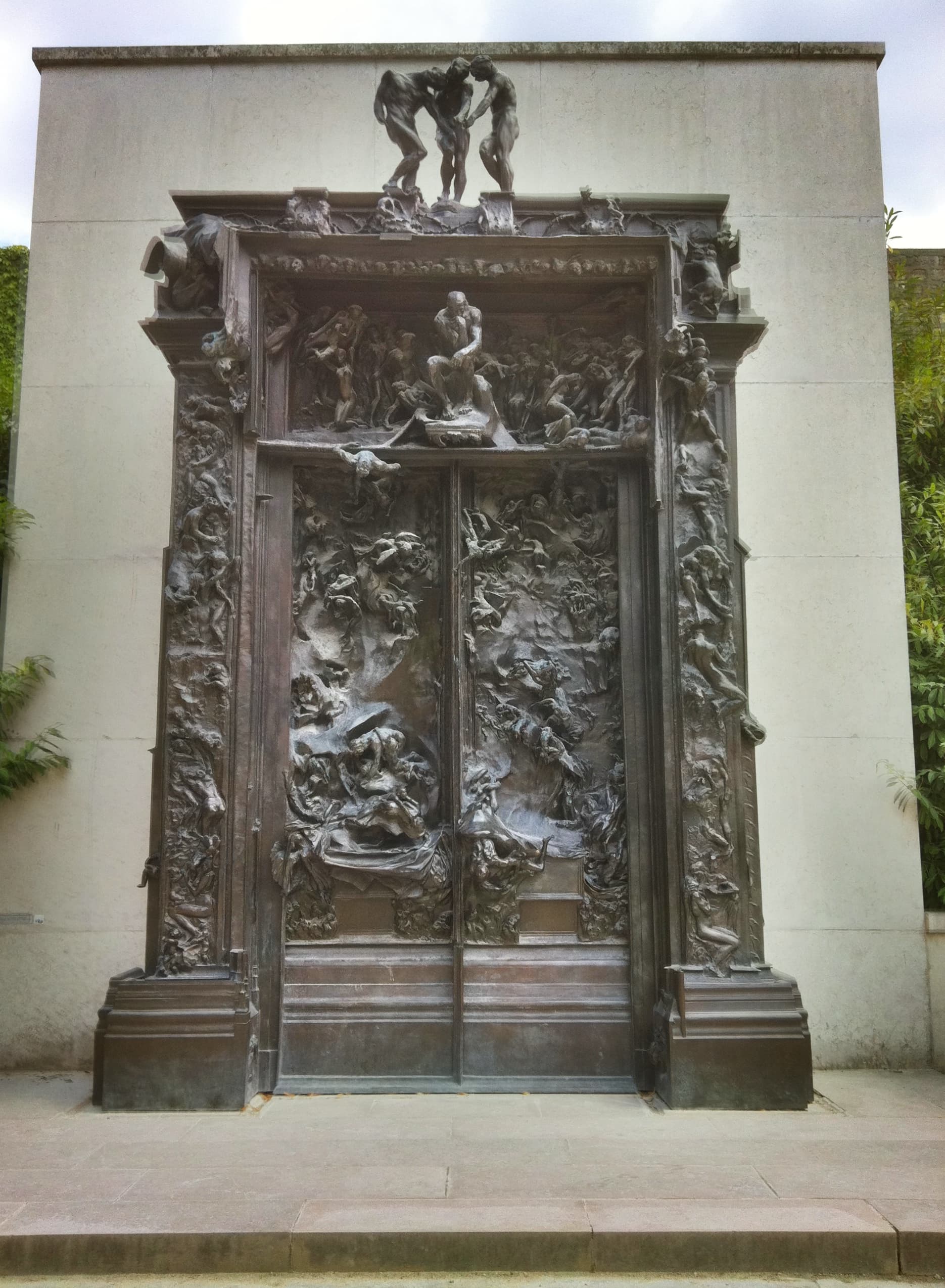
And then there is Auguste Rodin, whose largest work is Dante from top to bottom. The Gates of Hell, commissioned in 1880 and never finished, takes its whole population from the Inferno: Ugolino among his children, Paolo and Francesca on the left door. The Three Shades at the summit originally pointed downwards at the inscription from Canto III. Two of the most reproduced sculptures in the world came off those doors. The Kiss was first called Francesca da Rimini and was taken out of the scheme because its happiness did not belong among the damned. And the seated figure above the doors, brooding over the whole inferno, was first named The Poet. He is Dante, looking at what he has made.

Life events

  1. c. May–June 1265

    Born in Florence to Alighiero di Bellincione, a moneylender, and Bella degli Abati.

  2. 1274

    First meets Beatrice Portinari, aged nine, at a May celebration.

  3. c. 1283

    Death of his father Alighiero; Dante inherits a small patrimony and begins studying with the notary Brunetto Latini.

  4. c. 1285

    Marries Gemma di Manetto Donati under a contract arranged when he was twelve.

  5. 1290

    Death of Beatrice Portinari in Florence, aged twenty-four.

  6. c. 1293–1295

    Writes the Vita Nuova, the sequence of poems and prose about his love for Beatrice.

  7. 1295

    Enrols in the Florentine guild of physicians and apothecaries, becoming eligible for civic office.

  8. June–August 1300

    Serves as one of the six Priors of Florence, the city's highest executive office.

  9. January 1302

    Sentenced in absentia by the new Black Guelph government to two years' exile, a heavy fine, and, if he returns, death at the stake.

  10. c. 1308–1314

    Drafts the Inferno at various northern Italian courts.

  11. c. 1315–1319

    Substantially finishes the Purgatorio under the patronage of Cangrande della Scala at Verona.

  12. c. 1318–1321

    Lives at Ravenna at the invitation of Guido Novello da Polenta; finishes the Paradiso.

  13. 13–14 September 1321

    Dies at Ravenna of malaria contracted on an embassy for Guido to Venice. Buried at the church of San Pier Maggiore, now the Basilica of San Francesco.

  14. 1519

    Pope Leo X grants Florence permission to exhume Dante's tomb for reburial; the Ravenna Franciscans hide the bones in a monastery wall and the Florentine delegation opens an empty coffin.

  15. 1865

    The hidden bones are rediscovered by accident during construction work in Ravenna and interred in a neoclassical mausoleum next to San Francesco.

  16. 1880

    Auguste Rodin is commissioned to design The Gates of Hell for the future Musée des Arts Décoratifs, on a theme drawn from Dante's Inferno. The Thinker is the figure of Dante above the tympanum.

Dante Alighieri quotes

Verbatim, as recorded by the witnesses of the era — sources on every quotation.

Midway upon the journey of our life I found myself within a forest dark, for the straightforward pathway had been lost.

Nel mezzo del cammin di nostra vita / mi ritrovai per una selva oscura, / ché la diritta via era smarrita.

— Dante Alighieri, Inferno I.1–3
Through me the way is to the city dolent; through me the way is to eternal dole; through me the way among the people lost. Justice incited my sublime Creator; created me divine Omnipotence, the highest Wisdom and the primal Love. All hope abandon, ye who enter in!

Per me si va ne la città dolente, / per me si va ne l'etterno dolore, / per me si va tra la perduta gente. / Giustizia mosse il mio alto fattore; / fecemi la divina podestate, / la somma sapïenza e 'l primo amore. / Lasciate ogne speranza, voi ch'intrate.

— Dante Alighieri, the inscription over the gate of Hell, Inferno III.1–9
Love, that exempts no one beloved from loving, seized me with pleasure of this man so strongly, that, as thou seest, it doth not yet desert me.

Amor, ch'a nullo amato amar perdona, / mi prese del costui piacer sì forte, / che, come vedi, ancor non m'abbandona.

— Francesca da Rimini, Inferno V.103–105
All 40 Dante Alighieri quotes

Art Depicting Dante Alighieri

Works with Dante as their subject.

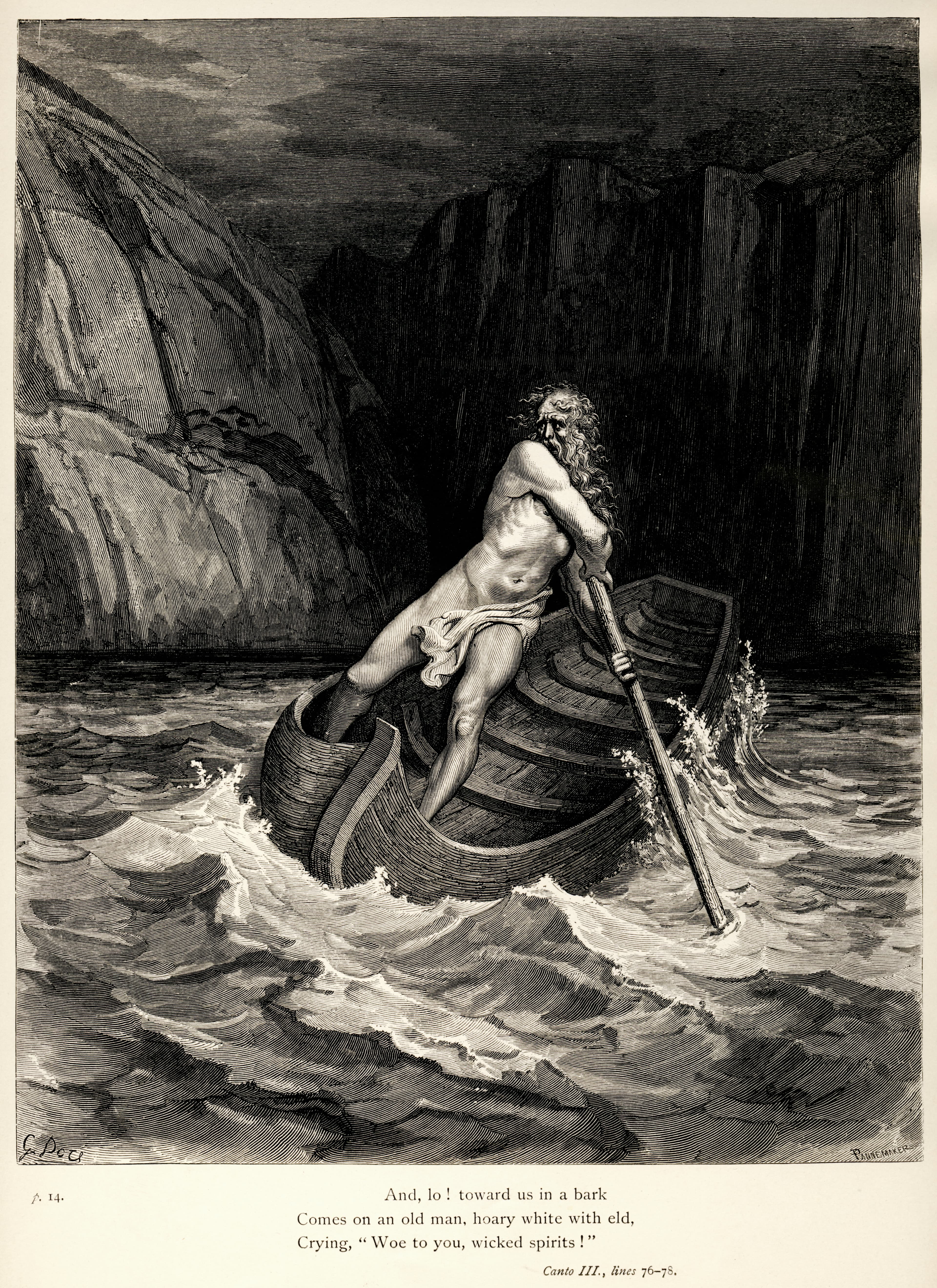
Doré's Charon plate: the ferryman standing in his boat swinging an oar over a crowd of naked souls on the shore of Acheron

Artwork reproduction

Print portfolio · Late Romanticism

Dante's Inferno — the Doré illustrations

Gustave Doré · 1861 · Wood engravings after Doré's drawings

Gustave Doré's folio edition of the Inferno, published in Paris in 1861 at his own expense after his publisher refused to fund it. Its plates fixed the look of Dante's hell for the modern imagination, and their success launched the series of great Doré folios.
Gustave Doré, Dante's Inferno — the Doré illustrations, 1861. Image: public domain.

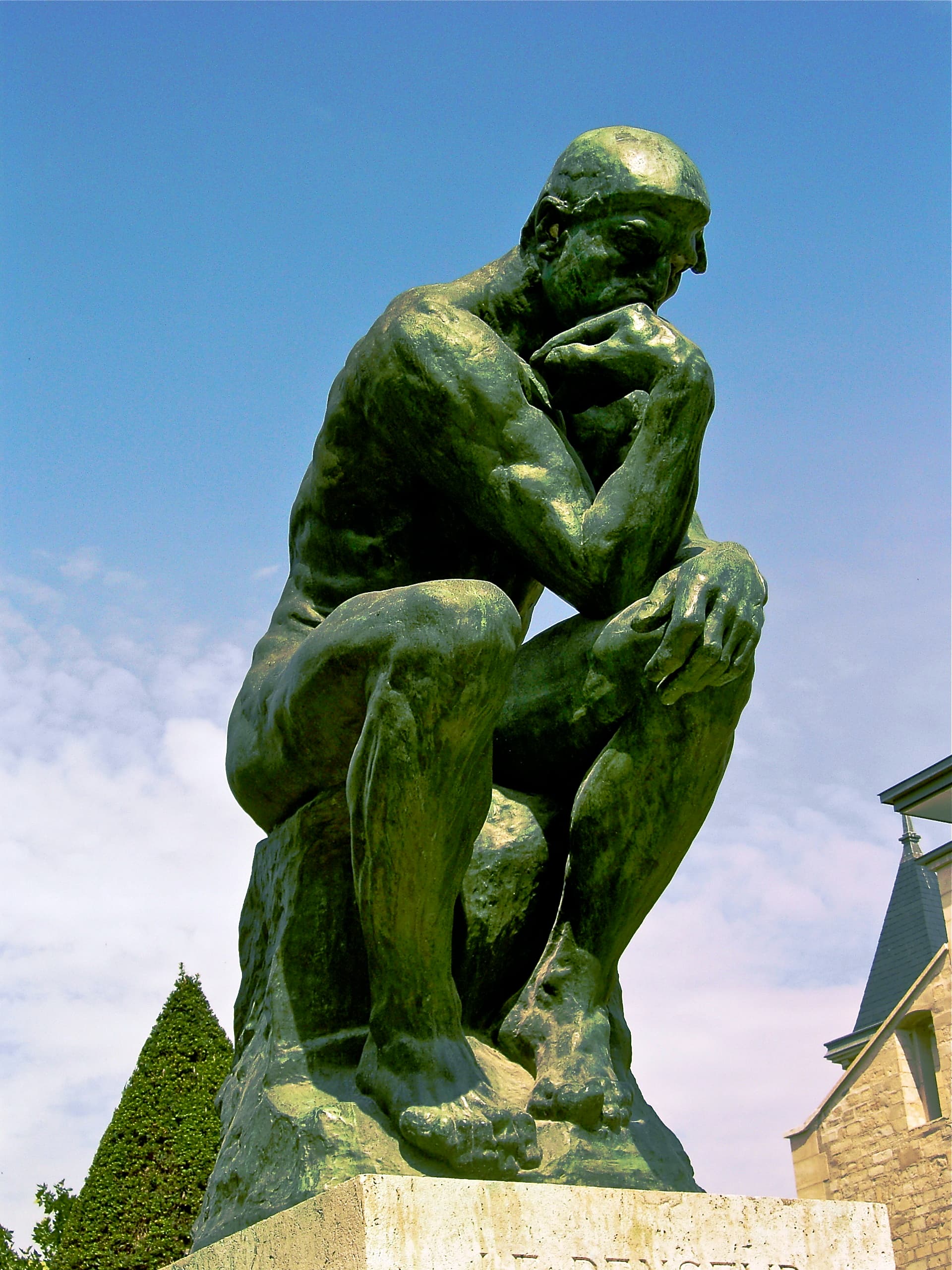
Auguste Rodin's monumental bronze Thinker in the Musée Rodin garden: a nude man seated on a rock, leaning forward with his chin against his right hand

Artwork reproduction

Sculpture · Modern sculpture

The Thinker

Auguste Rodin · 1880; enlarged 1903–1904 · Bronze

Auguste Rodin conceived this tense seated figure in 1880 as Dante above The Gates of Hell. He later exhibited it alone, renamed it The Thinker, and enlarged it into the monumental form now in the Musée Rodin garden.

Musée Rodin, Paris

Auguste Rodin, The Thinker, 1880; enlarged 1903–1904. Musée Rodin, Paris. Image: public domain.

Auguste Rodin's monumental bronze Gates of Hell in the Musée Rodin garden in Paris, covered with falling and twisting human figures beneath The Thinker and The Three Shades

Artwork reproduction

Sculpture · Modern sculpture

The Gates of Hell

Auguste Rodin · Conceived 1880–circa 1890; Paris bronze cast 1928 · Bronze

Auguste Rodin began this monumental doorway in 1880 for a Paris museum that was never built. Its crowded vision of Dante's Hell became the source of more than 200 figures and groups, including The Thinker, The Three Shades, and Ugolino and His Children.

Musée Rodin, Paris

Auguste Rodin, The Gates of Hell, Conceived 1880–circa 1890; Paris bronze cast 1928. Musée Rodin, Paris. Image: CC BY 3.0.

Books by Dante Alighieri

Cover of La Vita Nuova by Dante Alighieri

Poetry

Dante's first book: the poems he wrote for Beatrice Portinari, and his own account of why he wrote each one.

4.3
Cover of De Vulgari Eloquentia by Dante Alighieri

Essays & criticism

Dante, writing in Latin, makes the case for poetry in Italian, and mocks nearly every Italian dialect on the way.

3.9
Cover of Convivio by Dante Alighieri

Convivio

Dante Alighieri1307(posth.)

Essays & criticism

Dante's plan to serve philosophy to ordinary readers as a banquet, in Italian, with his own poems as the dishes.

3.7
Cover of De Monarchia by Dante Alighieri

Political philosophy

Dante's case, in Latin prose, that the world needs one emperor and that the pope has no power to make him.

3.9
Cover of The Divine Comedy by Dante Alighieri

Poetry

A Florentine in exile walks down through hell, up a mountain and into the sky, naming the people he knew on the way.

4.8

Questions about Dante Alighieri

Who was Dante Alighieri?

Dante Alighieri (c. 1265–1321) was a Florentine poet, politician, and moral philosopher whose Divine Comedy is one of the founding works of Western literature and the reason educated Italians today speak a language descended from fourteenth-century Tuscan. He wrote the poem in exile from Florence over the last fifteen years of his life and died at Ravenna hours after finishing the last canto of Paradiso.

What is the Divine Comedy?

A hundred-canto poem in three parts — Inferno, Purgatorio, and Paradiso — in which a first-person narrator, guided by the Roman poet Virgil and then by Beatrice, travels through hell, up the mountain of purgatory, and through the nine celestial spheres of paradise. It runs to roughly 14,233 lines, is written in Dante's own invention of the three-line stanza (terza rima), and is set in Easter week of the year 1300.

Who was Beatrice in Dante's work?

Beatrice Portinari (1266–1290), the daughter of the Florentine banker Folco Portinari and wife of the banker Simone dei Bardi. Dante says he first met her when he was nine and she was eight, at a May celebration in Florence. She died in June 1290 at twenty-four. He wrote the Vita Nuova about her, and thirty years later she is the guide who takes the Divine Comedy's pilgrim through Paradise.

Why was Dante Alighieri exiled from Florence?

Florence in Dante's time was split between two Guelph factions, the Whites and the Blacks. Dante was a moderate White. In November 1301 the Blacks took control of the city with the backing of Pope Boniface VIII and Charles of Valois; in January 1302 the new government sentenced Dante in absentia for corruption. If he returned to pay the fine, he would face two years' exile; if he refused, death at the stake. He never returned.

Where is Dante Alighieri buried?

In a small neoclassical mausoleum next to the Basilica of San Francesco in Ravenna. His original burial in 1321 was in the same church (then called San Pier Maggiore). Florence has repeatedly asked for his remains back — Pope Leo X granted permission in 1519 — but the Ravenna Franciscans hid the bones in a monastery wall, where they were rediscovered by accident during construction work in 1865 and moved to the current tomb. The empty sarcophagus Florence keeps for him at Santa Croce is a monument rather than a grave.

How did Dante Alighieri die?

He caught malaria while returning from an ambassadorial mission to Venice, undertaken for Guido Novello da Polenta, and died at Ravenna on the night of 13–14 September 1321, aged fifty-six. He had finished the last canto of Paradiso within a few days of his death.

Connections and Sources

Dante Alighieri’s connections to people, places, and works, with the sources behind each one.

Depicted in · 1880

The Thinker

Rodin first titled the figure The Poet and conceived it as Dante Alighieri leaning over The Gates of Hell. As he exhibited it independently, the title and meaning broadened into The Thinker.

— Musée Rodin, The Thinker — Paris cast S.01295 (2026); National Gallery of Art, The Thinker (Le Penseur), 1942.5.12 (2026)

Depicted in · 1880

The Gates of Hell

The seated Poet above the doors was conceived as Dante Alighieri looking down on the Hell described in his Divine Comedy. The same figure later became the independent Thinker.

— Musée d'Orsay, Porte de l'Enfer — DO 1986 4 / S 2450 (2026), central trumeau description; Musée Rodin, The Thinker — Paris cast S.01295 (2026)

References

References

The sources below include biographies, scholarly essays, interviews, and primary materials that informed this page. They reflect both the historical record and ongoing critical conversations about Dante Alighieri and their work.

  1. 1↑Vita Nuova

    Website
    Wikisource (Italian)
    Used for

    Italian Wikisource text of the Vita Nuova.

    View source
  2. 2↑Sandro Botticelli, Portrait of Dante

    Website
    Uffizi Galleries
    Used for

    Botticelli's portrait of Dante and the drawings for the Comedy.

    View source
  3. 3↑La Barque de Dante, Eugene Delacroix

    Website
    Musee du Louvre
    Used for

    The Louvre's record of Delacroix's The Barque of Dante, his Salon debut of 1822.

    View source
  4. 4Divina Commedia

    Website
    Wikisource (Italian)
    Used for

    Italian Wikisource text of the Divine Comedy, used to verify every Italian quotation by canto and line.

    View source
  5. 5The Divine Comedy, translated by Henry Wadsworth Longfellow (1867)

    Website
    Wikisource
    Used for

    Longfellow's 1867 translation via English Wikisource, the public-domain English used here.

    View source
  1. 6The Gates of Hell — S.01304

    Website
    Musée Rodin, 2026
    Used for

    The Musée Rodin's record of The Gates of Hell, its Dante subjects and the figures taken from it.

    View source
  2. 6The Gates of Hell — S.01304

    Website
    Musée Rodin, 2026
    Used for

    Web source consulted for documented facts and historical context presented on the Dante Alighieri page.

    View source
  3. 7Dante — Encyclopaedia Britannica

    Website
    Encyclopaedia Britannica
    Used for

    Web source consulted for documented facts and historical context presented on the Dante Alighieri page.

    View source
  4. 8Dante Alighieri — Poetry Foundation

    Website
    Poetry Foundation
    Used for

    Web source consulted for documented facts and historical context presented on the Dante Alighieri page.

    View source
  5. 9The Thinker — Paris cast S.01295

    Website
    Musée Rodin, 2026
    Used for

    Web source consulted for documented facts and historical context presented on the Dante Alighieri page.

    View source
i
Why these sources are here

These references anchor the page in the documented record and in the scholarly conversations around Dante Alighieri. Every claim on this page traces back to one or more of the works listed here.

Explore more resources
Browse all authors