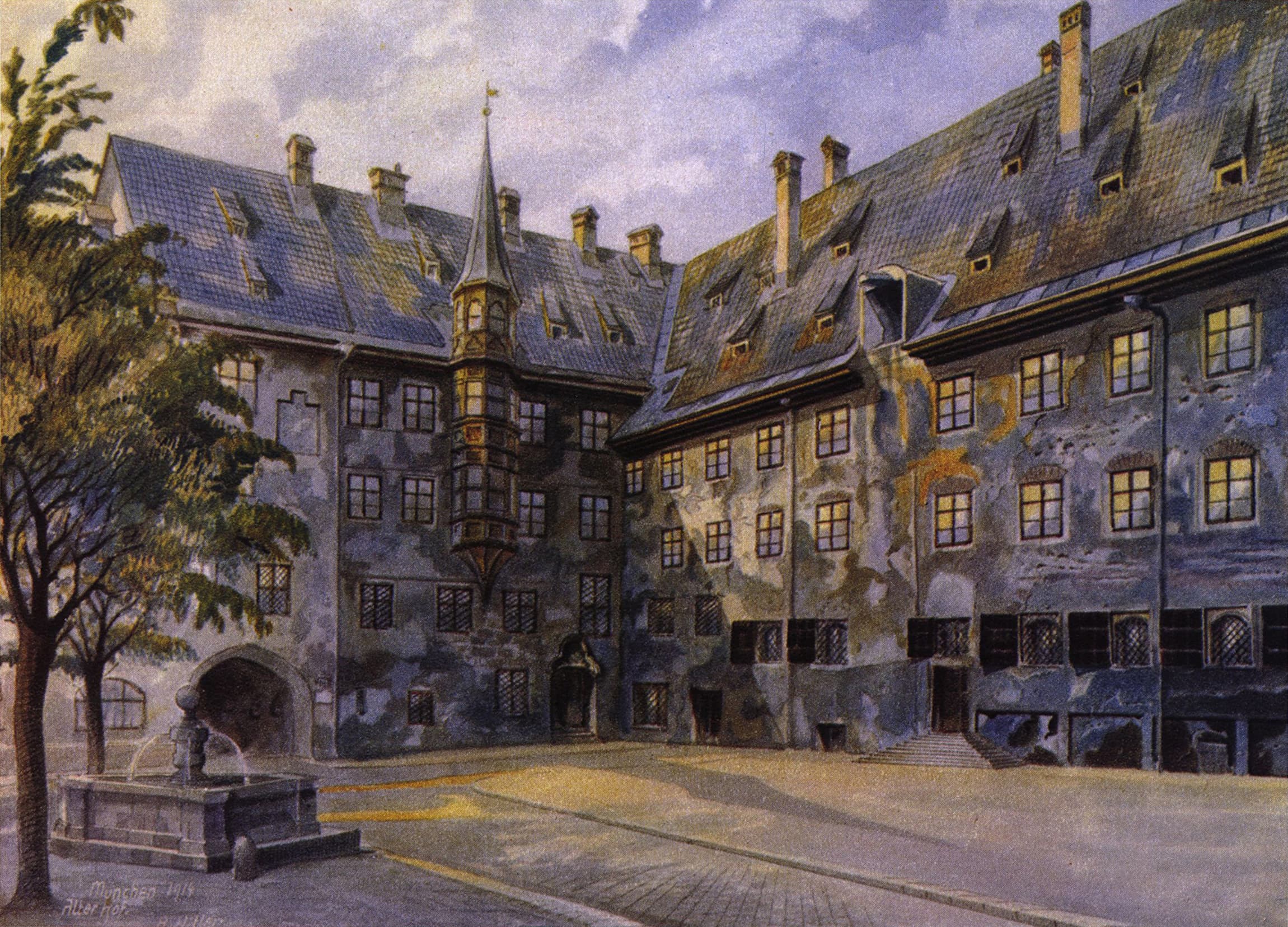
Der Alte Hof in München
by Adolf Hitler
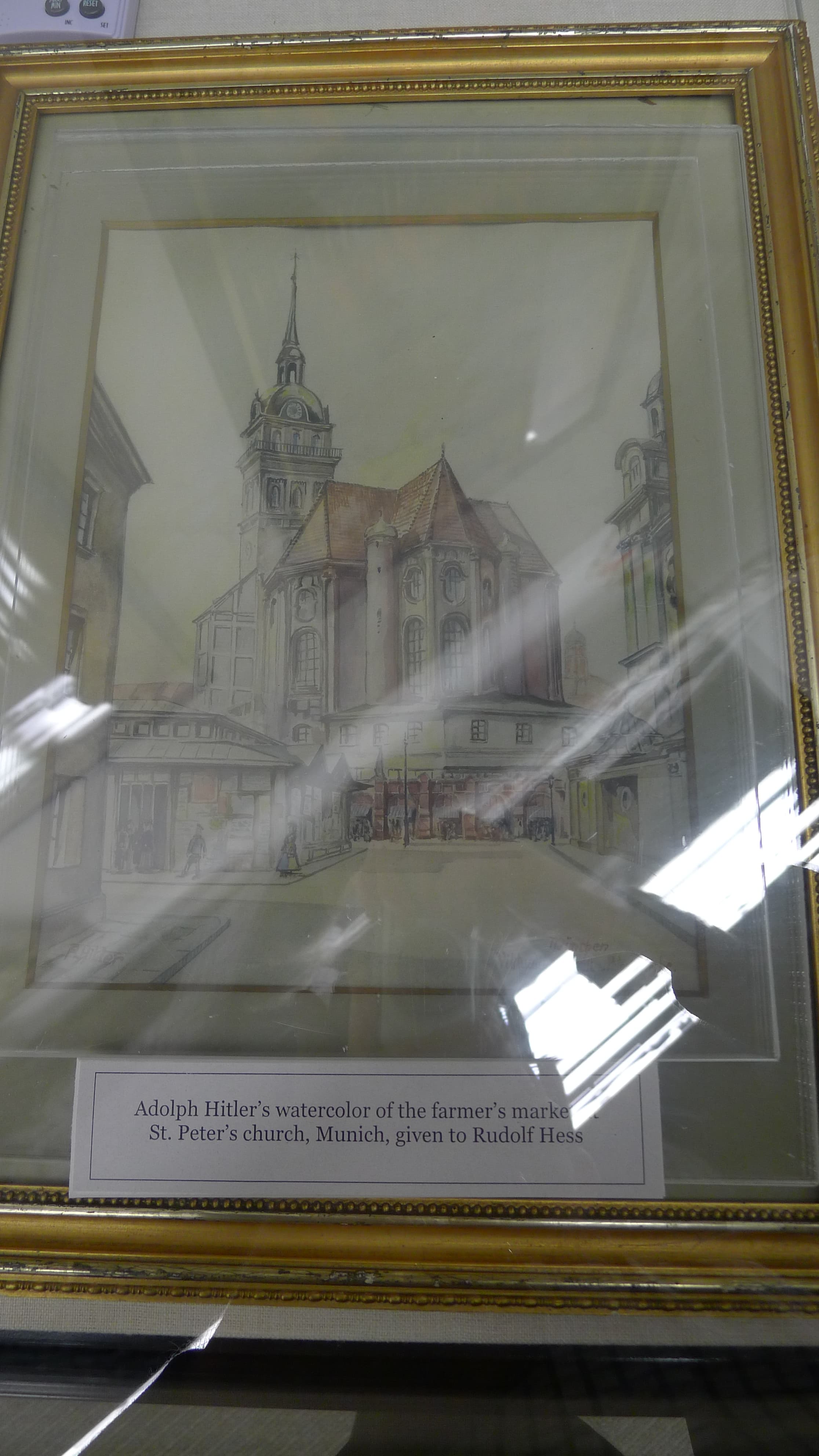
A watercolour of the Alter Hof courtyard in Munich, dated 1914 and attributed to Adolf Hitler. It was printed in a Nazi cigarette-card album in 1936, which is more documentation than most pictures signed “A. Hitler” can show.
- 1914
- Watercolour
About Adolf Hitler
The building in the picture
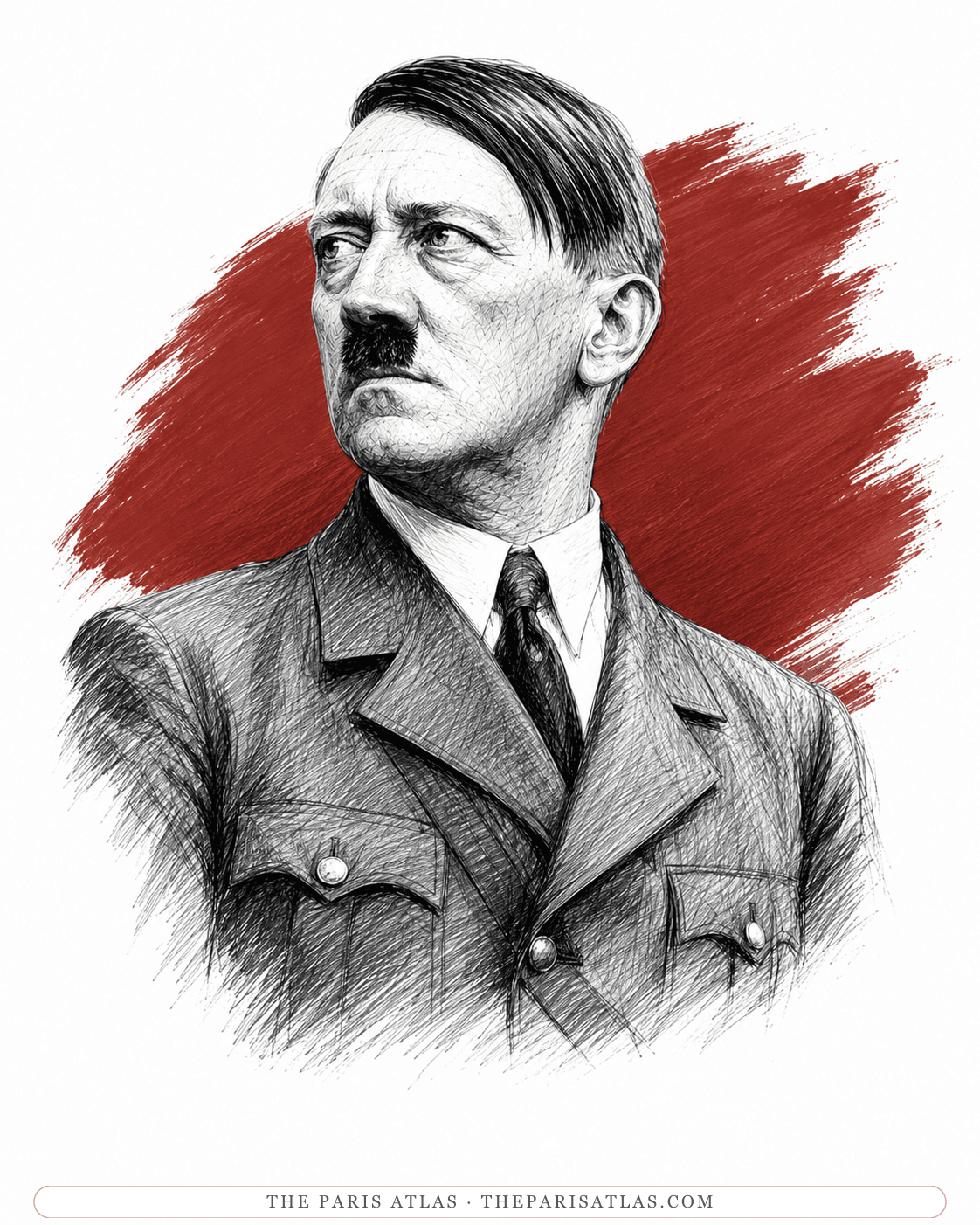
The Alter Hof is the courtyard of the old ducal residence in the centre of Munich, a short walk from Marienplatz. Its ranges enclose a yard on four sides, and the late-Gothic west wing, the Burgstock, carries the corner oriel the courtyard is known for.
The sheet is dated 1914 and titled Der Alte Hof in München. English-language records give it as The Courtyard of the Old Residency in Munich. No dimensions and no signature reading have been published for it.
He copied his views and sold them
Adolf Hitler did not compose these pictures. He worked from postcards, prints and photographs rather than from the motif, which is why the same Vienna and Munich views recur across the sheets attributed to him.
“He had no style of his own as a painter, but generally just copied.”
The selling was a small business with a partner in it. In Vienna from about 1910 the watercolours were hawked to frame dealers and tourists by Reinhold Hanisch, a drifter who took a share and eventually fell out with him over money. After the move to Munich in 1913 the method did not change: small sheets, sold through dealers and directly to visitors, with little commercial success by every account of it.
The art historian O. K. Werckmeister estimates two to three thousand works made between the ages of eighteen and twenty-five, when painting was his only occupation.
Why this one can be traced
The picture was reproduced in Adolf Hitler: Bilder aus dem Leben des Führers, a cigarette-card album published at Hamburg-Bahrenfeld in 1936 and printed in several million copies. The Historisches Lexikon Bayerns cites it at page 71 of that album and names the copy it used, at the Bayerische Staatsbibliothek under shelfmark BA/4 L.sel.I 727. The Library of Congress holds the same card image in its Prints and Photographs Division, catalogued as a watercolour of a Munich courtyard, 1914.
- The 1936 printing puts the picture on paper while Hitler was alive and in power, which rules out every forger working after 1945.
- It was published by his own propaganda apparatus, so the attribution is an interested claim rather than an authentication.
- No museum has published an object record for the sheet, and no conservation report on it is public.
Calvin University's German Propaganda Archive, which reproduces the album plates, marks two other works in its selection as certainly by Hitler and carries no such note against this one.
Wikimedia Commons and Wikidata both file the watercolour as a holding of the United States Army Center of Military History. The Army does hold four watercolours attributed to Hitler, taken from the collection of his photographer Heinrich Hoffmann and in federal custody since the confiscations of 1945 to 1947; the curator Renee Klish has said the four are correctly attributed. What those four depict is not agreed. The Art Newspaper reported in 2007 that they are Vienna views; the Washingtonian in 2017 described soldiers in a valley, a damaged Belgian town and the Alter Hof courtyard. The Army publishes no object record and releases no images, so whether this sheet is one of the four is unestablished.
Most paintings signed A. Hitler are fake
The forgery trade is as old as the market. Reinhold Hanisch, who had sold the genuine sheets in Vienna, was manufacturing fake ones from 1933. Birgit Schwarz calls him a shady figure and notorious liar who oversaw what she describes as a forgery centre in Vienna. He was arrested in November 1936 and died in custody the following year.
Two months of 2019 give the scale of the modern trade. Berlin police seized three watercolours from the Kloss auction house in January, each signed and dated 1910 or 1911 and each supplied with a certificate of authenticity. Prosecutors in Nuremberg-Fürth seized sixty-three works from Auktionshaus Weidler in February, twenty-six of which were about to be sold. In both cases the legal basis was suspected document forgery and fraud rather than the subject matter, which is legal to sell in Germany. The works Weidler still offered found no buyers.
There is no reliable reference work to check a sheet against. The standard catalogue, Billy F. Price's Adolf Hitler: The Unknown Artist of 1984, runs to 723 entries, was self-funded by a man who was then among the largest private owners of this material, and includes works the historian Hermann Weiss identified as forgeries by Konrad Kujau, who also forged the Hitler diaries. Price dedicated the book to August Priesack, whose signature appears on many of the certificates sold with paintings and who authenticated the diaries before they collapsed in 1983.
- A certificate of authenticity proves nothing; the documented fakes came with them.
- A bill of sale produced by the seller proves nothing.
- An entry in Price's 1984 catalogue proves nothing.
- A high auction price proves nothing. The 2019 seizures were made at auction houses.
“No one has really conducted any serious comprehensive research into Hitler's art.”
Schwarz adds the structural problem. Connoisseurship works by recognising a hand, and a painter who copied postcards leaves little for it to hold on to. She notes that Hitler himself, shown works attributed to him in later life, did not know whether they were genuine.[1]
Who held the rights, and until when
Copyright in everything Adolf Hitler made expired on 1 January 2016. German and Austrian law run the term seventy years from the end of the year of the author's death, and he died on 30 April 1945.[2]
For the sixty-seven years before that, the rights belonged to the Free State of Bavaria. A Munich court declared his will void, his sister Paula's claim to the estate failed, and because he had been registered as resident in Munich the state took the assets through denazification proceedings in 1948. Bavaria used the copyright as a power of refusal rather than a source of income: it blocked German reprints of Mein Kampf outright, and it went after a British publisher's facsimiles of Nazi-era newspapers, with more than 3,200 copies of one facsimile confiscated. When the term ran out there was no successor right and nothing replaced it. The Institute of Contemporary History in Munich published its annotated edition of Mein Kampf that same month.[2]
None of this ever covered the objects. Copyright is not title, and the watercolours sold in Vienna and Munich before 1914 have been private property ever since, which is why they appear at auction and why the auctions are lawful.[3]
What art historians say about the work
The consistent verdict is competence with buildings and weakness with people. The perspective holds, the rooflines are right, and there is no invention. The Academy of Fine Arts Vienna reached the same conclusion at the time: it refused him in 1907, after he had reached the practical stage, and again in 1908. The assessor Christian Griepenkerl recorded the 1907 verdict as sample drawing unsatisfactory, too few heads. The general painting school wanted the human figure, and the portfolio was architecture and landscape.[4]
“Prosaic, utterly devoid of rhythm, colour, feeling, or spiritual imagination.”
Klingen's remark about the state of the research is the more important one. A body of work cannot be assessed while it is unclear which works belong to it, so any confident judgement about a single sheet is running ahead of the evidence.[1]
Close reading
Reading the work, detail by detail
This second view of the Alter Hof is traceable through its publication in a 1936 propaganda album. Its details show a copied landmark rendered with orderly perspective and little human presence, while the publication history—not style—does the strongest work of attribution.
1.The famous oriel supplies the landmark
The projecting bay, small windows, and pointed roof concentrate the building's most recognizable feature. It is the kind of architectural detail a postcard copy must preserve to remain saleable.
2.Repeated windows make competence look systematic
Rows of openings and sloping roofs are carefully counted and aligned. The passage shows facility with buildings, but also the dependence on established architectural information rather than expressive transformation.
3.The courtyard is a stage with almost no life
Paving opens toward the building while figures, if present at all, are too slight to organize the view. Architecture receives the descriptive attention that people do not.
4.Steep roofs give the courtyard its uneven history
The roofline rises and falls rather than forming a single block. That irregularity is one of the few signs that the complex grew through different building campaigns.
5.The central passage interrupts the repeated windows
Repeated windows establish order until the dark opening breaks the pattern. It acts as both a visual anchor and the practical route through an otherwise closed architectural enclosure.
6.The few figures measure the courtyard without animating it
The people are too small and sparse to become a story. Their main role is scale: they show the height of the walls and the breadth of the open ground around them.
Timeline
1907
The Academy of Fine Arts Vienna refuses him after the practical stage. The assessor Christian Griepenkerl records the reason as an unsatisfactory sample drawing with too few heads.
1908
A second application to the Academy fails.
c. 1910
Reinhold Hanisch sells his Vienna watercolours to frame dealers and tourists for a share of the money. The partnership ends in a quarrel over cash.
1913
He moves from Vienna to Munich and goes on selling views the same way.
1914
The Alter Hof watercolour is painted and dated.
1936
Reproduced at page 71 of Adolf Hitler: Bilder aus dem Leben des Führers, a cigarette-card album printed in several million copies.
1945–1947
A US Army team under the art historian Gordon Gilkey confiscates 8,722 works of German war art. Four watercolours attributed to Hitler, from Heinrich Hoffmann's collection, stay in federal custody.
2002
Hoffmann's heirs lose their American suit for the return of the works; the case reached the Supreme Court.
1 January 2016
Copyright expires in Germany and Austria, seventy years after the end of the year of his death. Bavaria's power to refuse permission ends with it.
2019
German police seize sixty-six suspected fakes in two months, three in Berlin and sixty-three in Nuremberg, on suspicion of document forgery and fraud.
Where to see it
United States Army Center of Military History
A public viewing address has not yet been confirmed for this holding.
Frequently asked questions
Did Adolf Hitler really paint Der Alte Hof in München?
It is attributed to him on better evidence than most works that carry his signature, and it has not been authenticated by anyone. The picture was printed as his in a 1936 cigarette-card album published by the Nazi party's own suppliers, which rules out every forger working after 1945 but is a propaganda claim rather than an expert judgement. No museum has published an object record for the sheet, and Calvin University's German Propaganda Archive, which reproduces the album plates, marks two other works as certainly by Hitler and not this one.
Where is the painting now?
There is no confirmed location. Wikimedia Commons and Wikidata file it as a holding of the United States Army Center of Military History, which does hold four watercolours attributed to Hitler. The Army publishes no object record, releases no images and screens visit requests, and published accounts of what those four depict contradict each other, so the identification cannot be checked.
Are most paintings signed “A. Hitler” fake?
A large share of them are, and nobody knows the proportion. Fakes have been made since 1933, when Reinhold Hanisch, who had sold the genuine Vienna sheets, began manufacturing them. In two months of 2019 German police seized sixty-six suspected forgeries from two auction houses. The standard reference catalogue, Billy F. Price's of 1984, contains works identified as forgeries by Konrad Kujau, and the art historian Stephan Klingen says no serious comprehensive research has been done on the material at all.
Is it legal to sell or display Hitler's paintings?
Yes, in Germany and elsewhere. The German criminal provisions cover Nazi symbols such as swastikas, not landscapes and buildings, and the paintings are sold openly at public auction. When German police seized works in 2019 the grounds were suspected document forgery and fraud, not the content of the pictures.
Who owns the copyright in Hitler's paintings?
Nobody. The copyright expired on 1 January 2016, seventy years after the end of the year in which he died. Until then it belonged to the Free State of Bavaria, which inherited the estate through denazification proceedings in 1948 and spent decades refusing permission to republish. No successor right replaced it. Copyright was never ownership of the objects themselves, which have been in private hands since he sold them.
Was Hitler a good painter?
Art historians describe the architectural watercolours as competent and conventional and the figures as weak. He worked from postcards and prints rather than from life, and Birgit Schwarz's summary is that he had no style of his own and generally copied. The Academy of Fine Arts Vienna refused him in 1907 with the note that his sample drawing was unsatisfactory and had too few heads.
What do Hitler watercolours sell for?
Prices have run into six figures. A Munich watercolour sold at Auktionshaus Weidler in Nuremberg for €130,000 in November 2014, and fourteen works there reportedly made €391,000 in 2015. A price is not evidence of authenticity: it was the same auction house from which prosecutors seized sixty-three works in February 2019.
More by Adolf Hitler
If you like Adolf Hitler
Explore painters from the same movements and circles.

Tarsila do Amaral
Brazilian painter who spent the 1920s moving between São Paulo and Paris, studied Cubism under André Lhote, Albert Gleizes and Fernand Léger, and used what she learned to paint Brazilian towns, railways, plants and bodies. Her 1928 painting Abaporu prompted the manifesto that gave the Anthropophagic movement its name.
View artist
Arman
French-American artist, lifelong friend of Yves Klein, and a founder of New Realism.
View artist
Jean Arp
Strasbourg-born sculptor and poet — Hans in German, Jean in French, both all his life — who co-founded Dada at the Cabaret Voltaire in 1916, composed collages by dropping torn paper 'according to the laws of chance', and settled at Meudon outside Paris in a house his wife Sophie Taeuber-Arp designed.
View artist
References
The sources below include collection records, catalogues, scholarly research, and primary materials that informed this page. They document Der Alte Hof in München, its making, and its place in cultural history.


3↑Nuremberg prosecutor seizes 63 Hitler works from auction house on forgery suspicions
PeriodicalThe Art Newspaper, 2019Used forContemporary reporting or criticism used to document the historical reception and context of Der Alte Hof in München.

4↑When Hitler Tried (and Failed) to Be an Artist
WebsiteHistory.comUsed forWeb source consulted for documented facts and historical context presented on the Der Alte Hof in München page.
5Hitler, Alter Hof — plate 71 of Bilder aus dem Leben des Führers, from the Bayerische Staatsbibliothek copy BA/4 L.sel.I 727
WebsiteHistorisches Lexikon BayernsUsed forWeb source consulted for documented facts and historical context presented on the Der Alte Hof in München page.
6Cigarette card photo of art (LOT 2730, repro. no. LC-USZ62-49822)
ArchiveLibrary of Congress Prints and Photographs DivisionUsed forArchival evidence used to document the historical record connected to Der Alte Hof in München.
 View source
7Hitler's Paintings
ArchiveGerman Propaganda Archive, Calvin UniversityUsed forArchival evidence used to document the historical record connected to Der Alte Hof in München.
8Der Alte Hof in München (Q7727870)
WebsiteWikidataUsed forWeb source consulted for documented facts and historical context presented on the Der Alte Hof in München page.
9A Trove of Nazi Art Is Wound Up Under Lock and Key at an Army Base in Virginia
PeriodicalWashingtonian, 2017Used forContemporary reporting or criticism used to document the historical reception and context of Der Alte Hof in München.
10The US Army's hidden collection of Nazi art
PeriodicalThe Art Newspaper, 2007Used forContemporary reporting or criticism used to document the historical reception and context of Der Alte Hof in München.
11Faking Hitler: the story behind a sinister market
PeriodicalThe Art Newspaper, 2019Used forContemporary reporting or criticism used to document the historical reception and context of Der Alte Hof in München.
These references provide the documented foundation for this work's history and interpretation. Claim-level citations remain attached to the specific claims they support.
 Explore more resources