Alter Hof, Munich
by Adolf Hitler
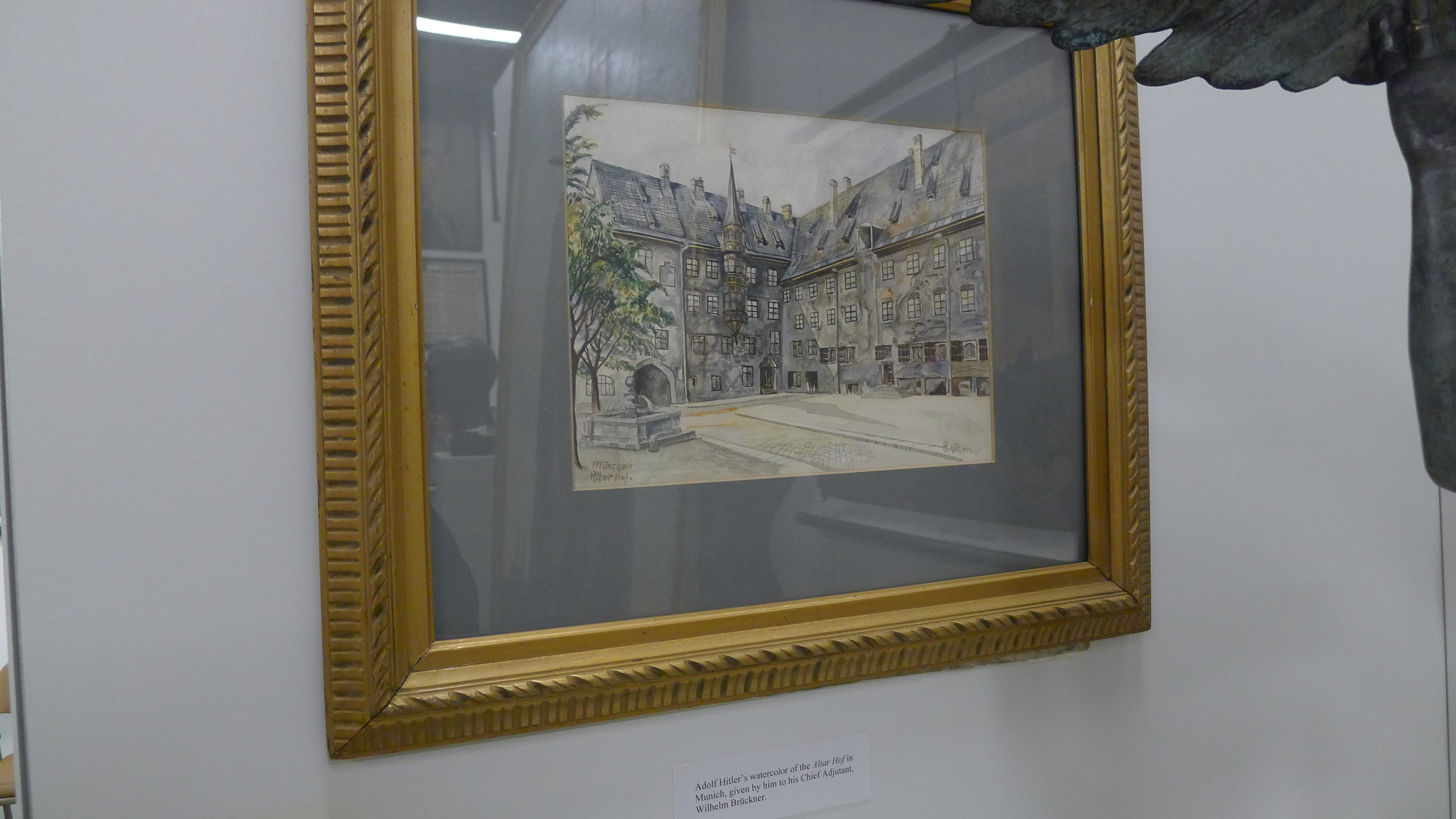
A watercolour of the Alter Hof courtyard in Munich, signed A. Hitler and inscribed with the name of the place. It hung in a private war museum in Massachusetts until that museum closed in 2019.
- Undated
- Watercolour over pencil
About Adolf Hitler
What the picture shows
This is a watercolour of a Munich courtyard, attributed to Adolf Hitler, who sold small pictures like it for a living until he enlisted in August 1914. Two ranges of an old grey building meet at a corner and close the yard. The left range runs back under a steep tiled roof broken by dormers and chimneys, and at its far end a slender polygonal oriel climbs through two storeys and finishes in a spire with a small flag. The right range is longer and taller, with rows of square and round-headed windows, barred openings at ground level, a flight of stone steps up to a doorway, and arcades at the right edge.
A tree in leaf stands at the left, beside a stone fountain basin with a spouted column. Nobody is in the yard. The sky is unpainted paper, and in the foreground the cobbles are drawn in pencil and left unwashed, so the bottom of the sheet is mostly bare with a few long shadows laid across it.
- Inscribed in pencil at lower left, in two lines: “München” and “Alter Hof.”
- Signed at lower right: “A. Hitler.”
- No date appears anywhere on the sheet.
- No dimensions, no paper description and no inventory number have been published for it.
Those readings come from the only photograph of the object anyone has published, taken at an angle through the glass of its frame. Nothing on the back of the sheet is visible, and no conservator has described it in print.
The courtyard itself
The Alter Hof is the courtyard of the old ducal residence in the centre of Munich, a few minutes' walk from Marienplatz, and the oriel on the corner of its late-Gothic west wing is the feature the place is known for. It is one of the standard Munich subjects, which is what recommended it to a man making small watercolours for tourists and frame dealers.
He worked from postcards, prints and photographs rather than in front of the buildings, so the same Vienna and Munich views come round again and again in the sheets attributed to him. The art historian Birgit Schwarz puts it flatly: he had no style of his own and generally copied. That matters here, because a painter who copied other people's views also repeated his own.
There is a second Alter Hof watercolour
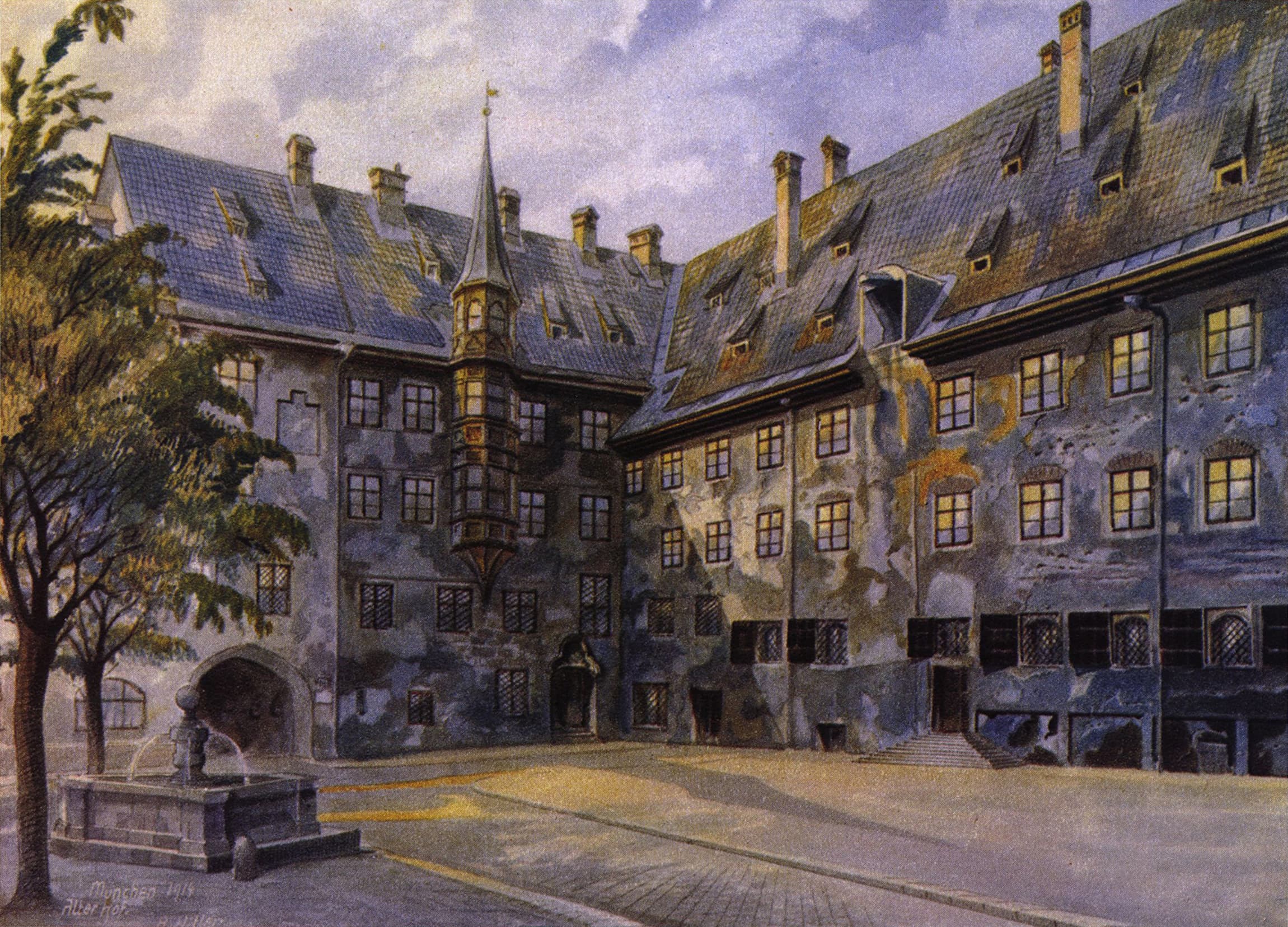
A watercolour of this courtyard, dated 1914, was printed at page 71 of Adolf Hitler: Bilder aus dem Leben des Führers, a cigarette-card album published at Hamburg-Bahrenfeld in 1936. Wikimedia Commons and Wikidata file that picture as a holding of the United States Army Center of Military History. It is catalogued separately, under its German title, Der Alte Hof in München.
The two published images show the same composition: the same corner, the same oriel, the same tree and fountain, the same steps. They also differ. The album card's inscription reads “München 1914” on its first line, where the sheet photographed in Natick reads “München” alone. The card has a sky full of cloud and a paved yard painted to the edges, where this sheet has bare paper for a sky and pencil ruling for its cobbles.
Those differences are visible, and they are not proof. One side of the comparison is not the object but a colour reproduction made for a propaganda album, printed to be attractive on a cigarette card. Nobody has examined either sheet on the record, the Army publishes no object record and releases no images of what it holds, and the two published accounts of its four Hitler watercolours contradict each other: The Art Newspaper reported in 2007 that they are Vienna views, while the Washingtonian in 2017 listed soldiers in a valley, a damaged Belgian town and the Alter Hof.
So the honest position is that the two trails have not been reconciled. This page does not claim that the Natick sheet is the picture printed in 1936, and it does not claim that it is a different one. Settling it would take an examination of both objects, or an object record from the Army for whatever it actually holds.
The wall label is the whole provenance
A printed label was mounted on the wall below the frame, and it is legible in the photograph. It reads: Adolf Hitler's watercolor of the Altar Hof in Munich, given by him to his Chief Adjutant, Wilhelm Brückner. The label misspells the courtyard; the sheet above it does not.
That sentence is the only account of where the picture came from. No deed of gift, sale record, inventory, exhibition catalogue or earlier photograph supporting it has been found, so it is the museum's claim rather than a documented chain of ownership. It also describes a gift rather than a sale. The Munich watercolours were painted to be sold, so if the label is right the sheet either never left his hands or came back to them.
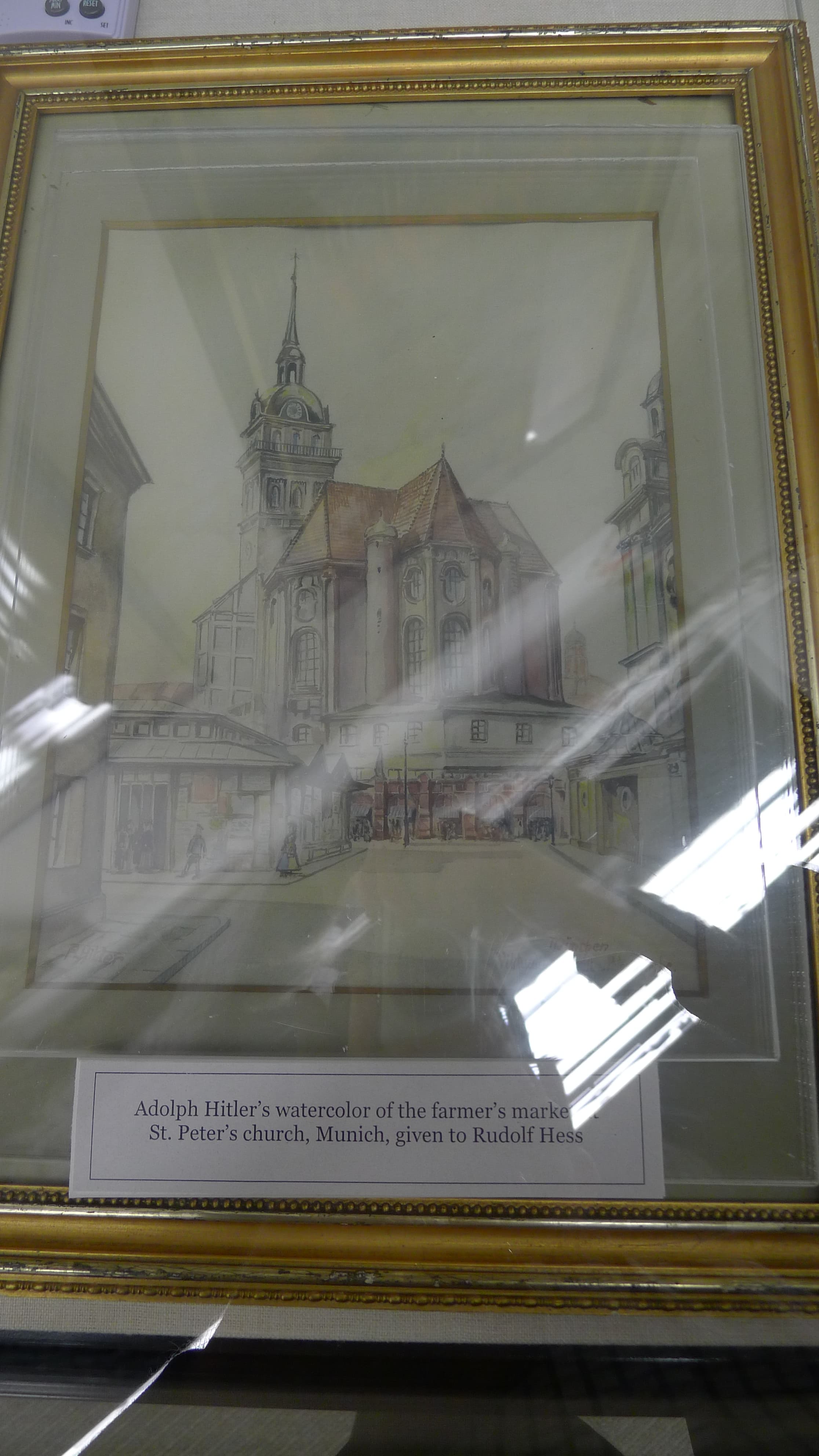
The same photographer photographed a second Hitler watercolour in the same room nine minutes later, a view of the Viktualienmarkt with the tower of St Peter's behind it. Its label named a different recipient, Rudolf Hess. Neither claim has any documentation behind it in the public record.
The museum closed, and the trail stops
The International Museum of World War II was a private collection at Natick, Massachusetts, a few miles west of Boston. It opened in 1999, showed more than seven thousand objects by reservation only, and closed in 2019.[1]
No later owner, sale, loan or exhibition of this watercolour is on record, and where the collection went has not been established. As of August 2026 that is the answer to the question of its whereabouts: unknown.[2]
What an attribution like this is worth
Works signed with Hitler's name have been forged since 1933, when Reinhold Hanisch, who had sold the genuine Vienna sheets a generation earlier, went into the business of making false ones. In two months of 2019 German police seized sixty-six suspected fakes, three from a Berlin auction house in January and sixty-three from Auktionshaus Weidler in Nuremberg in February, on suspicion of document forgery and fraud rather than of anything to do with the subject matter.[3]
The literature is no help. Billy F. Price's Adolf Hitler: The Unknown Artist of 1984, the catalogue the trade still cites, was self-funded by one of the largest private owners of the material and contains entries the historian Hermann Weiss identified as forgeries by Konrad Kujau, who also forged the Hitler diaries.[4]
“No one has really conducted any serious comprehensive research into Hitler's art.”
Connoisseurship cannot fill the gap either, because there is no personal handwriting to recognise in a copyist. What is left is paperwork, and this sheet has a museum label and a photograph of it. That is more than most pictures of its kind can show, and it is a long way short of an attribution anyone could defend.[5]
This page shows a photograph, not the painting
The image here is Lee Wright's photograph, taken on 5 December 2015 and released under a Creative Commons Attribution 2.0 licence. Naming him is the condition of using it, which is why the credit appears wherever the picture does.[6]
A flat, faithful copy of an out-of-copyright painting creates no new rights. This is not that. It is a photograph of a framed object on a wall, with the frame, the glass, the reflected room and the label all in the shot, and it belongs to the photographer who chose the angle.
The watercolour underneath is free of copyright. The term expired on 1 January 2016, seventy years after the end of the year in which Adolf Hitler died. Until then the rights belonged to the Free State of Bavaria, which had inherited the estate through denazification proceedings in 1948 and used the copyright to refuse permission to republish rather than to earn from it. None of that ever covered the objects themselves, which have been private property since they were sold.[7]
Close reading
Reading the work, detail by detail
This page reproduces a museum photograph of a framed watercolour, not a direct scan of the sheet. The details therefore examine both the conventional architectural view and the wall label that carries nearly all of the object's recorded provenance.
1.The corner oriel identifies the Alter Hof
The narrow projecting bay and its spire distinguish this courtyard from a generic old-Munich subject. Architectural recognition depends on the feature being copied accurately, not on an inventive arrangement.
2.An empty yard keeps attention on buildings
Rooflines, windows, and paving converge into a tidy enclosed view while human activity is absent. The choice reflects a body of saleable city pictures valued for recognizable landmarks rather than observed social life.
3.The wall label is the surviving paper trail
The printed label links the object to Wilhelm Brückner, but no catalogue, conservation report, or present location extends that history. Showing the photograph's label keeps the limits of the attribution visible rather than hiding them.
4.The roofline is recorded as a sequence of practical additions
Different heights, slopes, and chimneys make the courtyard read as a place altered over time. The artist records an accumulated building complex rather than simplifying it into one ideal silhouette.
5.The dark entry gives the empty courtyard a destination
The passage is one of the few strongly dark shapes in the sheet. It pulls the eye across the open ground and suggests circulation even though no crowd or vehicle is shown.
6.Thin washes leave the paper responsible for light
Color is applied lightly enough for the support to remain visible through walls and sky. The untouched paper supplies brightness, while a small number of darker strokes describe edges and recesses.
Timeline
1913
Adolf Hitler moves from Vienna to Munich and goes on selling watercolour views to dealers and visitors. The trade ends when he enlists in August 1914.
1999
The International Museum of World War II opens at Natick, Massachusetts, a private collection shown by reservation.
5 December 2015
Lee Wright photographs the framed watercolour on the museum wall at 12.45 p.m., and a second Hitler watercolour in the same room nine minutes later.
The watercolour on the wall of the International Museum of World War II in Natick, Massachusetts, photographed on 5 December 2015. It is framed in gilt and glazed, and the room behind the photographer reflects across the glass. The sheet is inscribed “München / Alter Hof.” at lower left and signed “A. Hitler.” at lower right. The printed label below reads that Adolf Hitler gave the picture to his chief adjutant, Wilhelm Brückner. 1 January 2016
Copyright in Adolf Hitler's work expires in Germany and Austria, seventy years after the end of the year of his death.
2019
The museum closes. Where its collection went, and who holds this watercolour, has not been established.
2019
German police seize sixty-six suspected fakes from two auction houses within two months, on suspicion of document forgery and fraud.
Where to see it
Formerly the International Museum of World War II, Natick, Massachusetts
On display at the museum in 2015, under a printed label naming Wilhelm Brückner as the recipient. The museum closed in 2019 and the present owner is unknown.
Frequently asked questions
Is this the same picture as the other Alter Hof watercolour attributed to Hitler?
Nobody has established that, either way. A watercolour of the same courtyard, dated 1914, was reproduced in a 1936 cigarette-card album and is filed by Wikidata and Wikimedia Commons as a United States Army holding; this sheet was photographed on a museum wall in Massachusetts in 2015. The two published images show the same composition but differ in visible ways, including the inscription, which reads “München 1914” on the album card and “München” alone here. Neither object has been examined on the record and no source addresses the question, so the two are kept apart: one cannot be folded into the other, and neither can confidently be called a different picture.
Where is the painting now?
It is not recorded. The picture hung at the International Museum of World War II in Natick, Massachusetts, which closed in 2019, and no later owner, sale, loan or exhibition of it has been traced. Where the museum's collection went has not been established.
Did Adolf Hitler really give it to Wilhelm Brückner?
That is what the museum's wall label said, and nothing has been found to support it. The label, legible in the 2015 photograph, describes the sheet as a gift from Hitler to his chief adjutant, Wilhelm Brückner. No deed, sale record, inventory or catalogue entry behind that claim is in the public record, so it stands as the museum's assertion.
What is written on the sheet?
Two inscriptions, both in pencil. At the lower left, in two lines, “München” and “Alter Hof.”; at the lower right, the signature “A. Hitler.” There is no date, and no other lettering is visible in the photograph.
When was it painted?
No date is recorded and none appears on the sheet. Adolf Hitler moved to Munich in 1913 and gave up the watercolour trade when he enlisted in August 1914, so a Munich view of this kind belongs to that period, but nothing narrows it further.
Is the picture genuine?
It is attributed to Adolf Hitler and has not been authenticated. The subject and the handling match the Munich sheets he sold in 1913 and 1914, and the signature and title are legible on the paper, but no conservation report, exhibition catalogue or documented ownership chain has been published. Forgeries of this material have been made since 1933 and outnumber the genuine sheets, so an attribution with only a museum label behind it is a claim awaiting evidence.
Who took the photograph, and why is he credited?
Lee Wright, who photographed the watercolour on the museum wall on 5 December 2015 and released the picture under a Creative Commons Attribution 2.0 licence. That licence allows reuse on the single condition that the photographer is named. The painting is out of copyright; his photograph of it is not.
Is it legal to own, show or sell a painting by Hitler?
Yes, in Germany and in the United States alike. The German criminal provisions people have in mind cover the symbols of banned organisations, and a courtyard with a fountain in it carries none. When German police have seized works, as they did in Berlin and Nuremberg in 2019, the grounds were suspected document forgery and fraud.
More by Adolf Hitler
If you like Adolf Hitler
Explore painters from the same movements and circles.
Tarsila do Amaral
Brazilian painter who spent the 1920s moving between São Paulo and Paris, studied Cubism under André Lhote, Albert Gleizes and Fernand Léger, and used what she learned to paint Brazilian towns, railways, plants and bodies. Her 1928 painting Abaporu prompted the manifesto that gave the Anthropophagic movement its name.
View artist
Arman
French-American artist, lifelong friend of Yves Klein, and a founder of New Realism.
View artist
Jean Arp
Strasbourg-born sculptor and poet — Hans in German, Jean in French, both all his life — who co-founded Dada at the Cabaret Voltaire in 1916, composed collages by dropping torn paper 'according to the laws of chance', and settled at Meudon outside Paris in a house his wife Sophie Taeuber-Arp designed.
View artist
In images
References
The sources below include collection records, catalogues, scholarly research, and primary materials that informed this page. They document Alter Hof, Munich, its making, and its place in cultural history.


1↑A Trove of Nazi Art Is Wound Up Under Lock and Key at an Army Base in Virginia
PeriodicalWashingtonian, 2017Used forContemporary reporting or criticism used to document the historical reception and context of Alter Hof, Munich.
2↑The US Army's hidden collection of Nazi art
PeriodicalThe Art Newspaper, 2007Used forContemporary reporting or criticism used to document the historical reception and context of Alter Hof, Munich.
3↑There Is a Market for Artworks by Hitler. Many of Them Are Fakes
PeriodicalSmithsonian Magazine, 2019Used forContemporary reporting or criticism used to document the historical reception and context of Alter Hof, Munich.
4↑Faking Hitler: the story behind a sinister market
PeriodicalThe Art Newspaper, 2019Used forContemporary reporting or criticism used to document the historical reception and context of Alter Hof, Munich.
5↑Nuremberg prosecutor seizes 63 Hitler works from auction house on forgery suspicions
PeriodicalThe Art Newspaper, 2019Used forContemporary reporting or criticism used to document the historical reception and context of Alter Hof, Munich.

6↑File: Museum of World War II, Natick, Massachusetts, 2015 — Hitler's watercolour of the Alter Hof in Munich
WebsiteWikimedia Commons, 2015Used forWeb source consulted for documented facts and historical context presented on the Alter Hof, Munich page.
 View source
7↑Copyright of Adolf Hitler's Mein Kampf expires
PeriodicalBBC News, 2016Used forContemporary reporting or criticism used to document the historical reception and context of Alter Hof, Munich.
8File: Museum of World War II, Natick, Massachusetts, 2015 — Adolf Hitler watercolour of the Viktualienmarkt and St Peter's Church, Munich
WebsiteWikimedia Commons, 2015Used forWeb source consulted for documented facts and historical context presented on the Alter Hof, Munich page.
9Hitler, Alter Hof — plate 71 of Bilder aus dem Leben des Führers, from the Bayerische Staatsbibliothek copy BA/4 L.sel.I 727
WebsiteHistorisches Lexikon BayernsUsed forWeb source consulted for documented facts and historical context presented on the Alter Hof, Munich page.
10Der Alte Hof in München (Q7727870)
WebsiteWikidataUsed forWeb source consulted for documented facts and historical context presented on the Alter Hof, Munich page.
11Hitler watercolours seized as suspected fakes
PeriodicalThe Art Newspaper, 2019Used forContemporary reporting or criticism used to document the historical reception and context of Alter Hof, Munich.
12When Hitler Tried (and Failed) to Be an Artist
WebsiteHistory.comUsed forWeb source consulted for documented facts and historical context presented on the Alter Hof, Munich page.
_St_Peter%27s_Chuch_(Sankt_Peter)_Munich.jpg) View source
View source View source
These references provide the documented foundation for this work's history and interpretation. Claim-level citations remain attached to the specific claims they support.
 Explore more resources