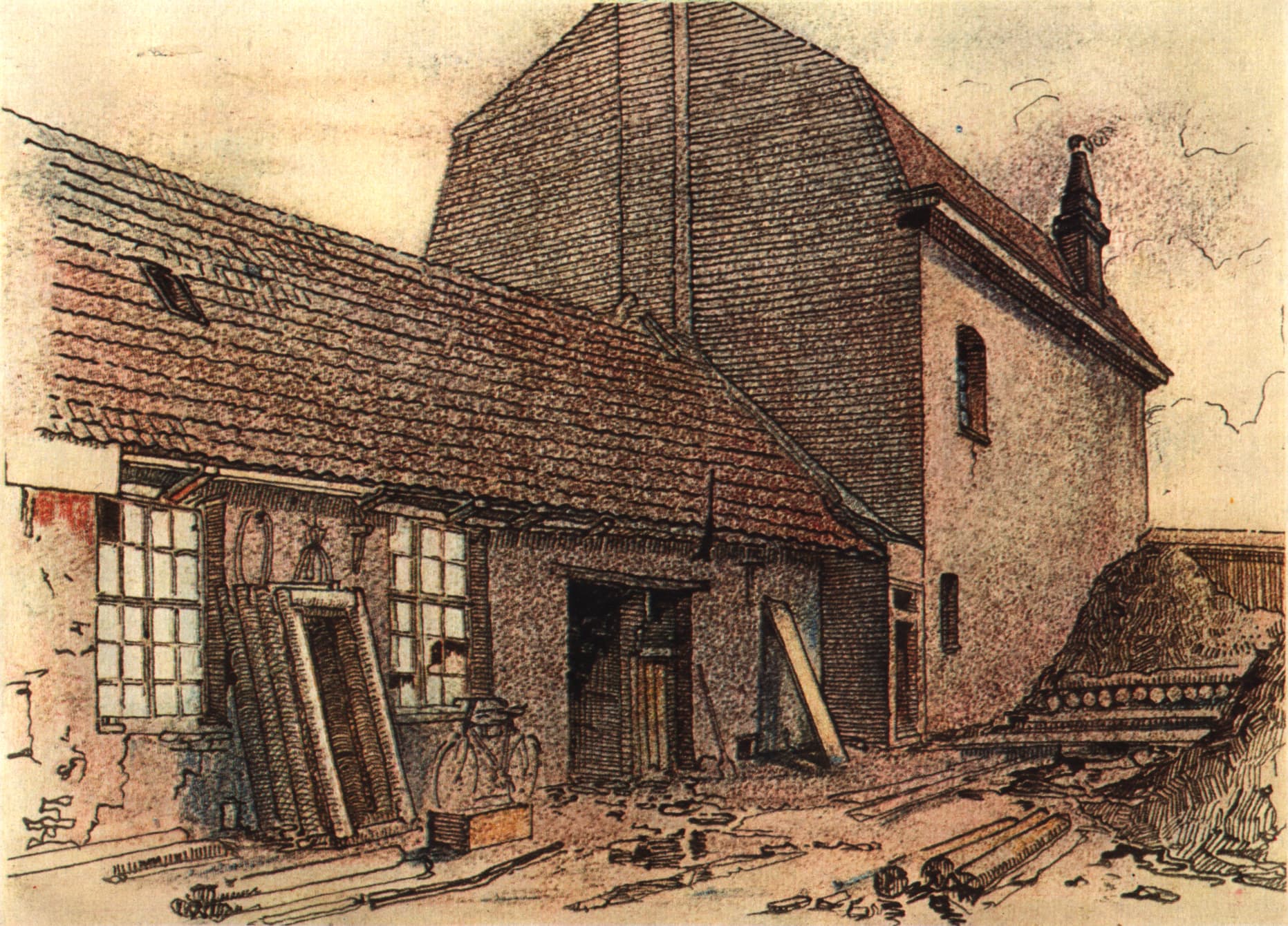
Unterstand in Fournes
by Adolf Hitler
Adolf Hitler drew this farm building at Fournes-en-Weppes, where his regiment kept its headquarters, during his First World War service. It was printed in 1936.
- c. 1917
- Drawing with colour wash; materials not recorded
About Adolf Hitler
What the picture shows
A farm building seen from a few paces away, from inside its own yard. A long tiled roof runs down from the right and sags towards the left edge of the sheet. Beneath it are two windows of small square panes, an open doorway with a plank door standing ajar, and boards and planks stacked against the wall on either side. A two-wheeled handcart stands in front of the doorway.
Behind the low range rises a tall blank brick gable with a flue running up it. To the right of that is a taller block with a pale rendered wall, one small square window high up, and a brick chimney at the ridge with smoke drawn coming out of it. Timber, beams and rubble lie across the ground in the foreground. At the right edge there is a fence and a heaped mound. Nobody is in the picture.
The reproduction shows ink line work tinted in reds and browns, with a pale, largely empty sky. No institution records the materials of the original, and the reproduction is a printed page rather than a photograph of the object, so the sheet's size and support are not established.[1]
The album that printed it captioned the group as the drawings of the front-line soldier Hitler and this sheet as Unterstand in Fournes, a shelter or dugout at Fournes. The building in the picture is a farm range, not a trench dugout.[2]
Where Fournes is
Fournes-en-Weppes is a commune in the Nord department of northern France, about fourteen kilometres from Lille. The Weppes is flat farmland of brick villages and small holdings between Lille and the Lys, and in 1914 the front line settled a few kilometres west of it, through Fromelles and Aubers.[3]
The village sat behind that line for most of the war, which is why a German regiment could keep an office, a billet and a yard full of building timber there. The Bavarian Reserve Infantry Regiment 16 had its headquarters at Fournes-en-Weppes in 1915 and 1916, and Hitler spent a large part of his service at it.[3]
Other drawings from the same album are titled for places within a short walk or ride of it: Fromelles, dated 1915, and Haubourdin, dated 1916.
What a regimental runner did
Adolf Hitler enlisted in August 1914 and served with the Bavarian Reserve Infantry Regiment 16, the List Regiment, in France and Belgium until the end of the war. He first went into action at Ypres in October 1914. In November he was promoted to Gefreiter and assigned as a regimental message-runner.[4]
The job was carrying orders and reports between regimental headquarters and the battalion and company staffs forward of it. Historians distinguish it from the company runner's job: regimental headquarters stood several kilometres behind the front, and a runner attached to it was not in the forward trenches for most of his service.[5]
- Iron Cross Second Class, 2 December 1914.
- Wounded in the left thigh in October 1916 on the Somme, when a shell burst at the entrance to the dispatch runners' dugout; about two months in hospital, and back with the regiment in March 1917.
- Bavarian Cross of Military Merit, Third Class with Swords, September 1917.
- Wound Badge in Black, May 1918.
- Iron Cross First Class, 4 August 1918.
- Temporarily blinded by British gas on 15 October 1918, and in hospital at Pasewalk when the war ended.
He drew throughout. The standard account of the service records that he carried paper with him to the front and used leave time to draw and paint, and that at headquarters he produced cartoons and drawings for an army newspaper. The subjects named in that account are the ordinary fabric of the sector: farmers' houses, the dressing station. In August 1917, when the regiment moved to a quiet stretch of the line in Alsace, his portfolio of sketches and paintings was stolen during the transfer.[5]
The 1936 album that printed it
The picture is known from Adolf Hitler: Bilder aus dem Leben des Führers, issued in 1936 by the Cigaretten-Bilderdienst at Hamburg-Bahrenfeld. This was a propaganda publication, and its format was a sales promotion: the buyer got a bound volume with blank spaces, and collected the photographic cards to paste into them from packets of cigarettes. Joseph Goebbels wrote the foreword, and the texts came from Hitler's circle. More than two million copies had been printed by 1940.[2]
The album was made to sell cigarettes and to build the leader's public image. It carries no catalogue information about the drawings, meaning no medium, no measurement and no owner, and it printed them under a heading identifying them as the work of the front-line soldier. That heading is the only attribution the picture carries.[6]
Its publication date is also what makes the picture usable. A work printed in Germany in 1936 as Hitler's cannot have been made by any of the postwar forgers whose output fills the present market. That rules out a large category of fakes. It does not establish that he drew this sheet.[7]
The copying trade, and the pictures made at the front
From about 1909 Adolf Hitler earned money in Vienna by making small watercolours of buildings and city landmarks, which he copied from postcards and sold through an agent to tourists and frame-sellers. Reinhold Hanisch, a fellow resident of the men's home, acted as that agent in 1910 until the two fell out over money. The art historian O. K. Werckmeister estimates two to three thousand works made between the ages of eighteen and twenty-five, when painting was his occupation.[8]
Art historians describe that body of work as copying rather than composition. Birgit Schwarz, who has written on Hitler and art, has said that he had no distinctive artistic style and generally just copied, and that watercolours by other Viennese painters of the same years look much the same.[9]
The front-line pictures take different subjects. They are not tourist landmarks but the places the regiment was posted to: a shelter at Fournes, Fromelles in 1915, Haubourdin in 1916. The account of the war service also records that he carried paper to the front and drew there. What no source establishes is whether any particular sheet was drawn in front of its subject, and this one carries no evidence either way.
The firmer difference is provenance. The Vienna and Munich watercolours mostly reach the present through the auction market, which is where the forgeries are. Several of the front-line pictures reach it through publication in 1935 and 1936, or through collections seized and catalogued by the United States Army in 1945.
Seventy years of Bavarian copyright, and its expiry
Hitler left no valid heir. A Munich court declared his will void, no death certificate had been issued, and his sister Paula's claim failed. Because he had been registered as resident in Munich, the estate passed to the Free State of Bavaria through denazification proceedings held in the autumn of 1948, and Bavaria took the copyright in everything he wrote and made.
Bavaria used it as a power of refusal for the next sixty-seven years rather than as a source of income. It permitted no German reprint of Mein Kampf. It acted against a publisher issuing facsimiles of Nazi-era newspapers with critical commentary, and more than 3,200 copies of one facsimile were confiscated before the Regional Court Munich I partly rejected that use of copyright.
The German Copyright Act sets the term at seventy years after the author's death and starts the clock at the end of the calendar year in which the death occurs. Hitler died on 30 April 1945, so the term ran out at the end of 2015 and the works entered the public domain in Germany and Austria on 1 January 2016. The same date governed Mein Kampf, and the Institute of Contemporary History in Munich published its annotated edition that January. Bavaria's veto ended with no successor right and no extension.
The United States position is less settled, and it is the reason the licence on the Wikimedia Commons file is worth reading twice. The file claims two grounds. One is that the copyright was never renewed, which applies to works that had a United States copyright to renew and is overridden for foreign works by the Uruguay Round Agreements Act. The other is an exception for copyrights once held by the Alien Property Custodian, whose documented seizure covers Mein Kampf and not the paintings. Neither ground supports the file. The German expiry is what actually makes the work free of copyright, and a work first published abroad in 1936 may carry a restored United States term to the end of 2031, so the reproduction here is published as editorial commentary.
German criminal law does not restrict the picture either. The provisions on symbols of unconstitutional organisations cover swastikas, runes and party insignia, none of which appear in a drawing of a farmyard, and the sale of Hitler's paintings is permitted in Germany.
Why most pictures signed A. Hitler cannot be trusted
The market in fakes is older than the Second World War. Reinhold Hanisch, who had sold the real watercolours in Vienna, was manufacturing false ones from 1933; he was arrested in November 1936 and died in custody the following year. Birgit Schwarz calls him a shady figure and a notorious liar who ran what amounted to a forgery centre in Vienna.
The standard reference for the field does not hold up. Billy F. Price published Adolf Hitler: The Unknown Artist in 1984, a self-funded catalogue of 723 numbered entries, at a time when he was among the largest private owners of the work. Schwarz calls the book catastrophic. The historian Hermann Weiss identified several of its entries as forgeries by Konrad Kujau, who forged the Hitler Diaries. Price dedicated it to August Priesack, the first historian to authenticate those diaries, whose signature also appears on certificates of authenticity sold with paintings.
German prosecutors have twice emptied auction rooms. In January 2019 Berlin police seized three watercolours from an auction house on a court order for suspected document forgery and fraud. In February 2019 prosecutors at Nuremberg-Fürth seized sixty-three paintings, watercolours, drawings and pastels from Auktionshaus Weidler, which had intended to sell twenty-six of them; the lots that did go under the hammer failed to sell. The proceedings were opened against persons unknown, and no outcome has been reported.
“No one has really conducted any serious comprehensive research into Hitler's art.”
Connoisseurship is the usual way to catch a fake, and here it has little to work with, because the work has no style of its own to imitate badly. One bright line does hold: there is no record of Hitler painting in oils, so an oil carrying his signature is a fake. Beyond that, an attribution is worth what its paper trail is worth, which is why publication in 1936 matters and a certificate of authenticity does not.
What is not established about this sheet
- The date. Wikimedia Commons gives circa 1917; Calvin University's German Propaganda Archive dates the same image probably 1915. Both take it from the same 1936 album, which is the only publication either cites.
- The medium and the size. Neither is recorded anywhere, and the only version available is a printed page.
- Where the original is. No museum, private collection, exhibition or sale of this sheet is on record. The four watercolours in United States Army custody at Fort Belvoir, the best-documented group anywhere, are described as other subjects, and the two published descriptions of them do not agree with each other.
- The attribution. It rests on a heading in a 1936 propaganda album, printed while Hitler was in power. No curator or conservator has examined the sheet on the record.
Closing any of these would mean a records search rather than a reading: the Cigaretten-Bilderdienst album's own picture credits, the case files of the Nazi Party archive that bought up work attributed to him, and the catalogue of the German War Art Collection compiled by Gordon Gilkey's team in 1945.[10]
Close reading
Reading the work, detail by detail
The known image is a printed reproduction from 1936 rather than the original sheet. Its details show a wartime farm range described through roof, doorway, and scattered materials, while the empty yard resists the heroic story the propaganda album placed around it.
1.The long roof establishes wear rather than monumentality
The roof descends unevenly over windows and an open door. Unlike the copied tourist landmarks, this low structure is defined by use, repair, and the practical shelter named in the title.
2.The open door and handcart imply absent work
Every object points to occupation, yet no worker or soldier appears. The building's function is suggested through tools and access rather than through a staged military scene.
3.Loose material keeps the yard from becoming picturesque
Boards and debris interrupt the foreground with short, irregular lines. They provide the sheet's most immediate evidence of a working wartime site while leaving the exact circumstances undocumented.
4.Uneven plaster gives the shelter a used surface
Patches of wash and broken outlines prevent the wall from looking newly built or decorative. The surface suggests exposure and repeated use without turning damage into picturesque ruin.
5.Stored material makes the yard feel provisionally occupied
Boards and equipment sit where they were left rather than forming a formal still life. These practical objects imply work that has paused and may begin again.
6.A narrow strip of sky keeps the shelter visually heavy
The building occupies most of the sheet, leaving little open air above it. That proportion makes the low structure feel more enclosing and keeps attention on immediate conditions rather than landscape.
Timeline
August 1914
Adolf Hitler enlists and is posted to the Bavarian Reserve Infantry Regiment 16, the List Regiment.
October–November 1914
First action at Ypres. Promoted to Gefreiter and assigned as a regimental message-runner; Iron Cross Second Class on 2 December.
1915–1916
The regiment's headquarters is at Fournes-en-Weppes, about fourteen kilometres from Lille, with the front line a few kilometres west through Fromelles and Aubers.
October 1916
Wounded in the left thigh on the Somme when a shell bursts at the entrance to the dispatch runners' dugout. Two months in hospital; back with the regiment in March 1917.
c. 1917
The date Wikimedia Commons gives for the drawing. Calvin University's German Propaganda Archive dates the same image probably 1915.
August 1917
The regiment transfers to a quiet sector in Alsace. His portfolio of sketches and paintings is stolen in the move.
1936
Reproduced in Adolf Hitler: Bilder aus dem Leben des Führers, a cigarette-card collecting album issued by the Cigaretten-Bilderdienst at Hamburg-Bahrenfeld. Over two million copies printed by 1940.
1948
Denazification proceedings in Munich pass the estate to the Free State of Bavaria, which takes the copyright and uses it to refuse republication.
1984
Billy F. Price publishes Adolf Hitler: The Unknown Artist, 723 entries. Several are later identified as forgeries by Konrad Kujau.
1 January 2016
Copyright in everything Hitler made expires in Germany and Austria, seventy years after the end of the year of his death.
January–February 2019
Berlin police seize three watercolours and Nuremberg-Fürth prosecutors seize sixty-three works from auction houses, on suspicion of document forgery and fraud.
Where to see it
A viewing location has not yet been listed for this work.
Frequently asked questions
Did Adolf Hitler draw Unterstand in Fournes?
The attribution comes from the 1936 album Adolf Hitler: Bilder aus dem Leben des Führers, which printed the picture among what it called the drawings of the front-line soldier Hitler. That is a claim published by the Nazi regime while he was in power, not an authentication by a curator or a conservator, and no expert examination of the original is on record. What the 1936 date does establish is that the picture predates every postwar forger, which is more than can be said for most works signed A. Hitler.
What does the picture show?
A farm building seen from its own yard, from a few paces away. A long tiled roof sags over a wall with two small-paned windows and an open plank door, planks are stacked against the wall, a two-wheeled handcart stands by the doorway, and timber and rubble lie across the ground. Behind it rise a tall blank brick gable and a rendered block with a smoking chimney. There are no figures.
Where is Fournes-en-Weppes?
In the Nord department of northern France, about fourteen kilometres from Lille, in the flat farming country between Lille and the Lys. It stood a few kilometres behind the German front line, which ran through Fromelles and Aubers.
What was Adolf Hitler doing at Fournes?
He served there as a regimental message-runner. Adolf Hitler enlisted in August 1914 and was assigned in November of that year to carry orders and reports between the headquarters of the Bavarian Reserve Infantry Regiment 16 and the units forward of it. The headquarters was at Fournes-en-Weppes in 1915 and 1916, several kilometres behind the front, and he spent much of his war there.
Where is the original?
It is not recorded. No museum, private collection, exhibition or auction record for this sheet has been traced, and the only version available is the reproduction printed in the 1936 album. The four watercolours held in United States Army custody at Fort Belvoir, Virginia, the best-documented group anywhere, are described as other subjects.
Is the picture in the public domain?
In Germany and Austria, yes, since 1 January 2016. The German Copyright Act runs the term seventy years from the end of the year of the author's death, and Adolf Hitler died on 30 April 1945. The United States position is less settled, because a work first published abroad in 1936 may carry a restored term to the end of 2031. The two United States public-domain grounds claimed on the Wikimedia Commons file do not hold: non-renewal does not apply to a foreign work, and the Alien Property Custodian exception rests on a seizure documented for Mein Kampf and not for the paintings.
Is it legal to show or sell Hitler's paintings in Germany?
Yes. The German criminal provisions people have in mind cover the symbols of banned organisations, meaning swastikas, runes and party insignia, and a drawing of a farmyard carries none. Hitler's paintings are sold openly at German auction. When police have seized them, in Berlin and Nuremberg in 2019, the grounds were suspected document forgery and fraud rather than Nazi content.
Why are so many paintings attributed to Hitler fake?
Because the market has been supplied with forgeries since the 1930s and has never had an authentication apparatus. Reinhold Hanisch, who sold the genuine Vienna watercolours, was making false ones by 1933. The standard catalogue, Billy F. Price's Adolf Hitler: The Unknown Artist of 1984, contains work by the Hitler Diaries forger Konrad Kujau and is dedicated to a historian whose signature appears on certificates of authenticity. Art historians add that the work has no distinctive style, so the usual test of connoisseurship has almost nothing to grip.
Are the wartime pictures different from the Vienna watercolours?
In two ways the evidence supports. The Vienna and Munich watercolours were a trade: Adolf Hitler copied city landmarks from postcards and sold the results through an agent to tourists and frame-sellers, and art historians describe that output as copying. The front-line pictures take as their subjects the places his regiment was posted to, and the record of his service says he carried paper to the front and drew there, though no source shows that any particular sheet was drawn in front of its subject. The clearer difference is provenance: several front-line pictures come down through publication in 1935 and 1936 or through documented United States Army custody, while the Vienna work mostly comes down through the auction market.
What medium is it, and how big is the original?
Neither is recorded. The reproduction shows ink line work tinted in reds and browns, and the 1936 album called the group drawings, but no institution has published a materials line or a measurement for this sheet.
More by Adolf Hitler
If you like Adolf Hitler
Explore painters from the same movements and circles.
Tarsila do Amaral
Brazilian painter who spent the 1920s moving between São Paulo and Paris, studied Cubism under André Lhote, Albert Gleizes and Fernand Léger, and used what she learned to paint Brazilian towns, railways, plants and bodies. Her 1928 painting Abaporu prompted the manifesto that gave the Anthropophagic movement its name.
View artist
Arman
French-American artist, lifelong friend of Yves Klein, and a founder of New Realism.
View artist
Jean Arp
Strasbourg-born sculptor and poet — Hans in German, Jean in French, both all his life — who co-founded Dada at the Cabaret Voltaire in 1916, composed collages by dropping torn paper 'according to the laws of chance', and settled at Meudon outside Paris in a house his wife Sophie Taeuber-Arp designed.
View artist
References
The sources below include collection records, catalogues, scholarly research, and primary materials that informed this page. They document Unterstand in Fournes, its making, and its place in cultural history.


1↑File: Adolf Hitler – Unterstand in Fournes.jpg
WebsiteWikimedia CommonsUsed forWeb source consulted for documented facts and historical context presented on the Unterstand in Fournes page.

4↑Photographie: Adolf Hitler et ses camarades du Königlich Bayerisches 16. Reserve-Infanterie-Regiment («List»), Fournes-en-Weppes, août 1916
ArchiveMusée Jean Moulin, Paris Musées, 1916Used forA museum photograph of August 1916 placing Hitler and his comrades of the Bavarian Reserve Infantry Regiment 16 at Fournes-en-Weppes.
6↑Hitler's Paintings
ArchiveGerman Propaganda Archive, Calvin UniversityUsed forArchival evidence used to document the historical record connected to Unterstand in Fournes.
7↑Act on Copyright and Related Rights (Urheberrechtsgesetz), official English translation
Official recordBundesministerium der JustizUsed forOfficial record used to verify names, dates, institutional details, or other factual information on this page.
8↑When Hitler Tried (and Failed) to Be an Artist
WebsiteHistory.comUsed forWeb source consulted for documented facts and historical context presented on the Unterstand in Fournes page.
 View source
9↑Hitler 1889–1936: Hubris
BiographyIan Kershaw, 1998Used forThe standard biography, for the enlistment of August 1914, the promotion to Gefreiter, the wound of October 1916 and the return to the regiment.
10↑There Is a Market for Artworks by Hitler. Many of Them Are Fakes
PeriodicalSmithsonian Magazine, 2019Used forReporting that carries Birgit Schwarz on the copying habit behind the pictures and on Reinhold Hanisch's forgeries.
11Faking Hitler: the story behind a sinister market
PeriodicalThe Art Newspaper, 2019Used forContemporary reporting or criticism used to document the historical reception and context of Unterstand in Fournes.
12Nuremberg prosecutor seizes 63 Hitler works from auction house on forgery suspicions
PeriodicalThe Art Newspaper, 2019Used forContemporary reporting or criticism used to document the historical reception and context of Unterstand in Fournes.
13Copyright of Adolf Hitler's Mein Kampf expires
PeriodicalBBC News, 2016Used forContemporary reporting or criticism used to document the historical reception and context of Unterstand in Fournes.
1417 U.S. Code § 104A — Copyright in restored works
Official recordLegal Information Institute, Cornell Law SchoolUsed forOfficial record used to verify names, dates, institutional details, or other factual information on this page.
15Das NS-Erbe des Freistaats
PeriodicalBayerische StaatszeitungUsed forContemporary reporting or criticism used to document the historical reception and context of Unterstand in Fournes.
These references provide the documented foundation for this work's history and interpretation. Claim-level citations remain attached to the specific claims they support.
 Explore more resources