
Post Office
The next chapter in the life: the wanderer fixed in place by one enormous employer.
Read our take
Henry Chinaski across wartime America, one abandoned job at a time — the American work ethic, refused politely and then not politely.
Factotum, Charles Bukowski's second novel, published by Black Sparrow Press in 1975, follows his fictional alter ego Henry Chinaski through the wandering years of the early 1940s: city to city, rooming house to rooming house, job to job. A factotum is a general hand who does whatever needs doing, and Chinaski does it all badly — warehouses, stockrooms, shipping departments — working because rent is due, quitting because he can, and getting fired for the rest. Underneath the comedy of terrible jobs runs the book's real subject: a man who needs money badly enough to work but never badly enough to believe in the work, carrying a rejected short story from town to town like proof of another life.
Rejected by the wartime draft and by every editor he submits to, the young Chinaski drifts through New Orleans, St. Louis, Philadelphia, New York and Los Angeles, taking whatever work exists and losing it: a pickle factory, a bicycle warehouse, an auto-parts stockroom, a dozen more. The jobs are interchangeable and the novel knows it — the repetition is the point, not a flaw in the plot.
Between jobs there is drinking, the racetrack, and Jan, the lover whose fights and reconciliations give the middle of the book its pulse. Through all of it Chinaski keeps writing stories and mailing them to magazines, collecting rejections — the one thread in the novel that points anywhere but down. Bukowski drew the material from his own wandering years in the 1940s, transformed with three decades of hindsight.
Set during the Second World War, the novel follows Henry Chinaski after he is rejected by the draft board. He leaves his parents' house after a fight with his father and moves through Los Angeles, New Orleans, Miami, St. Louis and back, taking whatever work he can get.
The jobs are the book: a pickle factory, a dog-biscuit plant, a bicycle warehouse, a newspaper loading dock, a Christmas-decoration shop. Each is described exactly, and each ends the same way, with Chinaski fired or walking out. Between jobs there is drinking, cheap rooms, the racetrack, and the woman Jan.
There is no arrival. The novel stops with Chinaski still drifting, still writing, still sending stories to magazines that reject them — the point being that this went on for years before anything changed.
Chinaski's hours watching pigeons sit between two kinds of counting: the slow passage of unclaimed time and the shrinking money that pays for it. His walks and distant observation of the bar offer freedom from a work schedule, but the single daily meal reveals its cost. Bukowski lets leisure and deprivation occupy the same brief paragraph. The next chapter's movement from declining a job to needing one makes that freedom temporary. Observation is a pleasure here, yet it cannot keep the observer fed indefinitely.
The telephone exchange turns on incompatible measures of a worker's claim to more money. Heathercliff points to the driver's two years of service; Chinaski answers with his own need. Neither accepts the other's terms. Short questions and replies strip the negotiation down until hanging up gives Chinaski control over its ending. But the next chapter immediately complicates that victory: he accepts another job for less money. The sequence separates the power to leave from the power to improve his circumstances, making the resignation both defiant and costly.
Tighter than Women, funnier than its reputation, and the purest statement of Bukowski's argument with the American work ethic.
Jobs do not build character here and employment confers no dignity — the novel says so out loud, decades before that became a common thing to say.
Chinaski’s rejected story gives the movement between jobs another purpose: he is trying to maintain a life as a writer without a reliable income.

Bukowski's alter ego in his twenties: rejected by the draft, unable to hold a job for long, drinking steadily, and writing stories nobody will print.

The woman Chinaski meets in a bar and lives with on and off through the middle of the book — the closest thing in it to a companion, and a drinker to match him.

A woman Chinaski takes up with after Jan, attached to a wealthy older man and to the drinking that surrounds him.
1941–1946
Bukowski's real wandering years: cities, short-lived jobs, and the rejections that later become the novel's material.
1944
Story magazine publishes his first professional piece, 'Aftermath of a Lengthy Rejection Slip' — the real event behind the novel's mailed-out manuscripts.
1975
Black Sparrow Press publishes Factotum.

The next chapter in the life: the wanderer fixed in place by one enormous employer.
Read our take

John Fante's Arturo Bandini walked these same Los Angeles streets first, and Bukowski called Fante his literary god.
Read our takeCharles Bukowski's second novel follows Henry Chinaski, his fictional alter ego, through the early 1940s as he drifts between American cities and dozens of low-paid jobs — working because rent is due, quitting or getting fired, drinking, and mailing out short stories that keep coming back rejected.
A factotum is a general hand employed to do all kinds of work. The title is the novel's thesis: Chinaski does every job and belongs to none of them.
Post Office is the usual entry point — it was written first and is the faster book. Factotum covers the earlier years of Chinaski's life, so readers who want life-chronology can read it before Post Office without harm.
It draws on Bukowski's real wandering years in the 1940s — the cities, the jobs, the rejections — but Chinaski is a fictional exaggeration of his author, and the novel rearranges the facts freely.
Black Sparrow Press published it in 1975, when Bukowski was fifty-five.
A factotum is someone employed to do all kinds of work. The novel is a sequence of such jobs — pickle factory, dog-biscuit plant, loading dock — each taken and lost in turn.
Yes. Bent Hamer's 2005 adaptation stars Matt Dillon as Henry Chinaski and Lili Taylor as Jan.
Explore authors with a similar voice, perspective, and influence.
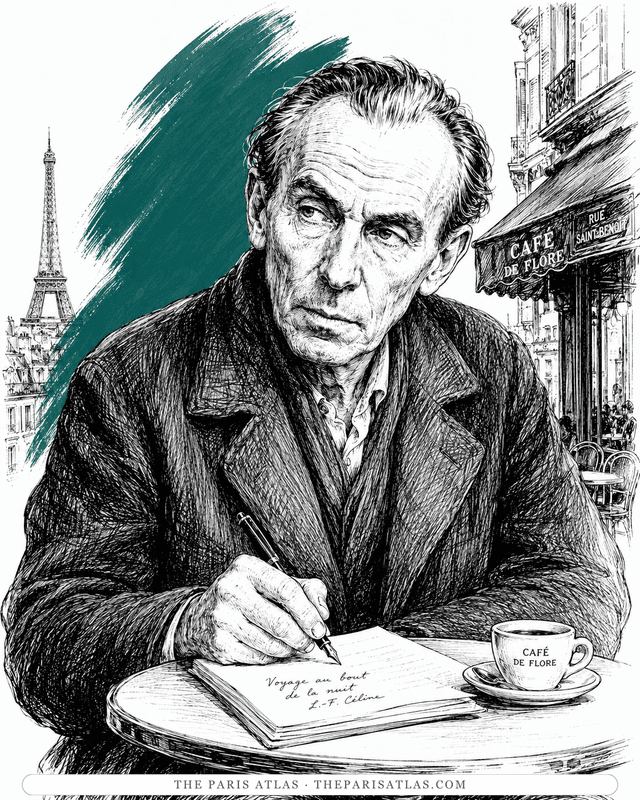
The doctor of the Paris slums who wrote the century's blackest, funniest novel — and changed the sound of French prose.
View author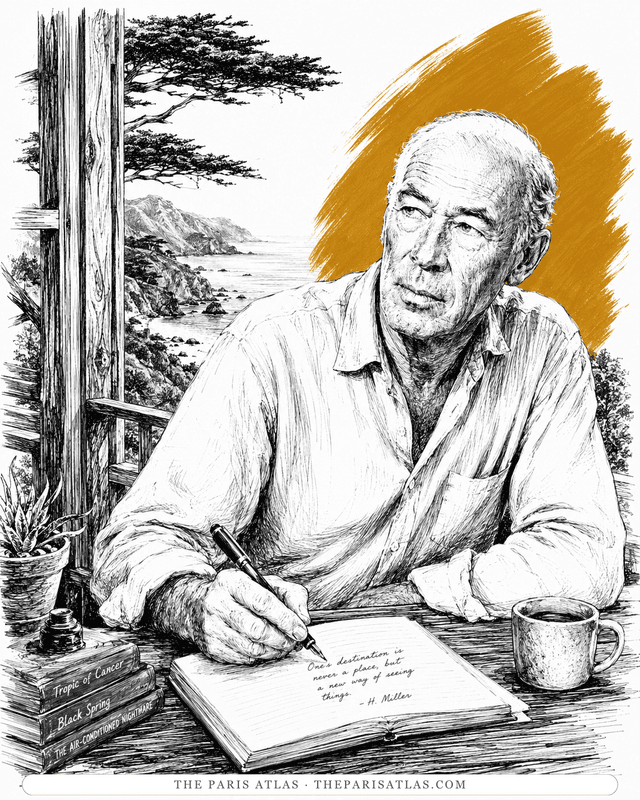
The Brooklyn dropout who arrived in Paris broke at thirty-eight and wrote the exuberant, banned books that ended American censorship.
View author
French writer and philosopher whose novels, memoirs, and social analysis examined freedom, gender, responsibility, aging, and the material conditions that shape a life.
View authorThe sources below include the primary text, editions, scholarship, archival materials, and other records that informed this page. They document Factotum, its publication, and its place in literary history.


Biographical and bibliographic backbone: the career arc, the Black Sparrow relationship, and the book's place in it.
Publication dates, publishers, and chronology checked against the bukowski.net timeline.
Bibliographic details cross-checked against the Verdant Press checklist.
Web source consulted for documented facts and historical context presented on the Factotum page.
Primary-text evidence for the two scene readings; chapter locators refer to the public preview.
The primary text is the baseline reference for every book page. Additional references document publication history, interpretation, and historical context where that evidence is available.
 Explore more resources