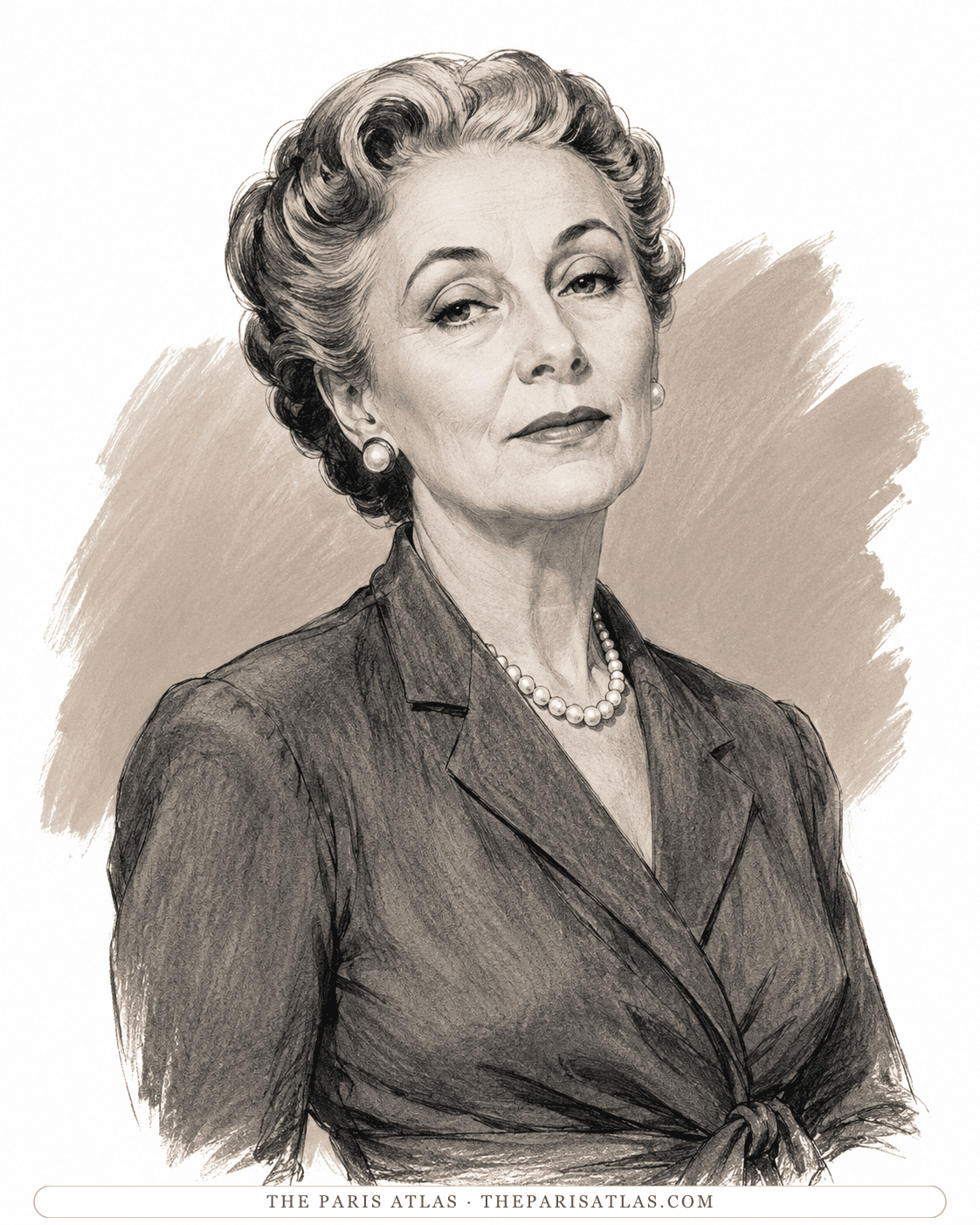
Aunt Alicia
Gigi's great-aunt, the most successful courtesan of the family, who instructs her in jewels, food, and comportment.
To finish Gigi's education herself, on her own terms. Her rule for jewels is her rule for everything: never accept the second-rate, and wait for the first-rate to arrive.
The book

At a glance
- Two long scenes at her own flat and two visits to her sister's. The family treats her judgement, and her jewels, as the standard
- Seventy
- Alicia de Saint-Efflam. She calls her younger sister by her first name, Inès
- Alone, with a manservant called Victor, on private means she describes as modest
- The book notes that nobody had ever heard of anyone so much as raising the subject with her
- A rosary of small pearls and the Gospels
Who they are in the book
Spoiler-freeAlicia is Gigi's great-aunt, the elder sister of her grandmother, and by the family's own reckoning the most successful of them. She is seventy, lives alone on an income she describes as modest, and was a courtesan: she was kept, in considerable style, by very rich men, which in Belle Époque Paris was a career a beautiful woman without money could make for herself. Her sister's dry inventory of the clientele runs to a king of Spain, a king named Milan, a khedive of Egypt and rajahs by the half-dozen — if you believe her, which her sister does not entirely. Nobody has ever heard of anyone raising the subject of marriage with her.
The flat is the proof of the career. A rope of beads hangs at the door for a bell-pull, with green vine leaves and purple grapes running through it, and the door itself is varnished to the colour of dark caramel. A manservant opens it. Inside there are carpets laid over Persian carpets, a small Louis XV drawing room that Gigi's grandmother has decided is boredom itself, and a pale lemonwood dining room that Gigi covets and intends to buy one day. In the silver-grey bedroom there are red Chinese vases, a bed shaped like a basin under a chinchilla cover, and a string of small pearls and the Gospels on the night table.
Gigi is sent to her for the half of the education her grandmother cannot supply: how to eat, what to accept, what to refuse, and eventually how to choose a man's cigars. The lessons come as fast unsentimental instructions delivered between mouthfuls, and Alicia is entirely unembarrassed about what they are for. Her health is excellent and she hides it. She receives with a scrap of black lace on her white hair to signal a migraine and climbs a flight of stairs imitating the breathlessness of a heart patient. Her sister points out that she has never once had so much as a cold.
How Aunt Alicia Is Portrayed
- Seventy, and pretending to be frailA piece of black Chantilly lace on her white hair means a headache is in progress and the visit is over. She arrives at her sister's in a hired brougham, in black lace and dull silk with a tea rose pinned near her shoulder, and goes up the stairs breathing like an invalid. Colette says plainly that the health is robust and the fragility is an affectation, and has her play the part of a marquise in a stage comedy.
- The lesson in stonesShe opens the jewel case and holds pieces up. Gigi gets the name of the navette cut wrong, then calls a canary diamond a topaz, which Alicia treats as the worst humiliation of a long life. The emerald she puts on her own thin finger and holds still, so that Gigi can see the barely-blue fire at the bottom of the green light. Her rule: never wear second-rate jewels, wait for the first-rate ones, and if they never come, wear a five-franc ring and tell people it is a keepsake you never take off, day or night.
- The jewellery she forbidsNothing artistic, by which she means a gold mermaid with chrysoprase eyes, an Egyptian scarab, a big engraved amethyst, a lyre or a star made up into a brooch, an inlaid tortoise, a bracelet said to be chased by a master hand. No baroque pearls, not even as hatpins. Be wary of family jewels. And there is no such thing as a beautiful cameo, whatever Gigi's grandmother may think of her own.
- Who hands out the best stonesShy men, she says, and vain men, and boors who think that giving a monstrous jewel proves they were well brought up. Sometimes a woman, to humiliate a man. Not great kings, because in her experience great kings do not care for jewellery — and, she adds, between the two of them, neither do small ones.
- Table manners as a trade skillOrtolans are cut in half with one clean stroke that does not scrape the knife on the plate, and then each half is crunched, bones included. Lobster à l'américaine, boiled eggs and asparagus are the three stumbling blocks of an education, and inelegant eating, she maintains, has broken up plenty of households. Gigi is to answer questions without stopping eating and without speaking with her mouth full: Alicia manages it, so Gigi can manage it. Pouring coffee, no flick of the wrist to catch the drip — she would rather have a footbath in the saucer than a waiter's tricks at her table.
- Believe in the evil eyeShe forbids opals, and when Gigi asks whether she really thinks they bring bad luck, says that what matters is appearing to think so. Believe in opals, in turquoises that die, in the evil eye. Nine men in ten are superstitious, nineteen in twenty believe in the evil eye and ninety-eight in a hundred are afraid of spiders; men forgive a woman a great deal, but not being free of the things that frighten them. When Gigi despairs of remembering it all, Alicia tells her it does not matter whether she remembers, as long as Alicia knows it.
- The inspectionShe goes over the girl's face with a sharp fingernail, lifts a lip to check the enamel on the teeth and says that with teeth like those she would have eaten Paris and the foreign countries too, and that she did in fact eat a decent piece of it. A spot near the nose and a squeezed blackhead are both forbidden and get her a bottle of astringent lotion. No cured meat except cooked ham. No almonds, which make the breasts heavy. She cups her hands over Gigi's chest, calls it a project, and allows that it is a pretty one and well attached.
- Her verdict on Gigi's faceThe little nose is impossible, the mouth has no style, the cheekbones are somewhat peasant-Russian. Against that: the eyes, the lashes, the teeth and the hair, which she says are enough to get the girl through, provided she is not a complete idiot. The whole assessment is delivered to Gigi's face with her hands on the girl's shoulders.
- Why she will teach her to choose cigarsBecause when a woman knows a man's preferences, cigars included, and a man knows what pleases a woman, the two of them are well armed against each other. Gigi's conclusion is that they then fight. Alicia looks at her with dismay and tells her she is clearly not the one who invented the three-panelled mirror.
- Ordinary peopleGigi is not to accept invitations, because only ordinary people would invite her, and ordinary people are useless: weak heads, loose bodies, and married into the bargain. Boredom at home is no bad thing, since boredom helps people make decisions. On the family's position she is exact — « Le mariage ne nous est pas interdit », meaning that marriage is not forbidden to them; instead of marrying at the start of a life, she says, one sometimes marries at the end of it.
- When the plan collapsesShe calls Gigi a little bedbug in front of her grandmother, then switches manner completely and tries to sell the girl what she thinks her sister failed to sell: the sea glowing on the far side of the world, hummingbirds in the flowers, making love under the gardenias beside a fountain. Gigi answers that when the eternal spring is over the gentleman leaves with another lady. Alicia gives up, tells her she deserves to end up with a small hat shop and had better go and marry a shipping clerk, and says flatly that what has been botched is botched and they will not discuss it for the rest of their lives.
Alicia states the ending halfway through the book without knowing it. Explaining to Gigi why their family does not marry the way other families do, she says marriage is not forbidden to them, and that instead of marrying at the beginning of a life one sometimes marries at the end of it. That is exactly what happens.
She is present for the last scene. When Gigi gives in and goes to Gaston, and her grandmother moves to intervene, Alicia catches her sister's arm and tells her to stop meddling, because the thing has gone past the pair of them. It is the last thing she says. The proposal follows immediately and the book stops there.
If you like Gigi


If you like Colette
Explore authors with a similar voice, perspective, and influence.

Henry Miller
The Brooklyn dropout who arrived in Paris broke at thirty-eight and wrote the exuberant, banned books that ended American censorship.
View author
Louis-Ferdinand Céline
The doctor of the Paris slums who wrote the century's blackest, funniest novel — and changed the sound of French prose.
View author
Martha Gellhorn
War correspondent who covered the Spanish Civil War, D-Day, and conflicts across five more decades; Hemingway's third wife, 1940–1945.
View author