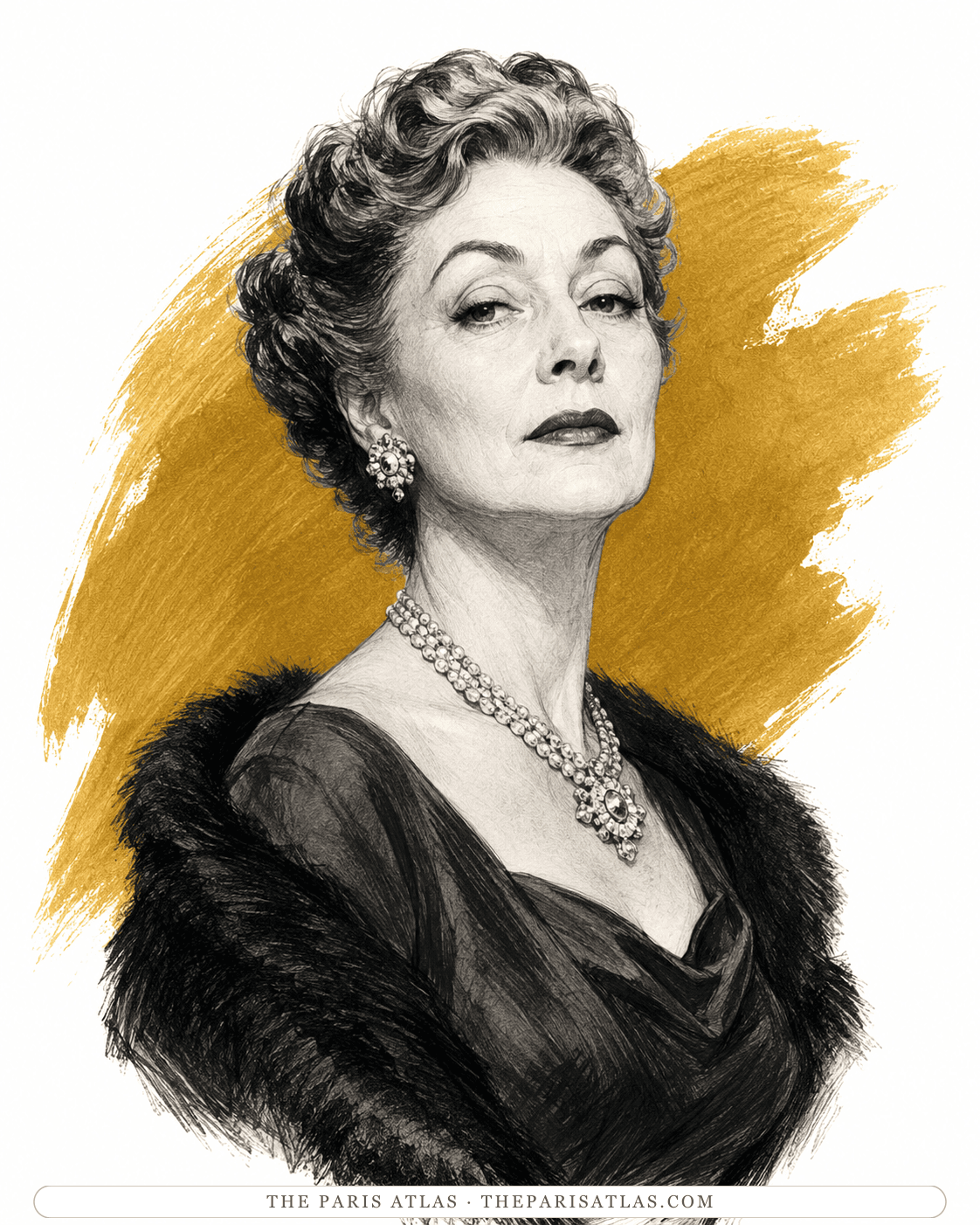
Madame Alvarez
Gigi's grandmother, a retired courtesan managing the household and her granddaughter's education.
To place Gigi permanently and on stated terms. She tells Gaston she will do her best to hand her granddaughter over only to a man who can say that he will take charge of her and secure her future.
The book

At a glance
- Throughout; the flat is hers and most of the scenes happen in it
- Inès Alvarez. The surname came from a dead Spanish lover; Gaston calls her Mamita
- Her unmarried daughter Andrée, who sings small parts at the Opéra-Comique, and her granddaughter Gilberte. Her elder sister Alicia lives across town
- Tight. Goose was beyond her the week Gaston came to dinner, and she rules out a telephone as an expense the family cannot justify
- The book gives no details, only that she was kept, and that from that life she has retained a set of scrupulous domestic habits she now teaches to two more generations
Who they are in the book
Spoiler-freeMadame Alvarez is Gigi's grandmother and the head of a household of three women in a small Paris flat around 1900. She is a retired courtesan: she spent her working life being kept by wealthy men outside marriage, which in Belle Époque Paris was a recognised way for a woman without money to live well. The name Alvarez came from one of those men, a Spaniard, now dead, and having taken his surname she eventually gave herself a first name to match it and became Inès. She is heavy and pale, powders too white, wears her hair glossy with brilliantine, and when she lowers her eyes the weight of her cheeks pulls at the lower lids and she looks like George Sand.
She is bringing her granddaughter up for the same trade and treats it as a profession with entry requirements. Her own department is manners and upkeep — how to sit, how to eat, when to put gloves on, how often the sheets are changed — while her elder sister Alicia handles jewels, food and men. She does not discuss the purpose of any of it with Gigi until she is forced to.
The household runs on very little. Her daughter Andrée sings small parts at the Opéra-Comique; a goose is beyond the family's means in a bad week; a telephone is an expense she cannot justify. What she has instead is Gaston Lachaille, a sugar heir who has been dropping in for years, and her handling of him is the most careful thing in the book. She makes him camomile tea, listens to his troubles, asks him for nothing, and brings up his late father exactly once per visit.
When Gaston's interest in Gigi turns into something else, Madame Alvarez sees it before anyone says it aloud, and she stops the drift at once by refusing to let him take the girl out to tea on her own. She tells him a girl seen alone with him stops being an ordinary girl. What she wants is for him to say what he is offering, in words, before Gigi goes anywhere with him.
How Madame Alvarez Is Portrayed
- The name she is usingAlvarez is the surname of a dead lover, and she took the first name Inès later to go with it. The Spanish name did the rest of the work: a buttery pallor, brilliantined hair parted in the centre, powder laid on too white, and a family orbiting her in good order.
- Her dayShe goes to bed last, on the folding divan in the dining room, and gets up first. At half past seven she opens the door to the newspapers, the litre of milk and the charwoman. By eight the curling pins are out. At ten to nine Gigi leaves for her class, brushed and tidy. At ten she thinks about lunch, which means putting on her mackintosh, hooking the string bag over her arm and going to market. She sits up at night playing patience until her daughter is home from the theatre.
- Decency is a matter of postureOn a low seat the knees go together and fold to one side. When Gigi objects that she is wearing drawers and a petticoat under the skirt anyway, her grandmother rules that drawers are one thing and decency is another, and that all of it is in the bearing. Gloves before leaving the house. Stop pushing your stomach forward when you have no stomach to push.
- Take your shoes offThe order can come at any moment, and Gigi has to produce white feet, trimmed nails and no threatened callus. Sheets stay on the beds ten days, and the washerwoman tells the neighbourhood loudly that at Madame Alvarez's there is never time to see the ladies' underlinen or the table napkins go past, so fast do they come round again. The maxim drilled into her daughter and her granddaughter is that in an emergency a woman's face can wait until the morning, but washing below the waist is her dignity.
- The camomileGaston gets the sagging armchair, a box of licorice pastilles and two cups of camomile tea. She picks the best of it herself, she says, on waste ground inside Paris: a very small camomile that looks like nothing and tastes exquisite. Once per conversation, and only once, she mentions how well she knew his late father.
- What she will not ask forOver the years Gaston has supplied sugar for her jam and her curaçao, poultry from his farms and presents for the child. When her daughter points out that a friend that rich might have done more, she answers that he owes them nothing, says she is certain he would rescue them if they were ever destitute, and adds that she would rather not have to put it to the test.
- Reading a suicide over breakfastShe calls Gigi in to hear that Gaston's mistress has killed herself, then explains that of course she has not: laudanum as usual, the doctors reassuring, the woman knows her business. Her own diagnosis is that at this game the lady will end up wrecking her stomach. Gigi asks whether the last attempt was over Prince Georgevitch, and is corrected — it was Count Berthou de Sauveterre.
- Her sense of rankShe despises the stage as a profession even though her daughter is on it, and she approves of the fact that Gaston has always kept to the great demi-mondaines rather than to music-hall performers. A liaison with a woman of that standing is, in her view, the only decent way for a bachelor in his position to pass the time until a grand marriage. When her daughter calls those women cows, she is told to mind her words: « D'appeler les choses et les personnes par leur nom, ça n'a jamais avancé à rien », which means that calling things and people by their names has never got anybody anywhere.
- The afternoon she says noGaston arrives in a light suit to take Gigi to tea at Versailles. Madame Alvarez unties her apron, puts her hand between their two arms and says no, then sends the girl out of the room and explains. Anywhere he goes his presence is noted, so a girl who goes out alone with him is no longer an ordinary girl, and she has no wish to laugh that off in the pages of Gil Blas. He asks who she is keeping the child for, then — a clerk on two thousand four hundred a year who will marry her and give her four children in three years? Her answer is that she understands a mother's job better than that, and will hand Gigi over only to a man who says he will take charge of her and secure her future.
- How she breaks the newsShe puts Gaston's offer to Gigi as a miracle, a god, an unbelievable stroke of luck, and reports as much to her sister the next morning. Alicia tells her she got it wrong and should have sold the difficulty instead: the game to be played, the fury of all the other women, the victory to be won over a man in the public eye. Asked why she did not at least offer romance — the sea glowing on the other side of the world, hummingbirds in the flowers — Madame Alvarez says she could not, because she has never been further than Cabourg and Monte-Carlo and is not capable of inventing it.
When Gigi refuses, her grandmother's reaction is closer to panic than to anger. She says it is enough to make you bang your head against the wall, and keeps telling Gaston that she had warned the girl, that God is her witness she had told her. Her sister demands to know what she intends to do about it, and she answers that she can hardly tie the child up.
She is in the room for the last scene, and it does not go the way she has spent the book arranging. When Gigi walks into Gaston's arms, Madame Alvarez starts forward to interfere and Alicia catches her by the wrist and tells her to leave it alone, because it is beyond both of them. The proposal, when it comes, is addressed to her: Gaston asks her for the honour of her granddaughter's hand.
If you like Gigi


If you like Colette
Explore authors with a similar voice, perspective, and influence.

Henry Miller
The Brooklyn dropout who arrived in Paris broke at thirty-eight and wrote the exuberant, banned books that ended American censorship.
View author
Louis-Ferdinand Céline
The doctor of the Paris slums who wrote the century's blackest, funniest novel — and changed the sound of French prose.
View author
Martha Gellhorn
War correspondent who covered the Spanish Civil War, D-Day, and conflicts across five more decades; Hemingway's third wife, 1940–1945.
View author