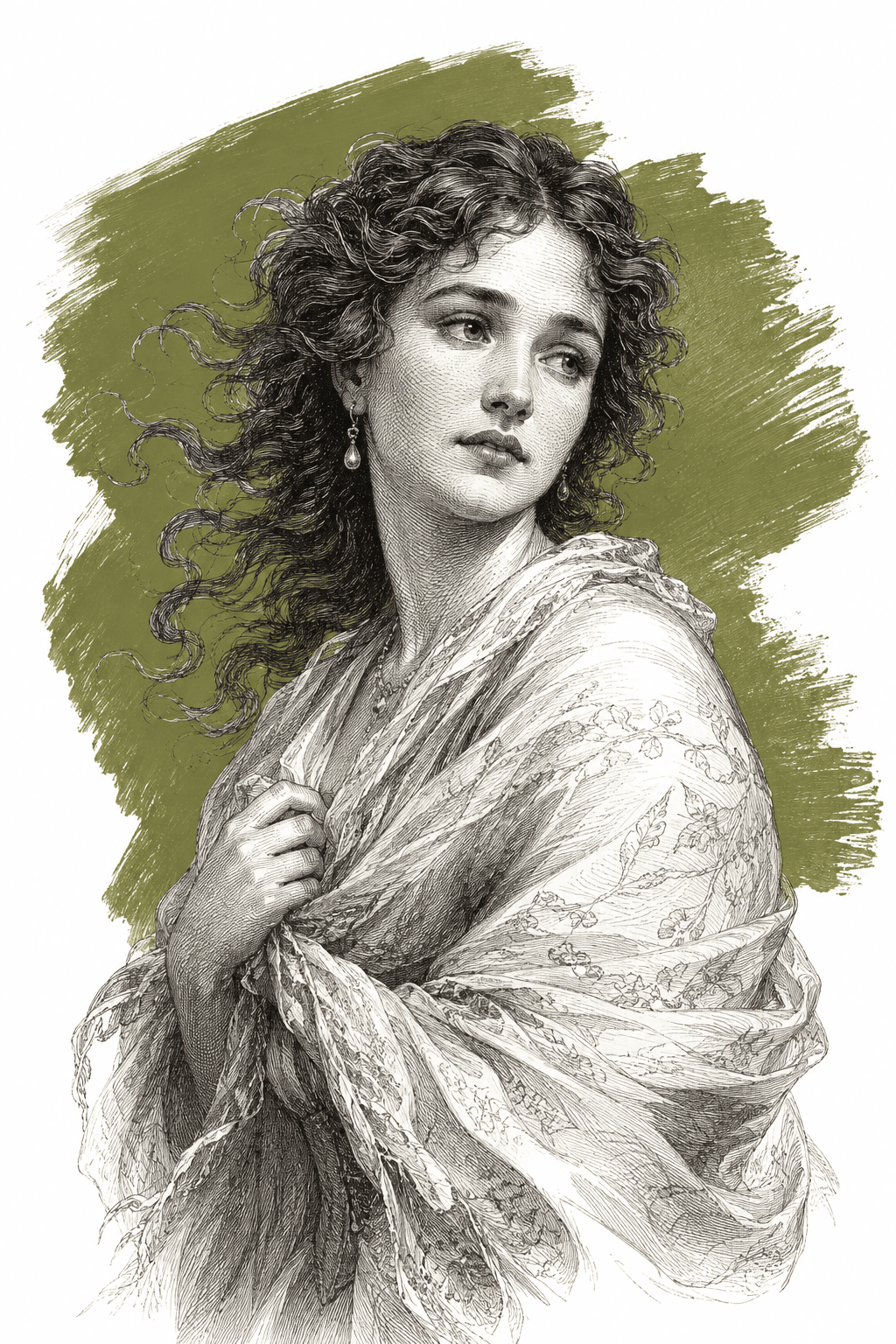
Masie Tuck-and-Frill
A midwife whose trade has disappeared, still hoping that two women will one day need her services. The book's prophet, and its softest voice.
A delivery. She believes some modern girl will rise from another modern girl's couch with something new in her mind, and that a feather, a song or an exclamation in the right place might do it.
The book

At a glance
- A midwife attached to the circle; principally the March chapter
- Sage-femme — out of a job "because of the Trend of the Times"
- Sewing a fine seam among the cushions
- Spelled Masie in March and Mazie in October
Who they are in the book
Spoiler-freeMasie Tuck-and-Frill is an invented character in Ladies Almanack, the 1928 mock almanac by the American writer Djuna Barnes. She is a sage-femme — a midwife — who is out of work because the women she now attends do not have babies. Rather than retrain, she has decided to wait: she is convinced that sooner or later two women will manage it between them, and she intends to be there when they do.
The joke is set up carefully and then abandoned, because Barnes gives her the most serious speech in the book. Asked to explain herself, she stops being a comic figure and delivers several paragraphs on what love is in men and what it is in women, and Dame Musset tells her she speaks like one of their own. She replies that she speaks in the voice of the prophet. Barnes spells her name Masie in March and Mazie in October.
How Masie Tuck-and-Frill Is Portrayed
- A trade with no customersShe is called to no beds but those of women who cannot make her necessary, and she goes anyway — looking hopefully between the sheets, putting a hand at the crook of an arm and between the knees, finding nothing that requires attention and no small voice asking where it is.
- The lullabyShe sings what the book calls the first lullaby ever composed for a girl's girl should she one day become a mother. She has also been overheard in corridors advising a pregnancy of nine months not to overtax itself and to take care on the stairs.
- The prophet's answerTold she should be one of them, she says she speaks in the voice granted to those who go neither hither nor thither: only people who sit in one condition their whole lives know what the plans were and where the hopes are. She adds that she wishes the mind's eye had not been bent so hard upon the heart.
- The lines the book is quoted for"Love in Man is Fear of Fear. Love in Woman is Hope without Hope." She goes on to say that a man's love is built to fit nature and a woman's is a kiss in the mirror. It is the passage most often lifted out of the almanac, and it is given to the character with the least standing in it.
- Sewing through the argumentThrough the whole of the March discussion she sits among the cushions working at a seam, speaking in what Barnes calls the wistful lost voice of someone with a trade too tender for oblivion. She is the only person in the chapter doing anything with her hands.
- The reassurance in OctoberWhen Musset works herself into a panic about being pursued into old age and says she will need friends, Masie twitters that she shall be well surrounded. It is two words of comfort, and it is immediately stepped on by Patience Scalpel's complaint about the absence of men.
If you like Ladies Almanack


If you like Djuna Barnes
Explore authors with a similar voice, perspective, and influence.

Henry Miller
The Brooklyn dropout who arrived in Paris broke at thirty-eight and wrote the exuberant, banned books that ended American censorship.
View author
Louis-Ferdinand Céline
The doctor of the Paris slums who wrote the century's blackest, funniest novel — and changed the sound of French prose.
View author
Martha Gellhorn
War correspondent who covered the Spanish Civil War, D-Day, and conflicts across five more decades; Hemingway's third wife, 1940–1945.
View author