Tilly-Tweed-In-Blood
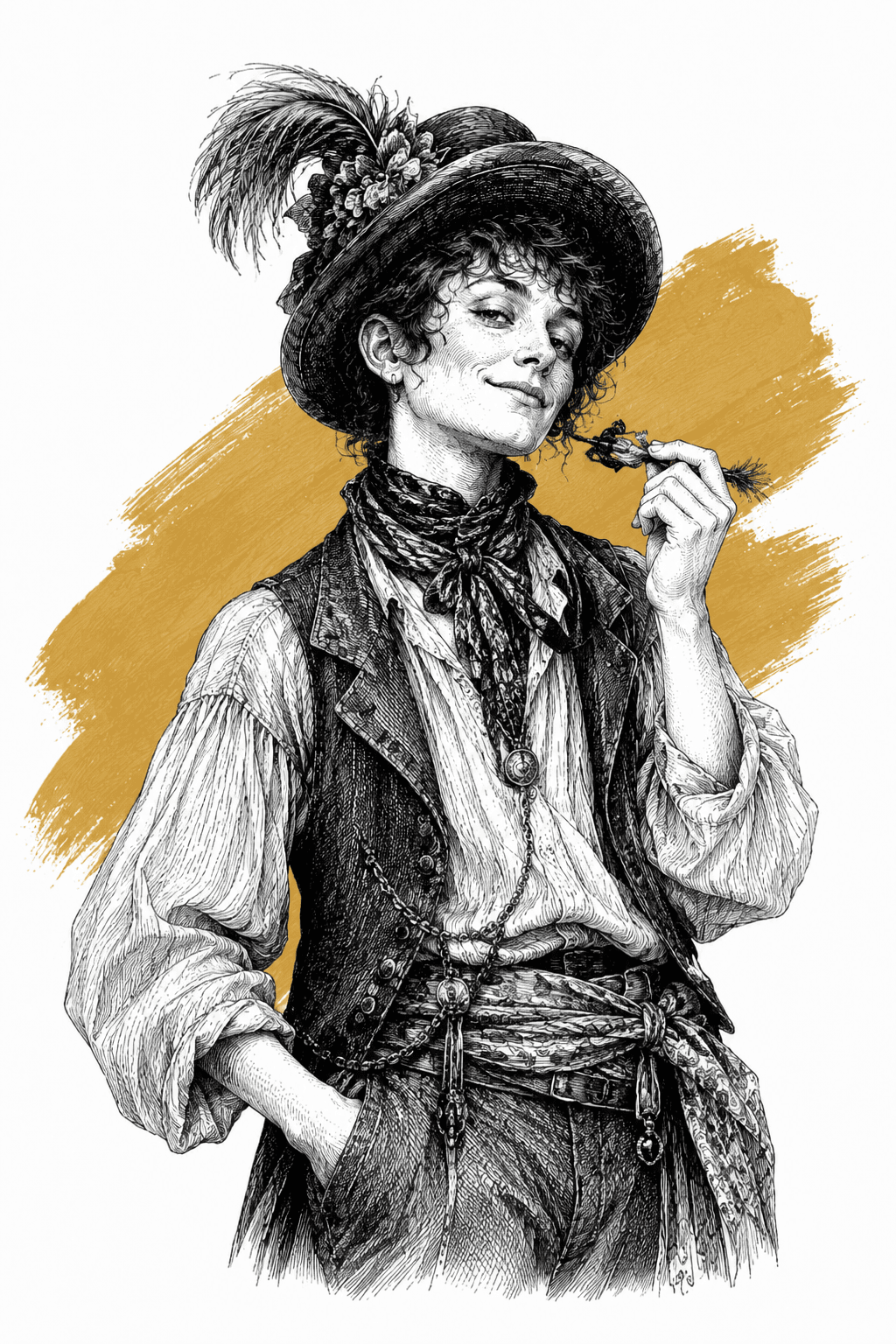
The other Englishwoman at the tea table — a Stetson, a firm belief in marriage, and the loudest sympathy in the book.
A wedding. Her half of the argument is that two women should be able to pace up an aisle in bridal lace and come out of it a wife and a bride.
The book

At a glance
- One of two Englishwomen at the March tea table
- A Stetson
- Marriage
- Lady Buck-and-Balk, who believes in spirits
- Radclyffe Hall · 1880–1943 · Bournemouth, England
Who they are in the book
Spoiler-freeTilly-Tweed-In-Blood is an invented character in Ladies Almanack, the 1928 mock almanac by the American writer Djuna Barnes, and the companion of Lady Buck-and-Balk. The two arrive together in the March chapter to argue that England should legalise marriage between women. Barnes introduces her in one clause: she wore a Stetson and believed in marriage.
She is generally identified with Radclyffe Hall, the English novelist whose The Well of Loneliness was published — and prosecuted for obscenity in London — in the same year this almanac was privately printed. Hall and her partner Una Troubridge were the couple the 1920s public could name, and Barnes wrote them into the tea party as a matched pair of respectable campaigners.
How Tilly-Tweed-In-Blood Is Portrayed
- The StetsonHer description is one clause, set against her companion's monocle. The hat does the work: an English lady in cowboy headgear, arguing for the most conventional institution there is.
- The wedding she describesHer case is made almost entirely in ceremonial detail — the bridal lace, the stately aisle, the fumbling for equal gold bands, the canopy of cambric afterwards. She wants the furniture of a wedding, not only the legal protection.
- Instant, total sympathyWhen Musset mentions that she was deflowered at ten by a surgeon's hand, Tilly wails on the second beat, calls her a poor betrayed mishandled soul, says she does not know whom to strike first and swears her eyes shall know no sleep until Musset is revenged. Musset puts a hand on her wrist and says: "I am my Revenge!"
- Cheerfully talked roundShe accepts the correction at once — she had not thought of that — and immediately produces a compliment about Musset having hanged, cut down and re-hung Judas a thousand times. Her enthusiasm outruns her position every time she opens her mouth.
- Keeping men on the payrollWhen Lady Buck-and-Balk wishes men could be abolished altogether, Tilly sighs that it cannot be done: they are needed for carrying coals, lifting beams, and things of one kind or another. It is the practical objection of a woman who runs a household.
If you like Ladies Almanack


If you like Djuna Barnes
Explore authors with a similar voice, perspective, and influence.

Henry Miller
The Brooklyn dropout who arrived in Paris broke at thirty-eight and wrote the exuberant, banned books that ended American censorship.
View author
Louis-Ferdinand Céline
The doctor of the Paris slums who wrote the century's blackest, funniest novel — and changed the sound of French prose.
View author
Martha Gellhorn
War correspondent who covered the Spanish Civil War, D-Day, and conflicts across five more decades; Hemingway's third wife, 1940–1945.
View author