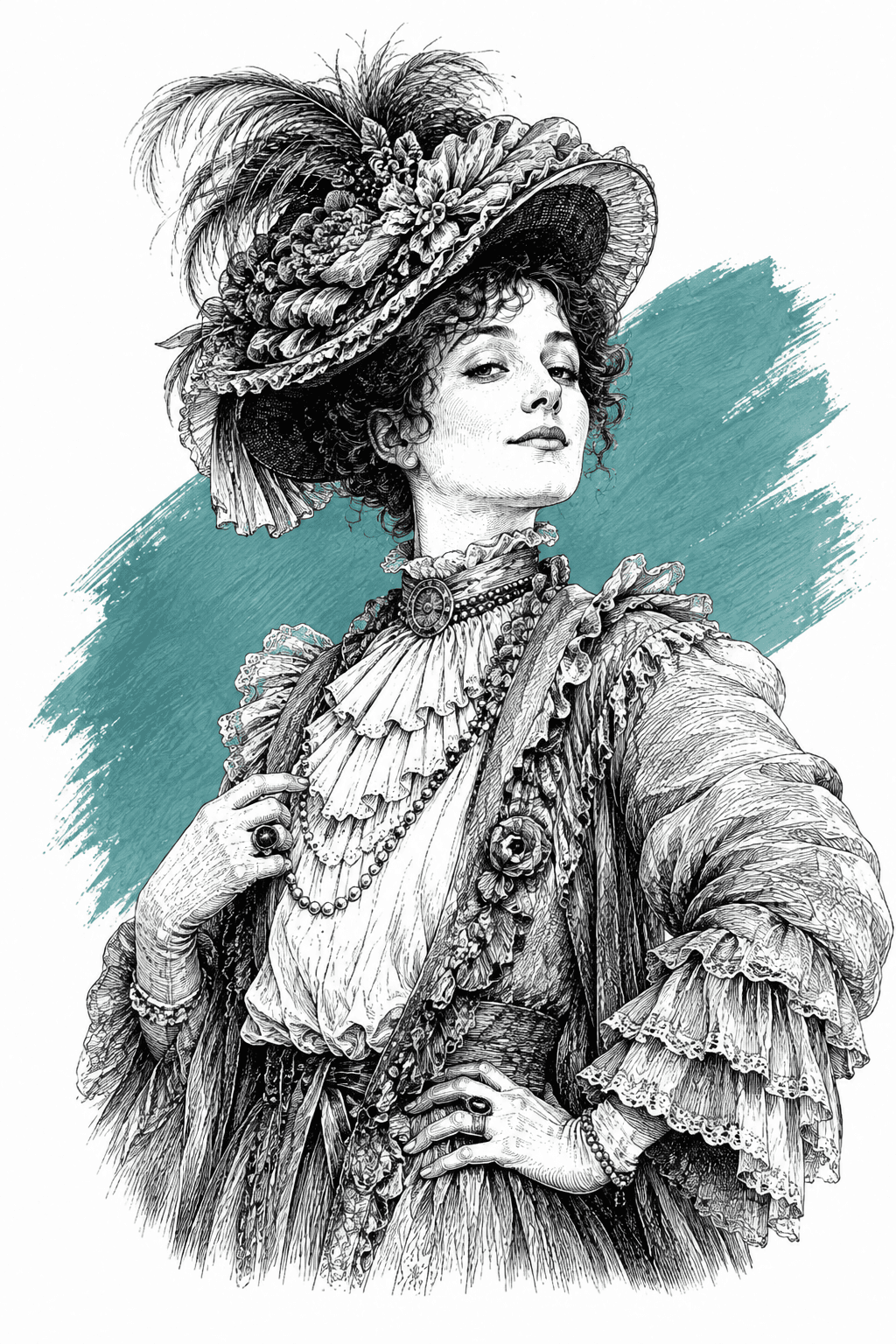
Dame Evangeline Musset
The book's heroine — a wealthy Englishwoman of fifty who rescues women in distress, holds court at a tea table, and is canonised as a saint a third of the way through.
To be understood, and to eat well while waiting. Told to explain herself, she says: "I live," she added, "for two remaining Ferocities, Food and Understanding!"
The book

At a glance
- The almanac's heroine and its saint
- "a witty and learned Fifty" through most of the year the book covers
- Short and, the narrator says, nothing handsome; a nose the book twice compares to a Pope's
- Lofty lineage; a mother who wanted a boy and a father who wanted her married
- Paris — the Luxembourg gardens, the Bois, the Champs-Élysées, and a house with a garden, a sundial and a fountain
- A whip, a busby worn over one eye, a pack of dogs, and later a pair of opera glasses carried in a bag
- Natalie Clifford Barney · 1876–1972 · Dayton, Ohio
Who they are in the book
Spoiler-freeDame Evangeline Musset is the invented central character of Ladies Almanack, the 1928 mock almanac by the American writer Djuna Barnes. She is a rich, short, plain, extremely confident Englishwoman of fifty who has spent her adult life seducing women and helping them, and who treats both activities as a public service. The book's first page introduces her as a one-woman relief organisation for girls in difficulty, and the joke of the whole volume is that it takes her at that valuation: by the third chapter the almanac is listing her saints' days.
She is drawn from Natalie Clifford Barney, the American writer and heiress whose salon at 20 rue Jacob in Paris ran from 1909 into the 1960s and whose circle supplied most of this book's cast. Barnes was a regular there. The identification was obvious to the women who first read the book and is standard in writing about Barnes, though Barnes herself never printed a key.
Musset talks more than anyone else in the almanac and is never once at a loss. She receives visitors, settles arguments, delivers verdicts on the women brought to her attention, and narrates her own career at length. The book's structure is built around her: it canonises her in the spring, sends her out to preach in November, and buries her in December.
How Dame Evangeline Musset Is Portrayed
- Introduced as a rescue serviceThe opening page presents her as an emergency organisation for women in distress — a parody of the Red Cross, complete with a catalogue of the complaints she is called out to relieve. It sets the book's method in the first sentence: an ordinary institution described in ordinary institutional language, doing something else entirely.
- The argument with her fatherHer father paces his library at night in his nightshirt trying to work out how to make her respectable. When he finally asks her outright what he is supposed to do, she tells him he was hoping for a son when he conceived her and should not now be wounded to find he got his wish — and adds that she manages it without the equipment, and never complains.
- Canonised month by monthThe chapter headed "Saints Days" gives one feat per month of the calendar, each from a different age of her life: what she noticed at five, what she learned at nine, what she managed at fifteen, at twenty-one, at thirty, at forty. The last two are old age and the ordering of a pastry she gives away just before she dies.
- The tea tableWomen bring her their problems and she gives rulings. Two Englishwomen arrive wanting marriage between women legalised so that alimony can be claimed; Musset proposes duelling as the simpler remedy, and says she could do it herself with disconcerting ease.
- Her account of her own educationAsked about her past she gives a survey of the women of every nation she has been to bed with, sorted by how quickly they warm and how long they burn. She finishes by saying that on her sword there is no rust and on her coat of arms so many stains that she has made her own banner out of them.
- A pioneer and a menaceShe complains that the thing has become fashionable and easy. In her day, she says, it was as daring as a crusade and left a woman in tears; now it leaves her talkative, and there is not a secret among them. She misses having someone to convert.
- The sermon nobody wantsIn November, having reached fifty and worked out what she thinks wisdom is, she goes through the town to give it away free — stopping a girl with an ox, a girl with geese, a crowd of girls on some palace steps — and every one of them walks off before she can finish. The chapter is the closest the book comes to pathos, and it is played as farce.
Natalie Clifford Barney outlived the joke by a wide margin. She was fifty-two when the book appeared and lived to ninety-five, keeping the salon at 20 rue Jacob going, on and off, until the 1960s. She is reported to have enjoyed the portrait.
If you like Ladies Almanack


If you like Djuna Barnes
Explore authors with a similar voice, perspective, and influence.

Henry Miller
The Brooklyn dropout who arrived in Paris broke at thirty-eight and wrote the exuberant, banned books that ended American censorship.
View author
Louis-Ferdinand Céline
The doctor of the Paris slums who wrote the century's blackest, funniest novel — and changed the sound of French prose.
View author
Martha Gellhorn
War correspondent who covered the Spanish Civil War, D-Day, and conflicts across five more decades; Hemingway's third wife, 1940–1945.
View author