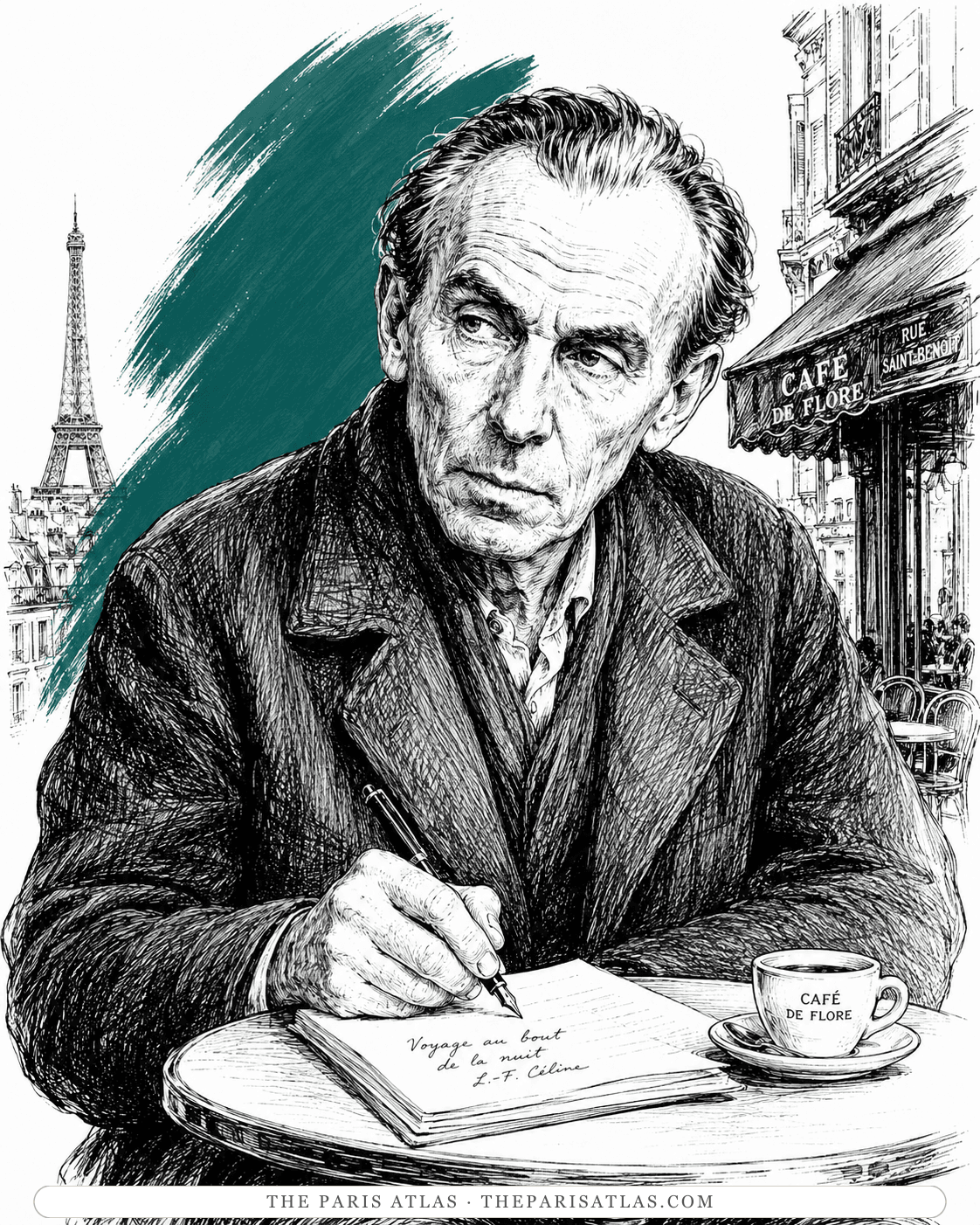

Bagatelles pour un massacre
The 1937 pamphlet that L'École des cadavres directly extends — same speaker, same subjects, less ballet.
Read our take
Louis-Ferdinand Céline's 1938 political pamphlet — a short grotesque opening beside the Seine gives way to a sustained argument against another war with Germany.
Céline's second major political pamphlet begins almost like a piece of grotesque fiction. The narrator is walking along the towpath between La Jatte and Courbevoie when he encounters a strange "siren." After their exchange, the narrative quickly abandons this fantastic opening. A hostile letter signed "Salvador, Juif" provides another transition into the main body of the work: an extended political argument about France, race, parliamentary government, Germany and the danger of another European war. Unlike Bagatelles, the book contains relatively little sustained fictional material once its opening is over.
Published in November 1938, L'École des cadavres continues many of the subjects Céline had developed in Bagatelles, but with less emphasis on ballet and cultural comedy and more sustained attention to European politics.
The narrator's strange encounter with the siren establishes a grotesque, unstable tone. He then presents the insulting letter from "Salvador," apparently a response to his previous pamphlet.
From there, Céline develops an extended racial and geopolitical argument. He attacks French parliamentary politics, discusses national and racial identity, argues against France entering another war with Germany, advances claims about political influence, and advocates a Franco-German alignment.
The looming European conflict is the central historical pressure behind the text: L'École des cadavres appeared less than a year before the beginning of the Second World War.
The pamphlet opens beside the Seine. Ferdinand / Céline is walking on the towpath between La Jatte and Courbevoie when a grotesque siren addresses him. They quarrel, and she disappears again into the water.
The text then moves to the narrator's immediate circumstances. He introduces a hostile letter addressed to him and signed "Salvador." The letter operates as a rhetorical provocation: Céline now has someone to answer.
What follows is not a story but a long sequence of political assertions and arguments.
He revisits many of the subjects of Bagatelles: race, Jewish political and cultural influence as he understands it, communism, French institutions, the press and national identity. But European diplomacy and war are much more prominent.
Céline's principal geopolitical argument is that France should avoid another war with Germany. He advocates closer Franco-German relations and increasingly presents politics through racial categories rather than the parliamentary and ideological divisions of conventional French politics.
The pamphlet also attacks parliamentary government and political elites, treating the existing French political system as incapable of protecting the country from the war Céline expects to come.
Rather than moving toward a fictional climax, the book accumulates arguments, examples and denunciations until its political position has been laid out at length.
There is no conventional conclusion involving the siren or Salvador.
They are devices that help launch the polemic; they do not become characters in a continuing story.
The book ends as a political pamphlet, with Céline continuing the programmatic and geopolitical argument developed through the main body of the work. Unlike Bagatelles, there is no final ballet to return the reader to an artistic narrative frame.
Alain Cresciucci points to two reversed images in the opening: an overturned barge and a siren wallowing in filthy water. Both could promise movement or enchantment; here they mark obstruction and disgust. The fantastic encounter therefore gives the narrator's contempt a setting before it becomes a political argument. The water is already interpreted through hostility, not neutrally observed. Reading this imaginative machinery does not make the pamphlet harmless: its wider argument is racist and antisemitic propaganda, not simply an appeal to avoid war.
An ALDE catalogue reproduces the author and publisher's notice explaining the missing leaves as a decision to attack policies rather than individuals. That distinction is itself an argument: it asks readers to separate the pamphlet's public cause from its personal accusations. Yet the material evidence resists a tidy story of correction. The same catalogue describes a copy missing only one of the three leaves and a later edition restoring disputed passages. Removal records a publishing intervention; it does not establish that the underlying antisemitism was withdrawn.
Structurally, L'École des cadavres shows Céline moving farther away from the hybrid form of Bagatelles. The earlier book repeatedly escaped its political argument through dance, comedy, dialogue and ballet. Here the imaginative opening rapidly gives way to a much more sustained political monologue.
The title's language of corpses connects directly with Céline's expectation of another European war. His First World War experience remained central to his opposition to another conflict, but in this pamphlet pacifism becomes attached to a specific racial and geopolitical program: avoiding war with Germany, rejecting France's existing international alignments and reorganising French politics according to Céline's own racial conception of the nation.
The writing remains highly performative. Céline is not constructing a neutral policy paper; he stages argument through exaggeration, direct address, mock dialogue, invective and abrupt shifts of voice.
What the book explores:
L'École des cadavres shows what Céline's polemic looks like once the ballet frame is gone. The subjects overlap with Bagatelles but the shape is more sustained and more centred on Franco-German geopolitics.
Read as a document of November 1938, the book is Céline arguing in real time against a conflict that was already less than a year away.
The physical history of the text — six pages excised from copies after the Rouquès / Treich defamation judgment — is itself part of the record and is documented in the Ajasse catalogue.
1938
Denoël publishes L’École des cadavres in November.
1939
Following a defamation judgment, six pages are removed from certain copies.
1945
A January ministerial directive orders the pamphlet withdrawn from sale.
The 1937 pamphlet that L'École des cadavres directly extends — same speaker, same subjects, less ballet.
Read our take
The 1941 wartime pamphlet; the third book in the polemical trilogy, this time written after the events L'École des cadavres tried to argue against.
Read our take
Céline's 1936 pamphlet, which set out the pessimistic anthropology behind the trilogy.
Read our takeNot a narrative sequel, but it directly continues Céline's political-pamphlet sequence and revisits many of the same subjects.
Only minimally. It has a short fictionalised opening — a grotesque encounter with a siren beside the Seine and a reproduced letter — after which the work becomes sustained political polemic.
He argues that France should avoid another conflict with Germany and advocates a Franco-German rapprochement, published less than a year before the Second World War began.
Denoël published the original edition in November 1938. The Bibliothèque nationale de France records it as a 306-page volume.
Yes. Following a defamation action involving Dr. Pierre Rouquès and Léon Treich, three leaves — six pages — were removed from certain copies after the 1939 judgment.
It was withdrawn from sale under a January 1945 ministerial directive, and Céline subsequently refused authorisation for further reprinting.
Explore authors with a similar voice, perspective, and influence.

Miller read Journey in manuscript while writing Tropic of Cancer and never recovered — the two books are the era's twin gutter-testaments.
View author
The other French modernist Céline could not look away from: a war-wounded amputee whose spoken prose ran ahead of grammar and whose Moravagine anticipates Bardamu's tour of the century's slaughterhouses.
View author
The same war, the same refusal of the big words — delivered in whispers where Céline delivers it in screams. Both writers died in the same week of July 1961.
View authorThe sources below include the primary text, editions, scholarship, archival materials, and other records that informed this page. They document L'École des cadavres, its publication, and its place in literary history.


The primary text represented by this page, used for descriptions of the work’s contents and for any quoted passages shown here.

Published analysis and historical context used in preparing the L'École des cadavres page.
Published analysis and historical context used in preparing the L'École des cadavres page.
Published analysis and historical context used in preparing the L'École des cadavres page.
Used to verify Louis-Ferdinand Céline's bibliography and place L'École des cadavres within the broader chronology of Louis-Ferdinand Céline's career.
Selected discussion and primary quotations, especially note 21; not a full-pamphlet or first-edition collation.
Catalogue descriptions and reproduced publisher notice; original copies and the court record were not inspected.
The primary text is the baseline reference for every book page. Additional references document publication history, interpretation, and historical context where that evidence is available.
 Explore more resources