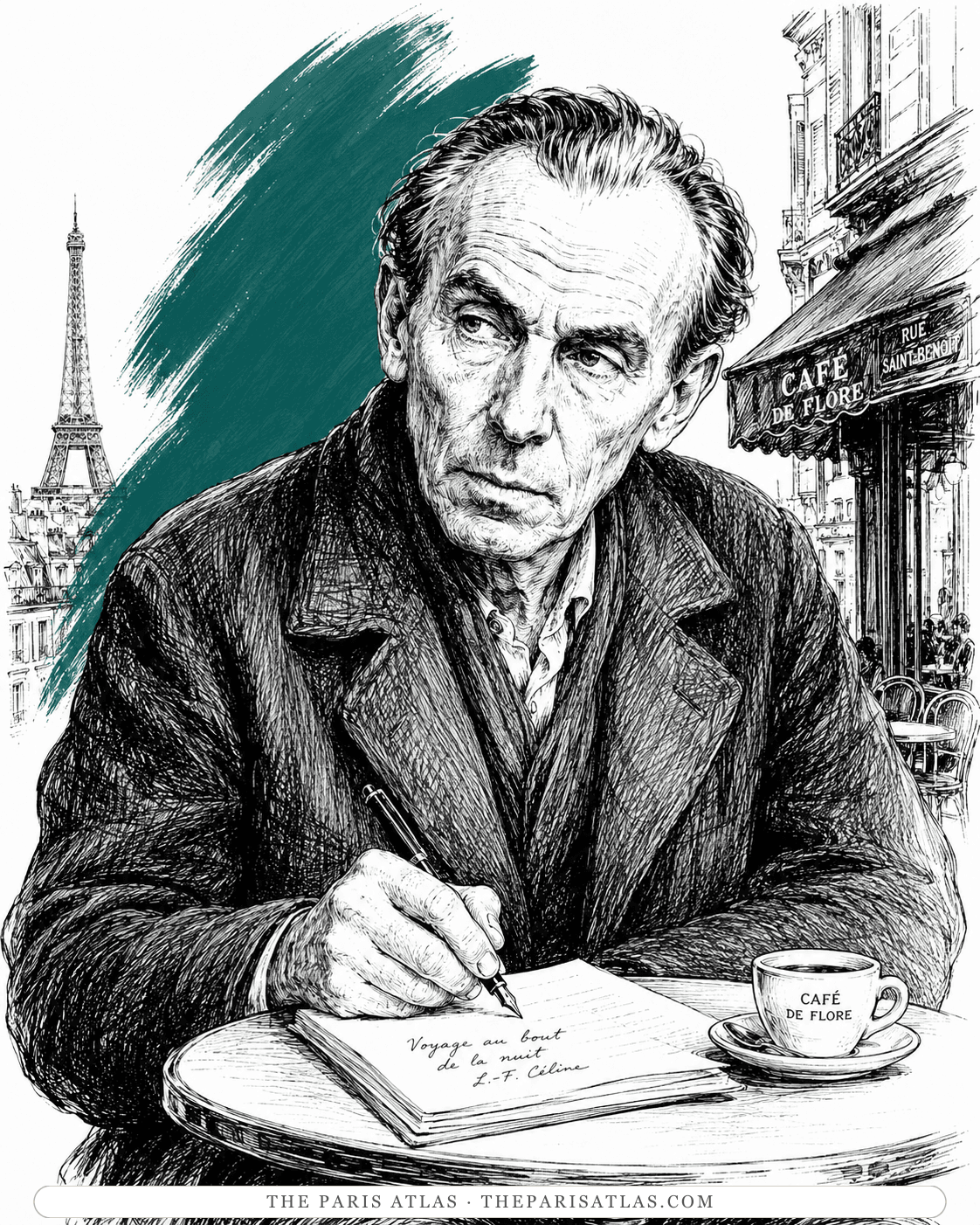

Bagatelles pour un massacre
The 1937 first pamphlet in the trilogy; Les Beaux draps continues several of its arguments but with far more attention to a positive social programme.
Read our take
Louis-Ferdinand Céline's 1941 political pamphlet — written after the fall of France, its later sections turn from defeat toward a social programme built around leisure, family and the arts.
Written after France's defeat in 1940, Les Beaux draps is Céline's third major political pamphlet and his most explicitly programmatic of the three. It begins from the condition of occupied France and revisits subjects including race, national identity, parliamentary government and the causes of French defeat. But the book increasingly turns toward Céline's proposals for how everyday French society should be reorganised: economic equality, shorter working hours, social security, family life, education, childhood, medicine, art and the protection of imaginative life from an increasingly mechanised society.
The title plays on the French expression être dans de beaux draps — roughly, "to be in a fine mess." The "mess" is France after military defeat.
Céline first looks backward, asking what produced France's collapse. He discusses prewar politics, racial questions, French social life and the institutions he regards as having failed.
But Les Beaux draps does something the preceding pamphlets do much less systematically: it asks what should replace the existing order.
Céline proposes what he calls "communisme Labiche." It is not Soviet communism. His scheme emphasises relatively modest material security, reductions in economic inequality, shorter working hours and an organisation of society around family, leisure and small-scale personal security rather than endless production or accumulation. He argues for a maximum working week of roughly thirty-five hours for many workers and employees and devotes considerable attention to schools, children, art and medicine.
The work opens with France after the catastrophe of 1940. Céline considers the country's military and political defeat and attacks many elements of prewar French public life. He continues the racial and political arguments of Bagatelles and L'École des cadavres, while also criticising parliamentarianism, social conventions, economic inequality and parts of the new Vichy order.
The argument then becomes increasingly prescriptive. Céline proposes a form of egalitarian economic organisation he calls "communisme Labiche," named after the nineteenth-century playwright Eugène Labiche. Rather than promising revolutionary abundance, this system aims at a relatively modest but secure standard of life. He wants sharp limits on economic inequality and imagines economic arrangements intended to give ordinary people stability rather than luxury.
Work is one of his central concerns. Céline rejects the idea that work is inherently ennobling and argues that factory and commercial labour place real physical and psychological limits on people. He therefore proposes a roughly 35-hour working week.
From economics he moves into social organisation: housing, leisure, family, children, health and medicine.
Education becomes especially important toward the end. Céline objects to schooling that simply prepares children for mechanical or bureaucratic life. He places unusual emphasis on imagination, stories, music, dance and artistic experience.
The final sections consequently move away from immediate wartime politics and toward an opposition between art and mechanisation — the preservation of imagination, rhythm and childhood against what he sees as the deadening effects of modern organised life.
Again, there is no narrative resolution.
But Les Beaux draps has a recognisable movement: from diagnosis toward prescription. The later pages increasingly emphasise education, children, medicine, music and the arts. Rather than ending solely on the defeat of France, the book ends closer to Céline's conception of what a different society might cultivate.
That makes it structurally different from L'École des cadavres: its final movement is more concerned with social and cultural reconstruction than with immediate geopolitics.
The case for shorter hours rests on a contrast between those who praise work and those who must endure it. Céline answers the planners' abstractions with the worker's exhausted body, making the factory a necessary burden rather than a moral ideal. Yet his proposed order also imprisons people who refuse to work. That contradiction matters: the speaker wants to limit labour's damage without giving individuals freedom to reject the system. His protective language can become another way of commanding the bodies it claims to defend.
The arts programme makes creativity seem as ordinary as a heartbeat: each living person has an inner rhythm that schooling should nourish. But the surrounding argument limits this apparent universality. Céline's national family explicitly excludes Jews, and his account of art ties creation to race and homeland. The opposition is therefore not simply imagination against machinery. The same voice that condemns the school for crushing difference also prescribes who may belong to its renewed community. Reading those claims together exposes the exclusion built into the promise of collective flourishing.
Les Beaux draps is perhaps the most useful of Céline's pamphlets for understanding that his political writing was not limited to foreign policy or racial ideology. It also contains an extensive theory of work and everyday life.
Its opposition to excessive labour is consistent with concerns found much earlier in Céline's fiction and medical / social work: what modern systems do to bodies, nerves, families and ordinary daily existence.
The "communisme Labiche" sections are especially revealing because they show Céline imagining neither liberal capitalism nor Soviet communism as his preferred economic model. His emphasis is on levelling, security, reduced labour and modest private comfort.
The book also complicates a simple description of Céline as merely repeating official Vichy doctrine. He criticises elements of Vichy society and policy strongly enough that the Vichy Ministry of the Interior prohibited the book in the unoccupied zone on 4 December 1941, while it remained available and was reprinted in the occupied zone.
What the book explores:
Where Bagatelles and L'École des cadavres are dominated by grievance and geopolitical argument, Les Beaux draps devotes substantial pages to what Céline actually wanted a French society to look like — shorter working weeks, small pensions, more music and dance in schools, less industrial routine.
The extended argument against factory and commercial labour, and the pages on education, family and childhood, are the closest thing in his prose to a social manifesto.
The Ministry of the Interior banned Les Beaux draps in the zone libre in December 1941 while it continued to circulate in the occupied zone. That split fact is itself part of the record and complicates simple pictures of Céline as a Vichy loyalist.
1940
France’s defeat provides the immediate political context for Céline’s pamphlet.
1941
Céline publishes Les Beaux draps.
December 1941
The Vichy authorities prohibit its circulation in the zone libre; it continues circulating in the occupied zone.
The 1937 first pamphlet in the trilogy; Les Beaux draps continues several of its arguments but with far more attention to a positive social programme.
Read our take
The 1938 continuation of Bagatelles; Les Beaux draps is written from the other side of the war they tried to argue against.
Read our take
The 1936 pamphlet setting out the pessimistic anthropology behind the trilogy.
Read our takeIt plays on être dans de beaux draps, a French expression meaning to find oneself in a difficult or embarrassing situation. The mess is France after military defeat in 1940.
No. Les Beaux draps is a political and social pamphlet published in 1941.
His own term for an egalitarian social programme emphasising reduced economic disparities, shorter working hours, security and relatively modest material needs rather than Soviet-style communism. Named after the nineteenth-century playwright Eugène Labiche.
He argues that industrial and commercial labour exhausts people and that society should preserve time and energy for family, leisure and other parts of human life.
Yes — specifically in the Vichy-controlled zone libre, beginning 4 December 1941. It continued to circulate and was reprinted in the German-occupied zone.
It continues several of their political subjects but devotes substantially more attention to a positive social programme: work, wages, education, childhood, family, medicine and art.
Explore authors with a similar voice, perspective, and influence.
Miller read Journey in manuscript while writing Tropic of Cancer and never recovered — the two books are the era's twin gutter-testaments.
View author
The other French modernist Céline could not look away from: a war-wounded amputee whose spoken prose ran ahead of grammar and whose Moravagine anticipates Bardamu's tour of the century's slaughterhouses.
View author
The same war, the same refusal of the big words — delivered in whispers where Céline delivers it in screams. Both writers died in the same week of July 1961.
View authorThe sources below include the primary text, editions, scholarship, archival materials, and other records that informed this page. They document Les Beaux draps, its publication, and its place in literary history.

The primary text represented by this page, used for descriptions of the work’s contents and for any quoted passages shown here.

Published analysis and historical context used in preparing the Les Beaux draps page.
Published analysis and historical context used in preparing the Les Beaux draps page.
Published analysis and historical context used in preparing the Les Beaux draps page.
Published analysis and historical context used in preparing the Les Beaux draps page.
Used to verify Louis-Ferdinand Céline's bibliography and place Les Beaux draps within the broader chronology of Louis-Ferdinand Céline's career.
The primary text is the baseline reference for every book page. Additional references document publication history, interpretation, and historical context where that evidence is available.
 Explore more resources