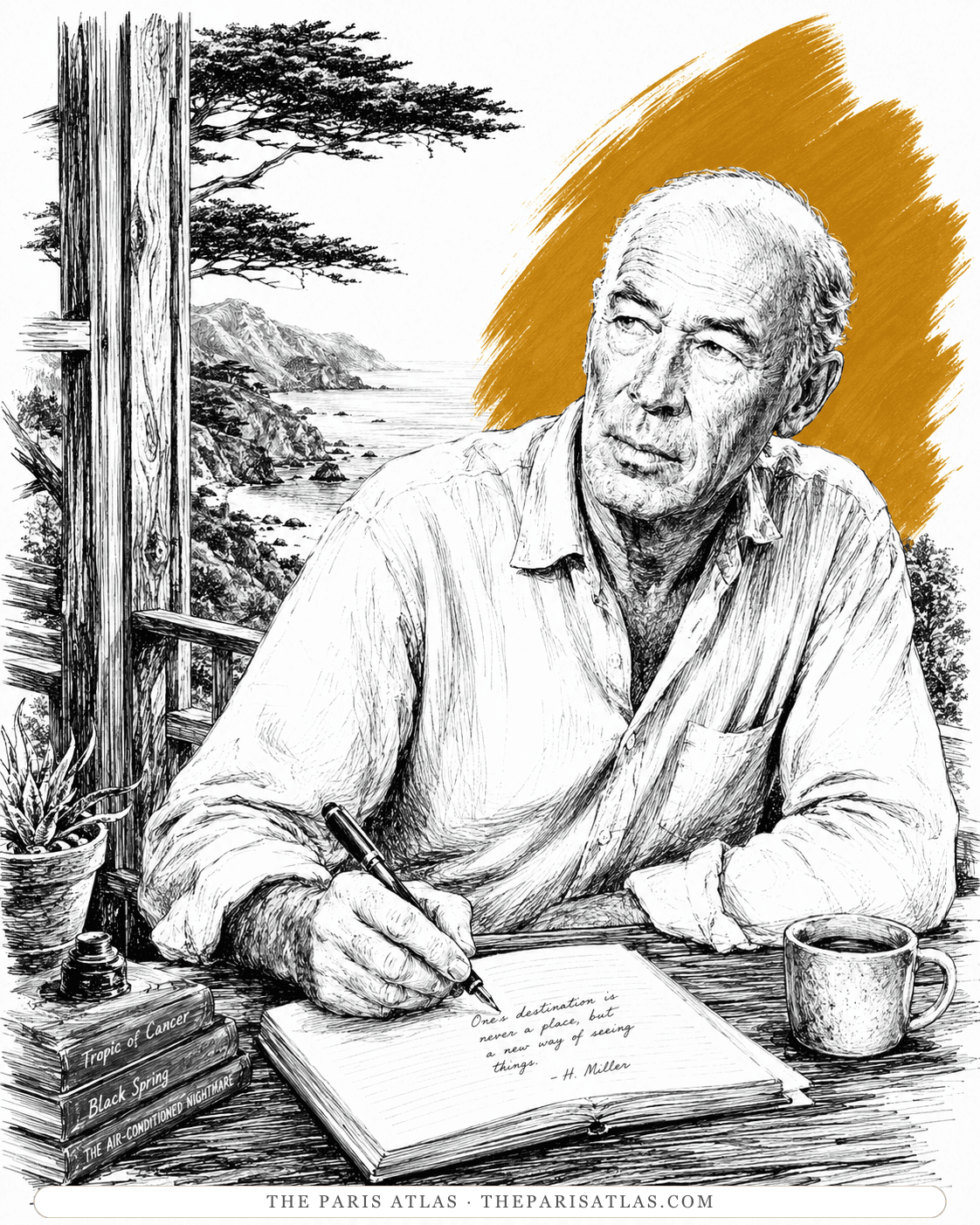


My Bike and Other Friends
by Henry Miller
Volume two of the friendships — opened, without apology, by the truest friend of all: the bicycle.
- 1978
About Henry Miller
The story, briefly
Spoiler-freeThe gallery of friends continues — and begins, notoriously, with a machine. The title essay is Miller's tribute to the racing bicycle of his Brooklyn youth, the companion of dawn rides and getaway dreams, mourned and praised exactly like a person; around it stand portraits of friends from the century's later stretches, each taken in the trilogy's key of gratitude. If volume one proved his memory, volume two proves his definition: a friend is whatever kept you alive, and the wheel qualified. (Portraits — nothing here to spoil.)
The story, in more detail
The bicycle chapter earned its top billing: the wheel was the boy's first taste of the two things the man spent a century chasing — speed and escape — and Miller writes it the way the ancients wrote of horses: the rituals of care, the covenant of the morning ride, the specific grief of outgrowing it. Readers who think they're being teased discover, a page in, that he means every word, and that the joke and the tenderness are the same gesture: love is love, whatever it lands on.
The human portraits carry the trilogy onward from Brooklyn into the later era — the friendships of the working decades, taken one per chapter in the same order-of-appearance method, each rendered with the late style's economy: the look, the voice, the essential anecdote, the debt. Capra published it in 1978, between the trilogy's other panels, and it remains the volume that best states the whole project's creed — that a life is finally the roll call of what befriended it.
What's inside
The title essay first: the racing bike of the Brooklyn years, bought, cherished, ridden at dawn, and remembered at eighty-six with undimmed specificity — the trilogy's thesis proved on two wheels. Then the friends of the later decades, chapter by chapter: the companions, patrons, and originals of the working life, each portrait built the same way — arrival, essence, anecdote, gratitude.
Like its siblings it reads best in sittings of one friend apiece; the bike deserves an evening to itself.
Themes and analysis
A companion on two wheels
In the bicycle passage, dependable companionship leads to an image that cannot be recovered. Miller recalls spending so much time riding that he became less interested in his human friends; unlike them, he could count on the bicycle. Yet he wishes someone had photographed them together. The shift complicates the apparent self-sufficiency of rider and machine. The bicycle may replace unreliable company in memory, but it cannot provide the outside view he now desires. His tribute creates a verbal portrait of a partnership for which no photograph, in his account, survives.
Friendship through making
In the Schatz portrait, artistic friendship takes the form of work shared unequally and acknowledged openly. As Sarah Garland notes, Miller credits Schatz not just with pictures for Into the Night Life but with layout and the labor of printing its silkscreen pages. Praise becomes more specific than admiration for a gifted personality: the book exists because someone undertook the patient manual work of making it. This acknowledgment resists a writer-centered account of collaboration. The friend's contribution is not decorative support for Miller's words; it shapes the object through which those words reach readers.
Why we recommend it
The title essay
The great bicycle piece in American prose — obsession, covenant, and loss, at boyhood scale and full seriousness.
The portrait method, perfected
By volume two the form is honed: a friend per chapter, an essence per page, a debt per ending.
The creed stated
A life as the roll call of what befriended it — the trilogy's idea, at its clearest here.
What this book explores
Timeline
1976
Book of Friends opens Miller's late trilogy with the friends of his Brooklyn boyhood.
1978
Capra Press publishes the second volume — the title essay's tribute to the boyhood racing bicycle, then portraits from the working decades, written at eighty-six.
1979
Joey follows as the trilogy’s third volume, focusing on Alfred Perlès.
Book editions
Hardcover
- Hardcover
- Capra Press
- 1978
Reader reviews
Readers may also like


Black Spring
The Fourteenth Ward mythologized — these pages remember what that book transfigured.
Read our takeMy Bike and Other Friends: frequently asked questions
Who wrote My Bike and Other Friends?
Henry Miller. Capra Press published it in 1978 as the second volume of the Book of Friends trilogy.
What is My Bike and Other Friends about?
The gallery of friends continues, and begins with a machine: the title essay is Miller's tribute to the racing bicycle of his Brooklyn youth, mourned and praised exactly like a person, followed by portraits of friends from the later decades.
Is the bicycle essay a joke?
No. Miller means every word — he writes the wheel the way the ancients wrote of horses, and by the end the reader agrees the bike belongs in the gallery.
What is the volume's argument?
That a friend is whatever kept you alive and free — machines eligible — a life finally the roll call of what befriended it.
Where does it sit in the trilogy?
It is the middle panel, between the Brooklyn boys of Book of Friends and the portrait of Perlès in Joey.
If you like Henry Miller
Explore authors with a similar voice, perspective, and influence.

Louis-Ferdinand Céline
Miller's acknowledged master at making literature out of the gutter. Journey gave him permission; Cancer is what he did with it.
View author
Ezra Pound
Pound read Cancer and sent Miller a famously backhanded postcard. Both believed literature's job was to wake the reader by any means necessary.
View author
Simone de Beauvoir
French writer and philosopher whose novels, memoirs, and social analysis examined freedom, gender, responsibility, aging, and the material conditions that shape a life.
View author
References
References
The sources below include the primary text, editions, scholarship, archival materials, and other records that informed this page. They document My Bike and Other Friends, its publication, and its place in literary history.

1My Bike and Other Friends
NovelHenry Miller, 1978Used forThe primary text represented by this page, used for descriptions of the work’s contents and for any quoted passages shown here.
2Henry Miller: A Life
BiographyW. W. Norton, 1991Used forUsed to verify My Bike and Other Friends's bibliographic context and its place within Henry Miller's published work.

3Beatrice Wickens Miller Sandford and Barbara Miller Sandford Collection of Henry Miller: A Preliminary Inventory
ArchiveHarry Ransom Center, University of Texas at AustinUsed forUsed for independent archival, institutional, or historical context surrounding Henry Miller and My Bike and Other Friends.

4Henry Miller: New Perspectives
NonfictionBloomsbury AcademicUsed forUsed to cross-check chronology, publication history, and the circumstances in which My Bike and Other Friends appeared.
5The Happiest Man Alive: A Biography of Henry Miller
BiographySimon & Schuster, 1991Used forUsed for an additional scholarly or biographical perspective on My Bike and Other Friends and Henry Miller's wider career.
6Henry Miller's Best Friend
EssaysMidlife Cycling, 2012Used forReproduces the bicycle passage used for the reading of companionship and the absent photograph; not a complete edition of the essay.
i
Why these sources are here
The primary text is the baseline reference for every book page. Additional references document publication history, interpretation, and historical context where that evidence is available.
 Explore more resources