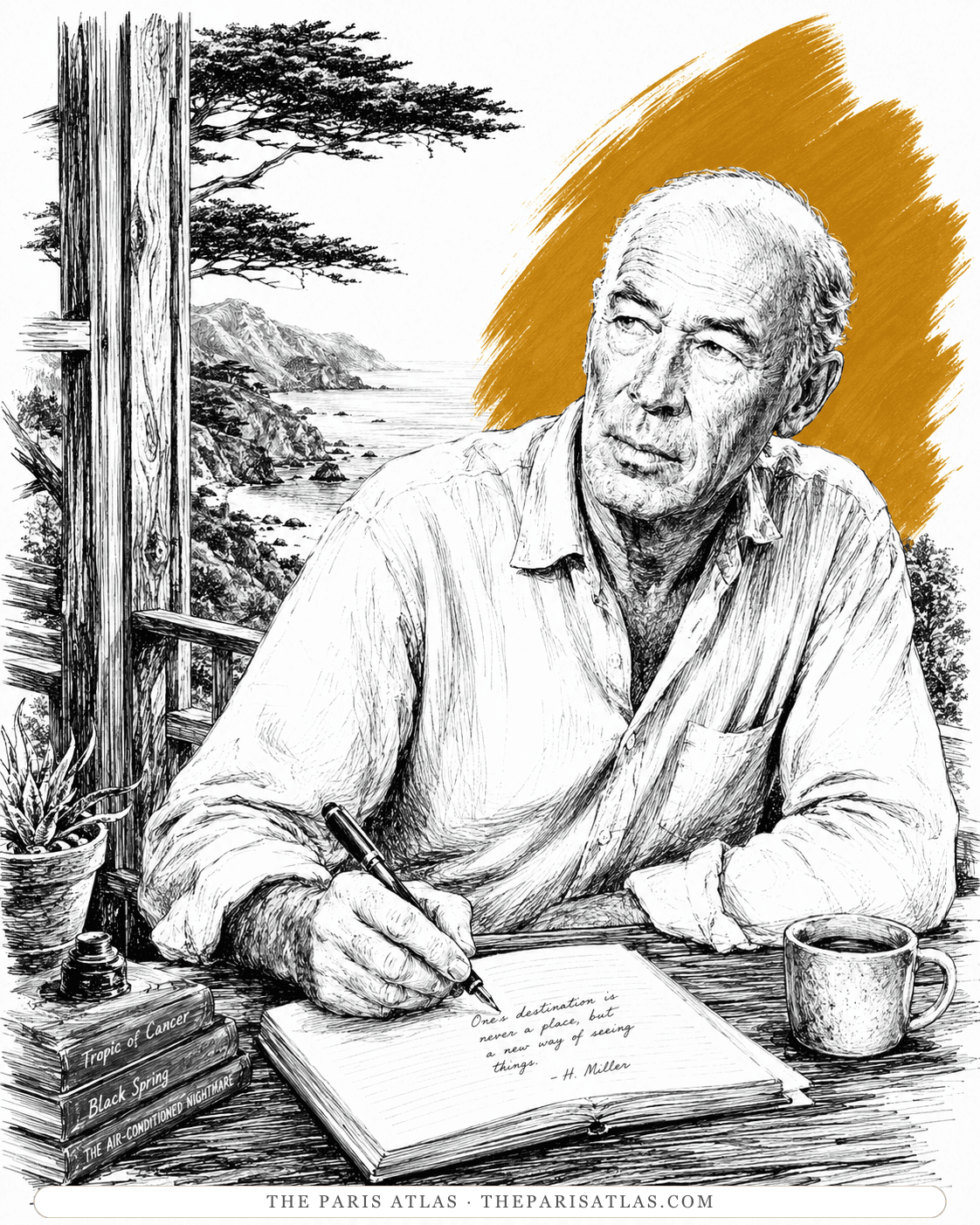


Book of Friends
by Henry Miller
At eighty-four, the rememberer goes back to the beginning: the boys of the Fourteenth Ward, named and thanked one by one.
- 1976
About Henry Miller
The story, briefly
Spoiler-freeThe first panel of the late trilogy: Miller in his mid-eighties, writing from Pacific Palisades, summons the friends of his Brooklyn boyhood — the gang of the old Fourteenth Ward, led by Stanley, the fierce Polish comrade of the street years — and pays each one the tribute of total recall. No scandal, no doctrine: just the astonishing fact that the old man could still smell the streets of 1900, and loved everyone on them. The gentlest sustained performance of his life. (Portraits — nothing here to spoil.)
The story, in more detail
Capra Press of Santa Barbara, the small house that kept late Miller in print, proposed the perfect project: a book of friends, taken in order of appearance. Volume one belongs to childhood — the Driggs Avenue world of the 1890s and 1900s that Black Spring had mythologized, now revisited person by person: Stanley Borowski, the volatile best friend whose approval mattered more than any adult's; the boys of the street and the lots; the first loyalties and treacheries that, Miller insists, formed him more than any book or city after.
What distinguishes it from ordinary reminiscence is the thesis, stated outright: that the friendships of boyhood are the originals, and everything after — Paris, the Villa Seurat, the famous circle — ran on patterns set before he was twelve. Read against the rest of the shelf it is a key: the gang loyalty, the talker's competition, the horror of respectability all begin here, in games and feuds remembered with a clarity that borders on the supernatural. He wrote it at the same age his own grandfathers had been in those streets; the tenderness is earned both directions.
What's inside
Portraits in order of appearance: Stanley first and always — the friendship of fierce loyalty and fiercer quarrels that set the pattern for every intense alliance after — then the boys of the Fourteenth Ward streets, the games, gangs, dares, and codes of a Brooklyn neighborhood in the century's first years, each friend rendered whole: looks, voice, fate, and what he taught the future rememberer.
The chapters stand alone like the friendships did. Read one per evening; the book was written at that tempo, one resurrected companion at a time.
Themes and analysis
The old man summons the first friends
In the preface, Miller presents remembering as an unfinished obligation. Most of the friends he wants to honor are unknown to the public, and this volume includes only some of them; he hopes to describe the others even if the task takes the rest of his life. That modest admission matters beside the vivid portraits. Their intensity need not mean that memory retrieves everything. His regret about missing photographs also acknowledges gaps in the record. The book gives overlooked companions a place in writing without claiming that its tribute is complete.
The originals on Driggs Avenue
Fine clothes divide the two boys in ways neither can easily explain to the other. Stanley envies what Miller's tailor father provides, while Miller feels embarrassed by outfits that distinguish him from the neighborhood gang. The same privilege becomes something one child wants and the other wishes to hide. Friendship does not erase that difference; it makes the difference painfully visible. When his mother offers to buy Stanley clothes, Miller suggests a suit, but cannot remember whether she bought it. The uncertainty prevents a generous intention from becoming a conveniently happy ending.
Why we recommend it
The gentlest Miller
No rage, no sex, no scores — the pure portraitist, working in gratitude at the end of the line.
The Brooklyn Rosetta stone
The street codes decoded here explain half the loyalties and feuds of the Paris books.
Old-age recall as art form
The prose performs its own subject: memory, holding everything, to the last marble and dare.
What this book explores
Timeline
1976
Capra Press of Santa Barbara publishes the trilogy's first panel — the boys of the old Fourteenth Ward, Stanley Borowski first, recalled in Miller's mid-eighties.
1978
The gallery continues in My Bike and Other Friends, volume two.
1979
Joey completes the Book of Friends trilogy with a portrait of Alfred Perlès.
Book editions
Hardcover
- Hardcover
- Capra Press
- 1976
Reader reviews
Readers may also like


Sunday After the War
'Reunion in Brooklyn' is the bridge — the return visit these portraits complete.
Read our takeBook of Friends: frequently asked questions
Who wrote Book of Friends?
Henry Miller. Capra Press of Santa Barbara published it in 1976, when Miller was in his mid-eighties.
What is Book of Friends about?
The first panel of a late trilogy: Miller summons the friends of his Brooklyn boyhood — the gang of the old Fourteenth Ward, led by Stanley, the fierce Polish comrade of the street years — and pays each one the tribute of total recall.
Who is Stanley?
Stanley Borowski, the volatile best friend of the Fourteenth Ward whose approval mattered more than any adult's — the keystone of the gallery and the original of every fierce alliance on the shelf.
What is its argument?
That the friendships of boyhood are the originals, and everything after — Paris, the Villa Seurat, the famous circle — ran on patterns set before he was twelve.
How does it read compared to his other books?
It is the gentlest sustained performance of his life — no scandal, no doctrine, just the pure portraitist working in gratitude at the end of the line.
If you like Henry Miller
Explore authors with a similar voice, perspective, and influence.
Louis-Ferdinand Céline
Miller's acknowledged master at making literature out of the gutter. Journey gave him permission; Cancer is what he did with it.
View author
Ezra Pound
Pound read Cancer and sent Miller a famously backhanded postcard. Both believed literature's job was to wake the reader by any means necessary.
View author
Simone de Beauvoir
French writer and philosopher whose novels, memoirs, and social analysis examined freedom, gender, responsibility, aging, and the material conditions that shape a life.
View author
References
References
The sources below include the primary text, editions, scholarship, archival materials, and other records that informed this page. They document Book of Friends, its publication, and its place in literary history.


1Book of Friends
NovelHenry Miller, 1976Used forThe primary text represented by this page, used for descriptions of the work’s contents and for any quoted passages shown here.
2Book of Friends (Jugendfreunde) — published German preview
MemoirRowohlt E-Book; public preview via Legimi, 2020Used forPreface and opening Stasiu passage read in Angela Praesent's published German translation, Jugendfreunde. Used for the tribute's admitted incompleteness and the boys' different responses to fine clothes, not for claims about the English wording or the complete memoir.
3Henry Miller: A Life
BiographyW. W. Norton, 1991Used forUsed to verify Book of Friends's bibliographic context and its place within Henry Miller's published work.

4Beatrice Wickens Miller Sandford and Barbara Miller Sandford Collection of Henry Miller: A Preliminary Inventory
ArchiveHarry Ransom Center, University of Texas at AustinUsed forUsed for independent archival, institutional, or historical context surrounding Henry Miller and Book of Friends.

5Henry Miller: New Perspectives
NonfictionBloomsbury AcademicUsed forUsed to cross-check chronology, publication history, and the circumstances in which Book of Friends appeared.
6The Happiest Man Alive: A Biography of Henry Miller
BiographySimon & Schuster, 1991Used forUsed for an additional scholarly or biographical perspective on Book of Friends and Henry Miller's wider career.
i
Why these sources are here
The primary text is the baseline reference for every book page. Additional references document publication history, interpretation, and historical context where that evidence is available.
 Explore more resources