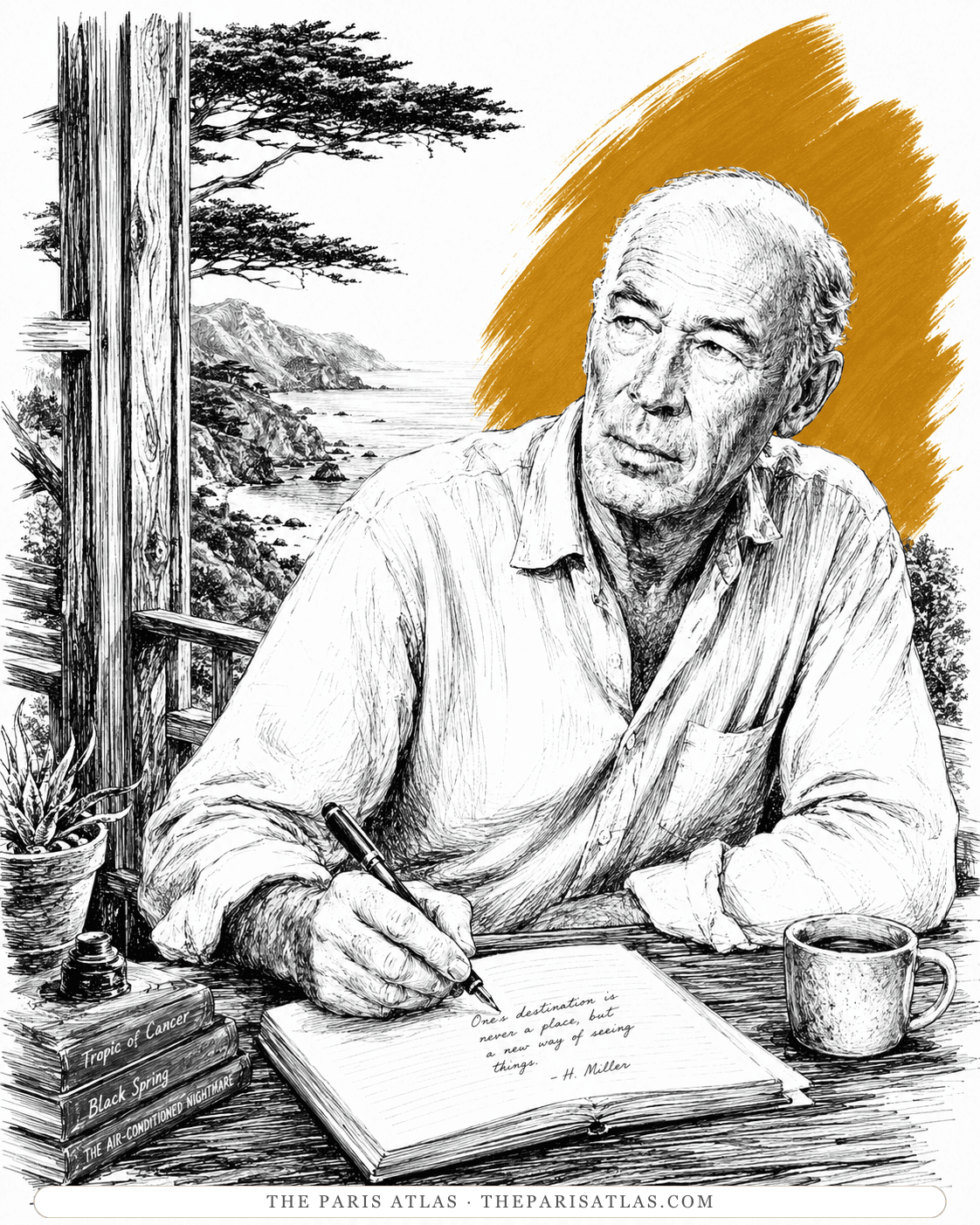


Sunday After the War
by Henry Miller
A wartime miscellany with one masterpiece inside: 'Reunion in Brooklyn,' the exile's homecoming to the parents he fled.
- 1944
About Henry Miller
The story, briefly
Spoiler-freePublished in 1944, assembled from whatever the war years yielded: essays, fragments, portraits — and, at the center, 'Reunion in Brooklyn,' Miller's account of returning from a decade abroad to his aging parents' house in the old neighborhood. Unsparing and half unbearable, it is one of the great American essays about family, and reason enough for the volume. The collection also slipped readers their first taste of the work in progress that would become The Rosy Crucifixion. (A collection — nothing here to spoil.)
The story, in more detail
By 1944 Miller was in California, broke as ever, and New Directions kept the flame with miscellanies like this one — a Sunday drawer of the war years. Most of it is the familiar mix: portraits, polemics, pages on art and peace written while the world burned. But the reason the book survives is 'Reunion in Brooklyn': in 1940, back from Europe, Miller returned to his parents' house in the Fourteenth Ward — the failing father he had mocked in print, the implacable mother, the damaged sister — and wrote down what a decade of distance let him finally see. No performance, no doctrine; just the exile standing in the old parlor, measuring what his freedom had cost the people who stayed.
The volume also printed excerpts from the vast autobiographical project Miller had been circling for years — the first public glimpses of what would surface in Paris in 1949 as Sexus. Read now, the collection is a core sample of the in-between Miller: after Paris, before Big Sur, holding the pieces of a life mid-air.
What's inside
A wartime gathering: 'Reunion in Brooklyn,' the long homecoming essay that anchors the book; portraits and appreciations from the California years; meditations on art, war, and peace; and excerpts from the unpublished Rosy Crucifixion — the June-and-New-York epic Miller had been building since Paris, here breaking the surface for the first time.
Come for 'Reunion in Brooklyn'; it stands with anything he wrote. The rest is the workshop floor of the middle years — uneven by design, alive in flashes.
Themes and analysis
The difficult return
At the end of Reunion in Brooklyn, Miller expands the meaning of home beyond the place to which he has returned. The conclusion, quoted in MANAS, refuses to make belonging depend on a country or a people. Yet this is not simply a declaration of isolation: the private destiny he insists on pursuing is connected to every other living creature. The passage moves between self-assertion and shared existence, making freedom an argument about allegiance rather than mere distance. Read against the homecoming, this ending does not restore an old identity; it proposes a different scale on which to understand attachment.
A life taking shape
Of Art and the Future unsettles the distinction between making an object and making a life. Miller describes art as an initiation rather than a final destination: its creations matter because they awaken their makers and readers to reality. His prediction that books will disappear takes that argument to a provocative extreme. The medium he practices becomes expendable if the communication it promises can happen otherwise. The sculpting image offers a metaphor for this reversal of priorities, not a literal scene from the essay. What needs shaping is the person, while the finished artwork remains a means rather than an end.
Why we recommend it
The homecoming
Ten years of Paris freedom walk into a Brooklyn parlor and meet their price. The essay earns the whole volume.
The first Rosy Crucifixion pages
Watching the June epic surface in fragments, years before Sexus, is a collector's pleasure the book gives away free.
The war from the far shore
Miller sat out the war preaching peace from California — infuriating then, and a strange, singular vantage now.
What this book explores
Timeline
1940
Back from a decade in Europe, Miller returns to his aging parents' house in the Fourteenth Ward — the homecoming behind 'Reunion in Brooklyn.'
1944
New Directions publishes the wartime miscellany, which also prints the first excerpts of the autobiographical project Miller had been circling for years.
1949
That project surfaces in Paris as Sexus, five years on.
Book editions
Hardcover
- Hardcover
- New Directions
- 1944

- Paperback
- New Directions
- 9780811201612
Reader reviews
Readers may also like


Sunday After the War: frequently asked questions
Who wrote Sunday After the War?
Henry Miller. New Directions published it in 1944.
What is Sunday After the War?
A wartime miscellany — essays, fragments, and portraits assembled from the war years — with one masterpiece at its center: "Reunion in Brooklyn."
What is "Reunion in Brooklyn"?
Miller's account of returning from a decade abroad to his aging parents' house in the old neighborhood — unsparing and half unbearable, one of the great American essays about family.
Does it connect to his later novels?
Yes. It printed excerpts from the vast autobiographical project Miller had been circling for years — the first public glimpses of what surfaced in Paris in 1949 as Sexus.
Where does it fall in his career?
It is a core sample of the in-between Miller: after Paris, before Big Sur, written from California while the novels remained banned in his own country.
If you like Henry Miller
Explore authors with a similar voice, perspective, and influence.

Louis-Ferdinand Céline
Miller's acknowledged master at making literature out of the gutter. Journey gave him permission; Cancer is what he did with it.
View author
Ezra Pound
Pound read Cancer and sent Miller a famously backhanded postcard. Both believed literature's job was to wake the reader by any means necessary.
View author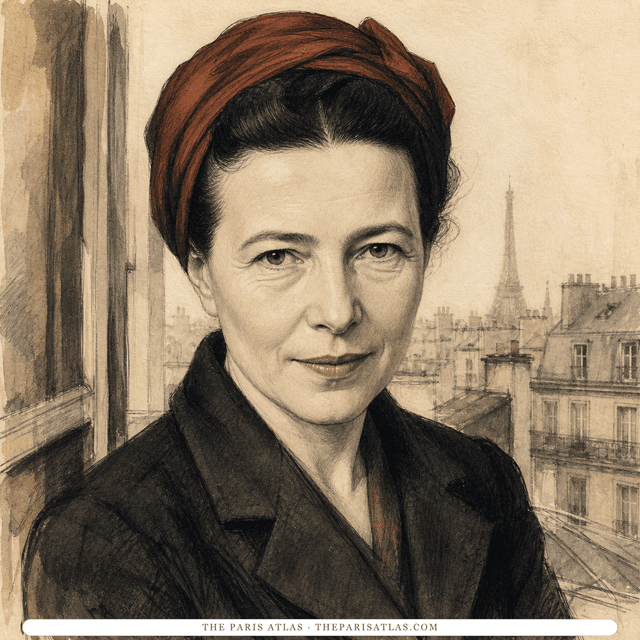
Simone de Beauvoir
French writer and philosopher whose novels, memoirs, and social analysis examined freedom, gender, responsibility, aging, and the material conditions that shape a life.
View author
References
References
The sources below include the primary text, editions, scholarship, archival materials, and other records that informed this page. They document Sunday After the War, its publication, and its place in literary history.


1Sunday After the War
NovelHenry Miller, 1944Used forThe primary text represented by this page, used for descriptions of the work’s contents and for any quoted passages shown here.
2Henry Miller: A Life
BiographyW. W. Norton, 1991Used forUsed to verify Sunday After the War's bibliographic context and its place within Henry Miller's published work.

3Beatrice Wickens Miller Sandford and Barbara Miller Sandford Collection of Henry Miller: A Preliminary Inventory
ArchiveHarry Ransom Center, University of Texas at AustinUsed forUsed for independent archival, institutional, or historical context surrounding Henry Miller and Sunday After the War.

4Henry Miller: New Perspectives
NonfictionBloomsbury AcademicUsed forUsed to cross-check chronology, publication history, and the circumstances in which Sunday After the War appeared.
5The Happiest Man Alive: A Biography of Henry Miller
BiographySimon & Schuster, 1991Used forUsed for an additional scholarly or biographical perspective on Sunday After the War and Henry Miller's wider career.
6Reflections on Technology — concluding quotation from Reunion in Brooklyn
WebsiteMANAS, volume XIV, number 26, 1961Used forThe attributed concluding quotation from Reunion in Brooklyn supports the reading of home, individual destiny and allegiance; not a collation of the complete essay.
7Henry Miller on Art, War, and the Future of Humanity
WebsiteThe Marginalian, 2012Used forMiller's primary passages reproduced by Maria Popova support the reading of art as initiation and of its media as provisional; predictions are treated as arguments, not established facts.
i
Why these sources are here
The primary text is the baseline reference for every book page. Additional references document publication history, interpretation, and historical context where that evidence is available.
 Explore more resources