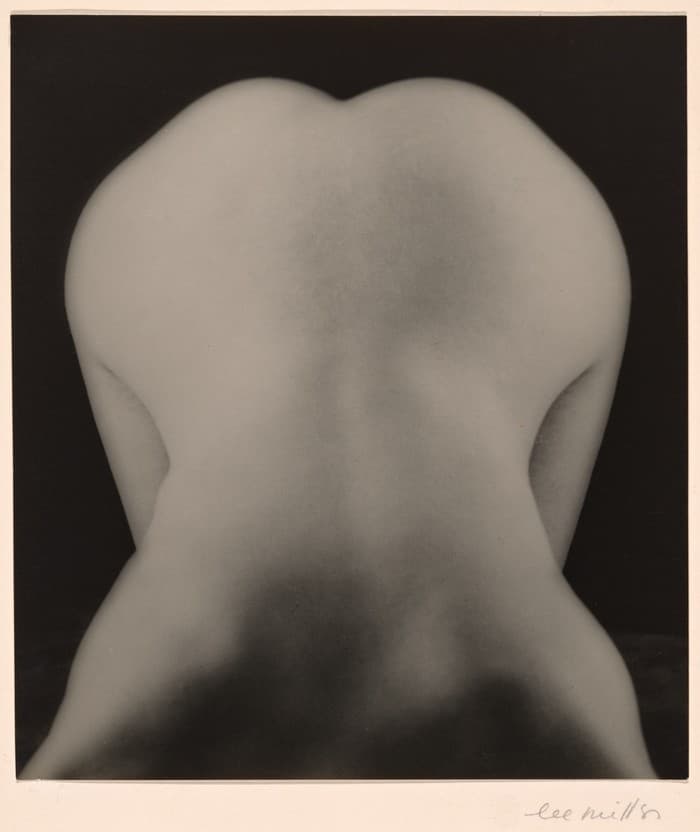
Nude Bent Forward, Paris
by Lee Miller
A body seen from behind and above, bent so far forward that the back fills the frame and the head is lost in shadow at the bottom. Lee Miller made the photograph in Paris about 1930, while she was working out of Man Ray's studio and then her own. The print belonged to Julien Levy, the New York dealer who first showed her work in America, and now belongs to the Art Institute of Chicago.
- c. 1930
- Gelatin silver print
- Art Institute of ChicagoChicago, Illinois, United States
About Lee Miller
What the photograph shows
The top of the frame is filled by a single pale form with a small notch at its centre, set against a ground of solid black. Below it the body narrows through the waist and widens again at the shoulders. No arms, legs or face are in the picture.
The light comes from the front and slightly above. It holds the upper part of the body in focus, where the skin shows grain and a few small marks, and lets the lower part sink through grey into shadow. At each side the contour meets the black ground as a single clean line.
The printed image measures 20 by 17.5 centimetres and stands upright. It is mounted on a larger card, 33.2 by 26.1 centimetres, and Lee Miller signed the mount in pencil at the lower right. The reverse of the mount carries a Paris stamp.
The museum reads the body as sculpture
The Art Institute of Chicago describes the picture as an experimental composition with Surrealist themes, and reads the figure as a modernist sculpture: armless, legless, and with an upended backside that suggests a profound reorientation of the human body.
The museum then sets the photograph against work by her male contemporaries. Man Ray made similar studies, and so did the American photographer Edward Weston, but the museum records that theirs carry more overtly erotic connotations. Lee Miller, it says, used the camera to render anatomy disquieting while avoiding the offering of sexual titillation.
The Lee Miller Archives make a related point from the other direction. Their catalogue entry says Man Ray's influence can be strongly detected here, because he was known for close-up studies that reduce the body to an anonymous shape.
The print came from Julien Levy
The Art Institute of Chicago's credit line reads Julien Levy Collection, Gift of Jean Levy and the Estate of Julien Levy. Julien Levy was the New York dealer who opened the gallery that introduced Surrealist photography to America, and he bought prints from Lee Miller on a visit to Man Ray's Paris studio in 1931.
She left Paris for New York the following year, opened Lee Miller Studios Inc. at 8 East 48th Street, and showed her work at his gallery. The print in Chicago is therefore a sheet that passed from her hands into the collection of her first American dealer and stayed there.
It went on public view again in 1976, when the museum mounted Photographs from the Julien Levy Collection: Starting with Atget, and it entered the collection as an accession in 1988. The museum records it as on view.
Who posed is not settled
The Art Institute of Chicago names no sitter. Its title is Nude Bent Forward, Paris, and the record carries no identification beyond that.
The Lee Miller Archives add a hedge of their own. Their catalogue entry titles the image Nude bent forward and follows it with a bracket reading thought to be Noma Rathner. That is the rights holder's own uncertainty, not a museum attribution.
The title is also worth reading carefully. Both halves are the museum's, and the word Paris in it is part of the title rather than a note appended to it. The museum's own place field for the object gives Poughkeepsie, New York, which is where Lee Miller was born and not where this was made.
Close reading
Reading the work, detail by detail
One body, no head, arms or legs. Follow the notch at the top of the form, the shallow groove of the spine, the two contours where the body meets black, the point at which focus gives out, and the pencil signature on the mount below the print.
1.The top of the form
The notch is the only break in an otherwise continuous curve, and it is the detail that tells a viewer which way up the body is. The Art Institute of Chicago describes the pose as an upended backside.
2.The groove of the spine
The spine registers as a shadow a few tones deeper than the skin around it, never as a line. The light is even and close to frontal, so the body reads as one continuous surface.
3.The left contour
The background is bare black and carries no floor, wall or prop. Nothing in the frame says where the body is, which is why the museum reads the figure as sculpture rather than as a person in a studio.
4.The right contour
A handful of small marks on the skin survive the printing. They are the only evidence in the frame that this is a particular body rather than a general shape.
5.Where the focus gives out
Focus holds at the top of the frame and fails toward the bottom. The head and shoulders are in this area, and they are lost in shadow rather than cropped out.
6.The signature on the mount
The signature is on the mount, not on the print, and it is in pencil. The Art Institute of Chicago records it in the object's inscriptions, along with a Paris stamp on the reverse of the same card.
Timeline
1929
Lee Miller moves to Paris and becomes Man Ray's student, model and partner. She prints her own work and some of his.
1930
Opens her own studio at 12 rue Victor Considerant in Montparnasse. The Art Institute of Chicago dates this photograph to about this year.
1931
Julien Levy buys prints by Lee Miller on a visit to Man Ray's studio in Paris.
1932
She leaves Paris for New York, opens Lee Miller Studios Inc. at 8 East 48th Street, and exhibits at the Julien Levy Gallery.
1976
Shown at the Art Institute of Chicago in Photographs from the Julien Levy Collection: Starting with Atget, which opens on 11 December and then tours to five other American museums.
1988
Accessioned by the Art Institute of Chicago as 1988.157.54, a gift of Jean Levy and the Estate of Julien Levy.
2008
Travels with The Art of Lee Miller to the Jeu de Paume in Paris, which shows it from 14 October to 11 January 2009.
Where to see it
Art Institute of Chicago
111 South Michigan Avenue, Chicago, IL 60603, United States
Recorded by the museum as on view in Photography and Media. Works on paper are rotated to limit light exposure.
Plan your visit on the museum’s official website (opens in a new tab)Frequently asked questions
What is Lee Miller's Nude Bent Forward, Paris?
A gelatin silver print made in Paris about 1930, showing a body bent so far forward that the back fills the frame and no head, arms or legs are visible. The Art Institute of Chicago holds it as 1988.157.54.
What does the Art Institute of Chicago say about it?
That the nude is presented as a modernist sculpture — armless, legless, and with an upended backside that suggests a profound reorientation of the human body. The museum contrasts it with similar studies by Man Ray and Edward Weston, which it describes as more overtly erotic.
Who is the model?
The museum names nobody. The Lee Miller Archives, who hold the rights, catalogue the image with the words thought to be Noma Rathner in brackets, which is a suggestion rather than an identification.
How big is the photograph?
The image is 20 by 17.5 centimetres, about 7 7/8 by 6 15/16 inches. It is mounted on a card of 33.2 by 26.1 centimetres, signed by Lee Miller in pencil at the lower right of the mount.
How did the print reach Chicago?
Through Julien Levy, the New York dealer who bought her prints at Man Ray's Paris studio in 1931 and showed her work at his gallery. The Art Institute of Chicago's credit line reads Julien Levy Collection, Gift of Jean Levy and the Estate of Julien Levy, and the museum accessioned it in 1988.
Can you see it in the gallery?
The Art Institute of Chicago records the print as on view in its Photography and Media department. Photographs are rotated often because light damages them, so check the object record before travelling.
More by Lee Miller
References
The sources below include collection records, catalogues, scholarly research, and primary materials that informed this page. They document Nude Bent Forward, Paris, its making, and its place in cultural history.

1Nude Bent Forward, Paris, c. 1930 — object record 1988.157.54
WebsiteArt Institute of ChicagoUsed forThe museum's record: title, date, medium, dimensions, inscriptions, credit line, exhibition history and its reading of the figure as sculpture.

2Lee Miller Archives picture library — catalogue records and credit lines
ArchiveLee Miller Archives, Farleys House and Gallery, East SussexUsed forThe rights holder's catalogue entry, which raises Noma Rathner as a possible sitter and names Man Ray's close-up studies as the influence.
3Lee Miller (1907–1977) — biography and chronology
ArchiveLee Miller Archives, Farleys House, East SussexUsed forThe Paris and New York years, including Julien Levy's 1931 visit to Man Ray's studio and the 1932 gallery show.
4Everything you need to know about Lee Miller
WebsiteVictoria and Albert Museum, LondonUsed forThe museum introduction used for her move to Paris and her standing as a Surrealist photographer.
These references provide the documented foundation for this work's history and interpretation. Claim-level citations remain attached to the specific claims they support.
 Explore more resources