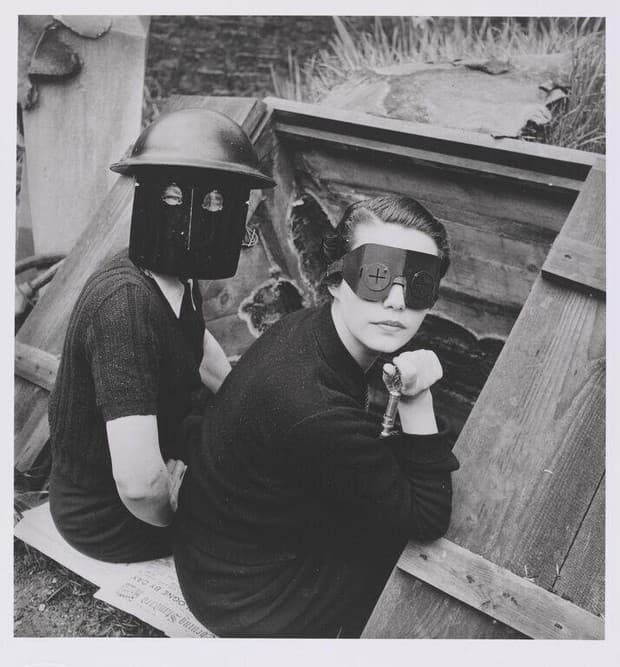
Women with fire-masks, Downshire Hill, London, England
by Lee Miller
Two women sit at the mouth of a timber-lined air raid shelter wearing masks issued to Air Raid Precautions wardens against incendiary bombs. One wears a steel helmet with a full rectangular face mask; the other wears a visor over the eyes. Lee Miller made the photograph in the garden of the Hampstead house she shared with the painter Roland Penrose in 1941, as a fashion shoot for Vogue rather than as a news picture.
- 1941, printed 2007
- Gelatin silver print on Forte Polywarmtone FB semimatt fibrebase paper, hand printed from Lee Miller's original negatives and selenium-toned
- Victoria and Albert Museum, LondonLondon, United Kingdom
About Lee Miller
What the photograph shows
The woman at the front is turned toward the camera and lit from above. Her hair is waved and swept back off her forehead. Across her eyes she wears a broad dark visor with two round eyepieces set into it, each marked with a cross. Her nose, mouth and chin are bare. She wears a dark knitted jumper and holds a small metal object with a knurled body in both fists, below her chin.
The woman behind her sits lower and to the left. Over her face is a large rectangular mask with two small oval eyepieces high in it and a seam running down the centre, and over that a British steel helmet with a wide brim. She wears a short-sleeved knitted top with a pale collar showing at the neck.
They are sitting among sawn timber. Planks and beams cross behind them and lie under them, and beyond the timber there is an earth bank with grass on it and a wall of rough masonry at the top left.
A newspaper lies under the two women, printed side up and upside down to the camera. Two lines of headline type survive. One reads OGNE BY DAY and the larger line below it reads SLAMMED. Neither the paper's name nor its date can be read from the print.
It is a fashion photograph
The Victoria and Albert Museum states the working circumstances plainly. During the Second World War, Lee Miller often used exterior locations for fashion shoots, particularly when bombing cut off electricity to her studio. The museum adds that she produced many soft propaganda shoots for magazines such as Vogue, focused on women's contribution to the war effort.
The Lee Miller Archives give the same account from the rights holder's side. German bombing frequently cut the power to the Vogue studio, so she worked outdoors. The location is the entrance to the air raid shelter in the garden of Roland Penrose's house in Hampstead.
Tate adds two details from its 2025 exhibition of her work. The shelter had been a coal vault, and Lee Miller and Roland Penrose painted it pastel pink. A variant of this photograph ran in an American Vogue story about the Blitz that argued fire has no more ruthless adversaries than the women of Britain.
Tate calls the garden Miller's; the Victoria and Albert Museum and the Lee Miller Archives call it Roland Penrose's. She was living with him in Hampstead at the time, which is how both descriptions can be true at once.
What the masks are for
The Victoria and Albert Museum records that the masks belong to Air Raid Precautions wardens and were intended to protect them from incendiary bombs. Tate describes them as made of rubber and tin. The Lee Miller Archives note that Roland Penrose was himself an Air Raid Precautions warden.
Incendiary bombs were small and dropped in large numbers to start fires rather than to destroy buildings by blast. A warden's job was to reach them fast and smother them, which meant getting close to burning magnesium and to the flame and sparks it threw.
The two masks in the picture are different pieces of equipment. One covers the whole face and is worn under a steel helmet; the other covers only the eyes. Tate's reading of the effect is that with their eyes concealed, the models' stares have an unsettling quality.
The print is a centenary reprint
The sheet in London is not a wartime print. Lee Miller made the negative in 1941, and the Lee Miller Archives printed this sheet from that negative in 2007, for the hundredth anniversary of her birth. The paper is Forte Polywarmtone fibre base, and the print was selenium-toned.
It belongs to a portfolio of six photographs chosen by Mark Haworth-Booth, the curator of the Victoria and Albert Museum's 2007 exhibition The Art of Lee Miller. The edition was ten prints plus two outside the edition, and this sheet is one of the two, marked as an artist's proof.
Mark Haworth-Booth gave the portfolio to the museum in 2010, and it was catalogued then as E.474:5X-2010. The museum currently records the print as on short-term loan out for exhibition. Tate's own label for it, when it borrowed the print, spelled the donor's name Hayworth-Booth.
Close reading
Reading the work, detail by detail
Two women in air-raid fire masks at the mouth of a garden shelter. Compare the two pieces of equipment, then the object held in the front woman's fists, the newspaper underneath them, and the timber and earth they are sitting in.
1.The mask under the helmet
The mask covers the face completely. Its eyepieces are small and set high, the helmet brim cuts across the top, and a strap loops away at the side. The Victoria and Albert Museum records the masks as equipment for Air Raid Precautions wardens.
2.The visor over the eyes
The second mask covers only the eyes. Her mouth, chin and hair are lit and legible, which is what a fashion photograph needs and what the full-face mask behind her denies.
3.What she is holding
The hands are placed as carefully as the masks. Both fists are closed on a small piece of metal hardware and held at the centre of the frame, and no institutional record names the object.
4.The newspaper under them
Tate's label for this photograph records that the models are perched on newspapers. The sheet is a barrier between clean clothes and dirty ground, and the only text anywhere in the frame.
5.The timber and the bank
The shelter is a cut in a garden, revetted with sawn timber and backed by earth. Tate records that it had been a coal vault, and that Lee Miller and Roland Penrose painted it pastel pink.
6.The masonry at the top left
A garden wall closes the frame on the left. Nothing in the background is dressed or removed, which is what separates this shoot from the studio work that the bombing had made impossible.
Timeline
1937
Lee Miller meets Roland Penrose in Paris at a Surrealist party and afterwards settles in London.
1940
Unable to keep working for American Vogue, she volunteers to cover the war effort for British Vogue, shooting fashion, pattern books and knitwear features.
1941
Photographs two women in air-raid fire masks at the shelter in the Hampstead garden on Downshire Hill. A variant runs in an American Vogue story about the Blitz.
2007
The Lee Miller Archives print six photographs from her original negatives for the centenary of her birth, selected by Mark Haworth-Booth, in an edition of ten plus two outside the edition.
2010
Mark Haworth-Booth gives the portfolio to the Victoria and Albert Museum, where this sheet becomes E.474:5X-2010.
2025
Lent to Lee Miller at Tate Britain, which runs from 2 October to 15 February 2026 and labels the photograph Fire masks, Downshire Hill, London, 1941.
Where to see it
Victoria and Albert Museum, London
London, United Kingdom
A public viewing address has not yet been confirmed for this holding.
Recorded by the museum as on short-term loan out for exhibition. The sheet is an artist's proof outside an edition of ten.
Frequently asked questions
What is Lee Miller's Fire Masks photograph?
A photograph made in 1941 of two women in air-raid fire masks sitting at the entrance to an air raid shelter in a Hampstead garden. The Victoria and Albert Museum titles it Women with fire-masks, Downshire Hill, London, England and holds a 2007 print as E.474:5X-2010.
Is it a war photograph or a fashion photograph?
A fashion photograph. The Victoria and Albert Museum records that Lee Miller shot fashion outdoors when bombing cut the power to her studio, and that she made many soft propaganda shoots for magazines including Vogue. Tate describes the two figures as models wearing plain wartime fashions.
What are the masks?
Equipment issued to Air Raid Precautions wardens to protect them from incendiary bombs. Tate describes them as made of rubber and tin. One covers the whole face and is worn under a steel helmet; the other covers only the eyes, with a round eyepiece over each eye.
Where was it taken?
At the air raid shelter in the garden of the house on Downshire Hill in Hampstead, north London, where Lee Miller was living with the painter Roland Penrose. Tate records that the shelter had been a coal vault and that the two of them painted it pastel pink.
Is the print from 1941?
No. The negative is from 1941, and this sheet was printed in 2007 by the Lee Miller Archives for the centenary of her birth, on Forte Polywarmtone fibre-base paper and selenium-toned. It is one of two proofs outside an edition of ten.
Can you see it at the museum?
Not at present. The Victoria and Albert Museum records the print as on short-term loan out for exhibition. Check the object record before travelling.
More by Lee Miller
References
The sources below include collection records, catalogues, scholarly research, and primary materials that informed this page. They document Women with fire-masks, Downshire Hill, London, England, its making, and its place in cultural history.

1Women with fire-masks, Downshire Hill, London, England, 1941 — object record E.474:5X-2010
WebsiteVictoria and Albert Museum, LondonUsed forThe museum's record: the artist's title, the 1941 negative and 2007 printing, materials, dimensions, blindstamp, edition, credit line and the note that this was a fashion shoot.
2Lee Miller — large print guide, Tate Britain, 2 October 2025 to 15 February 2026
Exhibition catalogueTate, London, 2025Used forTate's label for the borrowed print: the coal vault painted pastel pink, the rubber and tin masks, and the American Vogue story the variant appeared in.
3Lee Miller Archives picture library — catalogue records and credit lines
ArchiveLee Miller Archives, Farleys House and Gallery, East SussexUsed forThe rights holder's entry, which titles the image Fire Masks and records that Roland Penrose was himself an Air Raid Precautions warden.
4Lee Miller (1907–1977) — biography and chronology
ArchiveLee Miller Archives, Farleys House, East SussexUsed forThe 1937 meeting with Roland Penrose and the move to London before the war.
5Everything you need to know about Lee Miller
WebsiteVictoria and Albert Museum, LondonUsed forThe museum's account of her wartime work for Vogue.
These references provide the documented foundation for this work's history and interpretation. Claim-level citations remain attached to the specific claims they support.
 Explore more resources