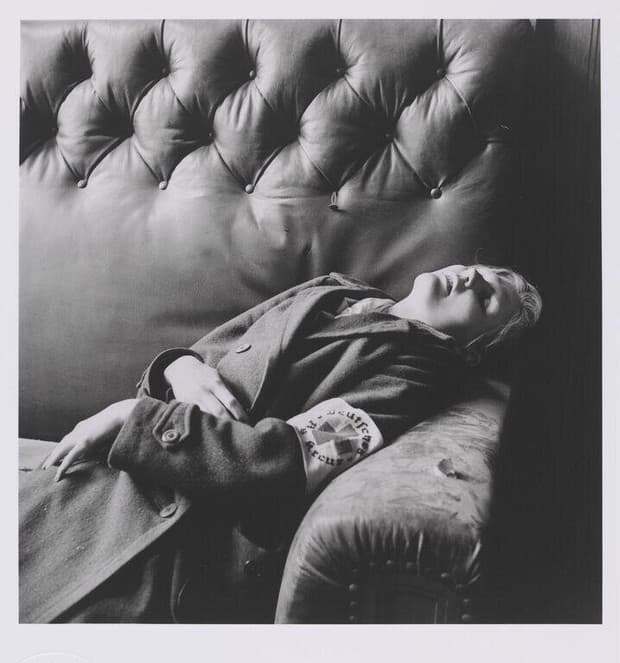
Bürgermeister of Leipzig's daughter after suicide, Germany
by Lee Miller
A dead young woman lies on a leather sofa in the town hall at Leipzig. The Victoria and Albert Museum identifies her as Regina Lisso, who took cyanide with her parents in April 1945 as American troops entered the city, and publishes the photograph with a content warning. Lee Miller was covering the advance for Vogue, and made the picture in the same weeks she photographed Buchenwald and Dachau.
- 1945, printed 2007
- Gelatin silver print on Forte Polywarmtone FB semimatt fibrebase paper, hand printed from Lee Miller's original negatives and selenium-toned
- Victoria and Albert Museum, LondonLondon, United Kingdom
About Lee Miller
What the photograph shows
A young woman lies on her back along a deep-buttoned leather sofa. Her head has fallen back over the arm at the right of the frame. Her eyes are closed, her lips are parted, and her front teeth are visible. Her fair hair is short and pushed up behind her.
She is wearing a heavy wool overcoat, wrapped across her body and fastened with a large flat button. Her left hand lies open on the coat, the fingers slightly curled. On her left sleeve, just above the elbow, there is a white armband.
The light falls from the left and picks out three things: her face, the open hand, and the armband. The rest of the coat is dark. Behind her the leather back of the sofa is buttoned into diamonds, and one covered button has come loose and hangs by its thread.
The sofa arm under her head is worn through in places. Its leather is scuffed and cracked, a piece has torn away, and a row of upholstery studs runs along its lower edge.
Who she was
The Victoria and Albert Museum names her. The photograph records the suicide of Regina Lisso, born 24 May 1924 and dead on 18 April 1945, in Leipzig town hall, to avoid capture by American soldiers.
The museum records that she was found with her parents and with other military personnel, and that all of them had taken cyanide. It names her father as Deputy Mayor Dr Kurt Lisso and her mother as Renate Lubbert. The museum's own title calls her the Bürgermeister's daughter while its description calls her father the deputy mayor.
Lee Miller was not alone in the room. The museum records that the scene was extensively photographed by others present, including Robert Capa and Margaret Bourke-White. The museum also publishes the object record behind a content warning.
What is on the armband
The armband is white, and it carries a cross with Fraktur lettering curving around it. The letters above the cross read Deutsches and the letters below read Kreuz. That is the German Red Cross.
The Victoria and Albert Museum's record does not mention the armband. Its description of the object says only that the photograph shows a woman wearing an overcoat with an armband, with closed eyes, on a sofa.
The band is legible in the museum's own reproduction, and the reading above is taken from it. It is the brightest object in the lower half of the picture, and the light is on it as squarely as it is on her face.
The same weeks as Buchenwald and Dachau
Lee Miller had been accredited to the United States armed forces as a war correspondent in December 1942 and was reporting for Vogue. Tate dates her arrival at Buchenwald to 16 April 1945 and her arrival at Dachau to 30 April, the day after American troops freed the survivors there. Regina Lisso died on 18 April, between the two.
The photographs from the camps were among the first published evidence of them. American Vogue printed her report in its issue of 1 June 1945 under the title Believe It, with the standfirst Lee Miller cables from Germany. The Buchenwald Memorial holds a copy and records it the same way.
The cable she sent her editor in London is quoted in two forms. Tate prints it as I IMPLORE YOU TO BELIEVE THAT THIS IS TRUE. Other accounts drop the word THAT. Tate also records that her Dachau photographs, unlike the Buchenwald ones, were not published in her lifetime.
The photograph in Hitler's bathtub is not hers alone
On the day she reached Dachau, Lee Miller and the Life photographer David E. Scherman went on to Munich, where American forces had requisitioned Adolf Hitler's apartment at 16 Prinzregentenplatz. The picture made there of Lee Miller sitting in the bath is the most reproduced image of her career, and it is not a photograph she took.
David E. Scherman said so himself. Asked about it by the Life picture editor John Loengard, he answered that the two of them were continually swapping cameras, and that he used her camera for the photograph of her in the bathtub.
The Lee Miller Archives, who hold the rights, credit that frame to Lee Miller with David E. Scherman and keep a separate joint attribution category for the series. Tate exhibited it in 2025 under the heading Lee Miller and David E. Scherman. A second photograph made in the same bathroom, of David E. Scherman in the tub, the Archives credit to Lee Miller alone.
Sources disagree on the day. Tate heads its section Munich, 1 May 1945; other accounts give 30 April. The Archives' own records give only the year.
The print and how it reached London
The negative is from 1945 and this sheet was printed in 2007 by the Lee Miller Archives, from her original negative, on Forte Polywarmtone fibre-base paper and selenium-toned. The printed image measures 23.6 by 22.8 centimetres.
It is one of six photographs selected by Mark Haworth-Booth, curator of the Victoria and Albert Museum's 2007 exhibition The Art of Lee Miller, and printed for the centenary of her birth. The edition ran to ten prints plus two outside it, and this sheet is one of the two.
Mark Haworth-Booth gave the portfolio to the museum in 2010, where the sheet became E.474:6X-2010. The museum's place field for the object records London, which is where the print was given rather than where the photograph was made.
Close reading
Reading the work, detail by detail
A room in Leipzig town hall in April 1945. The views below record what the photograph contains: the position of the body, the face, the armband, the open hand, and the state of the furniture she was left on.
1.How she is lying
The body runs the length of the frame and the head is at the far right, lower than the chest. The Victoria and Albert Museum publishes the object record with a content warning and lists the subject depicted as Corpse.
2.The face
The Victoria and Albert Museum identifies her as Regina Lisso, born 24 May 1924 and dead on 18 April 1945. The light falls straight onto the face, which is the brightest area of the photograph.
3.The armband
The lettering is legible in the museum's own reproduction: Deutsches above, Kreuz below, around a cross. That is the German Red Cross. The museum's description notes an armband but does not say what it carries.
4.The open hand
The hand is open and relaxed, lit as brightly as the face. It and the armband are the two pale objects in the lower half of the frame, and the coat between them is left in shadow.
5.The buttoned leather back
The leather is worked into deep diamonds, each pulled in by a covered button. One button has come away and hangs free on its thread.
6.The worn arm of the sofa
The arm under her head is the worn part of the sofa. Its leather is split, a piece has torn off, and the studs below it are the same fittings that hold the buttoned back together.
Timeline
1942
Lee Miller is accredited in December to the United States armed forces as a war correspondent, on the advice of the Life photographer David E. Scherman, and reports for Vogue.
1945
Enters Buchenwald on 16 April, according to Tate.
1945
Photographs the body of Regina Lisso in Leipzig town hall. The Victoria and Albert Museum gives her date of death as 18 April.
1945
Reaches Dachau on 30 April, the day after American troops free the survivors, and goes on to Munich, where the photograph in Adolf Hitler's bathtub is made.
1945
American Vogue publishes her report from Germany as Believe It in its issue of 1 June, under the standfirst Lee Miller cables from Germany.
2007
The Lee Miller Archives print six of her photographs for the centenary of her birth, selected by Mark Haworth-Booth, in an edition of ten plus two outside the edition.
2010
Mark Haworth-Booth gives the portfolio to the Victoria and Albert Museum, where this sheet becomes E.474:6X-2010.
Where to see it
Victoria and Albert Museum, London
London, United Kingdom
A public viewing address has not yet been confirmed for this holding.
The museum publishes the object record with a content warning. The sheet is an artist's proof outside an edition of ten.
Frequently asked questions
Who is the woman in Lee Miller's Leipzig photograph?
Regina Lisso, born 24 May 1924 and dead on 18 April 1945. The Victoria and Albert Museum records that she took cyanide in Leipzig town hall as American soldiers entered the city. She was found with her parents, whom the museum names as Deputy Mayor Dr Kurt Lisso and Renate Lubbert.
What is on her armband?
A cross with Fraktur lettering around it, reading Deutsches above and Kreuz below. That is the German Red Cross. The Victoria and Albert Museum's record notes that she wears an armband but does not say what it carries.
Was Lee Miller the only photographer there?
No. The Victoria and Albert Museum records that the scene was extensively photographed by others present, including Robert Capa and Margaret Bourke-White.
Did Lee Miller take the photograph of herself in Hitler's bathtub?
No. David E. Scherman pressed the shutter, using her camera, and said so to the Life picture editor John Loengard. The Lee Miller Archives credit the frame to Lee Miller with David E. Scherman. A companion photograph of David E. Scherman in the same bath is credited to Lee Miller alone.
Where did her photographs of the camps first appear?
In American Vogue's issue of 1 June 1945, in a report titled Believe It, introduced as Lee Miller cables from Germany. Tate records that her Buchenwald photographs were published but that none of her Dachau photographs appeared in her lifetime.
Is the print in the Victoria and Albert Museum from 1945?
No. The negative is from 1945 and the sheet was printed in 2007 by the Lee Miller Archives for the centenary of her birth. It is one of two proofs outside an edition of ten, given to the museum by Mark Haworth-Booth in 2010.
More by Lee Miller
References
The sources below include collection records, catalogues, scholarly research, and primary materials that informed this page. They document Bürgermeister of Leipzig's daughter after suicide, Germany, its making, and its place in cultural history.

1Burgermeister of Leipzig's daughter after suicide, Germany, 1945 — object record E.474:6X-2010
WebsiteVictoria and Albert Museum, LondonUsed forThe museum's record: the artist's title, the content warning, the identification of Regina Lisso and her parents, the other photographers present, and the print's materials and edition.
2Lee Miller — large print guide, Tate Britain, 2 October 2025 to 15 February 2026
Exhibition catalogueTate, London, 2025Used forTate's dating of Buchenwald to 16 April 1945 and Dachau to 30 April, its wording of the cable, its note that the Dachau photographs went unpublished in her lifetime, and its joint heading for the bathtub photographs.
3Believe It — Lee Miller cables from Germany
PeriodicalVogue (United States), 1 June 1945, via the Vogue Archive, 1945Used forHer own report from Germany, printed in the issue of 1 June 1945 under the standfirst Lee Miller cables from Germany.
4The Photographers in Hitler's Bathtub
WebsitePatrick WittyUsed forQuotes David E. Scherman on using Lee Miller's camera for the photograph of her in the bathtub, from John Loengard's Life Photographers: What They Saw (1998), page 113.
5Lee Miller Archives picture library — catalogue records and credit lines
ArchiveLee Miller Archives, Farleys House and Gallery, East SussexUsed forThe rights holder's credit lines: Lee Miller with David E. Scherman for the frame of her in the bath, and Lee Miller alone for the frame of David E. Scherman in it.
6Lee Miller (1907–1977) — biography and chronology
ArchiveLee Miller Archives, Farleys House, East SussexUsed forHer accreditation as a war correspondent and the 1945 entries on Buchenwald and Dachau.
7Everything you need to know about Lee Miller
WebsiteVictoria and Albert Museum, LondonUsed forThe museum's account of her war reporting for Vogue.
These references provide the documented foundation for this work's history and interpretation. Claim-level citations remain attached to the specific claims they support.
 Explore more resources