Exploding Hand
by Lee Miller
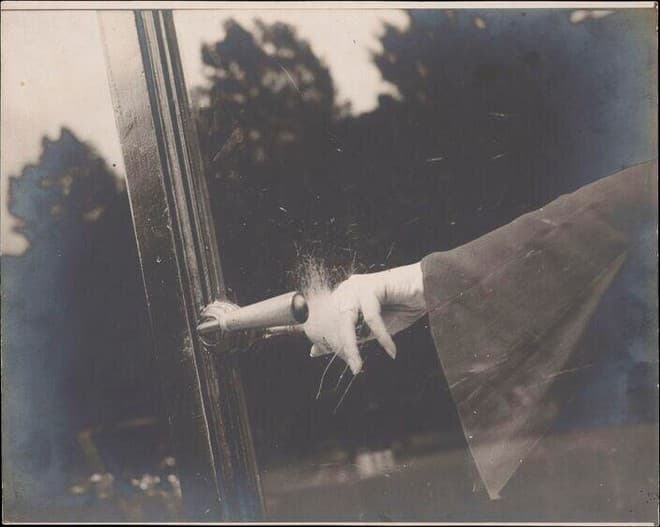
A hand reaches out of a dark coat sleeve toward the handle of a glass door, and a spray of fine white lines bursts from the wrist. The lines are scratches in the glass. The Victoria and Albert Museum records the door as the door of Guerlain, the Paris perfume shop, and says the scratches were cut by the diamond rings of its customers. Lee Miller made the photograph in Paris in 1930, in her first years behind a camera.
- 1930
- Gelatin silver print
- Victoria and Albert Museum, LondonLondon, United Kingdom
About Lee Miller

What the photograph shows
An arm enters the frame from the right in a dark coat with a wide cuff. The hand at the end of it is pale and open, four fingers hanging and the thumb tucked under. A dark bangle sits at the wrist.
From just behind the bangle a spray of fine white threads bursts upward and outward. It fans across the dark glass, thinning into separate specks near the top of the frame. Three or four of the same threads hang below the fingers.
To the left the arm runs on to a metal lever handle mounted on the door's upright. Behind the glass, trees and a patch of bright sky are reflected. The door's moulded frame crosses the left of the picture as three parallel ridges.
The print measures 23.8 by 29.8 centimetres and is wider than it is tall. On the back, in the upper right corner, someone has written FP270.
The cloud is scratches, and the shop is Guerlain
The Victoria and Albert Museum explains the effect in the record for its second print of the photograph. An elegant hand reaches toward a door handle in what looks like a cloud of smoke, and on closer inspection the smoke turns out to be scratches on a glass door. The door belongs to Guerlain, the Paris perfume house, and the museum attributes the scratches to the diamond rings of the shop's customers.
Mark Haworth-Booth, the curator who selected the photograph for the museum's 2007 exhibition The Art of Lee Miller, reads it through a phrase of André Breton's. Breton, the French poet who founded Surrealism, called the quality he wanted in art convulsive beauty. The museum records that Mark Haworth-Booth believes this photograph achieves it.
Neither the scratches nor the shop are guesses about what the picture might mean. They are a physical account of how the image was made, published by the museum that owns the print.
The museum's two records disagree
The Victoria and Albert Museum holds two prints of this photograph and describes them differently. The older record, PH.101-1984, was created in 2006 and calls the subject a hand on the door handle of a jeweller's. The newer record, E.474:3X-2010, names Guerlain.
Diamond rings are common to both readings, which is probably how the earlier description arose. The 2010 record is the more specific and the more recent, and the Lee Miller Archives in East Sussex give the location the same way in their own picture library, so Guerlain is the account followed here.
The date is also unsettled. Both museum records say 1930, and the portfolio record softens it to about 1930. The Lee Miller Archives catalogue the image as about 1931 and title it Untitled, with Exploding Hand in brackets. The museum's form of the title is recorded as the artist's own.
Made in her first year of working alone
Lee Miller arrived in Paris in 1929 and became the student, model and partner of Man Ray, the American photographer at the centre of Surrealism. She printed her own work and some of his in those years, a fact the Lee Miller Archives state plainly.
In 1930 she opened her own studio at 12 rue Victor Considerant, near Denfert-Rochereau on the southern edge of Montparnasse. Her photographs began appearing in French Vogue that September, and she took a part-time job photographing operations for a Paris surgeon.
The Victoria and Albert Museum records the place of origin as Paris and labels the style Surrealist. The Lee Miller Archives note that no maker is known for the cameras she used in Paris, and that the surviving negatives point to half-plate and full-plate studio cameras rather than the Rolleiflex she bought later.
Close reading
Reading the work, detail by detail
A hand, a door handle and a cloud that is not smoke. Follow the sleeve and the open fingers, then the burst above the wrist, the metal handle it reaches for, the threads hanging below the hand, and the reflections in the glass behind all of it.
1.The hand and the sleeve
The hand is not gripping anything. The fingers hang loose and slightly apart, and the coat cuff is cut square across the wrist.
2.The burst above the wrist
The Victoria and Albert Museum records these as scratches on the glass door of the Paris perfume house Guerlain, cut by the diamond rings of its customers. They are behind the hand rather than around it, which is why they read as an explosion.
3.The lever handle
The handle is ordinary hardware, photographed close and slightly from below. It gives the picture its only fixed point: without it the pale shapes in the middle of the frame would have nothing to be attached to.
4.The threads below the fingers
The same marks that fan upward also fall below the hand. Seeing them on both sides settles what they are: not a flare around the hand but a field of scratches across the whole pane.
5.The door's moulded edge
The moulding is the only straight line in the photograph. It separates the two kinds of dark in the picture: what is behind the glass on one side, and what the glass is reflecting on the other.
6.Trees reflected in the glass
The street behind the photographer is in the door. Lee Miller kept the reflection soft and let the scratches stay sharp, so the nearest thing in the picture is the surface of the glass itself.
Timeline
1929
Lee Miller moves to Paris and becomes Man Ray's student, model and partner. A darkroom accident re-discovers the Sabatier effect, which Man Ray names solarization.
1930
Opens her own studio at 12 rue Victor Considerant and photographs the scratched glass door in Paris. The Victoria and Albert Museum dates the photograph to this year; the Lee Miller Archives give about 1931.
1984
The Victoria and Albert Museum takes the gelatin silver print into its Prints, Drawings and Paintings Collection as PH.101-1984.
2007
The Art of Lee Miller opens at the Victoria and Albert Museum. Mark Haworth-Booth selects six photographs, which the Lee Miller Archives reprint from the original negatives for the centenary of her birth.
2010
Mark Haworth-Booth gives that portfolio to the museum. Its Exploding Hand is catalogued separately as E.474:3X-2010, with the Guerlain description attached.
2026
The museum records PH.101-1984 as on short-term loan out for exhibition. Its reading list for the print includes the catalogue of Tate Britain's 2025 Lee Miller exhibition.
Where to see it
Victoria and Albert Museum, London
London, United Kingdom
A public viewing address has not yet been confirmed for this holding.
Recorded by the museum as on short-term loan out for exhibition. A second print of the same photograph, E.474:3X-2010, belongs to the museum's Quintessential Lee Miller portfolio.
Frequently asked questions
What is Lee Miller's Exploding Hand?
A photograph made in Paris in 1930 of a hand reaching for the handle of a glass door, with a burst of fine white lines spraying from the wrist. The Victoria and Albert Museum holds a gelatin silver print, 23.8 by 29.8 centimetres, as PH.101-1984.
What causes the explosion in the photograph?
Scratches in the glass. The Victoria and Albert Museum records that the cloud is not smoke but marks on the door of Guerlain, the Paris perfume house, cut into the glass by the diamond rings of the shop's customers.
Whose hand is it?
Nobody records a name. The museum describes it only as a woman's hand on a lever doorknob. The arm wears a dark coat with a wide cuff and a bangle at the wrist.
Is the photograph solarized?
No. The Victoria and Albert Museum lists the medium simply as a gelatin silver print and says nothing about solarization. The white burst comes from marks on the glass in front of the hand, not from anything done in the darkroom.
Did Lee Miller give the photograph its title?
The Victoria and Albert Museum records Exploding Hand as a title assigned by the artist. The Lee Miller Archives catalogue the same image as Untitled, with Exploding Hand in brackets, and date it to about 1931 rather than 1930.
Where can you see it?
The Victoria and Albert Museum in London owns two prints, PH.101-1984 and E.474:3X-2010. The museum records the 1984 print as on short-term loan out for exhibition, so check the object record before travelling.
More by Lee Miller
References
The sources below include collection records, catalogues, scholarly research, and primary materials that informed this page. They document Exploding Hand, its making, and its place in cultural history.


1Exploding Hand, 1930 — object record PH.101-1984
WebsiteVictoria and Albert Museum, LondonUsed forThe museum's record for the 1930 print: title, medium, dimensions, the FP270 mark on the reverse, and the earlier description naming a jeweller's door.
2Exploding Hand, from the portfolio Quintessential Lee Miller — object record E.474:3X-2010
WebsiteVictoria and Albert Museum, LondonUsed forThe 2010 portfolio record, which names Guerlain, explains the scratches, and quotes Mark Haworth-Booth on convulsive beauty.

3Lee Miller Archives picture library — catalogue records and credit lines
ArchiveLee Miller Archives, Farleys House and Gallery, East SussexUsed forThe rights holder's own catalogue entry, which titles the image Untitled with Exploding Hand in brackets and dates it to about 1931.
4Lee Miller (1907–1977) — biography and chronology
ArchiveLee Miller Archives, Farleys House, East SussexUsed forThe 1929 and 1930 entries: the move to Paris, the studio at 12 rue Victor Considerant, and the cameras she used there.
5Everything you need to know about Lee Miller
WebsiteVictoria and Albert Museum, LondonUsed forThe museum's introduction to her career, used for the Paris years and the solarization discovery.
These references provide the documented foundation for this work's history and interpretation. Claim-level citations remain attached to the specific claims they support.
 Explore more resources