Portrait of Space
by Lee Miller
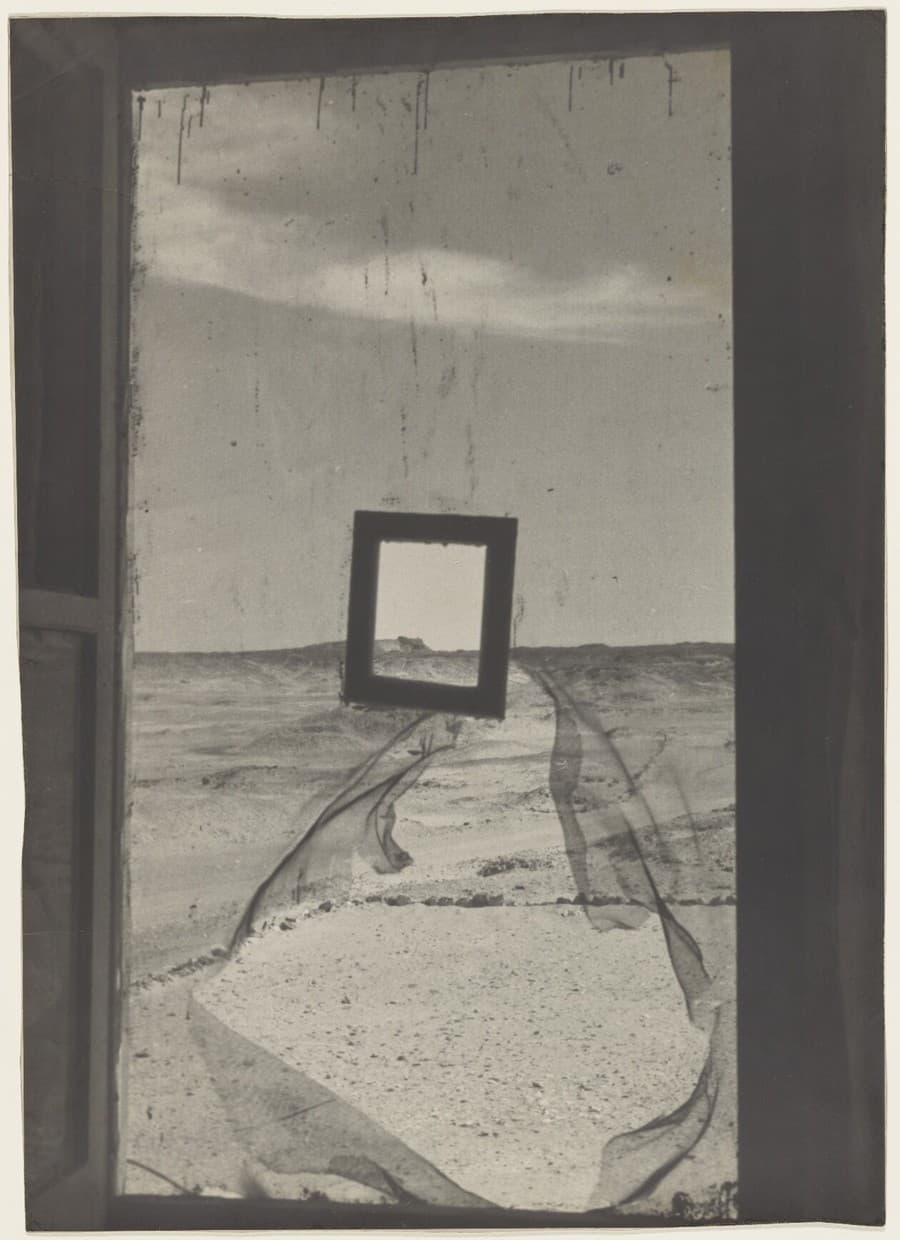
A torn wire screen, the desert beyond it, and an empty picture frame hanging in front of the tear. Lee Miller made the photograph near Siwa in the Western Desert of Egypt in 1937, during the years she lived in Cairo. The J. Paul Getty Museum in Los Angeles holds a print of 1937; Tate in London holds a platinum print made in 1999, cropped differently and catalogued under a longer title.
- 1937
- Gelatin silver print
- J. Paul Getty Museum, Los AngelesLos Angeles, California, United States
About Lee Miller

What the photograph shows
A tall opening fills the frame, with a dark upright down each side. Stretched across it is a fine mesh screen, torn open across the middle. The tear runs from the lower left to the upper right, and its cut edges have rolled over into thick grey curls.
Through the tear the desert is clear and sharp: a stony plain, a bank of larger stones, a low ridge along the horizon and a single band of cloud above it. Below the tear the same desert continues, but seen through the intact mesh, which turns it grey and flat. The same ground appears twice in one picture, once veiled and once not.
An empty picture frame hangs in front of the screen, above the tear. It is plain and dark, and the opening inside it holds pale sky, the horizon line and a small dark block on the ridge. A faint track curves across the desert to the right of it.
Dark drip marks run down through the sky from the top edge of the print, and the paper is worn along its lower edge. Lee Miller inscribed her name on the back in blue ink.
Two museums, two prints, two shapes
The J. Paul Getty Museum acquired a gelatin silver print of 1937 and catalogues it as 84.XP.926.7. Its image measures 37 by 26.2 centimetres, which is a tall rectangle.
Tate bought a platinum print made in 1999 and catalogues it as P82715. Its image measures 256 by 226 millimetres, which is very nearly square. The two prints are therefore cropped differently, and the wide uprights at the sides of the Getty print are outside Tate's frame altogether.
The titles differ as well. The Getty prints the title in square brackets, as [Portrait of Space], and records a second published title, [Landscape Through a Torn Mesh]. Tate gives it as Portrait of Space, Al Bulyaweb, near Siwa, Egypt. The Lee Miller Archives spell the same place Al Bulwayeb. Neither explains the difference, and the Getty's record names only Siwa.
The Getty's is the print reproduced here. Tate acquired its print in 2022 with funds from the Photography Acquisitions Committee and from Elizabeth and William Kahane, accessioned it in 2023, and records it as not on display.
What she was doing in Egypt
Lee Miller married the Egyptian businessman Aziz Eloui Bey in 1934 and moved to Cairo. The J. Paul Getty Museum sets the photograph inside that marriage and reads it as a change of subject: before Egypt her images were largely limited to fashion and advertising, and in Cairo she concentrated on still lifes and the landscape.
The museum reads the picture as Surrealist without calling it a Surrealist exercise. It records that the image embodies Surrealist impulses she had acquired earlier while working with Man Ray, and that the view contrasts interior and exterior worlds much as the Surrealists contrasted the unconscious and the conscious.
The Getty describes the screen as the torn screen of a tent. Its own place field for the object gives only Siwa, Egypt, and Tate's title gives Al Bulyaweb, near Siwa. Siwa is an oasis in the Western Desert, close to the Libyan border and about 560 kilometres from Cairo.
The claim about René Magritte
The photograph is often said to have prompted a painting. The Lee Miller Archives print the claim on their own catalogue entry, and they hedge it: the image is said to have inspired the Surrealist painter René Magritte to paint Le Baiser.
Neither the J. Paul Getty Museum nor Tate repeats it in its object record, and the Archives name no source for it. It stands as a claim made by the rights holder rather than a documented fact.
There is also a name that invites confusion. The Lee Miller Archives' own chronology records that Lee Miller herself showed a Surrealist object titled Le Baiser at the exhibition Objects and Poems at the London Gallery in 1937. That is her work and not René Magritte's painting.
The Archives contradict themselves on the publication date too. Their catalogue entry says the photograph was published in the London Bulletin in the same year it was made, 1937. Their chronology says the London Bulletin published it, alongside Eileen Agar's Shadow, in June 1938.
Close reading
Reading the work, detail by detail
A torn screen with a desert behind it. Start at the empty frame hanging in the opening, then the cloud and the marks in the print's sky, the rolled edges of the tear, the ground seen clear and the same ground seen through the mesh, and the dark uprights at each side.
1.The empty frame
The frame holds a view rather than a picture. Its lower edge sits below the horizon, so the opening contains both sky and a slice of ground, and the small dark block on the ridge lands near the middle of it.
2.The cloud and the drip marks
The cloud belongs to the day; the vertical streaks belong to the print. They run down from the top edge of the sheet and stop, which is how liquid behaves on paper rather than how weather behaves in a sky.
3.The rolled edge of the tear
The mesh has not simply split. Its edges have rolled back on themselves, doubling the fabric so the torn line reads as a solid dark curve rather than a gap.
4.The ground seen twice
The desert appears twice in one frame. Inside the tear the stones are separate and hard-edged; outside it the mesh turns the identical ground into flat grey. Nothing moves between the two states except the screen.
5.The track and the right-hand upright
A single track crosses the plain. The dark upright beside it is part of the structure the screen is fixed to, and it is one of the two edges Tate's print of this photograph does not include.
6.The horizon at the left
The horizon runs almost exactly level across the picture. That flatness is what lets the hanging frame read as a separate object: it is the only thing in the photograph tilted against the line of the ground.
Timeline
1934
Lee Miller marries Aziz Eloui Bey and moves to Cairo, where she turns from fashion and advertising toward still life and landscape.
1937
Makes the photograph in the Western Desert of Egypt. The J. Paul Getty Museum records the place as Siwa; Tate's title gives Al Bulyaweb, near Siwa.
1938
The London Bulletin publishes the photograph in June, with Eileen Agar's Shadow, according to the Lee Miller Archives chronology. The same archive's catalogue entry dates the publication to 1937 instead.
1984
The J. Paul Getty Museum accessions its 1937 print as 84.XP.926.7.
2003
Reproduced as figure 6 in Surrealist Muse: Lee Miller, Roland Penrose, and Man Ray, the exhibition brochure published by the J. Paul Getty Museum.
2022
Tate's 1999 platinum print is shown in Surrealism Beyond Borders at Tate Modern, which runs from 24 February to 29 August, and is purchased the same year.
2023
Tate accessions its print as P82715. The museum records it as not on display.
Where to see it
J. Paul Getty Museum, Los Angeles
1200 Getty Center Drive, Los Angeles, CA 90049, United States
Tate holds a second print, a platinum print of 1999 catalogued as P82715 and recorded as not on display. Photographs are rotated to limit light exposure.
Plan your visit on the museum’s official website (opens in a new tab)Frequently asked questions
What is Lee Miller's Portrait of Space?
A photograph made in the Egyptian desert in 1937, looking out through a torn wire screen at a stony plain and a low horizon, with an empty picture frame hanging in front of the tear. The J. Paul Getty Museum holds a 1937 gelatin silver print, 37 by 26.2 centimetres, as 84.XP.926.7.
Where was it taken?
In the Western Desert of Egypt. The J. Paul Getty Museum records the place of creation as Siwa, an oasis near the Libyan border. Tate's title for its own print gives Al Bulyaweb, near Siwa, and the Lee Miller Archives spell the place Al Bulwayeb.
What is the screen made of?
A fine mesh. The J. Paul Getty Museum calls it the torn screen of a tent. In the photograph the mesh is stretched across a tall opening with a dark upright at each side, and its torn edges have rolled into thick curls.
Did Portrait of Space inspire a Magritte painting?
The Lee Miller Archives say it is said to have inspired René Magritte to paint Le Baiser, and they name no source for that. Neither the J. Paul Getty Museum nor Tate repeats the claim in its record. Lee Miller separately exhibited a Surrealist object of her own called Le Baiser in London in 1937, which is easy to confuse with the painting.
Why do the Getty and Tate prints look different?
Because they are cropped differently and printed by different processes. The Getty print is a gelatin silver print of 1937 measuring 37 by 26.2 centimetres, a tall rectangle. Tate's is a platinum print made in 1999 measuring 256 by 226 millimetres, very nearly square, and it does not include the dark uprights at the sides.
Can you see the photograph on display?
Not reliably. Tate records P82715 as not on display. The J. Paul Getty Museum rotates works on paper to limit light exposure, so check each museum's object record before travelling.
More by Lee Miller
References
The sources below include collection records, catalogues, scholarly research, and primary materials that informed this page. They document Portrait of Space, its making, and its place in cultural history.


1[Portrait of Space], 1937 — object record 84.XP.926.7
WebsiteJ. Paul Getty Museum, Los AngelesUsed forThe museum's record: both bracketed titles, the 1937 date, medium, dimensions, the inscription on the reverse, the rights notice and the curatorial description.
2Portrait of Space, Al Bulyaweb, near Siwa, Egypt, 1937, printed 1999 — object record P82715
WebsiteTate, LondonUsed forTate's record for the 1999 platinum print: the longer title, the near-square dimensions, the acquisition line and the Surrealism Beyond Borders showing.

3Lee Miller Archives picture library — catalogue records and credit lines
ArchiveLee Miller Archives, Farleys House and Gallery, East SussexUsed forThe rights holder's catalogue entry, which carries the hedged claim about René Magritte and dates the London Bulletin publication to 1937.
4Lee Miller (1907–1977) — biography and chronology
ArchiveLee Miller Archives, Farleys House, East SussexUsed forThe Cairo years, the 1937 object called Le Baiser at the London Gallery, and the June 1938 London Bulletin entry that contradicts the catalogue.
5Lee Miller — collection highlights and The Art of Lee Miller portfolio
WebsiteVictoria and Albert Museum, LondonUsed forThe Victoria and Albert Museum on her standing as a Surrealist photographer.
These references provide the documented foundation for this work's history and interpretation. Claim-level citations remain attached to the specific claims they support.
 Explore more resources