
Twenty Love Poems and a Song of Despair
Pablo Neruda
Twenty Love Poems and a Song of Despair
Pablo Neruda's first book of love poems, published thirty-five years earlier, when he was nineteen.
Read our takeOne Hundred Love Sonnets
Pablo Neruda
by Pablo Neruda
A hundred love poems Pablo Neruda wrote for Matilde Urrutia, arranged from morning to night.
One Hundred Love Sonnets is Pablo Neruda's book of love poems for Matilde Urrutia, the woman who became his third wife. He began writing the sonnets in 1957 and worked on them in Paris that autumn. A private edition of three hundred copies was printed in Santiago in November 1959, and Editorial Losada published the book in Buenos Aires in December 1960. The hundred poems are grouped into four parts named for the times of day: morning, midday, evening and night. The University of Texas Press, which publishes Stephen Tapscott's English translation, calls it one of the most popular books of poetry of all time.[1][2]
Neruda first met Matilde Urrutia at a concert in Santiago in 1946. They met again in Mexico City in 1949, when he was in exile, and she nursed him through an illness. The Fundación Pablo Neruda says that love produced two books, The Captain's Verses and One Hundred Love Sonnets.[1]
The University of Chile's chronology dates the start of the sonnets to 1957.[3] In September 1957 Neruda settled in Paris for a time, and the Fundación records that he worked there on two books at once: Estravagario and One Hundred Love Sonnets.[1]
The book first appeared in a private edition. In November 1959 the Editorial Universitaria in Santiago printed three hundred copies, sold by subscription. Editorial Losada's edition followed in Buenos Aires on 14 December 1960, in a hard binding with a jacket drawn by Silvio Baldessari.[1][4]
The book opens with a dedication to Matilde Urrutia. In Stephen Tapscott's translation Neruda tells her that the happiness he feels in offering her these poems is as vast as a savanna.[2]
The hundred sonnets follow in four parts: Morning, Midday, Evening and Night. The Spanish headings are Mañana, Mediodía, Tarde and Noche. The University of Texas Press edition prints the Spanish sonnets beside the English.[2]
The setting is Isla Negra, the stretch of Chilean coast where Neruda had his house. The publisher describes the wind and tides, the white sand with its small wildflowers, and the salt smell of the sea running through the poems.[2]
Sonnet XVII is the sonnet from this book that the Academy of American Poets reprints in full. The speaker starts by saying what his love is not. He does not love her as if she were a rose of salt, a topaz, or an arrow of carnations.
Then he says what it is like. He loves her the way a plant that never flowers still carries the light of flowers hidden inside it. He loves her without knowing how, or when, or from where.
The last lines bring the two people as close as the poem can. Her hand on his chest is his, and her eyes close when he sleeps. The Academy of American Poets prints Mark Eisner's translation with the Spanish text, so a reader can compare them line by line.
Neruda wrote the sonnets while moving around the world. In 1957 he was briefly arrested in Buenos Aires, then travelled to Colombo, Rangoon and China. He settled in Paris in September and worked there on this book and on Estravagario.
He was back in Paris in 1960, the year the book reached the public. The Fundación places him there in April and again in August and September. He sailed from Marseille for Havana in November, a few weeks before Losada published the sonnets in Buenos Aires.
Neruda and Matilde Urrutia married in a private civil ceremony at Isla Negra on 28 October 1966, six years after the book was published.
The happiness I feel in offering these to you is vast as a savanna.
I love you as one loves certain obscure things, / secretly, between the shadow and the soul.te amo como se aman ciertas cosas oscuras, / secretamente, entre la sombra y el alma.
so close that your hand upon my chest is mine, / so close that your eyes close with my dreams.tan cerca que tu mano sobre mi pecho es mía, / tan cerca que se cierran tus ojos con mi sueño.
Twenty Love Poems was about longing and loss. These sonnets were written for a woman Neruda was living with, and they celebrate that.
The four parts, Morning, Midday, Evening and Night, give a hundred short poems an order that is easy to follow.
The sonnet the Academy of American Poets reprints on its own reads differently among the ninety-nine others.
Neruda worked on the sonnets in Paris in the autumn of 1957, alongside Estravagario.
1946
Pablo Neruda meets Matilde Urrutia at a concert in Santiago.
1949
They meet again in Mexico City during Neruda's exile.
1957
Neruda begins the sonnets. In September he settles in Paris and works there on this book and on Estravagario.
1959
In November the Editorial Universitaria in Santiago prints a private edition of three hundred copies.
1960
Editorial Losada publishes the book in Buenos Aires on 14 December, with a jacket by Silvio Baldessari.
1966
Neruda and Matilde Urrutia marry at Isla Negra on 28 October.
1986
The University of Texas Press publishes Stephen Tapscott's English translation.
2014
The University of Texas Press issues a redesigned bilingual edition.


Twenty Love Poems and a Song of Despair
Pablo Neruda
Pablo Neruda's first book of love poems, published thirty-five years earlier, when he was nineteen.
Read our takeMemoirs
Pablo Neruda
Canto General
Pablo Neruda
The long poem Neruda finished in exile in Mexico in 1949, the year he met Matilde Urrutia again.
Read our take
A novel by Gabriel García Márquez, who is quoted on the University of Texas Press edition calling Neruda the greatest poet of the twentieth century in any language.
Read our takeMatilde Urrutia, who became Pablo Neruda's third wife in 1966. The book is dedicated to her, and the Fundación Pablo Neruda says it celebrates their love.
A private edition of three hundred copies was printed in Santiago in November 1959. Editorial Losada published the book in Buenos Aires on 14 December 1960.
Into four parts named for the times of day: Morning, Midday, Evening and Night. In Spanish they are Mañana, Mediodía, Tarde and Noche.
Sonnet XVII begins by saying the speaker does not love her as if she were a rose of salt or a topaz. The Academy of American Poets prints it in Spanish and in Mark Eisner's English.
Stephen Tapscott's translation, published by the University of Texas Press in 1986, is the best-known complete version. Gustavo Escobedo's translation appeared from Exile Editions in 2004. Single sonnets have been translated by others, including Mark Eisner.
Partly. He began them in 1957, and that September he settled in Paris, where he worked on this book and on Estravagario.
No. The Captain's Verses is an earlier book of love poems for Matilde Urrutia, first printed anonymously in Naples in 1952. One Hundred Love Sonnets came seven years later, under Neruda's own name.
Explore authors with a similar voice, perspective, and influence.
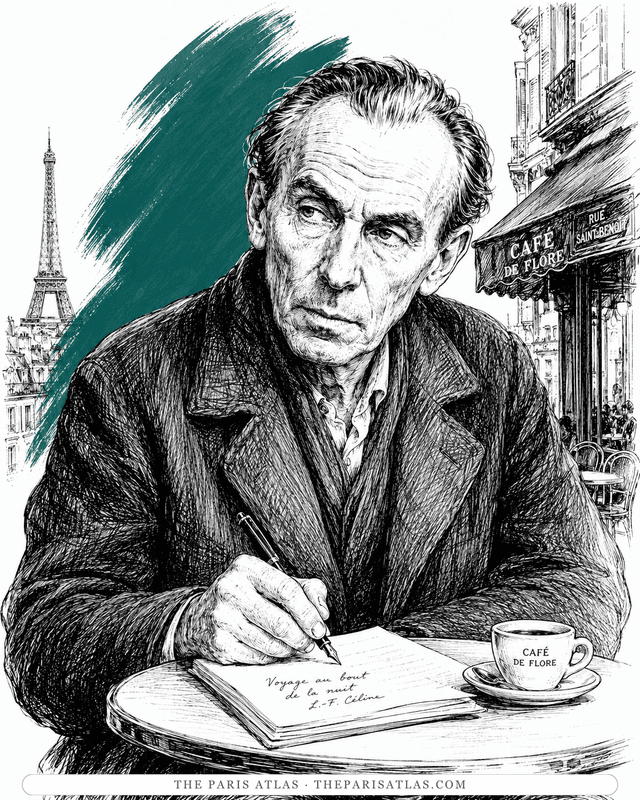
The doctor of the Paris slums who wrote the century's blackest, funniest novel — and changed the sound of French prose.
View author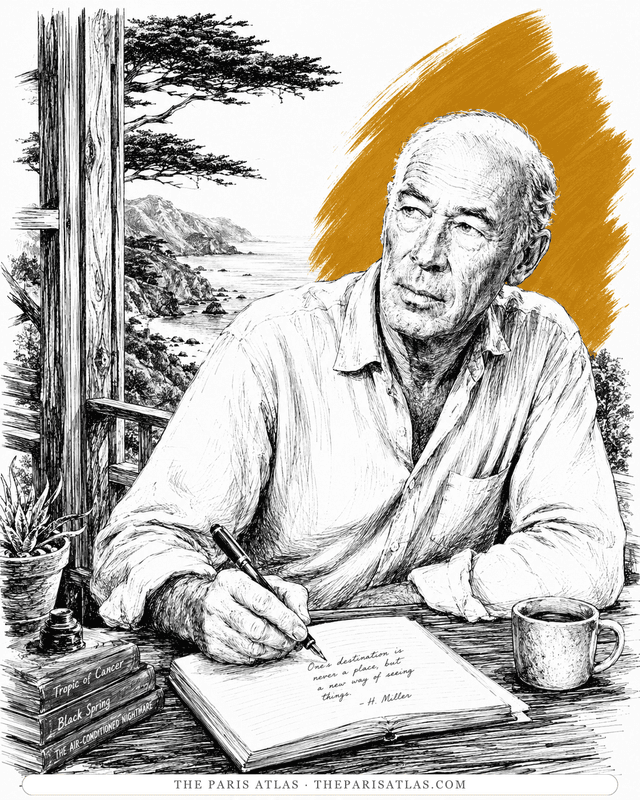
The Brooklyn dropout who arrived in Paris broke at thirty-eight and wrote the exuberant, banned books that ended American censorship.
View author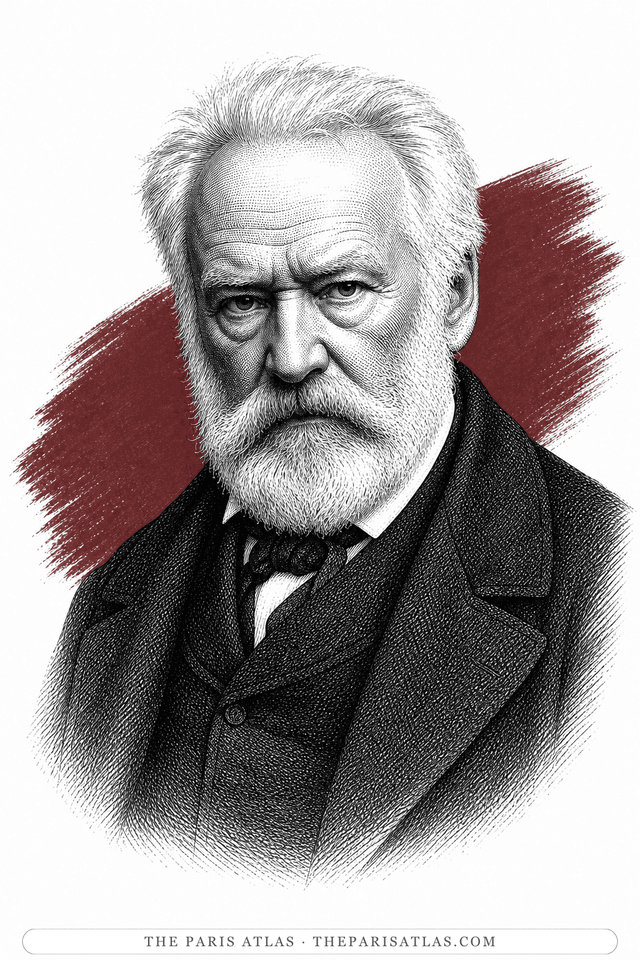
Poet, novelist and playwright who spent sixteen years in an apartment on the Place des Vosges that is now his museum, wrote a novel about Notre-Dame that shamed France into repairing the cathedral, spent nineteen years in exile for opposing the emperor Napoleon III, and was buried in the Panthéon — the Paris monument where France buries its most honoured dead — in 1885 after a funeral that brought roughly two million people into the streets of Paris.
View authorThe sources below include the primary text, editions, scholarship, archival materials, and other records that informed this page. They document One Hundred Love Sonnets, its publication, and its place in literary history.


The University of Chile's chronology, dating the start of the sonnets to 1957 and the two editions.

The Swedish Academy's bibliography: the 1959 Editorial Universitaria edition and Tapscott's 1986 translation.

Authorized text of Sonnet XVII in Spanish and in Mark Eisner's English, the source of the quotations.
Open Library edition records, used to confirm each ISBN listed.
The primary text represented by this page, used for descriptions of the work’s contents and for any quoted passages shown here.
The primary text is the baseline reference for every book page. Additional references document publication history, interpretation, and historical context where that evidence is available.
 Explore more resources