
Residence on Earth
Pablo Neruda
Residence on Earth
The inward, private poetry Pablo Neruda wrote before the Spanish Civil War, which Canto General leaves behind.
Read our takeCanto General
Pablo Neruda
by Pablo Neruda
Pablo Neruda's long poem of the whole American continent, finished while the Chilean police were looking for him.
Canto General is Pablo Neruda's long poem about the Americas: their land, their peoples and some five hundred years of their history. He began it in 1938 as a poem about Chile alone and widened it after he saw the ruins of Macchu Picchu in Peru in 1943. He finished it in hiding in Chile and then in exile, after the government outlawed his party and ordered his arrest. The book was published in Mexico City in 1950 with endpapers by the muralists Diego Rivera and David Alfaro Siqueiros. In Chile it was printed in secret the same year. The Nobel Prize biography calls it the central part of Neruda's work.[1][2]
The book started small. In 1938 Neruda wrote the first poems of what he then called a Canto general de Chile, a general song of Chile.[1] In Mexico, where he was Chile's consul general from 1940, he kept working on it. A private edition of a few fragments came out in Mexico City in 1943: one hundred signed copies of a sixteen-page booklet.[1]
A trip home changed the plan. In late 1943 Neruda travelled back to Chile along the Pacific coast and climbed to the Inca ruins of Macchu Picchu, above Cuzco.[3] He later said that the visit made him see the whole of America from those heights, and that the idea of an American Canto General began there.[4]
In September 1945, now a senator, Neruda went to his house at Isla Negra and began the poem Alturas de Macchu Picchu, The Heights of Macchu Picchu.[1] Chile's National Library dates its completion to 15 September 1945.[4] The poem became the second section of the finished book.[1]
Then politics took over. In February 1948 the Supreme Court stripped Neruda of a senator's immunity from arrest and the courts ordered him detained. He spent the next year hiding in friends' houses and writing the book.[3] Presenting his Nobel Prize in 1971, the Swedish Academy said Canto General was partly written while he was in exile in his own country.[5]
Fifteen sections of poems. The Fundación Pablo Neruda counts about 330 poems and some fifteen thousand lines. They cover the nature and peoples of the Americas and more than five hundred years of their history and politics.[1]
The second section is The Heights of Macchu Picchu, written after Neruda's visit to the Inca city. A later section, La arena traicionada, meaning the sand betrayed, names the dictators of Latin America. The last section, Yo soy, meaning I am, turns to Neruda's own life.[1]
Single poems inside the book began as poems for particular occasions. Neruda read one at the funeral of the Mexican composer Silvestre Revueltas in 1940. Another mourns the Spanish poet Miguel Hernández, who died in a Francoist prison in 1942.[1]
The first edition came out in Mexico City on 3 April 1950. The edition was a large-format printing of five hundred copies, and its endpapers were drawn by the Mexican muralists Diego Rivera and David Alfaro Siqueiros. The University of Chile's chronology records two Mexican editions that year, one for a sponsoring committee and one from Ediciones Océano.
At almost the same moment the Communist Party printed the book in Chile, where it could not be sold openly. The title page gave a false imprint, Imprenta Juárez, Reforma 75, Mexico City. The artist José Venturelli illustrated it and helped lay out the pages.
Chile's National Library describes how the printers avoided the police. Each stage was given to a different worker in a different place. They used ordinary shop paper so that no paper order could be traced, and old typesetting moulds that government agents could not follow. The result was five thousand copies of a 468-page book, 27 by 19 centimetres.
Neruda left Chile before the book was finished. He crossed the Andes on horseback into Argentina in February 1949, then reached Paris in April on the passport of his friend, the Guatemalan novelist Miguel Ángel Asturias. On 25 April he walked onto the stage of the World Congress of Partisans of Peace in Paris, revealing where he had been hiding.
After finishing the book in Mexico late in 1949, Neruda came back to Europe. In June 1950 he went to Prague and then Paris, and in October he signed copies of the French translation of Canto General.
In 1954 a French edition, Le Chant général, appeared in France with illustrations by the French painter Fernand Léger.
Chile's National Library describes Canto General as a kind of encyclopedic chronicle. The poem mixes literature and history to tell the story of the people of the Americas and their struggle for freedom. The inward-looking poems of Neruda's youth are left far behind.
Neruda explained the change himself. He said he came to understand that people who walked the same inherited land had something to do with the great efforts of the American peoples. Ignoring that, he said, was not only a crime but the continuation of a defeat.
The Nobel Prize biography says the same thing more briefly. In Mexico Neruda rewrote his song of Chile into an epic poem about the whole South American continent, its nature, its people and its history.
and drenching and flaring by turns, adolescence / like a lamp overturned in the rain.
South is a stallion, submerging, / in the gradual trees and the dew, garlanded.
The Nobel Prize biography calls Canto General the central part of his work, and the 1971 presentation speech singled it out.
The book's second section is the poem Neruda wrote after climbing to the Inca ruins in 1943. The visit changed the plan of the whole book.
Written in hiding, carried into exile, published in Mexico with endpapers by Diego Rivera and David Alfaro Siqueiros, and printed in secret in Chile.
Neruda reached Paris in 1949, before the book was finished, and returned in 1950 to sign the French translation.
1938
Pablo Neruda writes the first poems of what he calls a Canto general de Chile.
1943
A private edition of fragments, one hundred signed copies, appears in Mexico City. In late 1943 Neruda visits Macchu Picchu.
1945
At Isla Negra Neruda writes The Heights of Macchu Picchu, finishing it on 15 September.
1947
The Heights of Macchu Picchu is published on its own in Santiago.
1948
Stripped of his immunity from arrest, Neruda goes into hiding in Chile and keeps writing the book.
1949
Neruda crosses the Andes in February, appears at the peace congress in Paris on 25 April, and finishes the book in Mexico late in the year.
1950
The Mexico City edition appears on 3 April with endpapers by Diego Rivera and David Alfaro Siqueiros. A clandestine edition of five thousand copies is printed in Chile.
1950
In October, in Paris, Neruda signs copies of the French translation.
1954
Le Chant général is published in France with illustrations by Fernand Léger.
1991
The University of California Press publishes Jack Schmitt's complete English translation.


Residence on Earth
Pablo Neruda
The inward, private poetry Pablo Neruda wrote before the Spanish Civil War, which Canto General leaves behind.
Read our takeMemoirs
Pablo Neruda
Neruda's own account of the year in hiding, the ride over the Andes and the secret printing of this book.
Read our takeOne Hundred Love Sonnets
Pablo Neruda
The love poems for Matilde Urrutia, whom Neruda met again in Mexico in 1949 while he was finishing Canto General.
Read our takeThe Americas: their land and nature, their peoples, and more than five hundred years of their history and politics. Pablo Neruda began it as a poem about Chile and widened it to the whole continent.
In Mexico City in 1950, in an edition of five hundred large copies that appeared on 3 April. The same year a secret edition of five thousand copies was printed in Chile under a false Mexican imprint.
Yes. The Heights of Macchu Picchu is the book's second section. Neruda wrote it at Isla Negra in September 1945, two years after visiting the ruins, and it was also published on its own in 1947.
In 1948 the Chilean government turned against the Communist Party, and Neruda, a Communist senator, attacked the president from the Senate floor. The Supreme Court stripped him of his immunity from arrest, and he hid in friends' houses for a year while he wrote.
Diego Rivera and David Alfaro Siqueiros drew the endpapers of the 1950 Mexican edition. José Venturelli illustrated the secret Chilean edition, and Fernand Léger illustrated the 1954 French edition.
Jack Schmitt's translation, published by the University of California Press in 1991 and still in print. Earlier English versions, by Nathaniel Tarn and Ben Belitt, translated only parts of the book.
Neruda reached Paris in April 1949, before the book was finished, and appeared at the World Congress of Partisans of Peace. He was in Paris again in October 1950, signing copies of the French translation.
Explore authors with a similar voice, perspective, and influence.
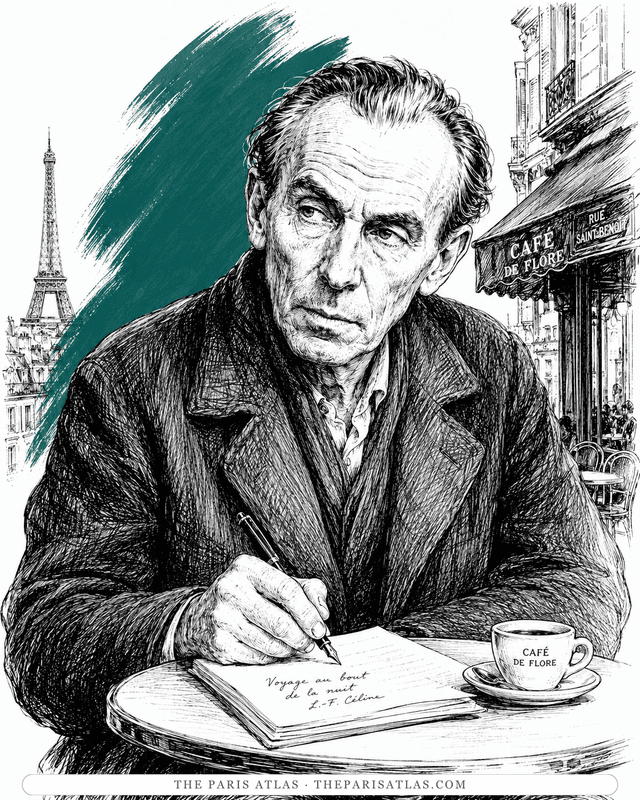
The doctor of the Paris slums who wrote the century's blackest, funniest novel — and changed the sound of French prose.
View author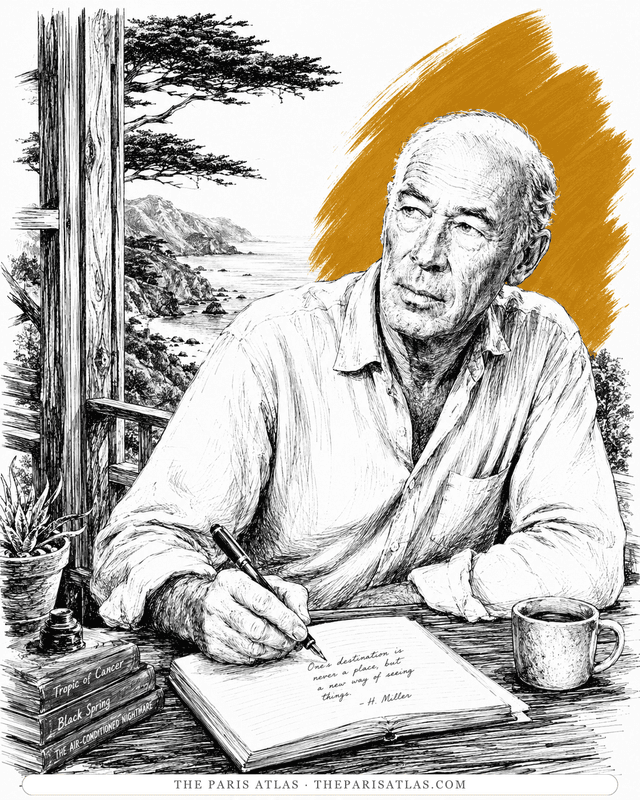
The Brooklyn dropout who arrived in Paris broke at thirty-eight and wrote the exuberant, banned books that ended American censorship.
View author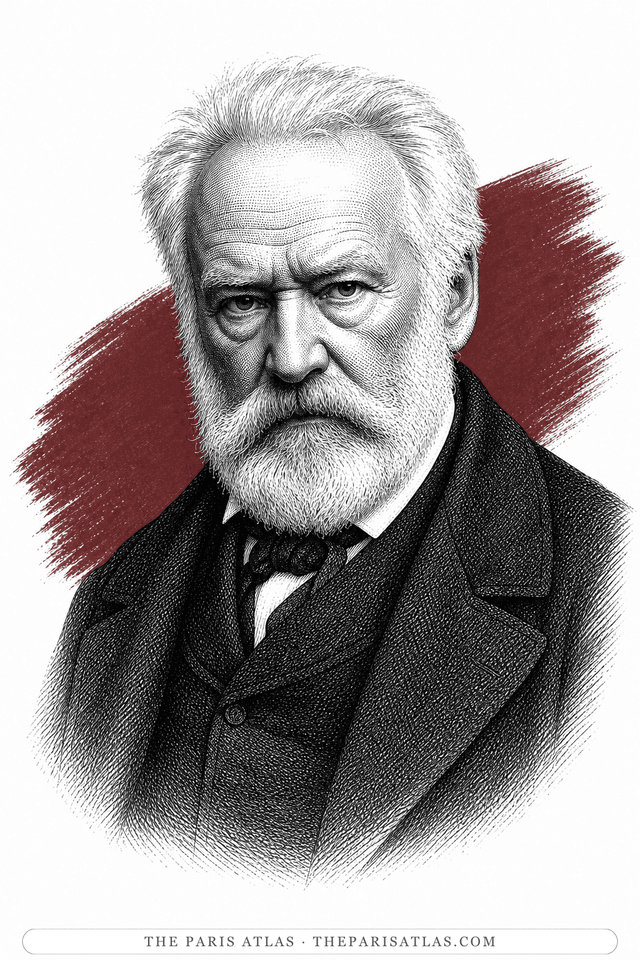
Poet, novelist and playwright who spent sixteen years in an apartment on the Place des Vosges that is now his museum, wrote a novel about Notre-Dame that shamed France into repairing the cathedral, spent nineteen years in exile for opposing the emperor Napoleon III, and was buried in the Panthéon — the Paris monument where France buries its most honoured dead — in 1885 after a funeral that brought roughly two million people into the streets of Paris.
View authorThe sources below include the primary text, editions, scholarship, archival materials, and other records that informed this page. They document Canto General, its publication, and its place in literary history.

The Nobel Prize biography, on the move from a Chilean poem to a continental one.
Karl Ragnar Gierow's 1971 presentation speech, on the book written in exile in Neruda's own country.

Poems from Canto General in Ben Belitt's translation, the source of the quotations.
The Swedish Academy's bibliography: the 1950 first edition, the 1947 Heights of Macchu Picchu, and the English translations.
Publisher's page for Jack Schmitt's translation: ISBN, date and page count.
Open Library edition records, used to confirm each ISBN listed.

The primary text represented by this page, used for descriptions of the work’s contents and for any quoted passages shown here.
The primary text is the baseline reference for every book page. Additional references document publication history, interpretation, and historical context where that evidence is available.
 Explore more resources