The Paris AtlasCharting the artists, works, and places worth returning to.

Twenty Love Poems and a Song of Despair

Veinte poemas de amor y una canción desesperada

by Pablo Neruda

The book of love poems Pablo Neruda published at nineteen, and the most read book he ever wrote.

Published
1924
Shelf rating
4.6

About Pablo Neruda

Illustrated portrait of Pablo Neruda
Pablo Neruda

5 books shelved

The story, briefly

Spoiler-free

Pablo Neruda was nineteen when Editorial Nascimento published Veinte poemas de amor y una canción desesperada in Santiago in June 1924. The book holds twenty numbered love poems and a longer closing poem, the Song of Despair. The poems were frank about desire, and some critics attacked the book on moral grounds. Young readers took to it at once. Chile's National Library now calls it the most published and probably the most read of all Neruda's books, translated into many languages, including Indigenous languages of Chile.[1]

The story, in more detail

Neruda had come to Santiago from Temuco in 1921 to train as a French teacher at the Instituto Pedagógico. On 18 April that year he met a fellow student, Albertina Rosa Azócar. The Fundación Pablo Neruda names her as the woman behind several of the poems.[2]

Some of the poems were printed in magazines before the book existed. The University of Chile's chronology notes that Poem XX first appeared in the student magazine Claridad on 24 November 1923, under the title Tristeza a la orilla de la noche, meaning sadness at the edge of the night.[3]

Neruda spent the summer of 1924 on the coast at Bajo Imperial, in southern Chile, and wrote part of the book there. In his memoirs he said the wharves in the Song of Despair are the old wharves of Carahue and Bajo Imperial.[2]

The first edition came out in June 1924. The National Library's copy is a slim book of forty-five unnumbered leaves.[4] In August 1924, stung by the reviews, Neruda published a letter in the Santiago paper La Nación explaining how he had written the poems. He called it Exégesis y soledad, meaning explanation and solitude.[2]

What's inside

Twenty short love poems, numbered in Roman figures, and then the Song of Despair. The poems speak to a woman the speaker desires or has lost. Neruda said they mixed his most tormented teenage passions with the overwhelming nature of the south of Chile.[1]

Poem XX is the one most readers know. The poem opens on the line Puedo escribir los versos más tristes esta noche, meaning tonight I can write the saddest lines, and keeps coming back to it.[5]

The Song of Despair is longer and darker. The speaker stands at a harbour at dawn and addresses a woman he has loved and lost. The phrase in you everything sank comes back again and again, and the poem ends on the hour of departure.[6]

Themes and analysis

These readings discuss events throughout the book, including its ending.

A book that critics disliked and readers kept

The book's openness about sex was the problem in 1924. The National Library of Chile says part of Chilean society and part of the press rejected it, and that critics dressed their objections up as moral ones. Young readers bought it anyway.

Neruda kept working on the text. Editorial Nascimento published a second, final version in July 1932, after he came home from his consular posts in Asia. By 1961 the book had reached its millionth copy.

Neruda himself later described it in his memoirs as a painful, pastoral book. Chile's National Library now counts it as the most published of all his books, with translations into many languages.

The Song of Despair and the wharves at Carahue

The closing poem is set at a harbour. W. S. Merwin's translation opens with the memory of a woman rising out of the night, and a river pouring its complaint into the sea. The third line is "Deserted like the wharves at dawn."

Those wharves were real. Neruda wrote in his memoirs that they are the old wharves of Carahue and Bajo Imperial. He spent the summer of 1924 on that stretch of coast, writing part of the book.

The poem builds from shipwreck images: a diver, a pilot, a sailor at the prow. After each one the speaker says the same thing to the woman, that in you everything sank. The last line returns to the harbour and the hour of departure.

What the Swedish Academy saw in it

When Neruda received the Nobel Prize in Literature in Stockholm in December 1971, the Swedish Academy's Karl Ragnar Gierow started his account of Neruda's work with this book. He described the love poems as the meeting of two people's desolation in the shadow of destruction.

Gierow treated the book as Neruda's starting point, a poetry of isolation. In his account, the later books move away from that loneliness toward what he called harmony with Man and the Earth.

Quotes from Twenty Love Poems and a Song of Despair

Quoted verbatim from the text, each line verified against its source.

Deserted like the wharves at dawn.
Pablo Neruda, The Song of Despair, in Twenty Love Poems and a Song of Despair (1924), translated by W. S. Merwin
Like a jar you housed the infinite tenderness, / and the infinite oblivion shattered you like a jar.
Pablo Neruda, The Song of Despair, in Twenty Love Poems and a Song of Despair (1924), translated by W. S. Merwin
It is the hour of departure. Oh abandoned one.
Pablo Neruda, The Song of Despair, in Twenty Love Poems and a Song of Despair (1924), translated by W. S. Merwin

Why we recommend it

  1. The book that made him famous

    Pablo Neruda was nineteen when it came out. Chile's National Library calls it the most published and probably the most read of all his books.

  2. Short, and easy to start

    Twenty short poems and one longer one. A reader can finish it in a sitting and go back to single poems for years.

  3. Real places behind the images

    Neruda said the wharves in the Song of Despair were the old wharves of Carahue and Bajo Imperial, on the southern Chilean coast where he wrote part of the book.

  4. A good translation with the Spanish beside it

    W. S. Merwin's English version, first published in London in 1969, is printed by Penguin Classics facing the Spanish text.

What this book explores

Bring it to book club

  • The woman in the poems is sometimes close and sometimes absent. Which poems depend most on her absence?
  • Critics in 1924 objected to the book on moral grounds. What in the poems do you think bothered them?
  • The Song of Despair repeats that everything sank in her. How does the repetition change as the poem goes on?
  • Neruda later called the book painful and pastoral. Which poems fit that description best?
  • If you read the Spanish beside the English, where does the translation seem closest, and where does it have to choose?

A complete discussion guide is on our editorial calendar. Join the letter to hear when it ships.

Inside the book

Selected works from this book, with notes on each.

Poem XX (Puedo escribir los versos más tristes esta noche)

The most famous poem in the book. A man sits up at night thinking about a woman he no longer has, and keeps returning to the line about writing the saddest lines. The poem first appeared in the magazine Claridad in November 1923 under another title.

The Song of Despair (La canción desesperada)

The long closing poem. A speaker at a harbour at dawn addresses a woman he has lost, and repeats that everything sank in her. Neruda said its wharves were those of Carahue and Bajo Imperial.

Timeline

  1. 1921

    Pablo Neruda moves to Santiago to study French and on 18 April meets Albertina Rosa Azócar, who inspired several of the poems.

  2. 1923

    Poem XX appears in the magazine Claridad on 24 November under the title Tristeza a la orilla de la noche.

  3. 1924

    Neruda writes part of the book on the coast at Bajo Imperial. Editorial Nascimento publishes it in Santiago in June.

  4. 1924

    On 20 August Neruda answers his critics in a letter to La Nación titled Exégesis y soledad.

  5. 1932

    Nascimento publishes the second, final version of the text in July.

  6. 1961

    The book reaches its millionth copy.

  7. 1969

    Jonathan Cape publishes W. S. Merwin's English translation in London.

  8. 1971

    Presenting the Nobel Prize in Literature to Neruda, Karl Ragnar Gierow of the Swedish Academy begins with these love poems.

  9. 2003

    Penguin Classics publishes the Merwin translation facing the corrected Spanish text, with sketches by Pablo Picasso.

Book editions

Paperback edition cover
Paperback
English and Spanish
Penguin Classics
2003
ISBN-13
9780142437704
Translated by
W. S. Merwin
Penguin Classics Deluxe Edition, published 2 December 2003, 112 pages. The corrected Spanish text faces W. S. Merwin's translation, with twelve sketches by Pablo Picasso and an introduction by Cristina García.
Paperback edition cover
Paperback
Penguin Classics
2006
ISBN-13
9780143039969
Translated by
W. S. Merwin
Penguin paperback of the Merwin translation, published 26 December 2006. The publisher lists 80 pages.

Reader reviews

Loading reviews…

Cover of The Weary Blues by Langston Hughes

The Weary Blues

Langston Hughes

Langston Hughes's first book of poems, published in 1926. Hughes was also in his early twenties when his first book made his name.

Read our take

Twenty Love Poems and a Song of Despair: frequently asked questions

How many poems are in Twenty Love Poems and a Song of Despair?

Twenty-one: twenty numbered love poems and a longer final poem, the Song of Despair.

How old was Pablo Neruda when he wrote it?

He was nineteen when Editorial Nascimento published the book in Santiago in June 1924, a few weeks before his twentieth birthday. Some of the poems had appeared in magazines in 1923.

Who is the woman in the poems?

The Fundación Pablo Neruda names Albertina Rosa Azócar, a fellow student Neruda met in Santiago in April 1921, as the inspiration for several of the poems. The book never names her.

Why was the book controversial?

The poems were open about sex. Chile's National Library says part of society and part of the press rejected the book, and critics framed their objections as moral ones. Neruda answered them in a letter to La Nación in August 1924.

Which English translation should I read?

W. S. Merwin's translation is the standard one. Jonathan Cape first published it in London in 1969, and Penguin Classics prints it facing the Spanish text.

Where were the poems written?

In Santiago, where Neruda was a student, and on the southern Chilean coast. He spent the summer of 1924 at Bajo Imperial and said the wharves of the Song of Despair were the old wharves of Carahue and Bajo Imperial.

Is the book connected to Paris?

Not directly. The poems belong to Chile. Neruda first saw Paris for a few days in July 1927, three years after the book came out, on his way to a consular post in Burma.

If you like Pablo Neruda

Explore authors with a similar voice, perspective, and influence.

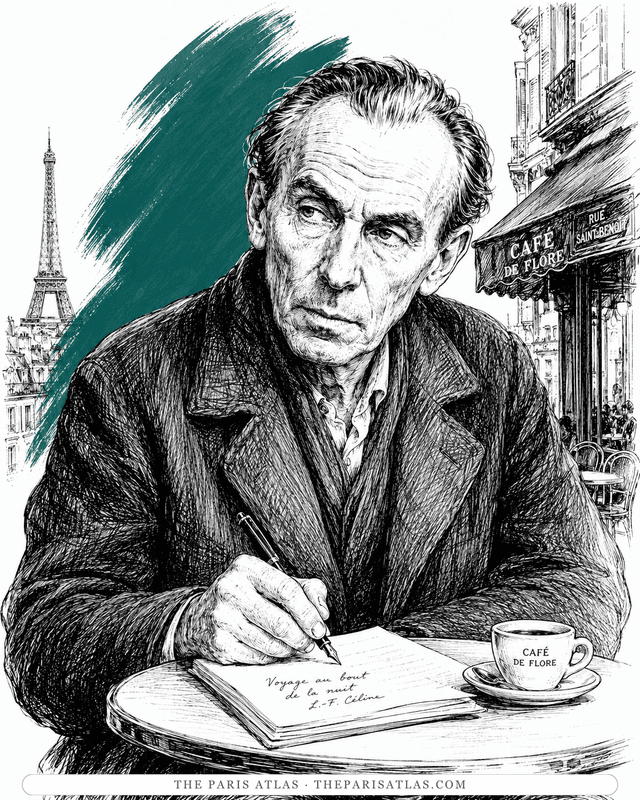
  • Illustrated portrait of Louis-Ferdinand Céline

    Louis-Ferdinand Céline

    The doctor of the Paris slums who wrote the century's blackest, funniest novel — and changed the sound of French prose.

    View author
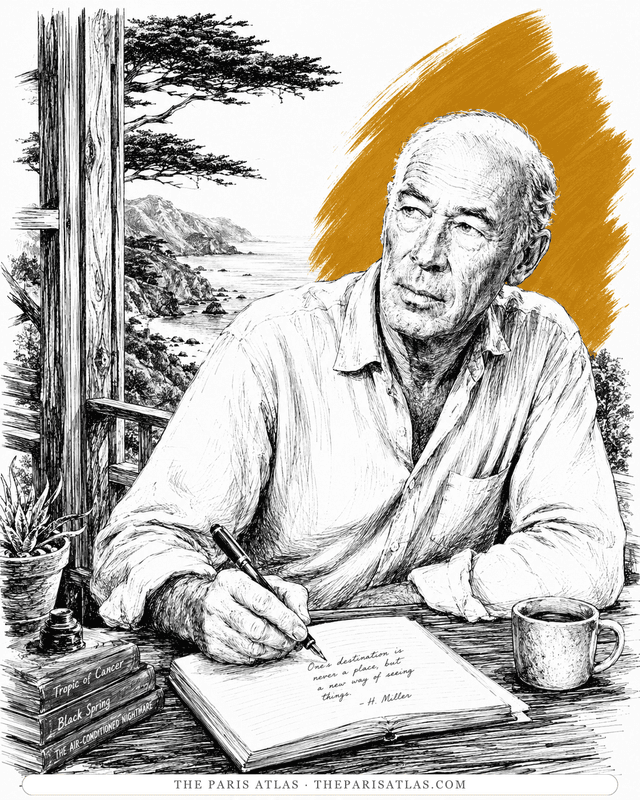
  • Illustrated portrait of Henry Miller

    Henry Miller

    The Brooklyn dropout who arrived in Paris broke at thirty-eight and wrote the exuberant, banned books that ended American censorship.

    View author
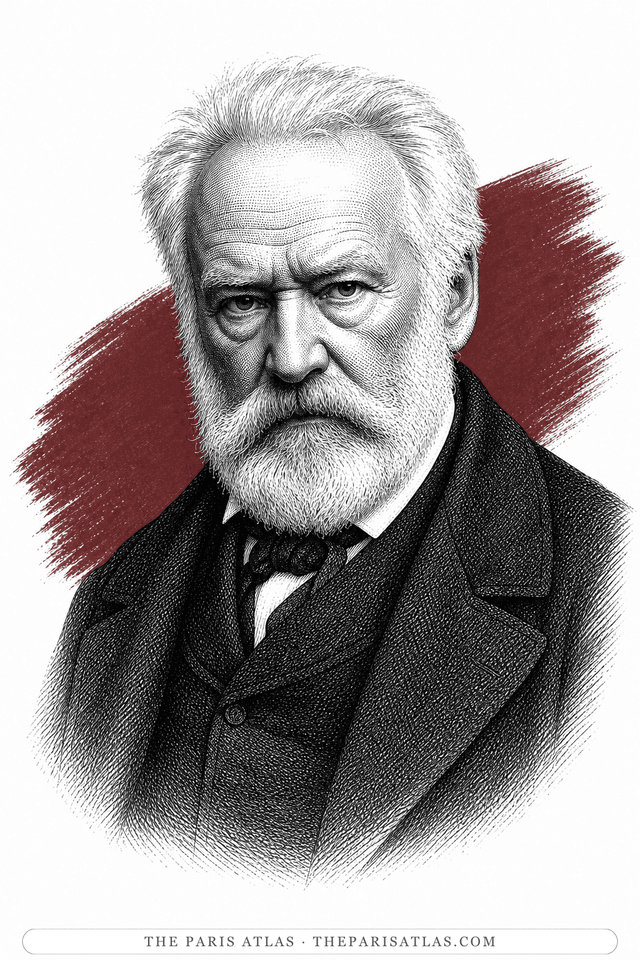
  • Illustrated portrait of Victor Hugo

    Victor Hugo

    Poet, novelist and playwright who spent sixteen years in an apartment on the Place des Vosges that is now his museum, wrote a novel about Notre-Dame that shamed France into repairing the cathedral, spent nineteen years in exile for opposing the emperor Napoleon III, and was buried in the Panthéon — the Paris monument where France buries its most honoured dead — in 1885 after a funeral that brought roughly two million people into the streets of Paris.

    View author
References

References

The sources below include the primary text, editions, scholarship, archival materials, and other records that informed this page. They document Twenty Love Poems and a Song of Despair, its publication, and its place in literary history.

  1. 1abVeinte poemas de amor y una canción desesperada

    Website
    Memoria Chilena, Biblioteca Nacional de Chile
    Used for

    The National Library of Chile's account of the book: first edition, reception, Neruda's own description, and its place as his most read book.

    View source
  2. 2abcBiografía de Pablo Neruda

    Website
    Fundación Pablo Neruda
    Used for

    The foundation's dated biography: Albertina Rosa Azócar, the summer at Bajo Imperial, the 1924 letter to La Nación and the 1932 edition.

    View source
  3. 3Pablo Neruda: Cronología

    Website
    Universidad de Chile
    Used for

    The University of Chile's chronology: Poem XX in Claridad in 1923, later editions, and the millionth copy in 1961.

    View source
  4. 4Veinte poemas de amor y una canción desesperada, Santiago: Editorial Nascimento, 1924 — catalogue record and cover of the first edition

    Archive
    Memoria Chilena, Biblioteca Nacional de Chile, 1924
    Used for

    Catalogue record and cover of the 1924 Nascimento first edition, forty-five unnumbered leaves.

    View source
  5. 5HathiTrust full-text search across Pablo Neruda's authored volumes

    Website
    HathiTrust Digital Library, searched 2 September 2026, 2026
    Used for

    Full-text search confirming the Spanish opening line of Poem XX across printed editions.

    View source
  6. 6The Song of Despair, by Pablo Neruda, translated by W. S. Merwin

    Poetry
    Academy of American Poets (Poets.org), reprinted from the Chronicle Books edition by permission of W. S. Merwin
    Used for

    Authorized complete text of the Song of Despair in W. S. Merwin's translation, the source of the quotations.

    View source
  1. 7Award ceremony speech for the 1971 Nobel Prize in Literature, by Karl Ragnar Gierow of the Swedish Academy

    Official record
    Nobel Prize Outreach, from Les Prix Nobel en 1971, 1971
    Used for

    Karl Ragnar Gierow's 1971 presentation speech, which opens its account of Neruda with this book.

    View source
  2. 8Pablo Neruda — Bibliography (works in Spanish and in English)

    Official record
    Nobel Prize Outreach, compiled by the Swedish Academy
    Used for

    The Swedish Academy's bibliography: the 1924 Nascimento first edition and Merwin's 1969 Cape translation.

    View source
  3. 9Twenty Love Poems and a Song of Despair, translated by W. S. Merwin, introduction by Cristina García (Penguin Classics Deluxe Edition)

    Website
    Penguin Random House, 2003
    Used for

    Publisher's page for the Penguin Classics editions: ISBNs, dates, page counts and contents.

    View source
  4. 10Pablo Neruda — Open Library author and edition records, used to confirm that every ISBN listed resolves to the book named

    Archive
    Open Library
    Used for

    Open Library edition records, used to confirm each ISBN listed.

    View source
  5. 11Twenty Love Poems and a Song of Despair

    Poetry
    Pablo Neruda, 1924
    Used for

    The primary text represented by this page, used for descriptions of the work’s contents and for any quoted passages shown here.

i
Why these sources are here

The primary text is the baseline reference for every book page. Additional references document publication history, interpretation, and historical context where that evidence is available.

Explore more resources