
The Big Sea
Hughes's own memoir tells the story behind these poems — the prize, the banquet, Van Vechten, and the Montmartre kitchen.
Read our take
Langston Hughes's first book: the poems of Lenox Avenue, the sea, and the Paris nightclub kitchen, published when he was twenty-four.
Langston Hughes's first book, published by Alfred A. Knopf in 1926 with an introduction by Carl Van Vechten. It opens with a proem — "I am a Negro: / Black as the night is black" — and closes with the poem now known everywhere as "I, Too", printed here simply as "Epilogue". In between are seven sections: the cabaret poems of Harlem at night, the dream lyrics, "The Negro Speaks of Rivers", the sea poems of his 1923 voyage down the African coast, and "Mother to Son". The title poem, about a piano player on Lenox Avenue, won Opportunity magazine's first poetry prize in 1925 and got him his publisher.
The book exists because of a banquet. Hughes's poem "The Weary Blues" — written about a piano player he had heard in Harlem, with an ending he could not get right for three years — won first prize, forty dollars, in Opportunity magazine's 1925 poetry contest. James Weldon Johnson read it aloud at the awards dinner in New York. Afterwards Carl Van Vechten asked whether Hughes had enough poems for a book, took the manuscript to his own publisher, Alfred A. Knopf, and a letter from Blanche Knopf soon followed. Hughes called the book The Weary Blues.
The collection gathers what Hughes had written between roughly 1921 and 1925, which means it carries his early life in it: Harlem's cabarets and rent parties, the merchant-marine voyage to West Africa, the year in Paris washing dishes at Le Grand Duc in Montmartre, Mexico, and the Washington months when he was working as a hotel busboy. "The Negro Speaks of Rivers", written when he was nineteen, is dedicated to W. E. B. DuBois. The jacket was drawn by the Mexican caricaturist Miguel Covarrubias, at Van Vechten's suggestion.
The book is organized as a frame: the "Proem" states the voice, seven titled sections each named for one of their poems follow, and the "Epilogue" — "I, too, sing America" — answers Whitman and closes the door. Published in 1926, the collection entered the public domain in the United States in 2022, and Knopf reissued it in 2015 with an introduction by Kevin Young.
The listener can hear and describe the pianist, yet the song insists on having nobody. That gap makes performance a form of contact without proving that loneliness has ended. Repeated swaying and the beat of a foot give grief a shape the listener can follow, while the singer moves from promising to put his troubles aside to wishing for death. The final comparison of sleep with both a rock and a dead man leaves rest uncertain: the music has stopped, but its burden may not have lifted.
The second stanza of “Dream Variations” repeats the first without simply copying it. The wish to dance becomes a burst of commands and exclamation marks; afterward, shorter phrases slow the voice toward rest. The day is no longer described by its whiteness but by its speed, while night becomes an increasingly intimate companion to the Black speaker. Freedom here includes both expansive movement and the right to stop moving. The changing rhythm lets the reader experience that imagined ease, even as its identification as a dream keeps fulfillment uncertain.
Droning a drowsy syncopated tune, / Rocking back and forth to a mellow croon, / I heard a Negro play. / Down on Lenox Avenue the other night / By the pale dull pallor of an old gas light / He did a lazy sway.... / He did a lazy sway.... / To the tune o' those Weary Blues.
I got the Weary Blues / And I can't be satisfied. / Got the Weary Blues / And can't be satisfied— / I ain't happy no mo' / And I wish that I had died.
The stars went out and so did the moon. / The singer stopped playing and went to bed / While the Weary Blues echoed through his head. / He slept like a rock or a man that's dead.
This is the first book by the central poet of the Harlem Renaissance, published when he was twenty-four, with the blues built into the line the way no American poet had done before.
"The Negro Speaks of Rivers", "Mother to Son", and "I, Too" (as "Epilogue") all live in this one slim collection, alongside the title poem.
Hughes wrote some of these poems while washing dishes at Le Grand Duc in Montmartre in 1924; the sea sections and cabaret poems map his working life of the early twenties.
1921
"The Negro Speaks of Rivers", written the summer Hughes finished high school, begins circulating; it enters this book dedicated to W. E. B. DuBois.
1923
The sea poems: Hughes sails to West Africa as a mess boy on the S.S. Malone.
1924
The Paris year — dishwashing at Le Grand Duc in Montmartre — while poems accumulate toward a book.
1925
"The Weary Blues" wins Opportunity's first poetry prize; Carl Van Vechten takes the manuscript to Knopf; in December, Vachel Lindsay 'discovers' the busboy poet in Washington.
1926
Alfred A. Knopf publishes The Weary Blues, Hughes's first book.
2015
Knopf reissues the collection for its ninetieth year, with an introduction by Kevin Young.
2022
The book enters the US public domain.

Hughes's own memoir tells the story behind these poems — the prize, the banquet, Van Vechten, and the Montmartre kitchen.
Read our take
James Baldwin's only volume of verse — the other great Black American prose writer of the century, also stepping into poems.
Read our take
Another young poet's breakthrough built on rhythm and travel — Cendrars's train to Hughes's ships and cabarets.
Read our takeIn 1926, by Alfred A. Knopf in New York. It was Langston Hughes's first book — he was twenty-four — and it carried an introduction by the critic and photographer Carl Van Vechten and a jacket drawn by the Mexican artist Miguel Covarrubias.
Yes, but under another name. The poem appears as the book's closing "Epilogue", beginning "I, too, sing America." The title "I, Too" belongs to its later, separate life in anthologies.
First prize in Opportunity magazine's 1925 poetry contest — forty dollars, awarded at a banquet in New York where James Weldon Johnson read the poem aloud. The prize led directly to the book: Carl Van Vechten offered that night to take Hughes's manuscript to Knopf.
As a frame. An opening "Proem" ("I am a Negro") is followed by seven sections, each named for one of its poems — The Weary Blues, Dream Variations, The Negro Speaks of Rivers, A Black Pierrot, Water Front Streets, Shadows in the Sun, and Our Land — and the book closes with the "Epilogue", now known as "I, Too".
Yes, in the United States. It was published in 1926, so it entered the US public domain in 2022, and the complete 1926 text is available on Project Gutenberg. Later Hughes collections remain in copyright.
The title poem is a portrait of a blues piano player on Lenox Avenue, heard late at night. The collection around it moves through Harlem cabarets, dream lyrics, the great river-poem of Black history, sea poems from Hughes's sailor year, and a mother's advice to her son — the whole range of his early life, set to blues and jazz rhythm.
Explore authors with a similar voice, perspective, and influence.

The doctor of the Paris slums who wrote the century's blackest, funniest novel — and changed the sound of French prose.
View author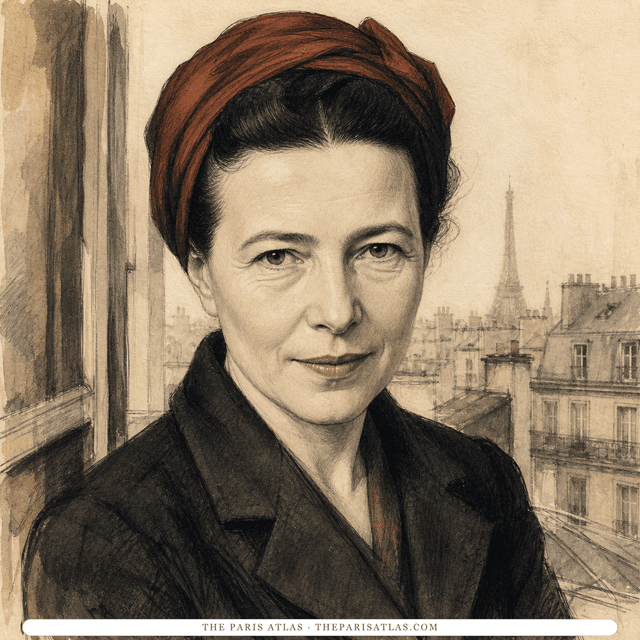
French writer and philosopher whose novels, memoirs, and social analysis examined freedom, gender, responsibility, aging, and the material conditions that shape a life.
View author
The Brooklyn dropout who arrived in Paris broke at thirty-eight and wrote the exuberant, banned books that ended American censorship.
View authorThe sources below include the primary text, editions, scholarship, archival materials, and other records that informed this page. They document The Weary Blues, its publication, and its place in literary history.


The primary text represented by this page, used for descriptions of the work’s contents and for any quoted passages shown here.
Web source consulted for documented facts and historical context presented on the The Weary Blues page.
Used to place The Weary Blues within Langston Hughes's published work and verify its bibliographic context.
Used for independent biographical, archival, or historical context surrounding Langston Hughes's career and the period in which The Weary Blues appeared.
Used to cross-check authorship, chronology, and the work's place in Langston Hughes's wider catalogue.
Used to verify Langston Hughes's bibliography and place The Weary Blues within the broader chronology of Langston Hughes's career.
The primary text is the baseline reference for every book page. Additional references document publication history, interpretation, and historical context where that evidence is available.
 Explore more resources